
2 layers47.6 × 27.3 mm
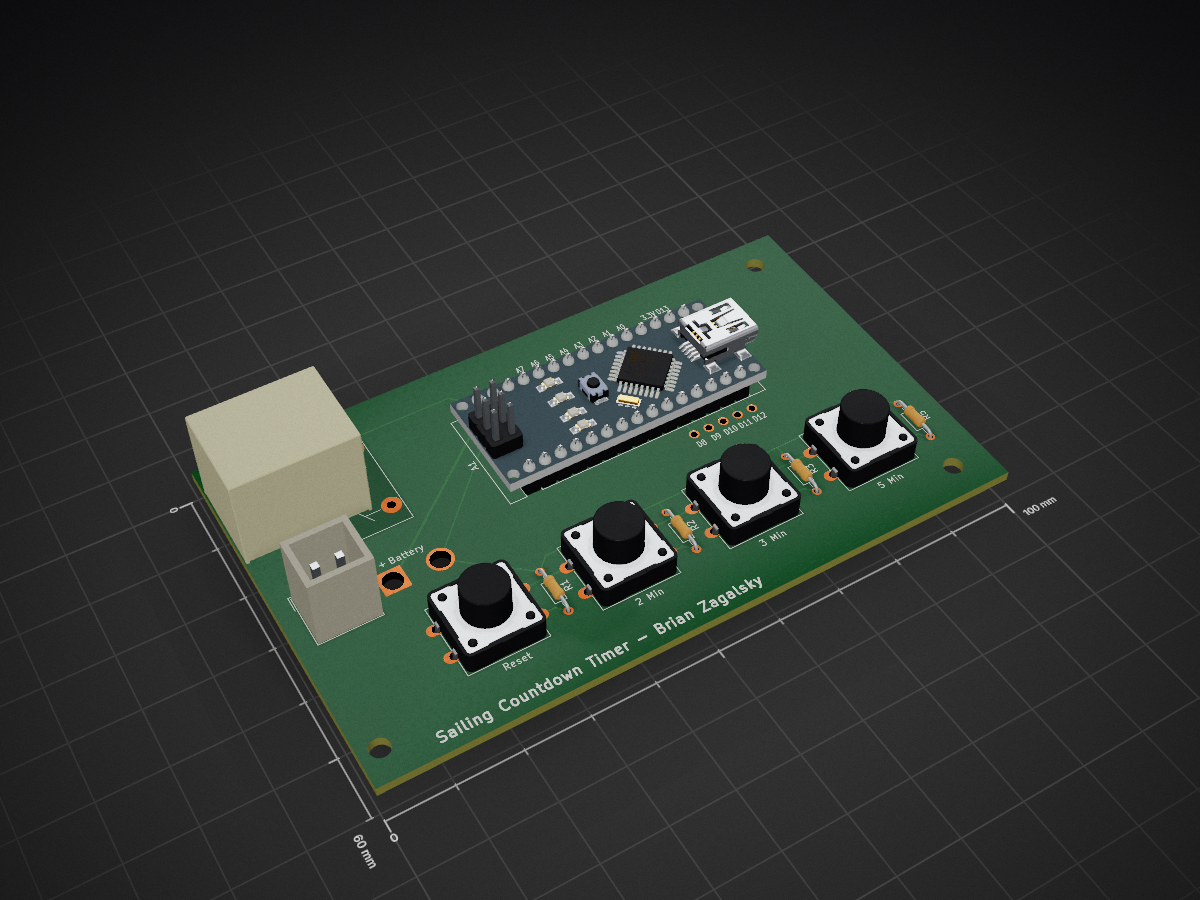
Automated horn for sailing start sequences
Timer is an open-source printed circuit board by brianz123, from the brianz123/sailingStartTimer repository on GitHub, published under the CC0-1.0 licence. It is a 2-layer board of 100 × 60 mm with 27 parts on 32 nets, routed with 73 tracks and 0 vias.
Its parts include 4 resistors and 4 switches. It belongs with the AVR (ATmega, ATtiny) boards of this library.
This project is a microcontroller-based horn system designed to automate race starts for sailboat regattas. It replaces manual countdowns and whistle systems with a reliable, consistent, and rugged solution tailored to race officials on the water.
The Sailing Start Timer outputs a sequence of horn blasts that follow standard sailing race countdown rules. A single button press initiates the sequence, allowing race officials to focus on managing boats instead of watching the clock. The system is built with an Arduino and a waterproof speaker, and was designed to be both portable and weather-resistant.
This device is intended for use by sailing race officials on the water. It simplifies race starts, ensures consistent timing, and reduces errors from manual systems.
Brian Zagalsky
| Qty | Value | Footprint | References |
|---|---|---|---|
| 15 | MountingHole_1.2mm | Arduino_MountingHole:MountingHole_1.2mm | 3.3V, A0, A1, A2, A3, A4, A5, A6, A7, D8, D9, D10, D11, D12, D13 |
| 4 | 10k | Resistor_THT:R_Axial_DIN0204_L3.6mm_D1.6mm_P7.62mm_Horizontal | R1, R2, R3, R5 |
| 1 | 2 Min | Button_Switch_THT:SW_PUSH-12mm | SW2 |
| 1 | 3 Min | Button_Switch_THT:SW_PUSH-12mm | SW3 |
| 1 | 5 Min | Button_Switch_THT:SW_PUSH-12mm | SW4 |
| 1 | Arduino_Nano_v3.x | Module:Arduino_Nano | A1 |
| 1 | Battery | Connector_Wire:SolderWire-2.5sqmm_1x02_P7.2mm_D2.4mm_OD3.6mm | Battery |
| 1 | FINDER-36.11 | Relay_THT:Relay_SPDT_Finder_36.11 | Relay |
| 1 | Reset | Button_Switch_THT:SW_PUSH-12mm | SW1 |
| 1 | Speaker | Connector_Wago:Wago_734-132_1x02_P3.50mm_Vertical | Speaker |
It measures 100 × 60 mm and has 2 copper layers, 1.6 mm thick.
27 parts. The full list of its parts is on this page, with links to each part's symbol and footprint where PCBKit's library has them.
From the brianz123/sailingStartTimer repository on GitHub, at the commit this page was made from: the board is Electronics/timer/timer-backups/timer-2023-04-03_133809/timer.kicad_pcb and its schematic Electronics/Timer V4/Timer V4.kicad_sch. PCBKit opens the board in the browser, with nothing to install.
Its repository publishes it under the CC0-1.0 licence: you may reuse it on that licence's terms (keep the author's notice, and for a copyleft licence share your changes alike).

hackclub/OnBoard
💡 Join 1,000 teenagers and make your first PCB with a $100 grant!


CRImier/MyKiCad
My KiCad boards. Can't be bothered uploading individually anymore, so here you go.

pjgpetecodes/pico-streamdeck
This project is an OBS Controller using a Raspberry Pi Pico and CircuitPython.

freeDSP/freeDSP-aurora
freeDSP ADAU1452 with 8 analog input, 8 analog outputs, S/P-DIF I/O, ADAT I/O, USB Audio Class2, WiFi, Bluetooth

ugcs/ddc
Drone Show Software is software designed for drone shows, allowing flight path planning as well as control of dozens of drones simultaneously in a synchronized manner.