2 layers87.7 × 40.5 mm
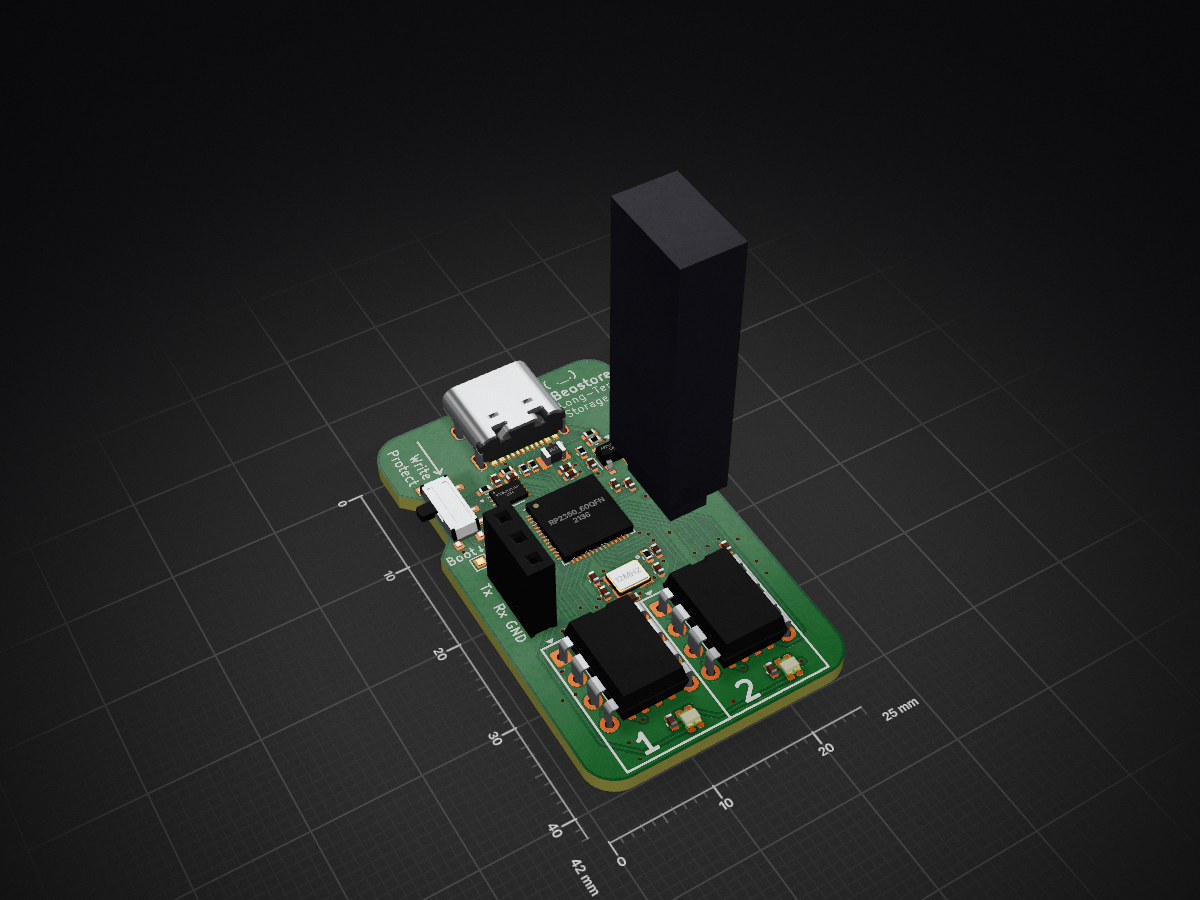
 Beo-Coder/Beostore
Long-Term Storage
Beostore is an open-source printed circuit board by Beo-Coder, from the Beo-Coder/Beostore repository on GitHub. It is a 2-layer board of 25 × 42 mm with 59 parts on 65 nets, routed with 613 tracks and 86 vias.
It is built around the W25Q128JVPIQ, AP2112K-3.3 and WS2812B. Its parts include 20 capacitors, 16 resistors, 11 connectors, 4 diodes and 3 ICs. It belongs with the RP2350 boards of this library.


Long-Term Storage
This project is a small USB stick-like device that uses FRAM to store any kind of data. It works just like a regular USB stick.
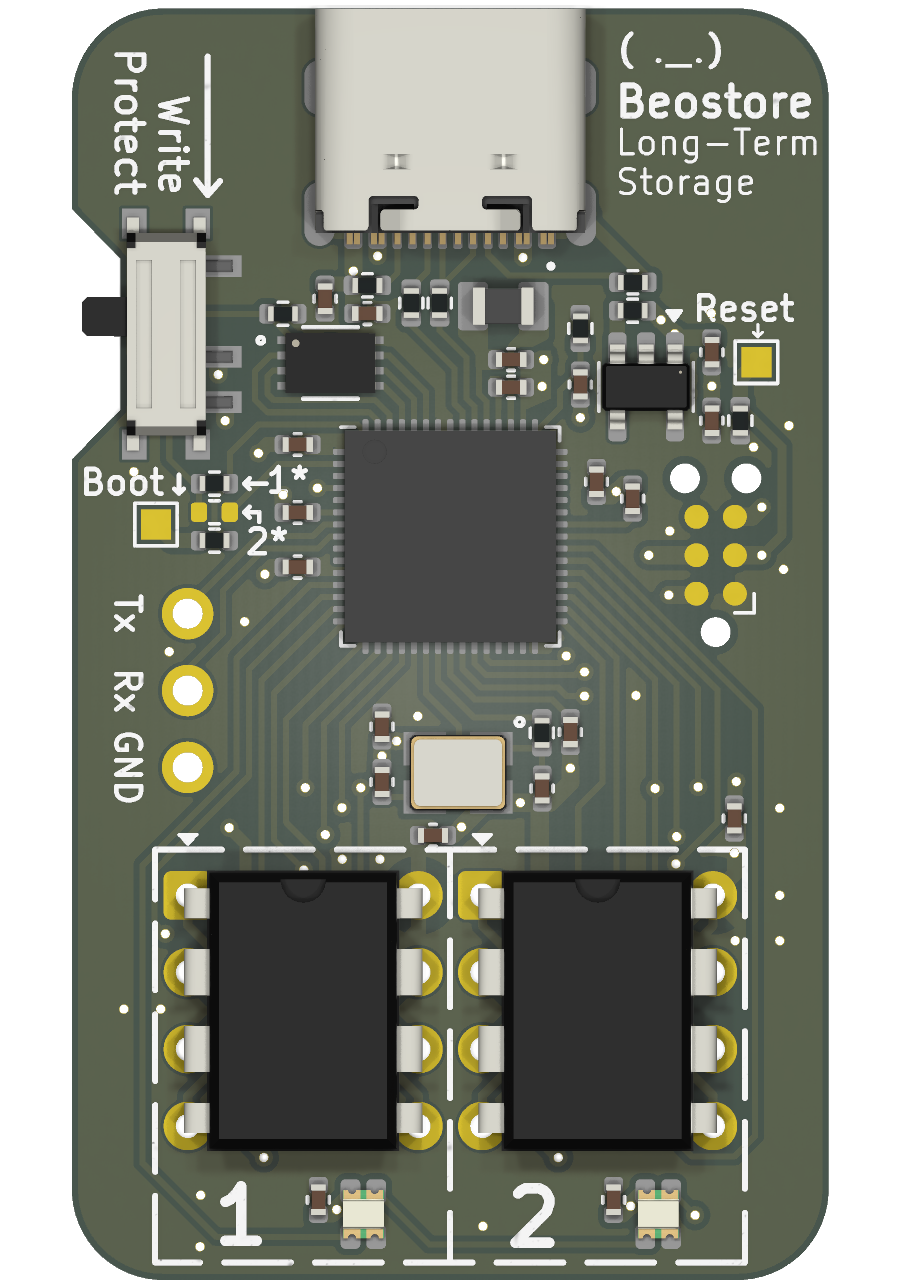
Traditional flash storage has a limited lifespan and degrades over time. FRAM offers a significantly longer data retention, making it ideal for long-term archival storage.
| Property | Flash Storage | FRAM |
|---|---|---|
| Data retention | ~10 years | ~100 years |
| Write endurance | ~100k cycles | ~10^13 cycles |
| Storage space | GB – TB range | KB – MB range |
Just plug it in and use it as a normal USB stick.
Before unplugging, it is advised to unmount all storage devices and wait until all LEDs turn green.
If the write protect switch is changed while plugged in, the computer/host will not notice this. The write protection is still active either way.
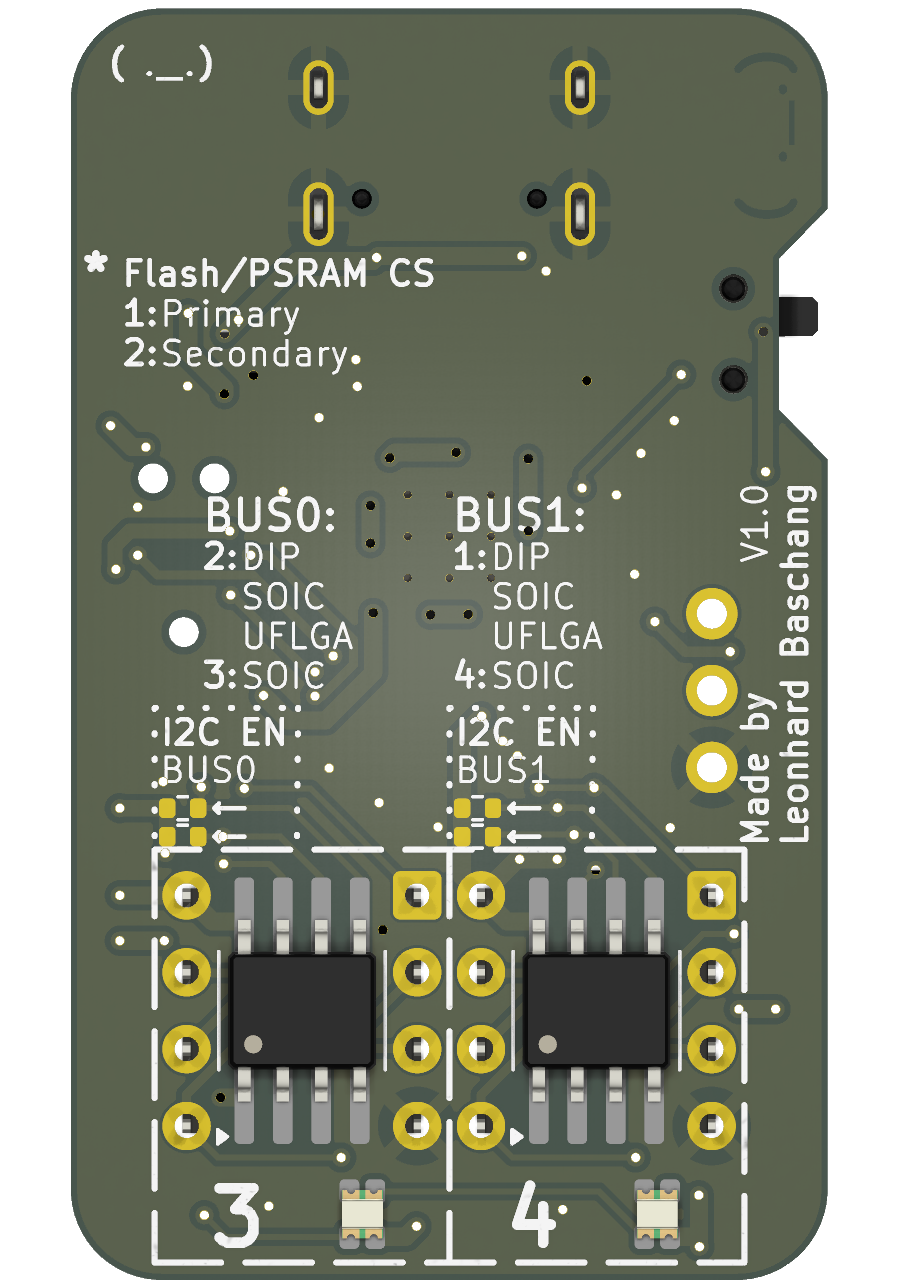
This board uses the RP235xA and can support up to four storage devices. Storage devices may support SPI or I2C and can have different footprints.
There are two buses, each connected to up to two storage devices. Each bus can be either SPI or I2C (place pull-up resistors on the backside).
Bus 0: Storage device 1 & 3
Bus 1: Storage device 2 & 4
Each storage device has an ARGB LED, which indicates the current state of the storage device.
There is a global write protect switch.
There is theoretical support for extra flash/PSRAM if you use the RP2354A (not tested).
Please see schematic for pinout!
| Color | State |
|---|---|
| Off | No device |
| Green | Waiting/Unmounted |
| Orange | Mounted |
| Red | Mounted - Write protected |
| Blinking red | Manual access (currently not used) |
The write protection is software-controlled only
The DIP package allows the FRAM IC to be easily removed and placed into another device, should the flash chip or MCU fail.
This projects was inspired by Blaustahl/Kaltstahl/Ebenstahl Storage Devices by Machdyne. Go check them out.
© 2026 Leonhard Baschang ( ._.)
| Qty | Value | Footprint | References |
|---|---|---|---|
| 12 | 100n | Capacitor_SMD:C_0402_1005Metric | C4, C5, C6, C7, C8, C9, C10, C11, C14, C15, C20, C21 |
| 4 | 4.7k | Resistor_SMD:R_0402_1005Metric | R11, R12, R13, R14 |
| 4 | 4.7u | Capacitor_SMD:C_0402_1005Metric | C1, C2, C3, C16 |
| 4 | WS2812B | LED_WS2812B_XL-1615RGBC-WS2812B:LED_WS2812B_XL-1615RGBC-WS2812B | D1, D2, D3, D4 |
| 2 | 0 | Resistor_SMD:R_0402_1005Metric | R10, R16 |
| 2 | 10k | Resistor_SMD:R_0402_1005Metric | R7, R15 |
| 2 | 10u | Capacitor_SMD:C_0402_1005Metric | C17, C24 |
| 2 | 15p | Capacitor_SMD:C_0402_1005Metric | C18, C19 |
| 2 | 1k | Resistor_SMD:R_0402_1005Metric | R3, R4 |
| 2 | 27 | Resistor_SMD:R_0402_1005Metric | R5, R6 |
| 2 | 5.1k | Resistor_SMD:R_0402_1005Metric | R8, R9 |
| 2 | DIP8 | Package_DIP:DIP-8_W7.62mm | J16, J17 |
| 2 | SOIC-8-Special_Back | SOIC-8-Special:SOIC-8-Special | J2, J5 |
| 2 | SOIC-8-Special_Front | SOIC-8-Special:SOIC-8-Special | J1, J4 |
| 2 | UFLGA-8_Front | PG-UFLGA-8-1:PG-UFLGA-8-1 | J7, J8 |
| 1 | 100k | Resistor_SMD:R_0402_1005Metric | R2 |
| 1 | 12MHz | ABM8_272_T3:ABM8-272-T3_ABR | Y1 |
| 1 | 3.3u | AOTA-B201610S3R3-101-T:AOTA-B201610S3R3-101-T | L1 |
| 1 | 33 | Resistor_SMD:R_0402_1005Metric | R1 |
| 1 | AP2112K-3.3 | Package_TO_SOT_SMD:SOT-23-5 | U2 |
| 1 | BOOTSEL (To GND) | TestPoint:TestPoint_Pad_1.0x1.0mm | TP1 |
| 1 | Conn_01x03_Socket | Connector_PinSocket_2.54mm:PinSocket_1x03_P2.54mm_Vertical | J9 |
| 1 | Conn_ARM_SWD_TagConnect_TC2030-NL | Connector:Tag-Connect_TC2030-IDC-NL_2x03_P1.27mm_Vertical | J3 |
| 1 | RP2350_60QFN | RP2350:RP2350-QFN-60-1EP_7x7_P0.4mm_EP3.4x3.4mm_ThermalVias | U1 |
| 1 | Reset (To GND) | TestPoint:TestPoint_Pad_1.0x1.0mm | TP2 |
| 1 | USB_C_Receptacle_USB2.0_16P | Connector_USB:USB_C_Receptacle_GCT_USB4105-xx-A_16P_TopMnt_Horizontal | J6 |
| 1 | W25Q128JVP | W25Q16JVUXIQ:USON-8_UX_2x3x0p6_WIN-L | U3 |
| 1 | WP_Switch | CUS12-TB:CUS-12TB_NDC | SW1 |
It measures 25 × 42 mm and has 2 copper layers, 1.6 mm thick.
59 parts, built around the W25Q128JVPIQ, AP2112K-3.3 and WS2812B. The full list of its parts is on this page, with links to each part's symbol and footprint where PCBKit's library has them.
From the Beo-Coder/Beostore repository on GitHub, at the commit this page was made from: the board is hardware/KiCAD/Beostore.kicad_pcb and its schematic hardware/KiCAD/Beostore.kicad_sch. PCBKit opens the board in the browser, with nothing to install.
Its repository states no licence, so its author keeps all rights: ask Beo-Coder before reusing the design.


sini6a/internet-radio-speaker
An open-source ESP32 Internet Radio Player with simple programming, USB charging, and on-the-go capability using a single-cell Li-ion battery.

emertcakir/OmniProbe
Open-source SWD, JTAG, UART, SPI, I2C and Logic Analyzer platform powered by RP2040

James-Livesey/ORGNET
A wireless networking peripheral for the Psion Organiser II, in a datapack form factor.

1vers1on/Mega
A microcontroller based on the RP2350B with a dedicated dac and adc, plus wifi and bluetooth.


PanosEconomou/open-keyboard
A 100% from scratch open source super cool awesome keyboard that will take years to make if ever