Skip to the content
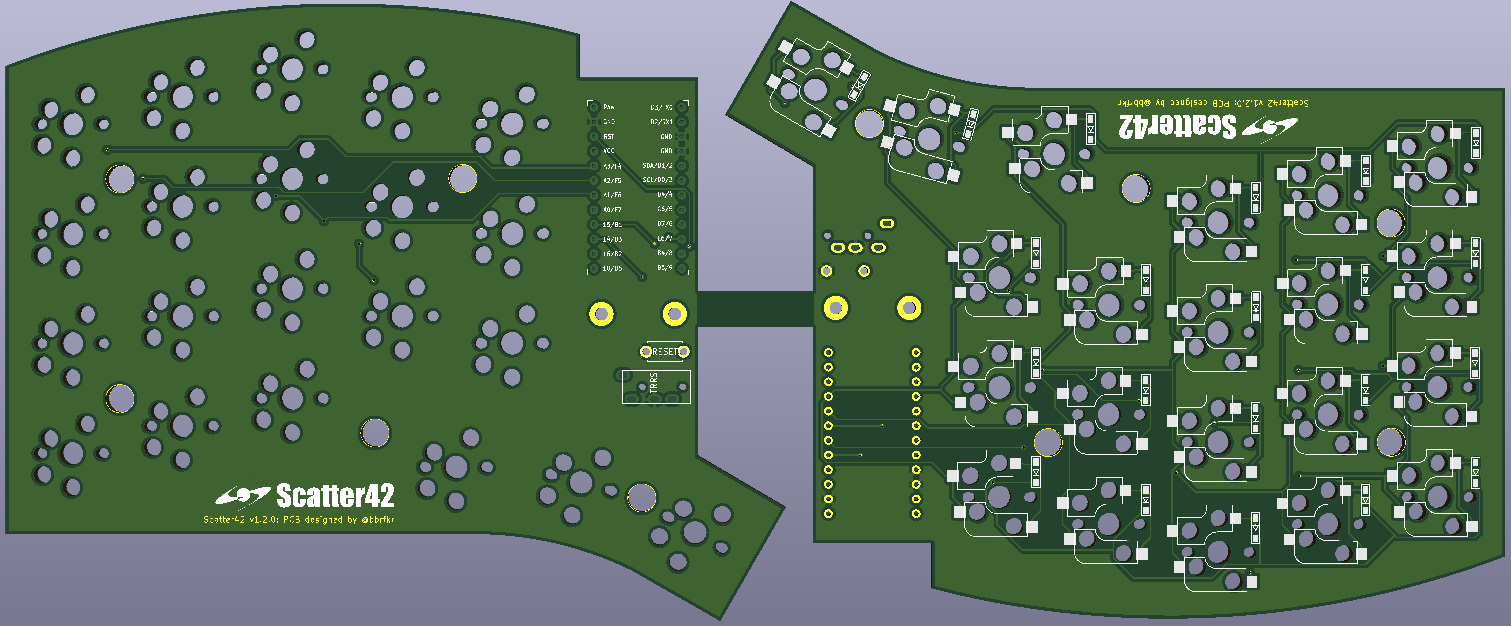
2 layers276.2 × 126.4 mmMolecule, the printed circuit board in 3D

keyboards source by bbrfkr

Size
276.2 × 126.4 mm
Copper layers
2
Thickness
1.6 mm
Parts
88
Nets
63
Pads
681
Tracks, vias
1,370, 48
Pours
2
Routed
Yes
KiCad
KiCad 5 (file 20171130)
Created
18 Oct 2020
Updated
25 Feb 2022

Overview

Molecule is an open-source printed circuit board by bbrfkr, from the bbrfkr/keyboards repository on GitHub, published under the MIT licence. It is a 2-layer board of 276.2 × 126.4 mm with 88 parts on 63 nets, routed with 1,370 tracks and 48 vias.

Its parts include 40 diodes, 40 switches and 1 IC. It belongs with the AVR (ATmega, ATtiny) boards of this library.

README

scatter42/README.md

Scatter42 - 40%分割型キーボード

Scatter42は以下の特徴を持つ、40%キーボードです。

  • columnar-staggered
  • 小指に無理をさせず、かつ親指を内側に入れる配置を避けるように意識したキー配列
  • 制御キーの数も十分に取れる42キー
  • Cherry MXとKailh low-profileスイッチに対応

最新バージョン基板

scatter-pcb

ビルドガイドはこちら

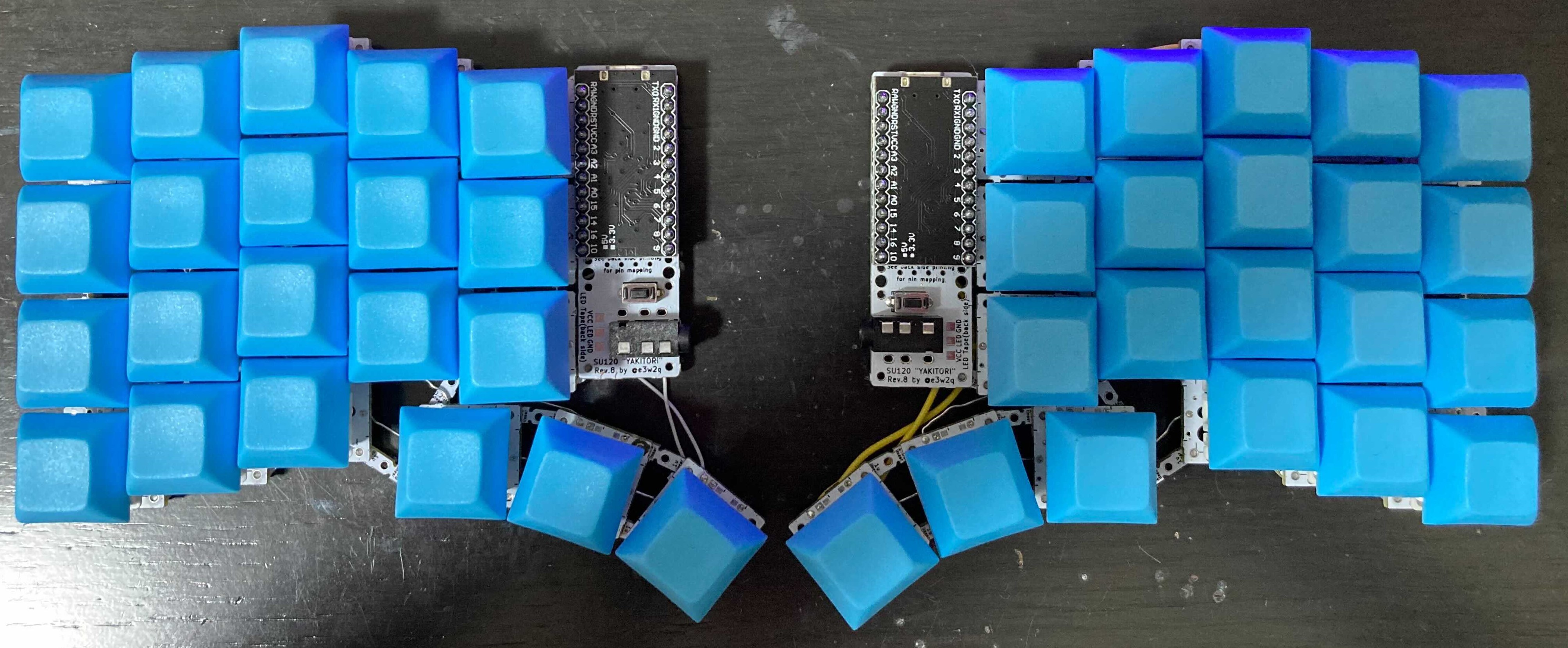
SU120での試作機

本キーボードは試作段階で @e3w2q さんの SU120 を利用させていただいてます。ありがとうございます :bow:

scatter42-by-su120

Parts

88
QtyValueFootprintReferences
40DIODEmolecule:D3_SMDD0, D1, D2, D10, D11, D12, D13, D14, D15, D16, D17, D18, D19, D20, D21, D22 +24
38SW_PUSHmolecule:CherryMX_Choc_HotswapSW0, SW1, SW2, SW10, SW11, SW12, SW13, SW14, SW15, SW16, SW17, SW18, SW19, SW20, SW21, SW22 +22
5Val**molecule:M2_HOLE_v3HOLE0, HOLE1, HOLE2, HOLE3, HOLE4
2SW_PUSHmolecule:CherryMX_Choc_Hotswap_1.5uSW34, SW35
1PINHD-2X4ADNS-9800 - v2.1:2X04JP0
1ProMicromolecule:ProMicro_v3U0
1SW_PUSHmolecule:ResetSW_1sideRSSW0

More from bbrfkr/keyboards

3
  • 2 layers260 × 219.7 mmScatter42, the printed circuit board in 3D

    Scatter42

    bbrfkr/keyboards

    keyboards source by bbrfkr

    122 parts2MIT
  • 2 layers238.4 × 89 mmQuantum, the printed circuit board in 3D

    Quantum

    bbrfkr/keyboards

    keyboards source by bbrfkr

    108 parts2MIT
  • 2 layers276.9 × 100.3 mmAtom, the printed circuit board in 3D

    Atom

    bbrfkr/keyboards

    keyboards source by bbrfkr

    100 parts2MIT

Similar boards

  • 2 layers142.5 × 106.3 mmLily58, the printed circuit board in 3D

    Lily58

    kata0510/Lily58

    6×4+4keys column-staggered split keyboard.

    88 parts2.3k
  • 2 layers43.8 × 60.3 mmSmallreplacement, the printed circuit board in 3D

    Smallreplacement

    c0pperdragon/C64-Video-Enhancement

    Component video modification for the C64 8-bit computer

    88 parts286MIT
  • 2 layers95.3 × 95.3 mmRhymestone, the printed circuit board in 3D

    Rhymestone

    marksard/Keyboards

    This repository is warehouse of my keyboard architecture.

    88 parts193MIT
  • 2 layers69.9 × 108 mmAbakus Main, the printed circuit board in 3D

    Abakus Main

    mzuelch/CATs-Eurosynth

    Analog Synth Eurorack Modules

    88 parts166MIT
  • 2 layers127 × 36.2 mmIo board, the printed circuit board in 3D

    Io board

    vedderb/rise_sdvp

    The RISE Self-Driving Model Vehicle Platform

    88 parts144GPL-3.0
  • 2 layers44.6 × 53.7 mmNO2C, the printed circuit board in 3D

    NO2C

    turboedge/SpeedyBoards

    EMS boards powered by Speeduino

    88 parts110GPL-2.0
  • 2 layers43 × 43 mmTurboCAN, the printed circuit board in 3D

    TurboCAN

    henrikssn/TurboCAN

    This is the official repository for the TurboCAN controller board, designed specifically for the Voron AfterBurner toolhead but can also be used on similar toolheads using NEMA17 steppers.

    88 parts82
  • 2 layers251.3 × 103.7 mmR41l2, the printed circuit board in 3D

    R41l2

    cyril279/keyboards

    88 parts74MIT

Questions

How big is the Molecule PCB?

It measures 276.2 × 126.4 mm and has 2 copper layers, 1.6 mm thick.

What parts does the Molecule use?

88 parts. The full list of its parts is on this page, with links to each part's symbol and footprint where PCBKit's library has them.

Where can I download the Molecule KiCad files?

From the bbrfkr/keyboards repository on GitHub, at the commit this page was made from: the board is molecule/molecule.kicad_pcb. PCBKit opens the board in the browser, with nothing to install.

Can I use the Molecule design in my own project?

Its repository publishes it under the MIT licence: you may reuse it on that licence's terms (keep the author's notice, and for a copyleft licence share your changes alike).