
2 layers103.3 × 63.7 mm

 BadenLab/Open-Visual-Stimulator3
An arbitrary-spectrum spatial visual stimulator for vision research
Lcr addon is an open-source printed circuit board by BadenLab, from the BadenLab/Open-Visual-Stimulator repository on GitHub, published under the MIT licence. It is a 2-layer board of 85.1 × 55.1 mm with 23 parts on 24 nets, routed with 201 tracks and 17 vias.
It is built around the LM2596T-5.0. Its parts include 8 ICs, 6 connectors, 2 capacitors, 1 resistor and 1 diode.
A board for integrating signals from a lightcrafter to a 2P microscope ("logic board"), part of the Open source visual stimulator project.
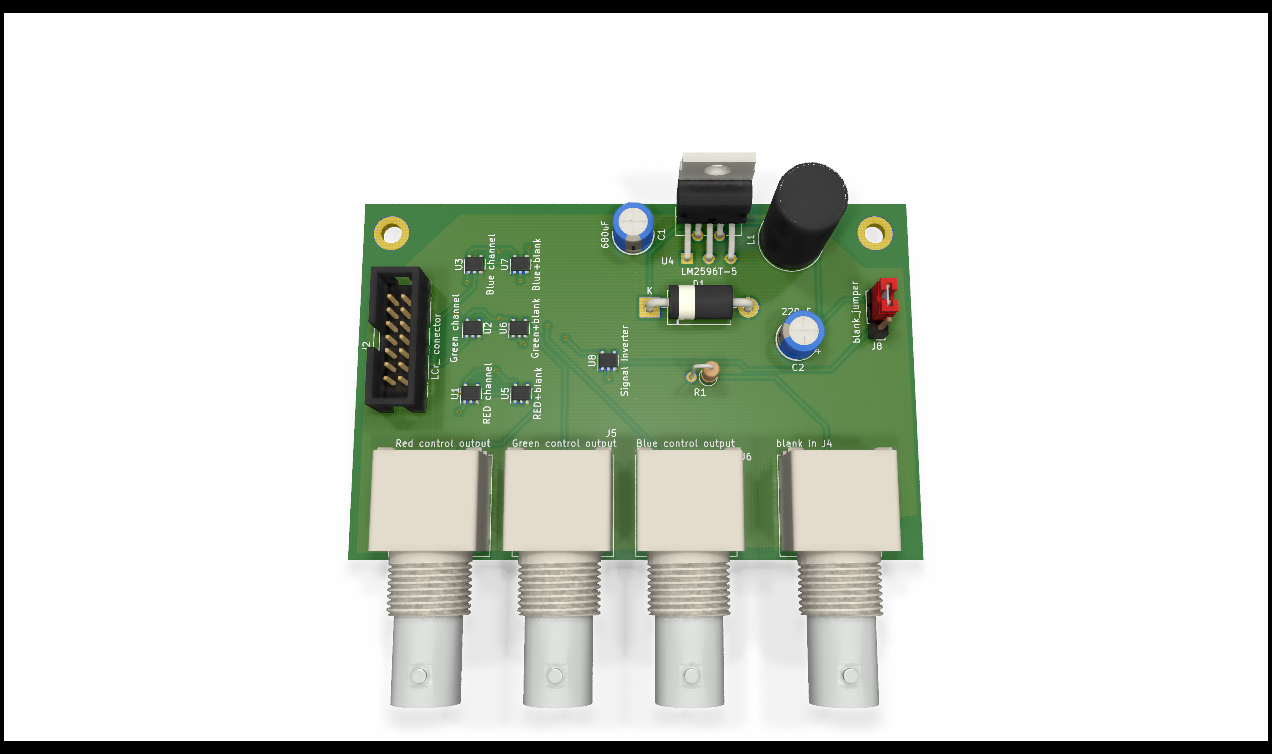
| Qty | Value | Footprint | References |
|---|---|---|---|
| 1 | 1k | Resistor_THT:R_Axial_DIN0207_L6.3mm_D2.5mm_P2.54mm_Vertical | R1 |
| 1 | 220uF | Capacitor_THT:CP_Radial_D6.3mm_P2.50mm | C2 |
| 1 | 33uH | Inductor_THT:L_Radial_D10.0mm_P5.00mm_Neosid_SD12_style3 | L1 |
| 1 | 680uF | Capacitor_THT:CP_Radial_D6.3mm_P2.50mm | C1 |
| 1 | Blue channel | Package_SO:TSOP-5_1.65x3.05mm_P0.95mm | U3 |
| 1 | Blue control output | extra_Connector:BNC_Amphenol_B6252HB-NPP3G-50_Horizontal | J6 |
| 1 | Blue+blank | Package_SO:TSOP-5_1.65x3.05mm_P0.95mm | U7 |
| 1 | D_Schottky | Diode_THT:D_DO-201AD_P15.24mm_Horizontal | D1 |
| 1 | Green channel | Package_SO:TSOP-5_1.65x3.05mm_P0.95mm | U2 |
| 1 | Green control output | extra_Connector:BNC_Amphenol_B6252HB-NPP3G-50_Horizontal | J5 |
| 1 | Green+blank | Package_SO:TSOP-5_1.65x3.05mm_P0.95mm | U6 |
| 1 | LCr_ conector | Connector_JST:JST_PUD_B14B-PUDSS_2x07_P2.00mm_Vertical | J2 |
| 1 | LM2596T-5 | Package_TO_SOT_THT:TO-220-5_P3.4x3.7mm_StaggerOdd_Lead3.8mm_Vertical | U4 |
| 1 | RED channel | Package_SO:TSOP-5_1.65x3.05mm_P0.95mm | U1 |
| 1 | RED+blank | Package_SO:TSOP-5_1.65x3.05mm_P0.95mm | U5 |
| 1 | Red control output | extra_Connector:BNC_Amphenol_B6252HB-NPP3G-50_Horizontal | J7 |
| 1 | Signal Inverter | Package_SO:TSOP-5_1.65x3.05mm_P0.95mm | U8 |
| 1 | blank in | extra_Connector:BNC_Amphenol_B6252HB-NPP3G-50_Horizontal | J4 |
| 1 | blank_jumper | Connector_PinHeader_2.54mm:PinHeader_1x03_P2.54mm_Vertical | J8 |
The 19 most common of 23 parts.
It measures 85.1 × 55.1 mm and has 2 copper layers, 1.6 mm thick.
23 parts, built around the LM2596T-5.0. The full list of its parts is on this page, with links to each part's symbol and footprint where PCBKit's library has them.
From the BadenLab/Open-Visual-Stimulator repository on GitHub, at the commit this page was made from: the board is PCB/lcr_add-on/Lcr_addon.kicad_pcb. PCBKit opens the board in the browser, with nothing to install.
Its repository publishes it under the MIT licence: you may reuse it on that licence's terms (keep the author's notice, and for a copyleft licence share your changes alike).

AidanHockey5/STM32_VGM_Player_YM2612_SN76489
A Sega Genesis music player based off of the STM32 BluePill board and real YM2612+SN76489 sound chips.


anujthakur512/Buck-Converter-5V
I build a Buck Converter (5V) using IC LM2596 on KiCad as my 1st project of learning PCB Designing.

jrtaylor71/Smart-Thermostat-Alt-Firmware
A comprehensive, feature-rich smart thermostat firmware for ESP32-S3 microcontrollers with touch display, web interface, and Home Assistant integration.

alexsomesan/nmea0183-i2c-wifi
Reads wind data from a NASA Clipper wind instrument via I2C and sends out NMEA0183 wind messages via WiFi.
