
2 layers208.8 × 396.9 mm
Ferris
pierrechevalier83/ferris
A low profile split keyboard designed to satisfy one single use case elegantly
145 parts1.3k
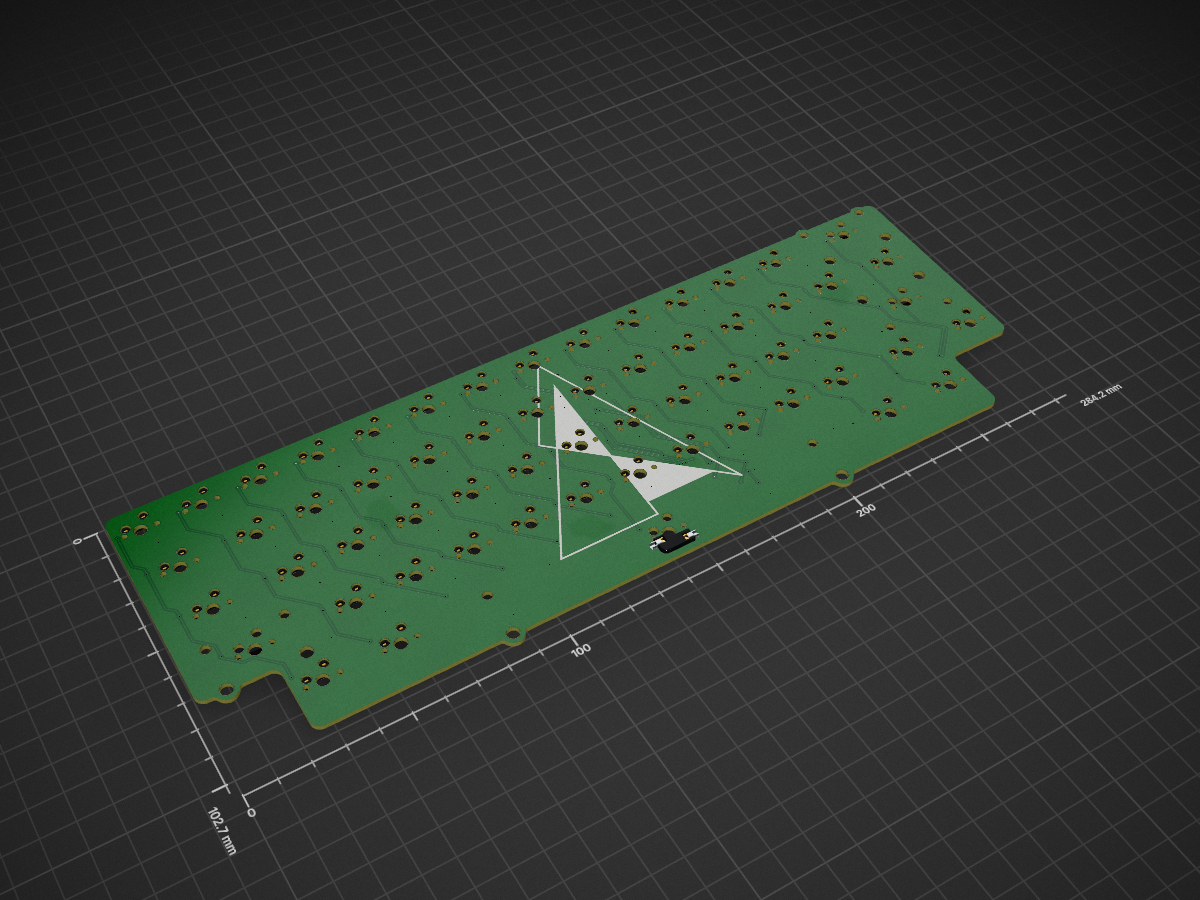
 AzYN-toro/kaizen-pcb
PCB for the Kaizen keyboard.
Kaizen is an open-source printed circuit board by AzYN-toro, from the AzYN-toro/kaizen-pcb repository on GitHub. It is a 2-layer board of 284.2 × 102.7 mm with 135 parts on 102 nets, routed with 671 tracks and 146 vias.
It is built around the STM32F072CBT6. Its parts include 59 diodes, 59 switches, 9 capacitors, 2 resistors and 2 ICs. It belongs with the STM32 boards of this library.
| Qty | Value | Footprint | References |
|---|---|---|---|
| 59 | D_Small | Diode_SMD:D_SOD-123 | D1, D2, D10, D11, D12, D13, D14, D15, D16, D17, D18, D19, D20, D21, D22, D23 +43 |
| 50 | SW_Push_45deg | MX_Hotswap:MX-Hotswap-1U | SW1, SW2, SW10, SW11, SW12, SW13, SW16, SW17, SW18, SW19, SW20, SW21, SW22, SW23, SW24, SW25 +34 |
| 6 | 100nF | Capacitor_SMD:C_0402_1005Metric | C2, C3, C4, C5, C6, C8 |
| 4 | SW_Push_45deg | MX_Hotswap:MX-Hotswap-1.5U | SW15, SW28, SW56, SW57 |
| 2 | 1uF | Capacitor_SMD:C_0402_1005Metric | C9, C10 |
| 2 | 5.1k | Resistor_SMD:R_0402_1005Metric | R2, R4 |
| 2 | SW_SPST | Button_Switch_SMD:SW_SPST_TL3342 | BOOT1, RST1 |
| 1 | 10uF | Capacitor_SMD:C_0603_1608Metric | C1 |
| 1 | LOGO | LOGO | G*** |
| 1 | PCB Connector | Connector_JST:JST_SH_SM04B-SRSS-TB_1x04-1MP_P1.00mm_Horizontal | J1 |
| 1 | STM32F072CBT6 | Package_QFP:LQFP-48_7x7mm_P0.5mm | U1 |
| 1 | SW_Push_45deg | MX_Hotswap:MX-Hotswap-1.75U | SW53 |
| 1 | SW_Push_45deg | MX_Hotswap:MX-Hotswap-7U | SW59 |
| 1 | SW_Push_45deg | MX_Hotswap:MX-Hotswap-2.25U | SW42 |
| 1 | SW_Push_45deg | MX_Hotswap:MX-Hotswap-2U | SW14 |
| 1 | SW_Push_45deg | MX_Hotswap:MX-Hotswap-2.25U-ReversedStabilizers | SW41 |
| 1 | XC6206PxxxMR-Regulator_Linear | Package_TO_SOT_SMD:SOT-23 | U3 |
pierrechevalier83/ferris
A low profile split keyboard designed to satisfy one single use case elegantly

dojoe/Twonkie
A USB-PD sniffer/injector/sink based on Google's Twinkie, re-designed to be manufactured by mere mortals.

conol-ai/openmicrokbd
Open-source recreation of OpenAI's Codex Micro macropad — PCB written in CoHDL, an AI-native hardware description language. Rust firmware (embassy) + companion app (makepad). MIT licensed. https://openmicrokbd.org


sporkus/le_capybara_keyboard
Capactive sensing (EC) pcb for Le Chiffre keyboard

sporkus/le_chiffre_keyboard_stm32
Le Chiffre keyboard pcb with stm32F072


It measures 284.2 × 102.7 mm and has 2 copper layers, 1.6 mm thick.
135 parts, built around the STM32F072CBT6. The full list of its parts is on this page, with links to each part's symbol and footprint where PCBKit's library has them.
From the AzYN-toro/kaizen-pcb repository on GitHub, at the commit this page was made from: the board is Kaizen.kicad_pcb. PCBKit opens the board in the browser, with nothing to install.
Its repository states no licence, so its author keeps all rights: ask AzYN-toro before reusing the design.