2 layers99.1 × 99.1 mm
At90s8535
atoomnetmarc/AVR-demo-board
AVR demo boards for old AT90S* microcontrollers.
46 parts4Apache-2.0

 atoomnetmarc/AVR-demo-board4
AVR demo boards for old AT90S* microcontrollers.
At90s2323 is an open-source printed circuit board by atoomnetmarc, from the atoomnetmarc/AVR-demo-board repository on GitHub, published under the Apache-2.0 licence. It is a 2-layer board of 99.1 × 99.1 mm with 171 parts on 57 nets, routed with 557 tracks and 45 vias.
It is built around the 74HC595, L7805 and MAX809M, with the TPIC6B595N and BAV99 among its other parts. Its parts include 130 diodes, 18 resistors, 7 capacitors, 6 ICs and 4 connectors.


Demo board for the 20-pin AT90S1200 and AT90S2313 microcontroller.
Yes these chips are old, Arduino was not a thing back then. The AT90S1200 on the pcb is my first microcontroller I bought and programmed. It has a date code of 1998 week 40. I wrote software for it using AVR studio (4?) in assembler and programmed it using the Handyman programmer and software made by Elektor.
This AT90S1200 has only ever been used in breadboards, now about 20 years later it got its own PCB.
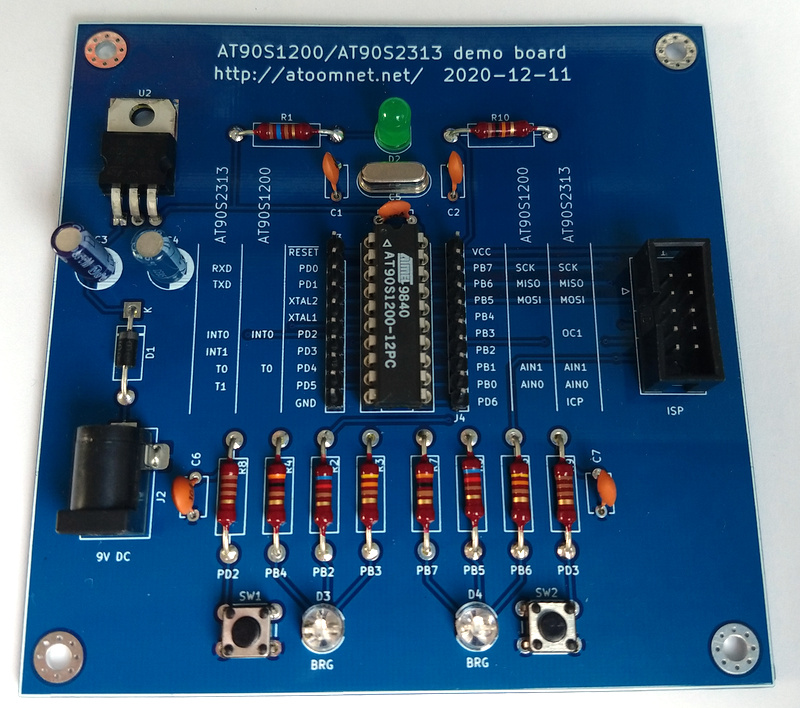
Like the silkscreen pinout? Here is a complete(-ish) overview of all know pin-compatible AT90S* microcontrollers and their pin functions.
The AT90S2323 is a 8-pin microcontroller with a whopping 3 I/O-pins. I believe this is the first 8-pin AVR.
One day I found some on eBay, bought them and proceeded to created this demo board to show its capabilities. I figured to control 128 LEDs with 3 I/O-pins. To expand de 3 I/O to drive 128 LEDs I used 3 shift registers in a 16x8 configuration. The shift registers however need 4 signals to drive them: DATA, CLK, RCLK and OE. When I tied RCLK and OE together I could bring that down to 3.
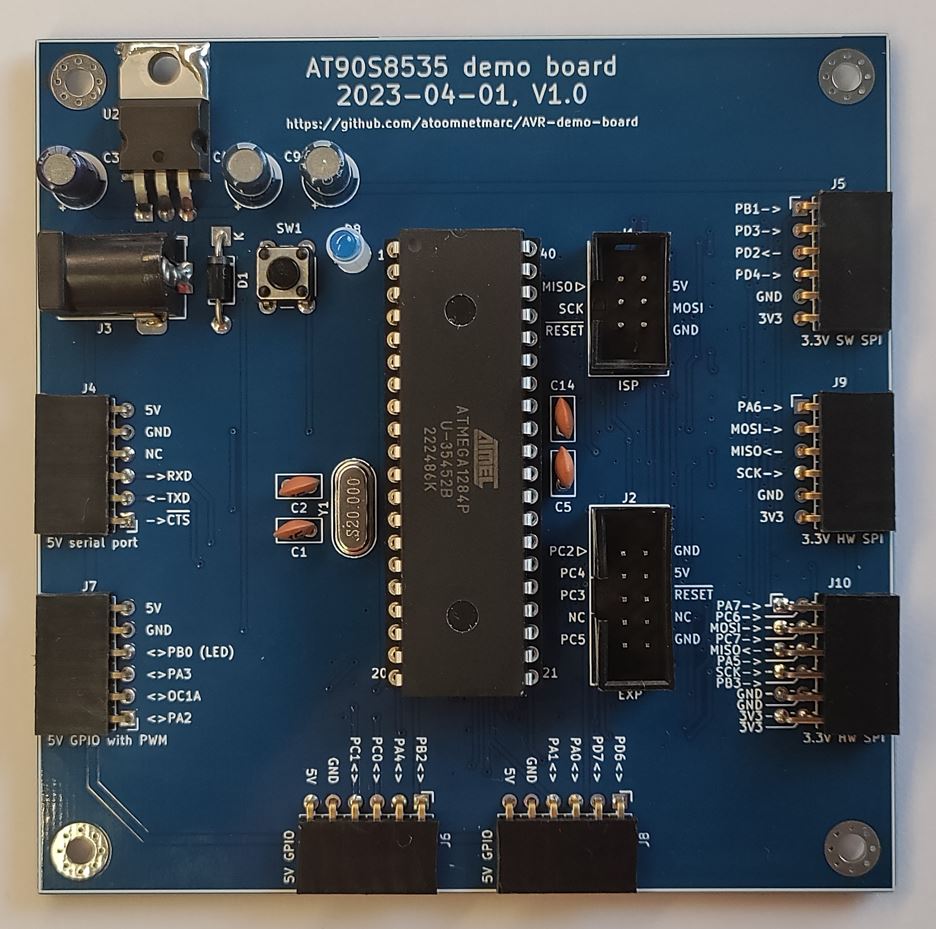
The AT90S8535 belongs to the first 40-pin AVR microcontrollers from Atmel together with the AT90S8515. There also existed a 4K flash version of this chip, but that version seems to be only short lived, if at all.
This board breaks out all pins of the microcontroller into mostly PMOD compatible connectors. Mostly because if I understand correctly the voltage for PMOD IO and VCC should normally be at 3.3V. This board has both 5V and 3.3V PMOD connectors.
All pin-compatible microcontrollers will fit. When using a ATmega163 or newer, J8 is useable as a 5V I2C PMOD connector. When using a ATmega8535, J5 can be used as a 3.3V HW SPI PMOD port. When using ATmega323 or newer, EXP can be used as a JTAG connector.
On the back of the PCB there is a SOT-23 voltage monitor that functions as a BOD (brow out detector). Unlike newer parts, the AT90S8535 does not have a onboard BOD.
More information about this board: README.md
Make a Arduino-as-ISP-shield, then use AVRDUDE or AVRDUDESS to program the .hex file. This works under Windows 10.
AVRDUDE 6.3 is unable to program the AT90S2323 because it wrongly assumes this chip is the same as a AT90S2343, but it is not. Edit avrdude.conf and add the contents of avrdude-at90s2323.conf to just below the AT90S2343 config. This new section is a copy of the AT90S2343 section with one change, the chip signature.
Use the ancient AVR Studio v4.19.730 to compile programs for the old AT90S* AVR's.
To compile c-programs you can still use WinAVR-20100110-install.exe containing an old a mature GCC compiler versioned 4.3, but you need some to fix some incompatibilities with Windows 10 in order to make it work.
There is a simpler solution, just use an updated GCC. This update contains GCC version 12 and works to compile programs for the old AT90S* chips in AVR Studio 4.19.
I was pleasantly surprised to find out that compiling a c-program using VSCode and PlatformIO also is a viable option. See the firmware directory of the AT90S2323 for an example on how to configure PlatformIO or see the PlatformIO example native-blink.
It is also possible to program the AT90S1200 in VSCode with PlatformIO in assembler! Have a look at my PlatformIO blink project. You could also program the ATtiny2313 with the same assembler (and some #if defined macros) and debug using Microchip Studio.

| Qty | Value | Footprint | References |
|---|---|---|---|
| 128 | blue opaque | LED_THT-extra:LED_D3.0mm_IRGrey | D1, D10, D11, D100, D101, D102, D103, D104, D105, D106, D107, D108, D109, D110, D111, D112 +112 |
| 16 | 300R | Resistor_THT:R_Axial_DIN0207_L6.3mm_D2.5mm_P2.54mm_Vertical | R1, R2, R3, R4, R5, R6, R7, R8, R9, R10, R11, R12, R13, R14, R15, R16 |
| 4 | MountingHole | MountingHole:MountingHole_3.2mm_M3_Pad_Via | H1, H2, H3, H4 |
| 3 | 100nF | Capacitor_THT:C_Disc_D5.1mm_W3.2mm_P5.00mm | C5, C6, C7 |
| 2 | 15pF | Capacitor_THT:C_Disc_D5.1mm_W3.2mm_P5.00mm | C1, C2 |
| 2 | 74HC595 | Package_DIP:DIP-16_W7.62mm | U1, U2 |
| 2 | Conn_01x04_Male | Connector_PinHeader_2.54mm:PinHeader_1x04_P2.54mm_Vertical | J3, J4 |
| 1 | 100R | Resistor_SMD:R_0805_2012Metric_Pad1.20x1.40mm_HandSolder | R18 |
| 1 | 100k | Resistor_THT:R_Axial_DIN0207_L6.3mm_D2.5mm_P10.16mm_Horizontal | R17 |
| 1 | 100uF 16V | Capacitor_THT:CP_Radial_D6.3mm_P2.50mm | C3 |
| 1 | 10MHz | Crystal:Crystal_HC49-U_Vertical | Y1 |
| 1 | 1N5819 | Diode_THT:D_DO-15_P5.08mm_Vertical_KathodeUp | D129 |
| 1 | 33uF 16V | Capacitor_THT:CP_Radial_D6.3mm_P2.50mm | C4 |
| 1 | AT90S2323 | Package_DIP:DIP-8_W7.62mm | U5 |
| 1 | AVR-ISP-10 | Connector_IDC:IDC-Header_2x05_P2.54mm_Vertical | J2 |
| 1 | BAV99 | Package_TO_SOT_SMD:SOT-23 | D130 |
| 1 | Barrel_Jack_Switch | Connector_BarrelJack:BarrelJack_Horizontal | J1 |
| 1 | L7805 | Package_TO_SOT_THT:TO-220-3_Horizontal_TabDown | U4 |
| 1 | MAX809M | Package_TO_SOT_SMD:SOT-23 | U6 |
| 1 | SW_Push | Button_Switch_THT:SW_PUSH_6mm | SW1 |
| 1 | TPIC6B595 | Package_DIP:DIP-20_W7.62mm_LongPads | U3 |


punkfab/pcb-corpus
235 real KiCad boards from open-source hardware repositories, prepared as a placement and routing benchmark


svenclawdbot-ai/acoustic-research
Multi-frequency shear wave elastography research

takarakasai/misa-usb-rs485-hub
4ch isolated USB-to-RS-485 hub board for humanoid robot motor control. FT4232HL + 2× ADM2582E + 2× CA-IS3098W, 5kV isolation, 920kbps-12Mbps, KiCad 10 / JLCPCB manufactured / verified working.

It measures 99.1 × 99.1 mm and has 2 copper layers, 1.6 mm thick.
171 parts, built around the 74HC595, L7805, MAX809M and TPIC6B595N. The full list of its parts is on this page, with links to each part's symbol and footprint where PCBKit's library has them.
From the atoomnetmarc/AVR-demo-board repository on GitHub, at the commit this page was made from: the board is at90s2323/Kicad/at90s2323.kicad_pcb and its schematic at90s1200/Kicad/at90s1200.kicad_sch. PCBKit opens the board in the browser, with nothing to install.
Its repository publishes it under the Apache-2.0 licence: you may reuse it on that licence's terms (keep the author's notice, and for a copyleft licence share your changes alike).
