Skip to the content
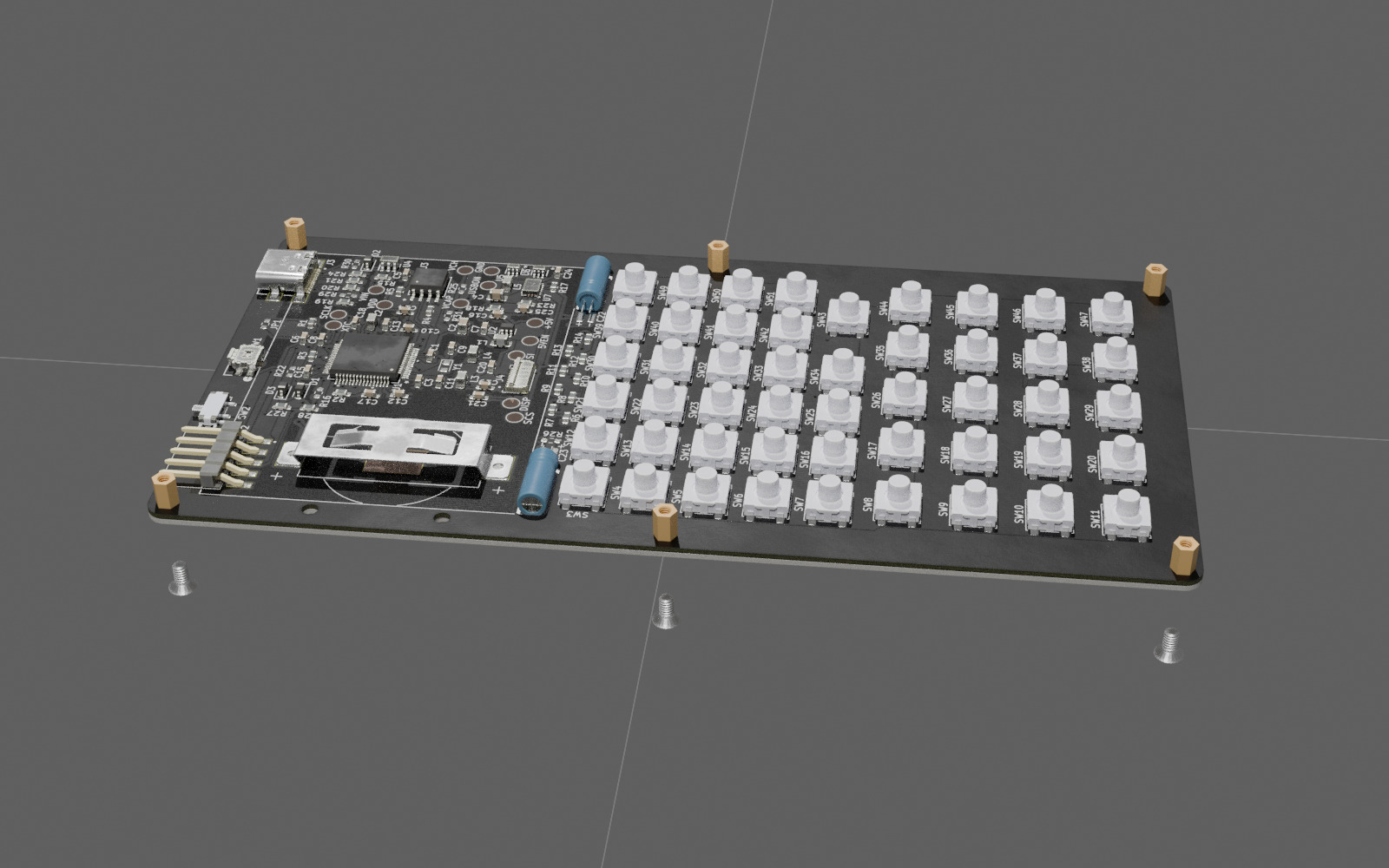
2 layers73 × 139 mmOpenRPNCalc, the printed circuit board in 3D

Open-source and open-hardware scientific RPN calculator

Size
73 × 139 mm
Copper layers
2
Thickness
0.8 mm
Parts
141
Nets
83
Pads
508
Tracks, vias
1,471, 150
Pours
1
Routed
Yes
KiCad
KiCad 9.0 (file 20241229)
Created
23 May 2021
Updated
8 Jun 2025

Overview

OpenRPNCalc is an open-source printed circuit board by apoluekt, from the apoluekt/OpenRPNCalc repository on GitHub, published under the CERN-OHL-P-2.0 licence. It is a 2-layer board of 73 × 139 mm with 141 parts on 83 nets, routed with 1,471 tracks and 150 vias.

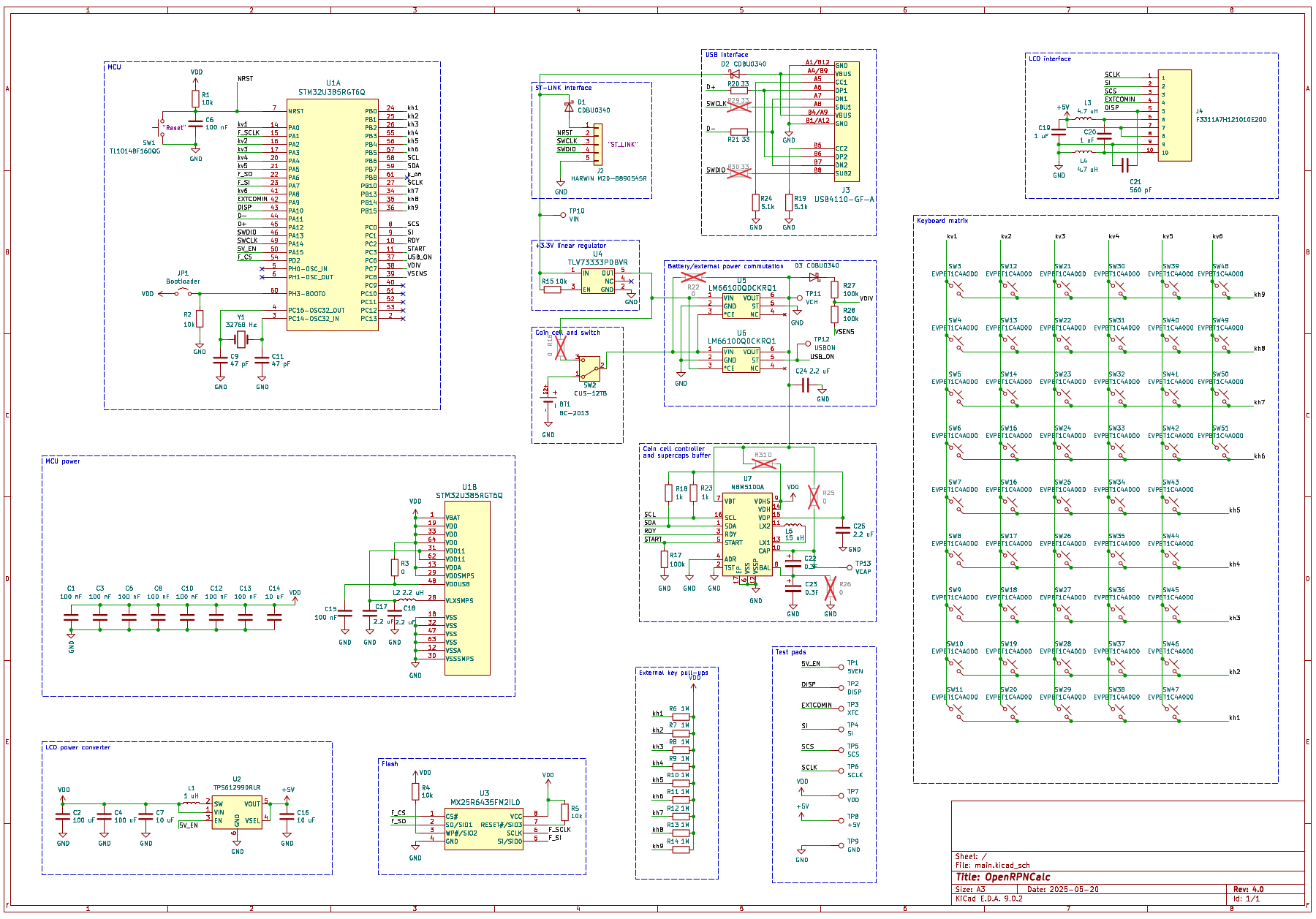
It is built around the STM32U385RGT6Q, MX25R6435FM2IL0 and LM66100QDCKRQ1, with the NBM5100ABQ, TLV73333PDBVR-HXY and NSR0340HT1G-HXY among its other parts. Its parts include 51 switches, 31 resistors, 25 capacitors, 7 ICs and 5 inductors. It belongs with the STM32 boards of this library.

Main components

11

README

README.md

OpenRPNCalc

Open-source and open-hardware scientific RPN calculator

Introduction

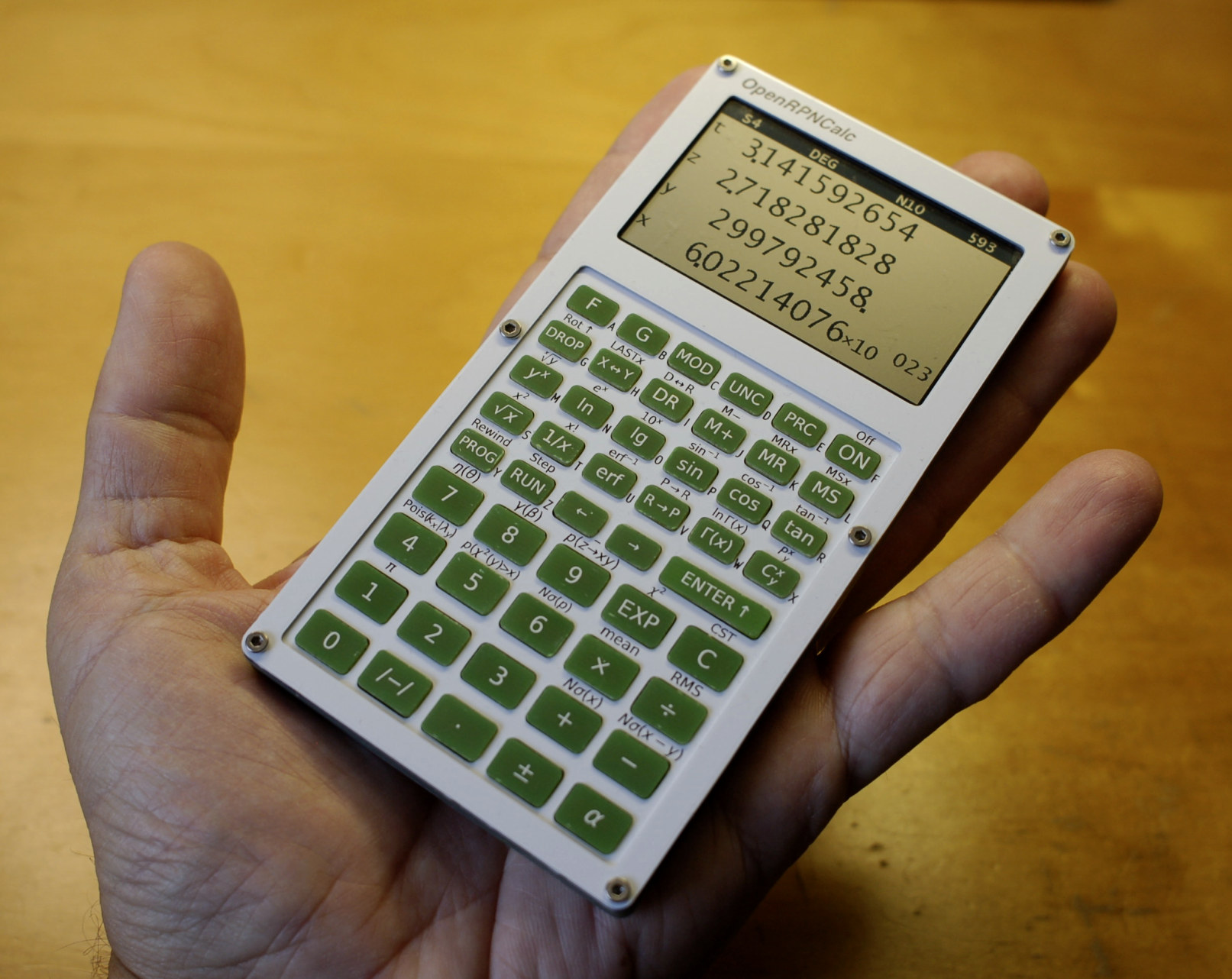
OpenRPNCalc is a scientific calculator based on the STM32 microcontroller. Its source code, schematics, and PCB design files are released under an open license. The goal is to develop a hardware platform with the following features:

  • Reproducible without special tools, using only boards produced by PCB prototyping services
  • A customizable keyboard to accommodate specific needs (such as RPN or algebraic logic, custom functions)
  • Low power consumption and long battery life
  • A high-quality, compact and sturdy enclosure

The hardware is inspired by the SwissMicros calculators, but is designed from scratch. The calculator features:

  • Reverse Polish notation with a large stack (up to 100 elements)
  • Double-precision arithmetic
  • "Standard" scientific calculator functions (trigonometric, logarithms, exponentiation, square root and power)
  • Error function (erf) and its inverse (erfinv), Gamma and log(Gamma) functions, combinations and permutations, p-values for Poisson, Gaussian, and chi-squared distributions
  • Fixed, scientific (SCI) and engineering (ENG) display modes (including SI prefixes in ENG mode), with adjustable precision from 3 to 10 digits
  • Calculations with uncertainties using error propagation (UNCERT mode) - a feature rarely found in software calculators and almost unheard of in hardware calculators
  • Formulas from relativistic kinematics (centre-of-mass two-body decay momentum, conversion between angle and pseudorapidity, beta and gamma factors)
  • Statistical functions: mean (or weighted mean in UNCERT mode), RMS, chi-squared of a series of values (only in UNCERT mode).
  • 100 memory registers
  • Power consumption: 0.6mA running at 16MHz, 16 uA in standby mode with the LCD on, and 5 uA with the LCD off.
  • Optional HP48 keyboard files, with the aim to run DB48x (this is still very much WIP)

Hardware overview

The calculator is built around a low-power 32-bit ARM microcontroller, the STM32U385. The display is a Sharp memory LCD module, the LS027B7DH01 (400x240 pixel monochrome). The keyboard uses light-touch tactile switches, specifically the Panasonic EVPBT1C4A000 (50g actuation force). All electronics are powered by a 3V lithium battery (CR2032), which should be sufficient for several years of operation.

The enclosure is designed as a stack of multiple PCBs. The front and back panels are aluminium PCBs with a white solder mask and black silkscreen. The keys are also made of PCB, with labels printed as silkscreen. All components are kept together with six M2 standoffs and twelve flat-head screws. The enclosure dimensions are 139 x 73 x 8 mm.

Repository contents

  • Code: STM32 firmware developed using STM32Cube IDE
  • Hardware: Schematic and PCB design files for KiCad, PCB production files
  • Doc: Documentation and images
  • Emulator: Online emulator files to be deployed to github-pages or other web hosting

Documentation

Emulator

Online emulator, based on the original calculator firmware extended with Emscripten and Raylib

Parts

141
QtyValueFootprintReferences
49EVPBT1C4A000footprints:SW_SPST_EVQQ2SW10, SW11, SW12, SW13, SW14, SW15, SW16, SW17, SW18, SW19, SW20, SW21, SW22, SW23, SW24, SW25 +33
9100 nFCapacitor_SMD:C_0603_1608Metric_Pad1.08x0.95mm_HandSolderC1, C3, C5, C6, C8, C10, C12, C13, C15
91MResistor_SMD:R_0603_1608Metric_Pad0.98x0.95mm_HandSolderR6, R7, R8, R9, R10, R11, R12, R13, R14
60Resistor_SMD:R_0603_1608Metric_Pad0.98x0.95mm_HandSolderR3, R16, R22, R25, R26, R31
510kResistor_SMD:R_0603_1608Metric_Pad0.98x0.95mm_HandSolderR1, R2, R4, R5, R15
42.2 uFCapacitor_SMD:C_0603_1608Metric_Pad1.08x0.95mm_HandSolderC17, C18, C24, C25
433Resistor_SMD:R_0603_1608Metric_Pad0.98x0.95mm_HandSolderR20, R21, R29, R30
310 uFCapacitor_SMD:C_0603_1608Metric_Pad1.08x0.95mm_HandSolderC7, C14, C16
3100kResistor_SMD:R_0603_1608Metric_Pad0.98x0.95mm_HandSolderR17, R27, R28
3NSR0340HT1GDiode_SMD:D_0603_1608Metric_Pad1.05x0.95mm_HandSolderD1, D2, D3
20.3Ffootprints:Supercap_4x10C22, C23
21 uFCapacitor_SMD:C_0603_1608Metric_Pad1.08x0.95mm_HandSolderC19, C20
2100 uFCapacitor_SMD:C_0805_2012Metric_Pad1.18x1.45mm_HandSolderC2, C4
21kResistor_SMD:R_0603_1608Metric_Pad0.98x0.95mm_HandSolderR18, R23
24.7 uHInductor_SMD:L_0805_2012Metric_Pad1.15x1.40mm_HandSolderL3, L4
247 pFCapacitor_SMD:C_0603_1608Metric_Pad1.08x0.95mm_HandSolderC9, C11
25.1kResistor_SMD:R_0603_1608Metric_Pad0.98x0.95mm_HandSolderR19, R24
2LM66100QDCKRQ1footprints:SC70-6_DCK_TEXU5, U6
1+5Vfootprints:TestPoint_Pad_D2.0mmTP8
11 uHInductor_SMD:L_0805_2012Metric_Pad1.15x1.40mm_HandSolderL1
115 uHInductor_SMD:L_0805_2012Metric_Pad1.05x1.20mm_HandSolderL5
12.2 uHInductor_SMD:L_0805_2012Metric_Pad1.05x1.20mm_HandSolderL2
132768 HzCrystal:Crystal_SMD_2012-2Pin_2.0x1.2mm_HandSolderingY1
1560 pFCapacitor_SMD:C_0603_1608Metric_Pad1.08x0.95mm_HandSolderC21
15VENfootprints:TestPoint_Pad_D2.0mmTP1
1BC-2013footprints:BAT_BC-2013BT1
1BootloaderResistor_SMD:R_0603_1608Metric_Pad0.98x0.95mm_HandSolderJP1
1CUS-12TBfootprints:CUS-12TB_NDCSW2
1DISPfootprints:TestPoint_Pad_D2.0mmTP2
1F3311A7H121010E200footprints:AMPHENOL_F3311A7H121010E200J4
1GNDfootprints:TestPoint_Pad_D2.0mmTP9
1HARWIN M20-8890545Rfootprints:HARWIN_M20-8890545RJ2
1MX25R6435FM2IL0footprints:SOP_8L_200_MACU3
1NBM5100APackage_DFN_QFN:DHVQFN-16-1EP_2.5x3.5mm_P0.5mm_EP1x2mmU7
1SCLKfootprints:TestPoint_Pad_D2.0mmTP6
1SCSfootprints:TestPoint_Pad_D2.0mmTP5
1SIfootprints:TestPoint_Pad_D2.0mmTP4
1STM32U385RGT6Qfootprints:LQFP64_STMU1
1TL1014BF160QGfootprints:TL1014BF160QG_EWISW1
1TLV73333PDBVRfootprints:DBV0005A_NU4
1TPS61299DRLRPackage_TO_SOT_SMD:SOT-563U2
1USB4110-GF-Afootprints:GCT_USB4110GFAJ3
1USBONfootprints:TestPoint_Pad_D2.0mmTP12
1VCAPfootprints:TestPoint_Pad_D2.0mmTP13
1VCHfootprints:TestPoint_Pad_D2.0mmTP11
1VDDfootprints:TestPoint_Pad_D2.0mmTP7
1VINfootprints:TestPoint_Pad_D2.0mmTP10
1XTCfootprints:TestPoint_Pad_D2.0mmTP3

Similar boards

  • 2 layers36 × 29.3 mmBle mvp 1b rev0, the printed circuit board in 3D

    Ble mvp 1b rev0

    saewoonam/ble_adv_covid

    Repo to implement the advertise and scanner portion for bluetooth to enable encounter/exposure tracing (e.g. Apple/Google / TCN / etc...) on a nRF52840 based battery powered dongle/device

    71 parts10
  • 4 layers42.2 × 49.8 mmJetboard, the printed circuit board in 3D

    Jetboard

    uge/jetboard

    KiCad and related artifacts for a WSPR tracker based on Traquito/Jetpack

    84 parts1
  • 6 layers14.5 × 90 mmNew stm32u3-203f, the printed circuit board in 3D

    New stm32u3-203f

    IsaacNorris/new-stm32u3-203f-hardware

    hardware design for my stm32 board

    82 parts
  • 2 layers136 × 92 mmBB3plus DSI TFT display, the printed circuit board in 3D

    BB3plus DSI TFT display

    eez-open/eez-bb3plus

    EEZ Bench Box 3 Plus (BB3+) Modular T&M chassis

    50 parts13
  • 4 layers81 × 37 mmMaidenhead pocket locator, the printed circuit board in 3D

    Maidenhead pocket locator

    EdmundLimBoEn/gps-maidenhead-device

    Open-source portable GNSS Maidenhead grid locator with a 16x2 LCD

    117 parts
  • 4 layers39.4 × 39.4 mmMicroMod Extension, the printed circuit board in 3D

    MicroMod Extension

    Leonana69/POD-Micromod-Extension

    80 partsGPL-3.0
  • 2 layers50 × 27.3 mmEngemil pmw3901mb, the printed circuit board in 3D

    Engemil pmw3901mb

    engemil/engemil_pmw3901mb_hardware

    PMW3901MB Optiocal Flow Sensor Module designed with KiCAD

    20 parts2CERN-OHL-W-2.0
  • 4 layers100 × 100 mmA SGSS cskpin routed, the printed circuit board in 3D

    A SGSS cskpin routed

    ThatguyCplus/throttleECU

    STM32F411CE Throttle ECU — PID position control with AS5048A encoder, H-bridge motor, safety module

    571 parts1

Questions

How big is the OpenRPNCalc PCB?

It measures 73 × 139 mm and has 2 copper layers, 0.8 mm thick.

What parts does the OpenRPNCalc use?

141 parts, built around the STM32U385RGT6Q, MX25R6435FM2IL0, LM66100QDCKRQ1 and NBM5100ABQ. The full list of its parts is on this page, with links to each part's symbol and footprint where PCBKit's library has them.

Where can I download the OpenRPNCalc KiCad files?

From the apoluekt/OpenRPNCalc repository on GitHub, at the commit this page was made from: the board is Hardware/PCBs/Main/main.kicad_pcb. PCBKit opens the board in the browser, with nothing to install.

Can I use the OpenRPNCalc design in my own project?

Its repository publishes it under the CERN-OHL-P-2.0 licence: you may reuse it on that licence's terms (keep the author's notice, and for a copyleft licence share your changes alike).