2 layers57.3 × 19 mm

 andyclymer/minikbd122
The MiniKbd is a USB device based on the Adafruit Trinket M0 development board which is programmable with CircuitPython.
Minikbd is an open-source printed circuit board by andyclymer, from the andyclymer/minikbd repository on GitHub. It is a 2-layer board of 91.4 × 41.9 mm with 26 parts on 18 nets, routed with 201 tracks and 3 vias.
Its parts include 6 diodes, 6 switches, 3 resistors and 1 IC. It belongs with the keyboards and input boards of this library.
The MiniKbd is a USB device based on the Adafruit Trinket M0 development board which is programmable with CircuitPython. The parts are available for sale on Tindie, with build documentation and software samples available in this repo.
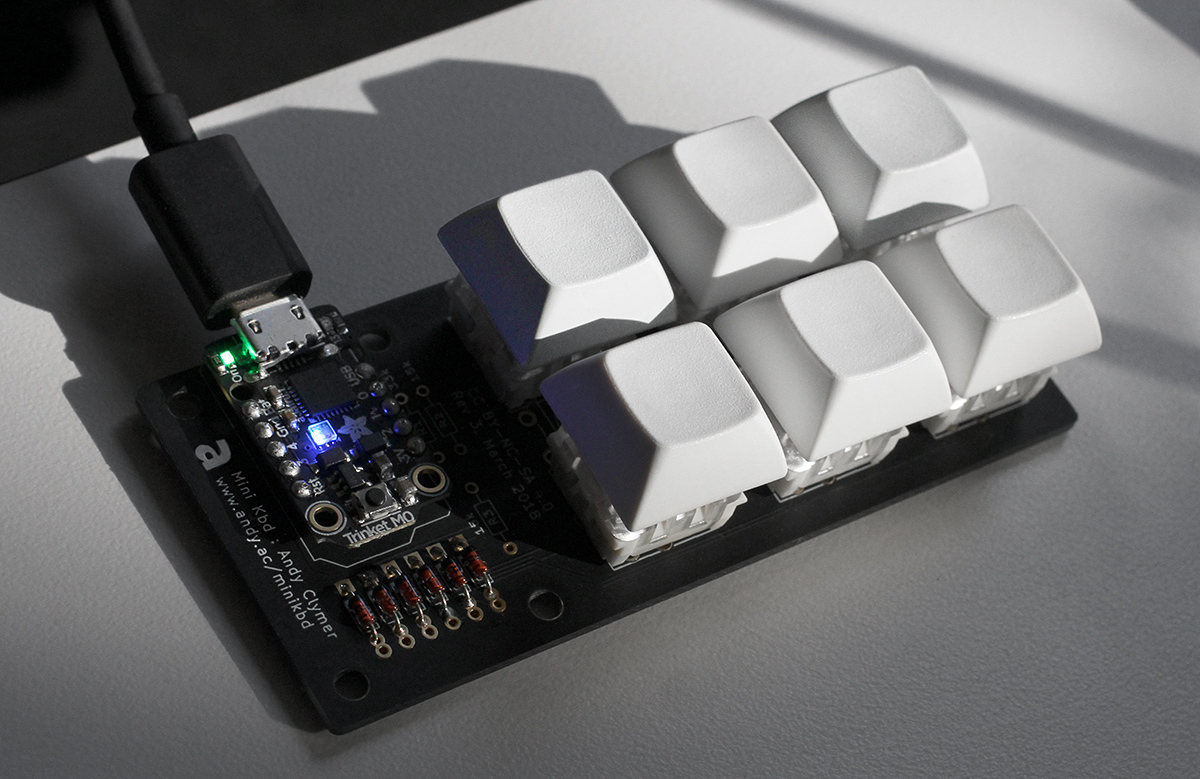
The MiniKbd is programmable with CircuitPython, each key can be easily customized to perform any combination of keystroke or mouse movement. When plugging it in over USB, your computer will recognize it as a “USB HID” (Human Interface Device), as if a keyboard or mouse had been plugged in. The keystrokes that are output by the MiniKbd can then be configured by editing the CircuitPython code running on the device.
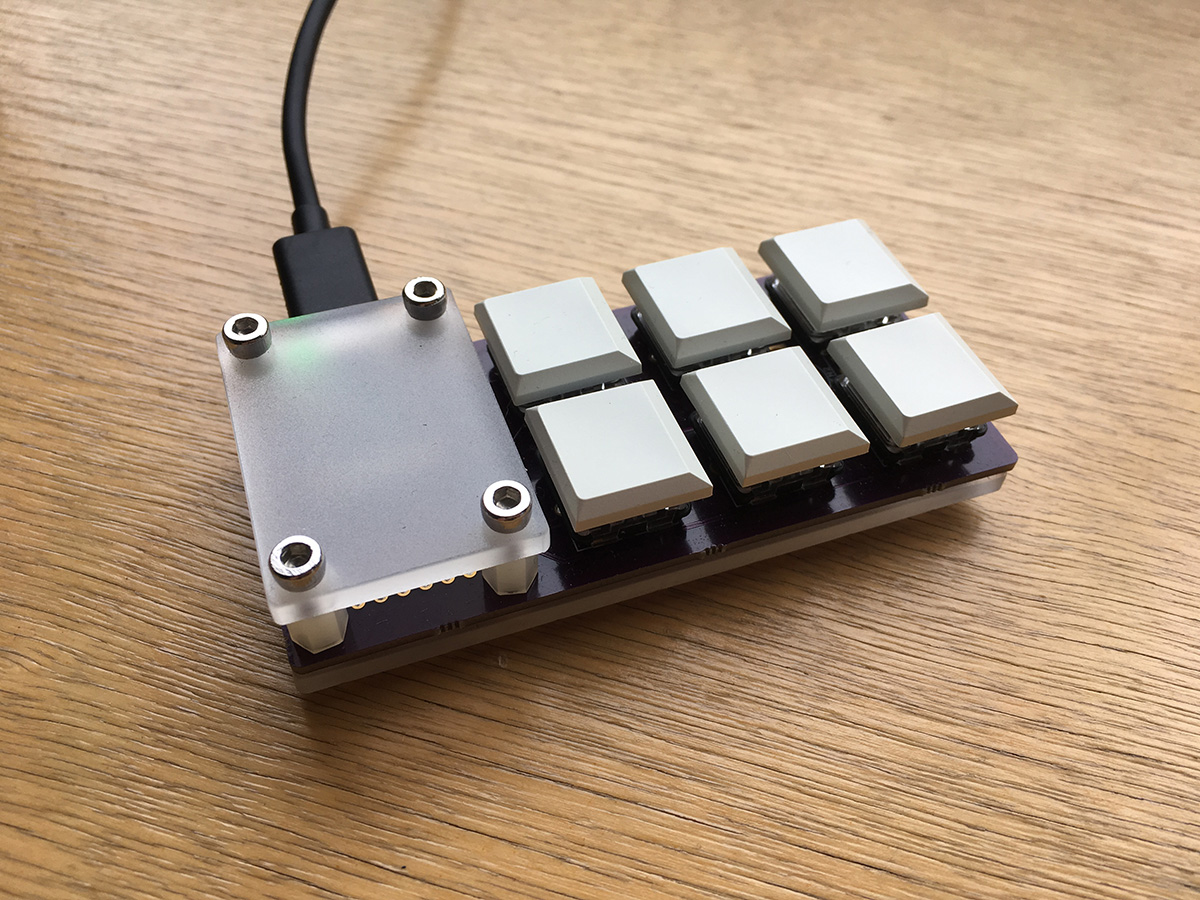
The project came out of the idea of wanting a keyboard that simply had a larger set of arrow keys that I could position to the left side of my keyboard. OSH Park, the prototyping service that I use to manufacture PCBs will always make boards in sets of three, so instead of having three of the same device I designed the MiniKbd to be built in three separate ways —
The MiniKbd is a DIY project, and I hope that you'll build one! Complete build documentation, parts list, and KiCad source files can be found in the Hardware directory of this repo, and code examples can be found inthe Software directory.
The MiniKbd kit is available for sale on Tindie if you'd like to build one (or two) for yourself!

The build documentation can be found in the Hardware directory of this repo.
Six keyboard keys, with component footprints for the most popular Cherry MX, Cherry ML and Kalih Low Profile keyswitches. Choose keyswitches that are as clicky and springy as you wish.
Since the Trinket M0 only has five general purpose IO pins and this variation has six keyswitches, they are wired up as a matrix of three rows by two columns of keyswitches. I've written a simple library to read the keypresses of a small button matrix like this one.
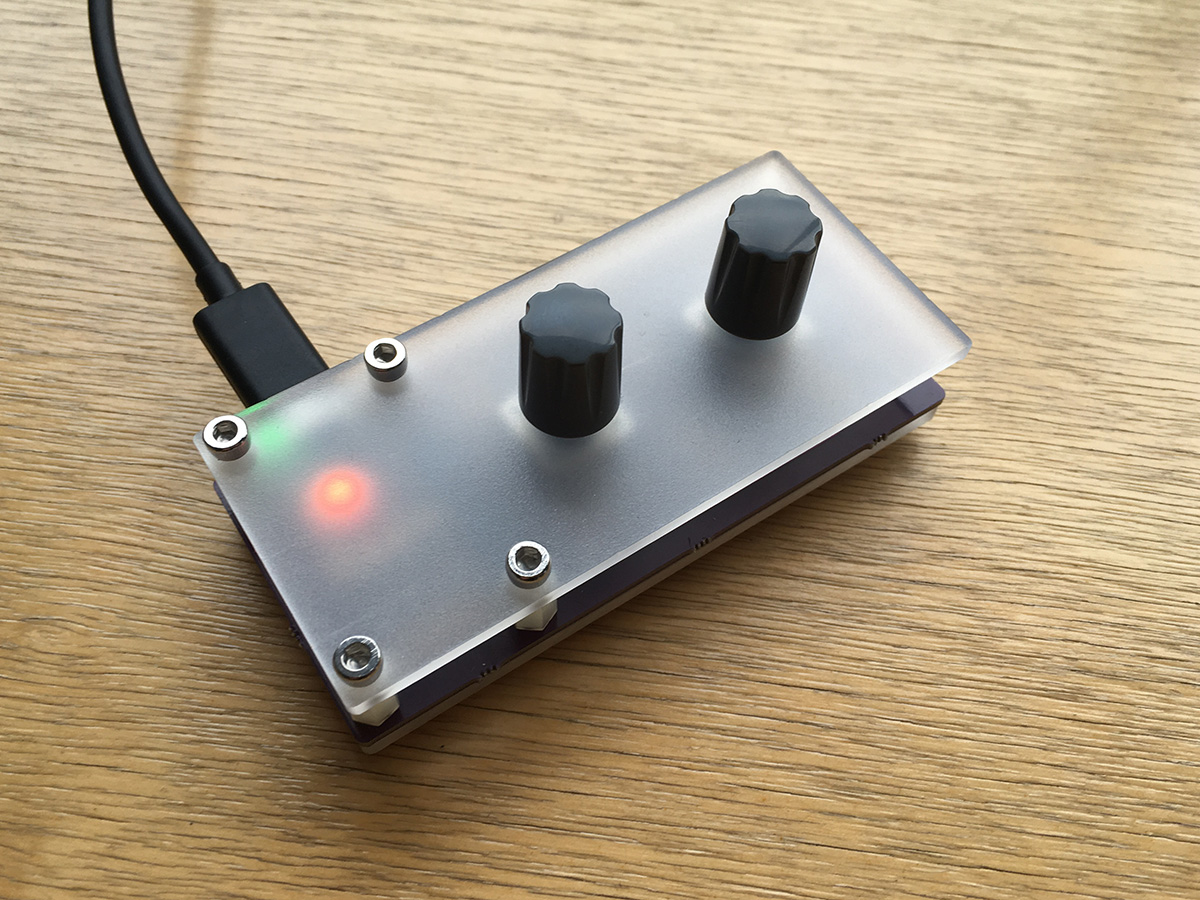
Whereas a “potentiometer” is the kind of knob designed to turn from 0 to 100% (like a volumne knob), its cousin the Rotary Encoder can freely turn continuously in either direction, clicking like a jog-dial as it turns (usually 12 or 24 clicks per rotation). With each click, the MiniKbd receives a signal that it's able to interpret to know whether it was turned clockwise or counterclockwise. Then, with each click, a keyboard command can be sent to the computer.
For instance, if the "z" and "x" keys are set up to zoom in and out in your drawing application, you can make one of the encoders into a zoom knob by having it type the letter "z" with each click in one direction, and the letter "x" in the other.
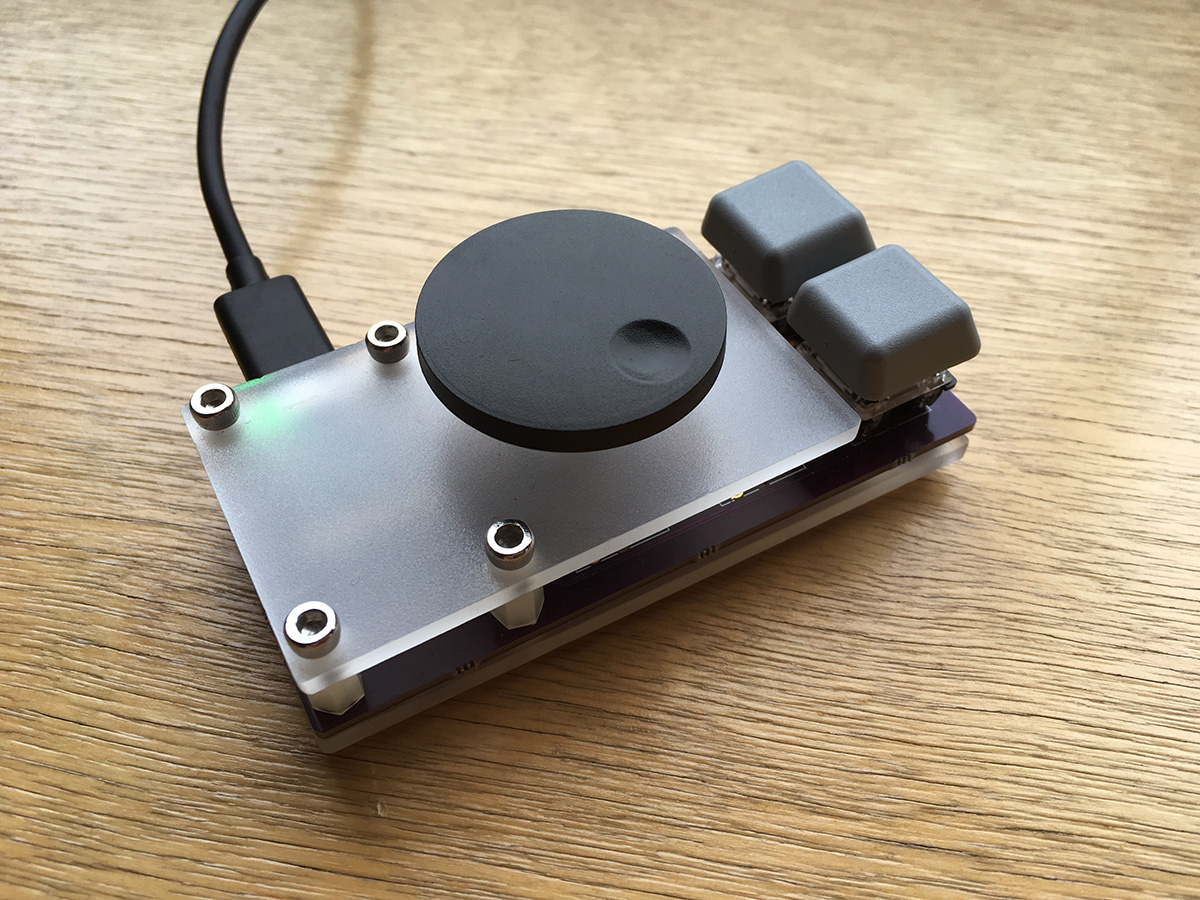
The best of both worlds, almost like a little mouse that only has a scroll wheel and two buttons for clicking.
| Qty | Value | Footprint | References |
|---|---|---|---|
| 6 | D | Misc:Diode_SmallDualSize | D1, D2, D3, D4, D5, D6 |
| 6 | SPST | Keyboard:CHERRY_MXML_KAILH_PCB_100H | SW1, SW2, SW3, SW4, SW5, SW6 |
| 2 | 15k | Resistors_ThroughHole:R_Axial_DIN0204_L3.6mm_D1.6mm_P7.62mm_Horizontal | R2, R3 |
| 2 | LOGO | Logos:a-015-1200 | G***, G*** |
| 2 | ROTARY_ENCODER_SWITCH | Rotary Encoder:Encoder_Bourns_PEC11_12mm_123 | EN1, EN2 |
| 1 | 33k | Resistors_ThroughHole:R_Axial_DIN0204_L3.6mm_D1.6mm_P7.62mm_Horizontal | R1 |
| 1 | Trinket3v3 | Trinket:Trinket_3v3 | IC1 |
The 20 most common of 26 parts.
It measures 91.4 × 41.9 mm and has 2 copper layers, 1.6 mm thick.
26 parts. The full list of its parts is on this page, with links to each part's symbol and footprint where PCBKit's library has them.
From the andyclymer/minikbd repository on GitHub, at the commit this page was made from: the board is Hardware/KiCad project/MiniKbd.kicad_pcb. PCBKit opens the board in the browser, with nothing to install.
Its repository states no licence, so its author keeps all rights: ask andyclymer before reusing the design.

hackclub/OnBoard
💡 Join 1,000 teenagers and make your first PCB with a $100 grant!


harbaum/galagino
A Galaga, Pac-Man and Donkey Kong arcade emulator for the ESP32

Luos-io/luos_engine
Open-source and real-time orchestrator for cyber-physical-systems, to easily design, test and deploy embedded applications and digital twins.

google/walt
A device for measuring latency of physical sensors and outputs on phones and computers
