
4 layers56 × 56 mm
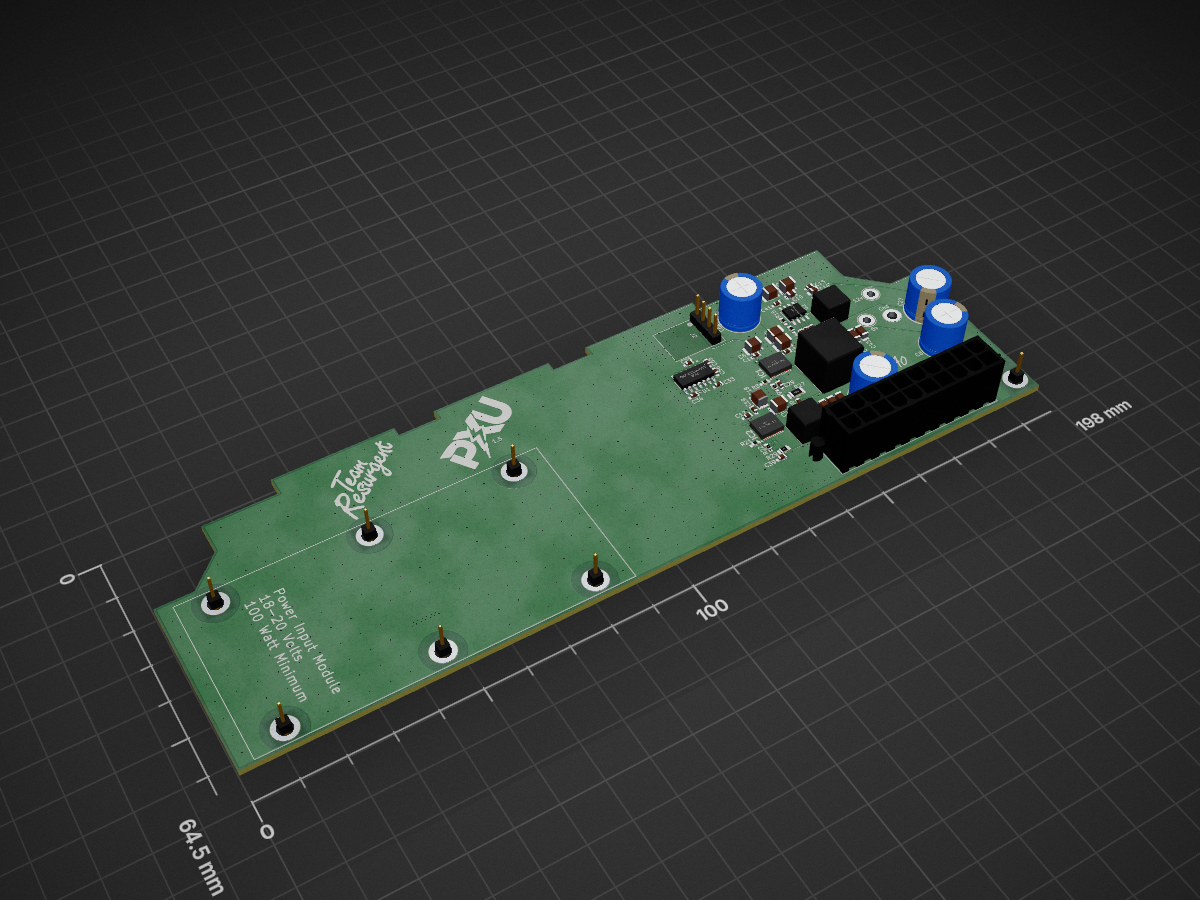
Replacement Original Xbox Power Supply
PXU is an open-source printed circuit board by Andr-Zero, from the Andr-Zero/PXU repository on GitHub, published under the CERN-OHL-S-2.0 licence. It is a 4-layer board of 198 × 64.5 mm with 129 parts on 48 nets, routed with 289 tracks and 835 vias.
It is built around the SN74LVC2G17DBVR, TPS53318DQPT and TPS53319DQPT, with the UCC27517ADBV, CSD25402Q3A and SN74LVC08ADRG3 among its other parts. Its parts include 70 capacitors, 34 resistors, 8 ICs, 3 inductors and 2 connectors.


This project involves working with and replacing a power supply unit that was originally designed to handle mains voltage. The original OEM power supply can retain a lethal electrical charge long after it has been unplugged. Proceed with extreme caution.
HIGH VOLTAGE RISK: You are solely responsible for your safety. Improper handling of electronics can lead to serious injury, death, or fire. If you are not experienced and confident in working with electronics, do not attempt to install this hardware.
USE AT YOUR OWN RISK: This is a hobbyist project provided "as is" without warranties of any kind. The author, Andr0, is not responsible for any damage to your console, other property, or any personal injury that may occur from the use or misuse of this hardware.
Warning: The OEM power supply can be dangerous even after being unplugged for long periods. Proceed with caution!
Will my "****" work as a power source?** I cannot test every power source available. I have personally tested an MSI laptop charger (180W) and an Anker 100W USB-C charger. Similar adapters that meet the specification of 16-20V and can deliver 100W or more should work.
Can you add feature "X"? The goal of the main PXU board is to be a drop-in replacement that powers the console just like the OEM supply. Additional features can and should be added as daughterboards using the provided mount points.
I dont see the USB-C Board Here. That's in another repo: https://github.com/Andr-Zero/PXU-C-PIM
This project is open-source hardware, licensed under the CERN-OHL-S v2 (CERN Open Hardware Licence - Strongly Reciprocal).
Copyright © 2025 Andr0
You are free to:
In return, you must:
| Qty | Value | Footprint | References |
|---|---|---|---|
| 10 | 100uF 10V | Capacitor_SMD:C_1206_3216Metric_Pad1.33x1.80mm_HandSolder | C26, C43, C49, C50, C51, C52, C53, C54, C67, C68 |
| 9 | 1uF 10V | Capacitor_SMD:C_0603_1608Metric_Pad1.08x0.95mm_HandSolder | C7, C21, C22, C36, C38, C40, C48, C69, C70 |
| 7 | 0Ω | Resistor_SMD:R_0603_1608Metric_Pad0.98x0.95mm_HandSolder | R2, R4, R6, R11, R26, R32, R33 |
| 7 | 100nF 10V | Capacitor_SMD:C_0603_1608Metric_Pad1.08x0.95mm_HandSolder | C12, C33, C34, C35, C41, C42, C65 |
| 7 | 100nF 50V | Capacitor_SMD:C_0603_1608Metric_Pad1.08x0.95mm_HandSolder | C5, C15, C28, C31, C32, C59, C64 |
| 7 | 105kΩ | Resistor_SMD:R_0603_1608Metric_Pad0.98x0.95mm_HandSolder | R3, R7, R12, R13, R14, R16, R20 |
| 7 | 47uF 25V | Capacitor_SMD:C_1210_3225Metric_Pad1.33x2.70mm_HandSolder | C2, C3, C6, C9, C16, C18, C20 |
| 6 | , , , , , | ||
| 5 | 22uF 25V | Capacitor_SMD:C_0805_2012Metric_Pad1.18x1.45mm_HandSolder | C14, C45, C46, C47, C55 |
| 4 | 1uF 16V | Capacitor_SMD:C_0603_1608Metric_Pad1.08x0.95mm_HandSolder | C1, C11, C17, C44 |
| 3 | TestPoint | TestPoint:TestPoint_THTPad_D4.0mm_Drill2.0mm | 5v, 12v, Gnd |
| 2 | 100nF 50V | Capacitor_SMD:C_1206_3216Metric_Pad1.33x1.80mm_HandSolder | C60, C61 |
| 2 | 10kΩ | Resistor_SMD:R_0603_1608Metric_Pad0.98x0.95mm_HandSolder | R8, R21 |
| 2 | 10uF 10V | Capacitor_SMD:C_0805_2012Metric_Pad1.18x1.45mm_HandSolder | C37, C63 |
| 2 | 1MΩ | Resistor_SMD:R_1206_3216Metric_Pad1.30x1.75mm_HandSolder | R17, R23 |
| 2 | 2200uF 16V | Capacitor_THT:CP_Radial_D10.0mm_P5.00mm | C8, C27 |
| 2 | 22uF 35V | Capacitor_SMD:C_1210_3225Metric_Pad1.33x2.70mm_HandSolder | C57, C58 |
| 2 | 4.7uF 25V | Capacitor_SMD:C_0603_1608Metric_Pad1.08x0.95mm_HandSolder | C4, C19 |
| 2 | 475kΩ | Resistor_SMD:R_0603_1608Metric_Pad0.98x0.95mm_HandSolder | R5, R19 |
| 1 | 0Ω | Resistor_SMD:R_1206_3216Metric_Pad1.30x1.75mm_HandSolder | R10 |
| 1 | 1.87kΩ | Resistor_SMD:R_0805_2012Metric_Pad1.20x1.40mm_HandSolder | R28 |
| 1 | 100pF | Capacitor_SMD:C_0603_1608Metric_Pad1.08x0.95mm_HandSolder | C39 |
| 1 | 100Ω | Resistor_SMD:R_0603_1608Metric_Pad0.98x0.95mm_HandSolder | R37 |
| 1 | 105k Ω | Resistor_SMD:R_0603_1608Metric_Pad0.98x0.95mm_HandSolder | R24 |
| 1 | 10uF 16V | Capacitor_SMD:C_0603_1608Metric_Pad1.08x0.95mm_HandSolder | C66 |
| 1 | 12pF 25V | Capacitor_SMD:C_0603_1608Metric_Pad1.08x0.95mm_HandSolder | C13 |
| 1 | 1500uF 6.3V | Capacitor_THT:CP_Radial_D10.0mm_P5.00mm | C23 |
| 1 | 150kΩ | Resistor_SMD:R_0603_1608Metric_Pad0.98x0.95mm_HandSolder | R1 |
| 1 | 171826-4 | Library:CONN_171826-4_TYCO_TYC | J2 |
| 1 | 180pF | Capacitor_SMD:C_0603_1608Metric_Pad1.08x0.95mm_HandSolder | C30 |
| 1 | 1nF 50V | Capacitor_SMD:C_0603_1608Metric_Pad1.08x0.95mm_HandSolder | C29 |
| 1 | 1uF 35V | Capacitor_SMD:C_0603_1608Metric_Pad1.08x0.95mm_HandSolder | C24 |
| 1 | 1uF 6.3V | Capacitor_SMD:C_0603_1608Metric_Pad1.08x0.95mm_HandSolder | C56 |
| 1 | 2.2uF 6.3V | Capacitor_SMD:C_0603_1608Metric_Pad1.08x0.95mm_HandSolder | C25 |
| 1 | 220nF 25V | Capacitor_SMD:C_0805_2012Metric_Pad1.18x1.45mm_HandSolder | C10 |
| 1 | 22Ω | Resistor_SMD:R_0603_1608Metric_Pad0.98x0.95mm_HandSolder | R34 |
| 1 | 33 Ω | Resistor_SMD:R_0603_1608Metric_Pad0.98x0.95mm_HandSolder | R25 |
| 1 | 39-38-1203 | Connector_Molex:Molex_Mini-Fit_Jr_5566-20A_2x10_P4.20mm_Vertical | J1 |
| 1 | 3Ω | Resistor_SMD:R_1206_3216Metric_Pad1.30x1.75mm_HandSolder | R27 |
| 1 | 3Ω | Resistor_SMD:R_0805_2012Metric_Pad1.20x1.40mm_HandSolder | R29 |
| 1 | 44.2kΩ | Resistor_SMD:R_0603_1608Metric_Pad0.98x0.95mm_HandSolder | R22 |
| 1 | 55kΩ | Resistor_SMD:R_0603_1608Metric_Pad0.98x0.95mm_HandSolder | R31 |
| 1 | 680uF 35V | Capacitor_THT:CP_Radial_D10.0mm_P5.00mm | C62 |
| 1 | 71.5kΩ | Resistor_SMD:R_0603_1608Metric_Pad0.98x0.95mm_HandSolder | R9 |
| 1 | 80.6kΩ | Resistor_SMD:R_0603_1608Metric_Pad0.98x0.95mm_HandSolder | R18 |
| 1 | 9.53kΩ | Resistor_SMD:R_0603_1608Metric_Pad0.98x0.95mm_HandSolder | R15 |
| 1 | AP7375Q-33SP-13 | Library:SO-8EP_DIO | U4 |
| 1 | CSD25402Q3A | Imports:CSD25402Q3A | U3 |
| 1 | LMR33640ADDAR | Package_SO:Texas_HSOP-8-1EP_3.9x4.9mm_P1.27mm_ThermalVias | U2 |
| 1 | SN74LVC08ADR | Library:D14 | U1 |
| 1 | SN74LVC2G17DBVR | Package_TO_SOT_SMD:SOT-23-6_Handsoldering | U6 |
| 1 | TPS53318DQPT | Library:SON50P500X600X150-23N-D | IC2 |
| 1 | TPS53319DQPT | Library:SON50P500X600X150-23N-D | IC1 |
| 1 | UCC27517A | Package_TO_SOT_SMD:SOT-23-5 | U5 |
| 1 | XAL1010-222MED | Inductor_SMD:L_10.4x10.4_H4.8 | L1 |
| 1 | XAL6060-103MEB | Inductor_SMD:L_6.3x6.3_H3 | L2 |
| 1 | XAL6060-472MEC | Inductor_SMD:L_6.3x6.3_H3 | L3 |
The 126 most common of 129 parts.
It measures 198 × 64.5 mm and has 4 copper layers, 1.6 mm thick.
129 parts, built around the SN74LVC2G17DBVR, TPS53318DQPT, TPS53319DQPT and UCC27517ADBV. The full list of its parts is on this page, with links to each part's symbol and footprint where PCBKit's library has them.
From the Andr-Zero/PXU repository on GitHub, at the commit this page was made from: the board is KiCad/PXU.kicad_pcb and its schematic KiCad/12V-Rail.kicad_sch. PCBKit opens the board in the browser, with nothing to install.
Its repository publishes it under the CERN-OHL-S-2.0 licence: you may reuse it on that licence's terms (keep the author's notice, and for a copyleft licence share your changes alike).


ddanila/Pico1715
Pico-based SD, RAM and controller replacement for Robotron PC 1715

Redherring32/100W-Charging-PCB
100W USB C PD Lithium Ion charging PCB based on the TPS25750D and BQ25713


Konkzor/LinKey
Une clé WIFI lisant la sortie TIC du Linky connectée au broker MQTT d'un Home Assistant