
2 layers235 × 160 mm
Processor.80C188
lynchaj/duodyne
Duodyne is a hobbyist retrocomputer system designed to run ROMWBW. It is comprised of modules on a system bus
111 parts15
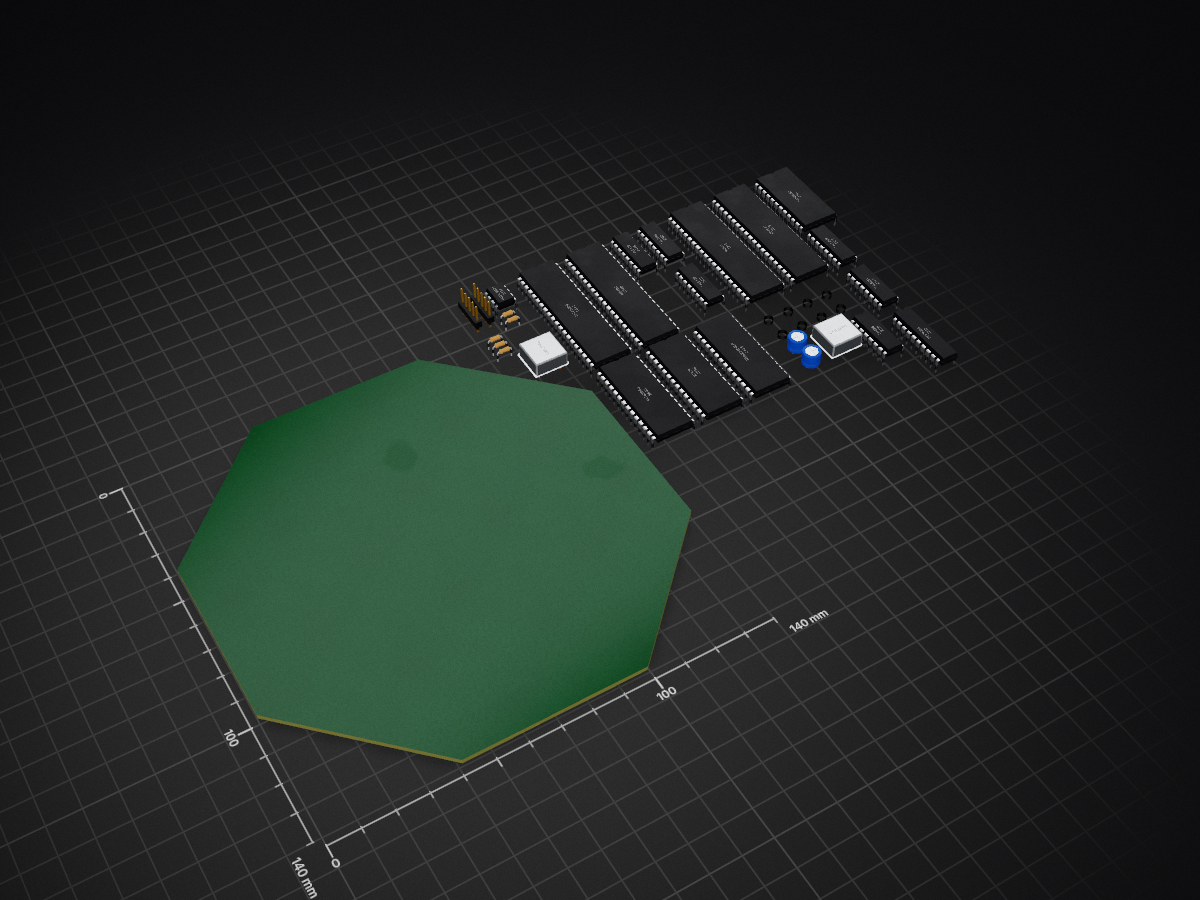
 anachrocomputer/Octuplex
6502/6809 microcomputer in octagonal format
Octuplex is an open-source printed circuit board by anachrocomputer, from the anachrocomputer/Octuplex repository on GitHub. It is a 2-layer board of 140 × 140 mm with 35 parts on 180 nets.
It is built around the MC68B09CP, PCF8584T and 74LS139PC, with the 74LS259DC, HCPL-2631 and HM62256BLP-7 among its other parts. Its parts include 16 ICs, 5 resistors, 2 capacitors, 2 connectors and 2 crystals. It belongs with the retro computing and games boards of this library.


A 6502/6809 microcomputer in the shape of an octagon.
A choice of two classic 8-bit CPUs, the 6502 or the 6809. The two chips have similar pinouts and are placed on the PCB overlapping. Only one chip may be installed at a time. Clock speed 2MHz in both cases, with the 68B09 requiring a 4x clock input, i.e. 8MHz. The Hitachi 63B09 may also be fitted.
The standard Motorola MC6840 timer chip. Can generate interrupts and/or PWM signals.
The standard 6522 parallel port chip. Can generate interrupts.
Two handy little circuits for additional 8-bit I/O with minimal pin count: 74LS259 and 74LS251. The 74LS259 is an unusual chip, an addressable latch. It takes three address input pins and a single data input pin, and has eight output pins. The 74LS251 is an eight-input multiplexer with tri-state output. The selector inputs are connected to three address pins, while the output is connected to data bit D7. The 6502's BIT instruction can read D7 directly into the sign flag, which can be followed by BMI or BPL.
The classic Ferranti ZN428 8-bit DAC chip.
The classic Ferranti ZN448 b-bit ADC chip. Although I'm not sure about this one due to its need for a negative supply rail.
Classic Philips PCF8584 I2C bus controller. Can generate interrupts.
Rockwell R65C52 dual ACIA. Can generate interrupts.
Motorola MC6850 with optocoupler for MIDI. Can generate interrupts.
TBD, most likely an LED starburst display of some kind.
| Qty | Value | Footprint | References |
|---|---|---|---|
| 8 | MountingHole_Pad | MountingHole:MountingHole_3.2mm_M3_Pad | H1, H2, H3, H4, H5, H6, H7, H8 |
| 3 | 10k | Resistor_THT:R_Axial_DIN0204_L3.6mm_D1.6mm_P5.08mm_Horizontal | R3, R4, R5 |
| 2 | 0.1uF | Capacitor_THT:C_Radial_D6.3mm_H5.0mm_P2.50mm | C1, C2 |
| 2 | 74LS138 | Package_DIP:DIP-16_W7.62mm | U11, U15 |
| 2 | CXO_DIP8 | Oscillator:Oscillator_DIP-8 | X1, X2 |
| 2 | DIN-5_180degree | Connector_PinHeader_2.54mm:PinHeader_1x05_P2.54mm_Vertical | J1, J2 |
| 1 | 220 | Resistor_THT:R_Axial_DIN0204_L3.6mm_D1.6mm_P5.08mm_Horizontal | R1 |
| 1 | 27128 | Package_DIP:DIP-28_W15.24mm | U4 |
| 1 | 280 | Resistor_THT:R_Axial_DIN0204_L3.6mm_D1.6mm_P5.08mm_Horizontal | R2 |
| 1 | 74LS139 | Package_DIP:DIP-16_W7.62mm | U6 |
| 1 | 74LS251 | Package_DIP:DIP-16_W7.62mm | U13 |
| 1 | 74LS259 | Package_DIP:DIP-16_W7.62mm | U8 |
| 1 | HCPL-2631 | Package_DIP:DIP-8_W7.62mm | U12 |
| 1 | HM62256BLP | Package_DIP:DIP-28_W15.24mm | U5 |
| 1 | M6502 | Package_DIP:DIP-40_W15.24mm | U9 |
| 1 | MC68B09 | Package_DIP:DIP-40_W15.24mm | U1 |
| 1 | MC68B40 | Package_DIP:DIP-28_W15.24mm | U2 |
| 1 | MC68B50 | Package_DIP:DIP-24_W15.24mm | U7 |
| 1 | PCF8584 | Package_DIP:DIP-20_W7.62mm | U14 |
| 1 | R6522 | Package_DIP:DIP-40_W15.24mm | U10 |
| 1 | R65C52 | Package_DIP:DIP-40_W15.24mm | U3 |
| 1 | ZN428 | Package_DIP:DIP-16_W7.62mm | U16 |
It measures 140 × 140 mm and has 2 copper layers, 1.6 mm thick.
35 parts, built around the MC68B09CP, PCF8584T, 74LS139PC and 74LS259DC. The full list of its parts is on this page, with links to each part's symbol and footprint where PCBKit's library has them.
From the anachrocomputer/Octuplex repository on GitHub, at the commit this page was made from: the board is Octuplex.kicad_pcb and its schematic Octuplex.kicad_sch. PCBKit opens the board in the browser, with nothing to install.
Its repository states no licence, so its author keeps all rights: ask anachrocomputer before reusing the design.
lynchaj/duodyne
Duodyne is a hobbyist retrocomputer system designed to run ROMWBW. It is comprised of modules on a system bus

Dephrilibrium/FE-FEAR16v2-PCB-Mainboard
Regulation circuit mainboard of the Field Emission Array Regulation (FEAR) system with up to 16 channels.

edwinDOS/pcb_gofa_gripper
This repository contains the PCB design for the ABB GOFA Gripper at UC3M


fortinsylvain/MyCpu
Home brew CPU Hardware with 1-bit ALU implementation using 74LSxx, a micro-code and assembler coded in C#.


