2 layers189.2 × 72.4 mm

 ambraglow/VLF-receiver3
ExplorerE202-based design
Exploere202 is an open-source printed circuit board by ambraglow, from the ambraglow/VLF-receiver repository on GitHub, published under the CERN-OHL-P-2.0 licence. It is a 2-layer board of 47 × 81.5 mm with 60 parts on 36 nets, routed with 195 tracks and 56 vias.
It is built around the LM386, TL081 and L7809, with the BC237 among its other parts. Its parts include 15 capacitors, 12 resistors, 5 connectors, 4 ICs and 3 diodes.


This is my own spin on the E202 VLF receiver design, as a PCB. It features 2.1mm mounting holes, a line-out audio transformer (so it can be directly connected to a soundcard) and a volume control slider.
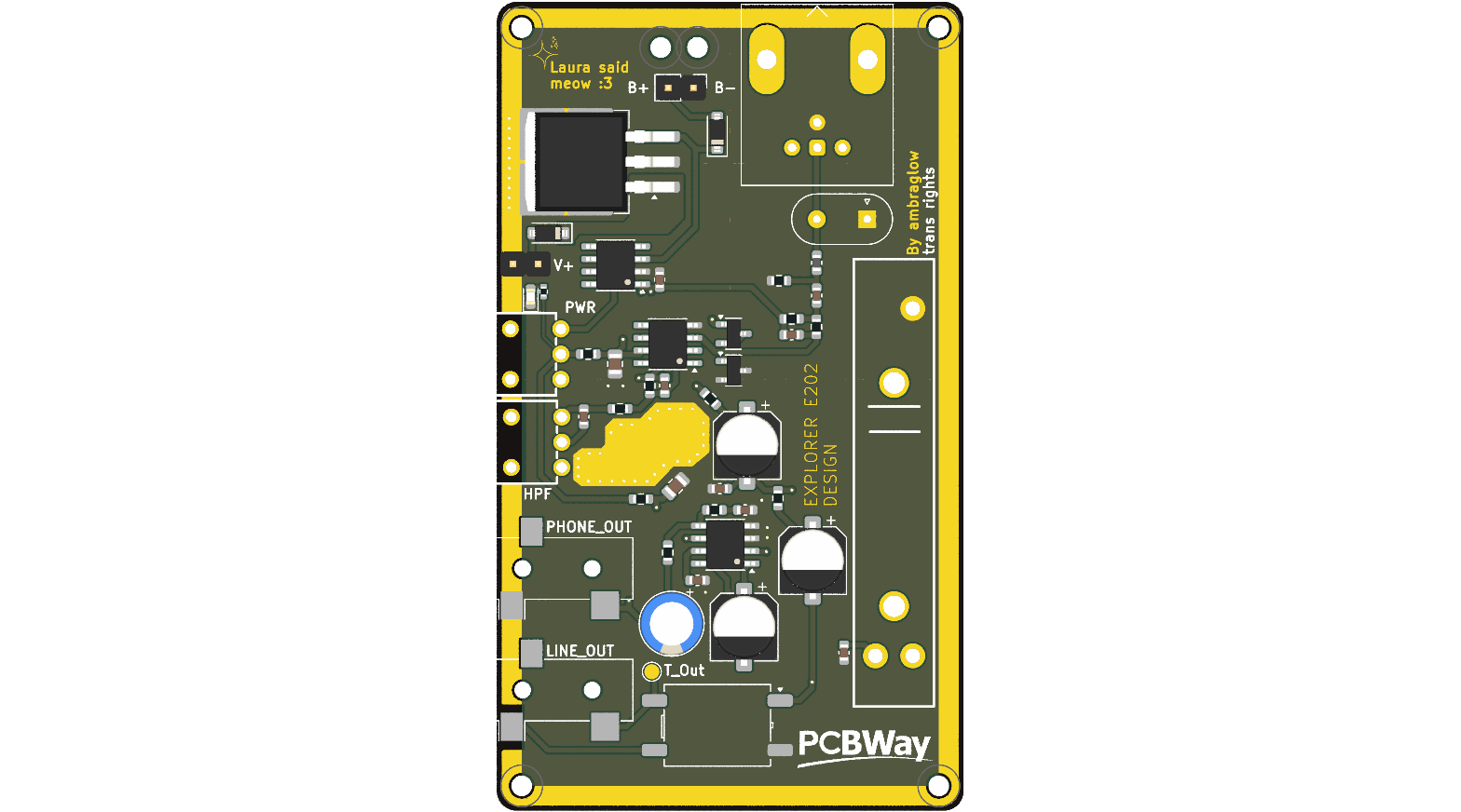
Today on June 16th i received a batch of boards, thanks to PCBWay for sponsoring this project! The ordering process is pretty straightforward, i used their Kicad plugin for exporting production files and uploading them to their system. Compared to their conpetitors, different soldermask colors don't add too much cost to production and look stunning, shipping times aren't too bad either, it took less than a week for the PCBs to arrive to Italy, it was an overall pleasant experience and their support is also really helpful as i had to ask for help with my order at some point, because of a different revision of my board. Here's some pictures of the boards, they really look stunning in yellow soldermask.


Functionally they should work, but that will be a problem for future me :D
Original schematic design by Renato | rendered PCB images, thanks to Lina's plugin
| Qty | Value | Footprint | References |
|---|---|---|---|
| 4 | MountingHole_Pad | MountingHole:MountingHole_2.1mm | H1, H2, H3, H4 |
| 4 | TestPoint | TestPoint:TestPoint_Pad_D2.5mm | TP1, TP2, TP4, TP5 |
| 3 | 10u | Capacitor_SMD:CP_Elec_6.3x4.5 | C7, C9, C12 |
| 2 | 100k | Resistor_SMD:R_0603_1608Metric | R4, R7 |
| 2 | 100u | Capacitor_SMD:C_0805_2012Metric | C2, C11 |
| 2 | 10M | Resistor_SMD:R_0603_1608Metric | R5, R6 |
| 2 | 1N4001 | Diode_SMD:D_SOD-123 | D1, D2 |
| 2 | 22n | Capacitor_SMD:C_0603_1608Metric | C10, C13 |
| 2 | 33 | Resistor_SMD:R_0603_1608Metric | R10, R12 |
| 2 | 4.7n | Capacitor_SMD:C_0603_1608Metric | C1, C8 |
| 2 | AudioJack3 | Connector_Audio:Jack_3.5mm_CUI_SJ-3523-SMT_Horizontal | J5, J6 |
| 2 | BC237 | Package_TO_SOT_SMD:SOT-23-3 | Q1, Q2 |
| 2 | LOGO | LOGO | G***, G*** |
| 1 | 10 | Resistor_SMD:R_0603_1608Metric | R11 |
| 1 | 100n | Capacitor_SMD:C_0603_1608Metric | C6 |
| 1 | 100u | Capacitor_THT:CP_Radial_D6.3mm_P2.50mm | C15 |
| 1 | 10k | Resistor_SMD:R_0603_1608Metric | R8 |
| 1 | 10k | project:RES-ADJ-TH_RS30111A602N | RV1 |
| 1 | 10n | Capacitor_SMD:C_0603_1608Metric | C14 |
| 1 | 150p | Capacitor_SMD:C_0603_1608Metric | C3 |
| 1 | 1k | Resistor_SMD:R_0603_1608Metric | R2 |
| 1 | 2.2k | Resistor_SMD:R_0402_1005Metric | R1 |
| 1 | 3.3k | Resistor_SMD:R_0603_1608Metric | R3 |
| 1 | 33n | Capacitor_SMD:C_0603_1608Metric | C4 |
| 1 | 3u | Inductor_SMD:L_0603_1608Metric | L1 |
| 1 | 4.7k | Resistor_SMD:R_0603_1608Metric | R9 |
| 1 | 8.2p | Capacitor_SMD:C_0603_1608Metric | C5 |
| 1 | 9V Battery | Connector_PinHeader_2.54mm:PinHeader_1x02_P2.54mm_Vertical | J2 |
| 1 | Conn_Coaxial | Connector_Coaxial:BNC_Win_364A2x95_Horizontal | J4 |
| 1 | External power supply 12V/18V | Connector_PinHeader_2.54mm:PinHeader_1x02_P2.54mm_Vertical | J1 |
| 1 | HPF | project:SW-TH_ST-0-102-C03-N003-RS | SW2 |
| 1 | L7809 | Package_TO_SOT_SMD:TO-263-3_TabPin2 | U3 |
| 1 | LED | LED_SMD:LED_0603_1608Metric | D3 |
| 1 | LM386 | Package_SO:SOIC-8-1EP_3.9x4.9mm_P1.27mm_EP2.29x3mm | U2 |
| 1 | Lamp_Neon | Valve:Valve_Glimm | NE1 |
| 1 | PWR | project:SW-TH_ST-0-102-C03-N003-RS | SW1 |
| 1 | TL081 | Package_SO:SOIC-8-1EP_3.9x4.9mm_P1.27mm_EP2.29x3mm | U1 |
| 1 | TLE2426xLP | Package_SO:SOIC-8-1EP_3.9x4.9mm_P1.27mm_EP2.29x3mm | U4 |
| 1 | TestPoint | TestPoint:TestPoint_Pad_D1.5mm | TP3 |
| 1 | Transformer_Audio | Transformer_SMD:Transformer_ED8_4-Lead_10.5x8mm_P5mm | T1 |
The 58 most common of 60 parts.


greenjacketgirl/SDR_Receiver
This project is an attempt at designing and building a Software Defined Radio receiver that has the capabilities of listening to frequencies ranging from 500kHz to 50MHz utlizing the board designed, a sound card, and…


DoESLiverpool/doorbot-setup
Scripts to install the software required to deploy the Raspberry Pi DoorBots
It measures 47 × 81.5 mm and has 2 copper layers, 1.6 mm thick.
60 parts, built around the LM386, TL081, L7809 and BC237. The full list of its parts is on this page, with links to each part's symbol and footprint where PCBKit's library has them.
From the ambraglow/VLF-receiver repository on GitHub, at the commit this page was made from: the board is exploere202.kicad_pcb and its schematic exploere202.kicad_sch. PCBKit opens the board in the browser, with nothing to install.
Its repository publishes it under the CERN-OHL-P-2.0 licence: you may reuse it on that licence's terms (keep the author's notice, and for a copyleft licence share your changes alike).