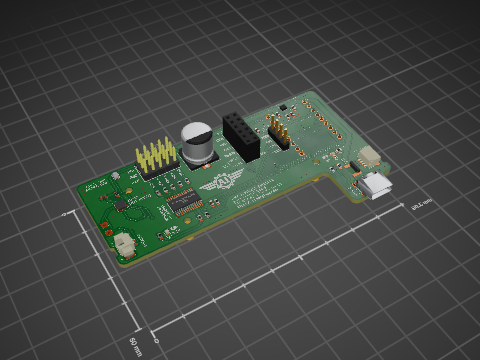
2 layers174 × 58 mm
Breakout 112pin Connector
rusefi/rusefi
rusefi - GPL internal combustion engine control unit
42 parts1.2k

 akreager/TDA74295S_Breakout
TDA7429 audio DSP IC breakout board
TDA7429 BREAKOUT is an open-source printed circuit board by akreager, from the akreager/TDA74295S_Breakout repository on GitHub. It is a 2-layer board of 49.8 × 49.5 mm with 42 parts on 56 nets, routed with 196 tracks and 2 vias.
Its parts include 29 capacitors, 5 resistors and 1 diode. It belongs with the interfaces and adapters and audio and music boards of this library.
Breakout board and Arduino library for the ST TDA7429 digitally controlled audio processor with surround sound matrix.
The TDA7429 is an I²C-controlled audio DSP designed for TV and Hi-Fi systems. It handles input selection, volume/tone control, surround sound processing, and speaker balance — all through a two-wire serial bus with no external microcontroller overhead beyond simple register writes.
Key specs:
├── pcb/
│   ├── TDA7429_BREAKOUT.kicad_pro      # KiCad project
│   ├── TDA7429_BREAKOUT.kicad_sch      # Schematic
│   ├── TDA7429_BREAKOUT.kicad_pcb      # PCB layout
│   ├── fp-lib-table                    # Footprint library table
│   ├── sym-lib-table                   # Symbol library table
│   ├── eagle2kicad_pcb.py              # Board conversion script
│   ├── eagle2kicad_sch.py              # Schematic conversion script
│   ├── TDA7429_KiCad_Lib/             # Custom KiCad library
│   │   ├── TDA7429.kicad_sym
│   │   └── TDA7429.pretty/
│   │       └── SDIP-42_W15.24mm_P1.778mm.kicad_mod
│   └── Archive Eagle Design/           # Original Eagle 6.5 files
│       ├── TDA7429_BREAKOUT.sch
│       ├── TDA7429_BREAKOUT.brd
│       └── TDA7429_BREAKOUT.pdf
├── TDA7429S TDA7429T.pdf               # Datasheet
├── .gitattributes
├── .gitignore
└── README.md~50 × 50 mm board carrying the TDA7429S (SDIP-42) with all external filter components from the datasheet reference circuit. Pin headers break out:
| Header | Pins |
|---|---|
| AUDIO_IN | 3 stereo input pairs (L/R × IN1–IN3) |
| AUDIO_OUT | L_OUT, R_OUT, AUXOUT_L, AUXOUT_R |
| MONITOR | MONITOR_L, MONITOR_R |
| DATA | SDA, SCL |
| POWER | +9V, GND |
| Breakout | Arduino Uno/Nano | Arduino Mega |
|---|---|---|
| SDA | A4 | 20 |
| SCL | A5 | 21 |
| GND | GND | GND |
The TDA7429 runs at 7–10.2 V — do not power it from the Arduino 5V pin. Use a separate 9V supply for the breakout board. The I²C bus needs pull-up resistors to the Arduino's 3.3V or 5V (4.7kΩ typical). The chip's I²C thresholds (V_IL max 1V, V_IH min 3V) are compatible with both 3.3V and 5V logic.
Copy the firmware/TDA7429/ folder into your Arduino libraries directory, or use the Arduino IDE Library Manager if published.
#include <Wire.h>
#include <TDA7429.h>

TDA7429 audio;

void setup() {
  Wire.begin();
  audio.begin();

  audio.selectInput(1);          // Input 1
  audio.setInputAttenuation(0);  // 0 dB (no attenuation)
  audio.setBass(0);              // Flat
  audio.setMiddle(0);            // Flat
  audio.setTreble(0);            // Flat
  audio.setSpeakerAttenuation(TDA7429_LEFT, -20);   // -20 dB
  audio.setSpeakerAttenuation(TDA7429_RIGHT, -20);  // -20 dB
  audio.setSurroundMode(TDA7429_SURROUND_OFF);
}

void loop() {
  // Adjust volume, tone, etc. from serial commands, buttons, encoder...
}| Method | Description |
|---|---|
begin() | Initialize with default (muted) state |
selectInput(1–4) | Choose stereo input pair |
setInputAttenuation(dB) | 0 to -31.5 dB in 0.5 dB steps |
setBass(dB) | -14 to +14 dB in 2 dB steps |
setMiddle(dB) | -14 to +14 dB in 2 dB steps |
setTreble(dB) | -14 to +14 dB in 2 dB steps |
setSpeakerAttenuation(ch, dB) | 0 to -79 dB per channel, 1 dB steps |
setAuxAttenuation(ch, dB) | 0 to -79 dB per channel, 1 dB steps |
setSurroundMode(mode) | OFF, MUSIC, MOVIE, SIMULATED |
setEffectControl(dB) | -6 to -21 dB surround effect level |
setPhaseShifters(...) | Configure 4 phase shift resistors |
mute() / unmute() | Mute/unmute all speaker outputs |
Hardware design files are released under CERN-OHL-P v2. Arduino library is released under the MIT License. See individual directories for details.
Board design by Allen Kreager. Originally designed in Eagle 6.5, converted to KiCad 7.
| Qty | Value | Footprint | References |
|---|---|---|---|
| 6 | 0.47uF | OPL Eagle Library:C0805 | C22, C23, C24, C25, C26, C27 |
| 6 | 100nF | OPL Eagle Library:C0805 | C4, C11, C12, C13, C14, C30 |
| 4 | 22nF | OPL Eagle Library:C0805 | C1, C2, C15, C17 |
| 3 | 2.2uF | OPL Eagle Library:C0805 | C8, C9, C10 |
| 3 | 5.6nF | OPL Eagle Library:C0805 | C6, C19, C20 |
| 2 | SparkFun-Connectors:1X02 | DATA, POWER | |
| 2 | 18nF | OPL Eagle Library:C0805 | C16, C18 |
| 2 | 2.7K | OPL Eagle Library:R0603 | R3, R4 |
| 2 | 5.6K | OPL Eagle Library:R0603 | R1, R2 |
| 1 | pinhead:2X02 | MONITOR | |
| 1 | pinhead:2X06 | AUDIO_IN | |
| 1 | pinhead:2X04 | AUDIO_OUT | |
| 1 | OPL Eagle Library:LED0603 | D1 | |
| 1 | 1.2nF | OPL Eagle Library:C0805 | C5 |
| 1 | 10uF | OPL Eagle Library:C0805 | C31 |
| 1 | 220 | OPL Eagle Library:R0603 | R5 |
| 1 | 22uF | OPL Eagle Library:C0805 | C21 |
| 1 | 4.7nF | OPL Eagle Library:C0805 | C3 |
| 1 | 680nF | OPL Eagle Library:C0805 | C7 |
| 1 | FRAME-LETTER | SparkFun-Aesthetics:CREATIVE_COMMONS | FRAME1 |
| 1 | TDA7429S_SURFACE | ATK_lib:SDIP42_SURFACE | TDA7429S |
rusefi/rusefi
rusefi - GPL internal combustion engine control unit


hackclub/sprig
🍃 Learn to code by making games in a JavaScript web-based game editor.
jamro/tiny-engineer
A small desktop robot that brings an AI coding assistant to life, physically acting out when it reads files, thinks, writes code, and finishes work.

hoglet67/RGBtoHDMI
Bare-metal Raspberry Pi project that provides pixel-perfect sampling of Retro Computer RGB/YUV video and conversion to HDMI

hackclub/OnBoard
💡 Join 1,000 teenagers and make your first PCB with a $100 grant!


It measures 49.8 × 49.5 mm and has 2 copper layers, 1.6 mm thick.
42 parts. The full list of its parts is on this page, with links to each part's symbol and footprint where PCBKit's library has them.
From the akreager/TDA74295S_Breakout repository on GitHub, at the commit this page was made from: the board is pcb/TDA7429_BREAKOUT.kicad_pcb and its schematic pcb/TDA7429_BREAKOUT.kicad_sch. PCBKit opens the board in the browser, with nothing to install.
Its repository states no licence, so its author keeps all rights: ask akreager before reusing the design.