2 layers171.2 × 72.9 mm
Amiga gfxcard old
mntmn/amiga2000-gfxcard
MNT VA2000, an Open Source Amiga 2/3/4000 Graphics Card (Zorro II/III), written in Verilog
34 parts1k

 AaronC81/delta-radix4
Programmer's calculator with customisable data types
Delta radix rev1 is an open-source printed circuit board by AaronC81, from the AaronC81/delta-radix repository on GitHub. It is a 2-layer board of 100.6 × 159 mm with 79 parts on 91 nets, routed with 425 tracks and 28 vias.
It is built around the TXB0108PW and 2N7002K. Its parts include 30 diodes, 30 switches, 2 resistors, 2 ICs and 1 transistor. It belongs with the RP2040 boards of this library.


The Delta Radix is a desktop calculator designed specifically to be useful for binary and hexadecimal calculations.
Notable features:
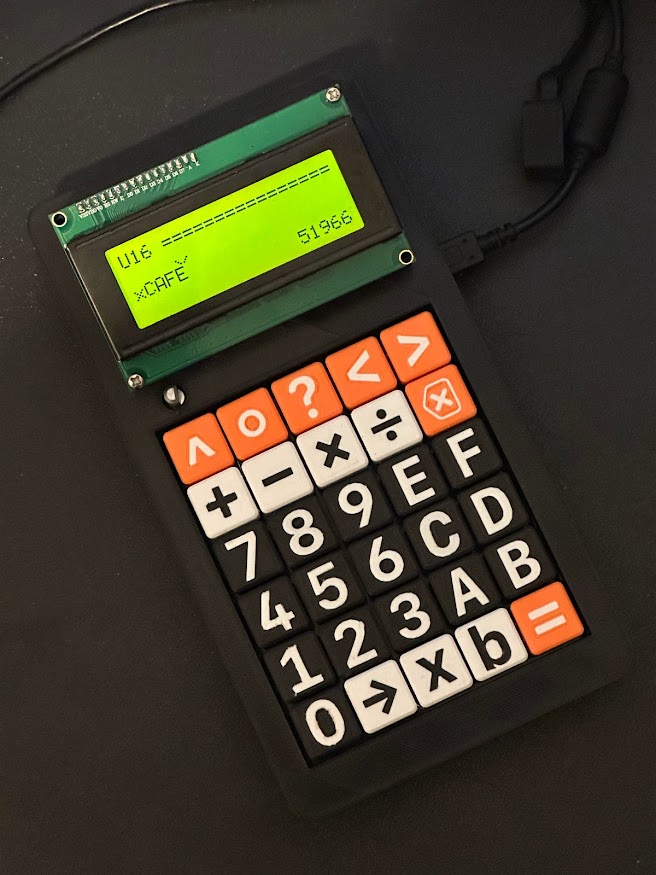
This repository is a Cargo workspace comprising a handful of crates. These are:
delta-radix-os - The user-facing calculator software, 100% hardware-agnosticdelta-radix-hal - Traits which the OS uses to interact with hardware (keypad, display, etc)delta-radix-hal-pico - Implementation of HAL traits for the Raspberry Pi Picodelta-radix-hal-sim - Implementation of HAL traits for a simulator which runs in the terminaldelta-radix-hal-web - Implementation of HAL traits for a browser-based simulator with WebAssembly
(build with wasm-pack build --target web, then visit index.html)flex-int - Arbitrary-precision arithmetic library used by the OSThe HAL implementations are the executable targets which should be flashed/run.
Elsewhere, you'll also find:
delta-radix-numworks - Implementation of HAL
traits for an app on the NumWorks graphing calculator.
hardware/ contains a KiCad schematic and PCB design.
cad/ contains a 3D-printable case which the PCB can be mounted into, and keycaps for the switches.
Note: Arithmetic parsing is incomplete! While they are implemented in the arithmetic library, there's no way to input operations other than addition yet.
Base specifiers can appear on either site of a number (xCAFE or CAFEx), whichever you prefer. A
number without a base specifier is always interpreted as a decimal.
To change the result base, press the Format Select (->) key and then the base you'd like. Press
the Format Select key twice to return to decimal.
To change the arithmetic data type, use the Menu key. Enter a number of bits, and use the +/-
keys to choose signed or unsigned respectively.
Shift > Menu shows a menu of meta options, such as entering the bootloader.
FlexInt::from_unsigned_decimal_string| Qty | Value | Footprint | References |
|---|---|---|---|
| 30 | D | Diode_SMD:D_SOD-123 | D1, D2, D10, D11, D12, D13, D14, D15, D16, D17, D18, D19, D20, D21, D22, D23 +14 |
| 30 | SW_Push | Button_Switch_Keyboard:SW_Cherry_MX_1.00u_PCB | SW1, SW2, SW10, SW11, SW12, SW13, SW14, SW15, SW16, SW17, SW18, SW19, SW20, SW21, SW22, SW23 +14 |
| 7 | SolderJumper_2_Open | Jumper:SolderJumper-2_P1.3mm_Open_RoundedPad1.0x1.5mm | JP2, JP3, JP4, JP5, JP6, JP7, JP8 |
| 1 | 10k | Resistor_SMD:R_0603_1608Metric_Pad0.98x0.95mm_HandSolder | R1 |
| 1 | 2N7002K | Package_TO_SOT_SMD:SOT-23_Handsoldering | Q1 |
| 1 | 330 | Resistor_SMD:R_0603_1608Metric_Pad0.98x0.95mm_HandSolder | R2 |
| 1 | Conn_01x16 | Connector_PinHeader_2.54mm:PinHeader_1x16_P2.54mm_Vertical | J1 |
| 1 | Pico | MCU_RaspberryPi_and_Boards:RPi_Pico_SMD_TH | U1 |
| 1 | R_Potentiometer | Potentiometer_THT:Potentiometer_Alpha_RD901F-40-00D_Single_Vertical_CircularHoles | RV1 |
| 1 | SolderJumper_2_Bridged | Jumper:SolderJumper-2_P1.3mm_Bridged_RoundedPad1.0x1.5mm | JP1 |
| 1 | TXB0108PW | Package_SO:TSSOP-20_4.4x6.5mm_P0.65mm | U2 |
The 75 most common of 79 parts.
It measures 100.6 × 159 mm and has 2 copper layers, 1.6 mm thick.
79 parts, built around the TXB0108PW and 2N7002K. The full list of its parts is on this page, with links to each part's symbol and footprint where PCBKit's library has them.
From the AaronC81/delta-radix repository on GitHub, at the commit this page was made from: the board is hardware/rev1/delta_radix_rev1/delta_radix_rev1.kicad_pcb and its schematic hardware/rev1/delta_radix_rev1/delta_radix_rev1.kicad_sch. PCBKit opens the board in the browser, with nothing to install.
Its repository states no licence, so its author keeps all rights: ask AaronC81 before reusing the design.
mntmn/amiga2000-gfxcard
MNT VA2000, an Open Source Amiga 2/3/4000 Graphics Card (Zorro II/III), written in Verilog

FPGAwars/icezum
:star2: IceZUM Alhambra: an Arduino-like Open FPGA electronic board

shilga/rp-gameboy-cartridge-hw
You should order with ENIG (electroless nickel immersion gold) plating. While the cartridge will work with HASL you will getter contact with ENIG and it is less prone to wearing down.


uinika/UINIO-Signal-Translator
A level signal converter based on TXB0108 and TXS0108.