4 layers84.5 × 129.5 mm
 WantClueTechnologies/BitForge-Nano15
This project presents a fully open-source Bitcoin mining hardware platform, designed for transparency, modularity, and extensibility.
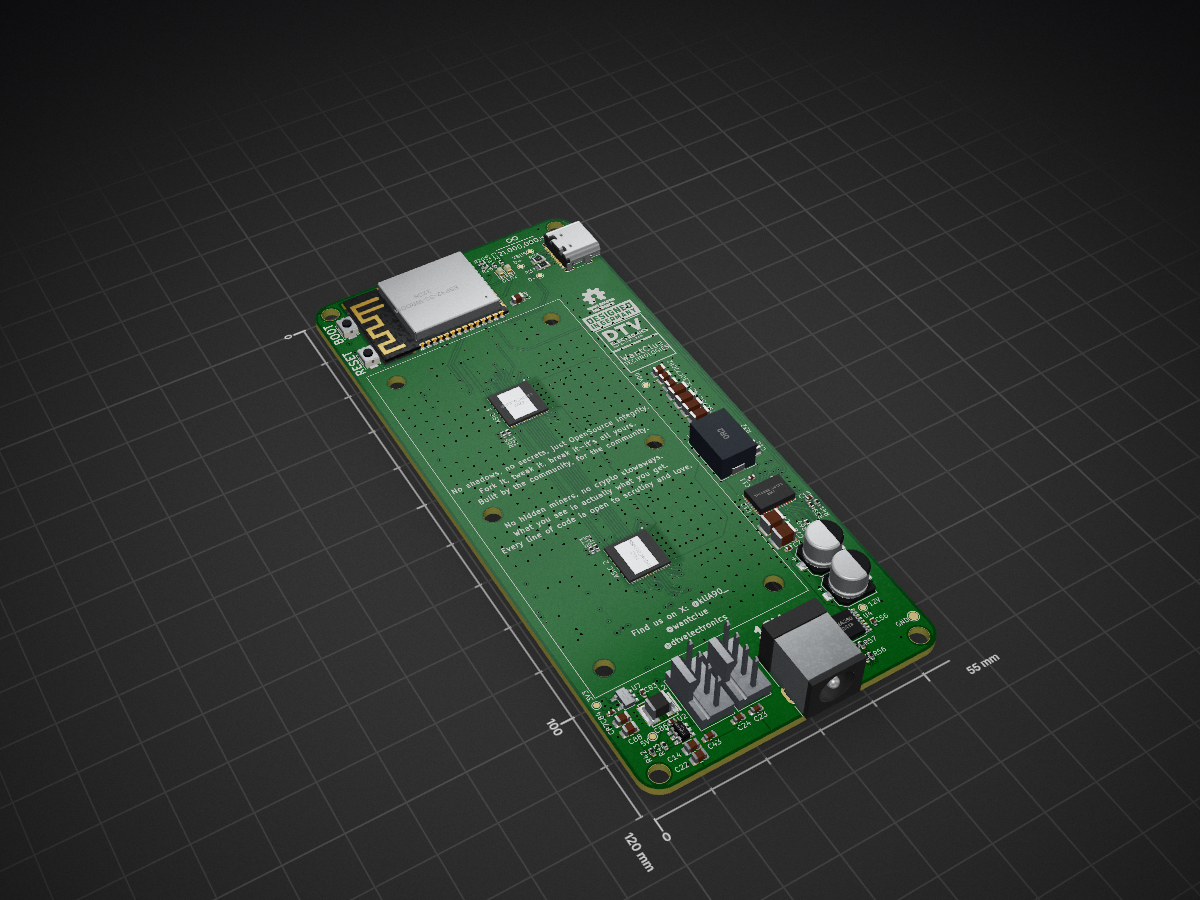
BitForge Nano is an open-source printed circuit board by WantClueTechnologies, from the WantClueTechnologies/BitForge-Nano repository on GitHub, published under the CERN-OHL-S-2.0 licence. It is a 6-layer board of 55 × 120 mm with 220 parts on 150 nets, routed with 1,157 tracks and 803 vias.
It is built around the ESP32-S3-WROOM-1-N8, LMR54410DBV and PCA9544APW, with the TPS546D24ARVFR, RT9080-33GJ5 and SN74AVC4T774PW among its other parts. Its parts include 100 capacitors, 62 resistors, 14 ICs, 4 connectors and 2 diodes. It belongs with the ESP32 boards of this library.



This project presents a fully open-source Bitcoin mining hardware platform, designed for transparency, modularity, and extensibility. Built around the BM1370 ASICs and powered by an ESP32-S3 microcontroller, this board offers a compact yet powerful solution for enthusiasts and developers interested in cryptocurrency mining hardware.
Released under the CERN OHL 2 S, all design files, firmware, and documentation are freely available for use, modification, and redistribution.
The board is powered via a 12 V barrel jack, with a recommended power supply of at least 70 W to ensure stable operation under full load. Power distribution is carefully managed through multiple buck converters:
A Texas Instruments INA260 is used to monitor the total current and voltage, providing accurate power consumption data for the entire board and its peripherals.
The core mining functionality is handled by two BM1370 ASICs, connected in parallel and powered by the regulated 1.2 V supply. These chips communicate via UART, with signal levels adjusted using a SN74AVC level shifter to ensure compatibility between the ESP32-S3 and the ASICs.
Each ASIC requires two reference voltages (1.2 V and 0.8 V), which are derived from the 3.3 V rail using dedicated regulators.
Each BM1370 ASIC includes an internal die temperature sensor, which is monitored by an EMC2101 temperature controller. These controllers also support PWM fan control, allowing each ASIC to drive a dedicated 12 V cooling fan.
Since the EMC2101 has a fixed I2C address, a PCA9544 I2C multiplexer is used to switch between the two devices, enabling independent monitoring and control.
At the heart of the board is an ESP32-S3, which runs the firmware responsible for:
A USB-C port is provided for firmware flashing and future updates, making development and deployment straightforward.
This project is proudly released under the CERN Open Hardware Licence Version 2 - Strongly Reciprocal (CERN-OHL-S). This means:
The CERN-OHL-S is specifically designed for open-source hardware, ensuring that designs remain open and accessible. We believe in open collaboration and transparency, and by releasing this project under CERN-OHL-S, we aim to foster innovation in the hardware mining community and provide a solid foundation for further development.
For the full license text, see the LICENSE file.
| Qty | Value | Footprint | References |
|---|---|---|---|
| 40 | 1uF | BitForgeNano:C_0402_1005Metric | C1, C15, C16, C18, C19, C26, C27, C28, C31, C32, C33, C34, C36, C37, C38, C39 +24 |
| 15 | 100uF | BitForgeNano:C_1206_3216Metric | C53, C73, C74, C75, C79, C80, C93, C94, C95, C96, C97, C98, C99, C100, C101 |
| 14 | 0 | BitForgeNano:R_0402_1005Metric | R6, R46, R47, R48, R49, R54, R55, R57, R58, R61, R62, R64, R65, R69 |
| 13 | 4k7 | BitForgeNano:R_0402_1005Metric | R25, R26, R56, R63, R78, R79, R80, R81, R82, R83, R84, R85, R86 |
| 13 | TestPoint | BitForgeNano:TestPoint_Pad_D1.0mm | TP1, TP2, TP3, TP5, TP6, TP7, TP8, TP9, TP10, TP11, TP13, TP14, TP15 |
| 8 | 0.1uF | BitForgeNano:C_0402_1005Metric | C8, C11, C46, C81, C86, C89, C90, C91 |
| 8 | 10k | BitForgeNano:R_0402_1005Metric | R17, R23, R31, R36, R44, R45, R68, R73 |
| 7 | 22uF | BitForgeNano:C_0805_2012Metric | C20, C25, C30, C77, C78, C82, C92 |
| 6 | 0.1uF | BitForgeNano:C_0805_2012Metric | C17, C29, C35, C48, C58, C59 |
| 6 | 10uF | BitForgeNano:C_0805_2012Metric | C2, C14, C22, C47, C87, C88 |
| 6 | MountingHole | BitForgeNano:MountingHole_3.2mm_M3_ISO14580 | H1, H2, H3, H4, H5, H6 |
| 5 | LOGO | BitForgeNano:LOGO | G***, G***, G***, G***, G*** |
| 4 | BitForgeNano: | , , , | |
| 3 | 100k | BitForgeNano:R_0402_1005Metric | R40, R52, R53 |
| 3 | 47uF | BitForgeNano:C_1210_3225Metric | C3, C4, C76 |
| 2 | 100uF | BitForgeNano:C_1210_3225Metric | C41, C64 |
| 2 | 10k Thermistor | BitForgeNano:R_0402_1005Metric | TH1, TH2 |
| 2 | 10uF | BitForgeNano:C_0603_1608Metric | C23, C24 |
| 2 | 180uF | BitForgeNano:CP_Elec_6.3x5.9 | C45, C85 |
| 2 | 1k | BitForgeNano:R_0402_1005Metric | R13, R33 |
| 2 | 22 | BitForgeNano:R_0805_2012Metric | R37, R38 |
| 2 | 470pF | BitForgeNano:C_0402_1005Metric | C21, C42 |
| 2 | 49.9 | BitForgeNano:R_0402_1005Metric | R39, R41 |
| 2 | 4k7 | BitForgeNano:R_0805_2012Metric | R50, R51 |
| 2 | 5.1k | BitForgeNano:R_0805_2012Metric | R28, R29 |
| 2 | 5.6k | BitForgeNano:R_0402_1005Metric | R18, R20 |
| 2 | 560 | BitForgeNano:R_0402_1005Metric | R14, R22 |
| 2 | BM1370_mode1 | BitForgeNano:BM1370 | U3, U9 |
| 2 | Conn_01x04 | BitForgeNano:470531000 | J6, J8 |
| 2 | EMC2101 | BitForgeNano:TSSOP-8_3x3mm_P0.65mm | U503, U504 |
| 2 | GT-TC029B-H025-L1N | BitForgeNano:SW_CS1213AGF260_CRS | SW1, SW2 |
| 2 | LED | BitForgeNano:LED_0603_1608Metric | D1, D2 |
| 2 | OPEN_HARDWARE | BitForgeNano:OSHW-Logo_5.7x6mm_SilkScreen | LOGO1, LOGO1 |
| 1 | 0.1uF | BitForgeNano:C_0603_1608Metric | C43 |
| 1 | 1 | BitForgeNano:R_1206_3216Metric | R32 |
| 1 | 10 | BitForgeNano:R_0402_1005Metric | R30 |
| 1 | 1000pF | BitForgeNano:C_0805_2012Metric | C12 |
| 1 | 100pF | BitForgeNano:C_0402_1005Metric | C13 |
| 1 | 10k | BitForgeNano:R_0805_2012Metric | R21 |
| 1 | 115k | BitForgeNano:R_0402_1005Metric | R42 |
| 1 | 13.3k | BitForgeNano:R_0402_1005Metric | R9 |
| 1 | 150nH | BitForgeNano:FP1007R3-R15-R | L1 |
| 1 | 1uF | BitForgeNano:C_0805_2012Metric | C49 |
| 1 | 21.5k | BitForgeNano:R_0402_1005Metric | R5 |
| 1 | 22.1k | BitForgeNano:R_0402_1005Metric | R43 |
| 1 | 2200pF | BitForgeNano:C_0402_1005Metric | C9 |
| 1 | 25MHz | BitForgeNano:O 25,0-JO32-B-1V3-1-T1-LF | U11 |
| 1 | 4.75k | BitForgeNano:R_0402_1005Metric | R8 |
| 1 | 4.7uF | BitForgeNano:C_0402_1005Metric | C10 |
| 1 | 4700pF | BitForgeNano:C_0402_1005Metric | C6 |
| 1 | 68.1k | BitForgeNano:R_0402_1005Metric | R10 |
| 1 | 8.2 uH | BitForgeNano:Inductor-74438357082 | L2 |
| 1 | 8.25k | BitForgeNano:R_0402_1005Metric | R1 |
| 1 | ESP32-S3-WROOM-1 | BitForgeNano:ESP32-S3-WROOM-1 | U8 |
| 1 | INA260 | BitForgeNano:TSSOP-16_4.4x5mm_P0.65mm | U4 |
| 1 | LMR54410 | BitForgeNano:SOT-23-6 | U2 |
| 1 | MCP1824T-0802E | BitForgeNano:SOT-23-5 | U6 |
| 1 | MCP1824T-1202E/OT | BitForgeNano:SOT-23-5 | U5 |
| 1 | PCA9544APW | BitForgeNano:TSSOP-20_4.4x6.5mm_P0.65mm | U502 |
| 1 | PJ-063AH | BitForgeNano:BarrelJack_CUI_PJ-063AH_Horizontal | J1 |
| 1 | RT9080-33GJ5 | BitForgeNano:RT9080-33GJ5 | U7 |
| 1 | SN74AVC4T774 | BitForgeNano:TSSOP-16_4.4x5mm_P0.65mm | U1 |
| 1 | TPS546D24ARVFR | BitForgeNano:LQFN40-CLIP | U12 |
| 1 | TestPoint | BitForgeNano:TestPoint_Pad_D1.5mm | TP28 |
| 1 | USB_C_Receptacle_USB2.0 | BitForgeNano:USB_C_Receptacle_GCT_USB4105-xx-A_16P_TopMnt_Horizontal | J5 |
| 1 | net-tie | BitForgeNano:NetTie-2_SMD_Pad0.5mm | T1 |

bitaxeorg/bitaxeGamma
Bitaxe based on the BM1370 from the S21 Pro


PrinceYadav78/My_custom_miner
Mines crypto runs python pck bitaxetool to use this

bitaxeorg/BitaxeGT
Bitaxe Gamma Turbo 2x BM1370 ASIC ESP32 powered Bitcoin miner

acha666/RP2040_ToolheadPCB_SB
A Toolhead PCB for VORON StealthBurner based on RP2040
It measures 55 × 120 mm and has 6 copper layers, 1.6 mm thick.
220 parts, built around the ESP32-S3-WROOM-1-N8, LMR54410DBV, PCA9544APW and TPS546D24ARVFR. The full list of its parts is on this page, with links to each part's symbol and footprint where PCBKit's library has them.
From the WantClueTechnologies/BitForge-Nano repository on GitHub, at the commit this page was made from: the board is KiCad/BitForgeNano/BitForgeNano.kicad_pcb and its schematic KiCad/BitForgeNano/BitForgeNano.kicad_sch. PCBKit opens the board in the browser, with nothing to install.
Its repository publishes it under the CERN-OHL-S-2.0 licence: you may reuse it on that licence's terms (keep the author's notice, and for a copyleft licence share your changes alike).