
2 layers327.9 × 139 mm
Coco2
baldengineer/bit-preserve
Project for capturing vintage, classic, aka old computer schematics in KiCad.
147 parts446

 VikramR3/Servo_Tester
NE555 servo tester with pot-controlled pulse width - KiCad 9, 2-layer, 38.2 x 31.8 mm
Servo Tester is an open-source printed circuit board by VikramR3, from the VikramR3/Servo_Tester repository on GitHub, published under the MIT licence. It is a 2-layer board of 38.3 × 31.8 mm with 10 parts on 8 nets, routed with 44 tracks and 0 vias.
It is built around the NE555P. Its parts include 3 resistors, 2 diodes, 2 connectors, 1 capacitor and 1 IC. It belongs with the robots and motor control boards of this library.
A 2-layer PCB that exercises an RC servo without a microcontroller: an NE555 astable generates the servo pulse train, and a 100 kΩ potentiometer sweeps the pulse width to drive the horn across its full travel. Designed in KiCad 9.
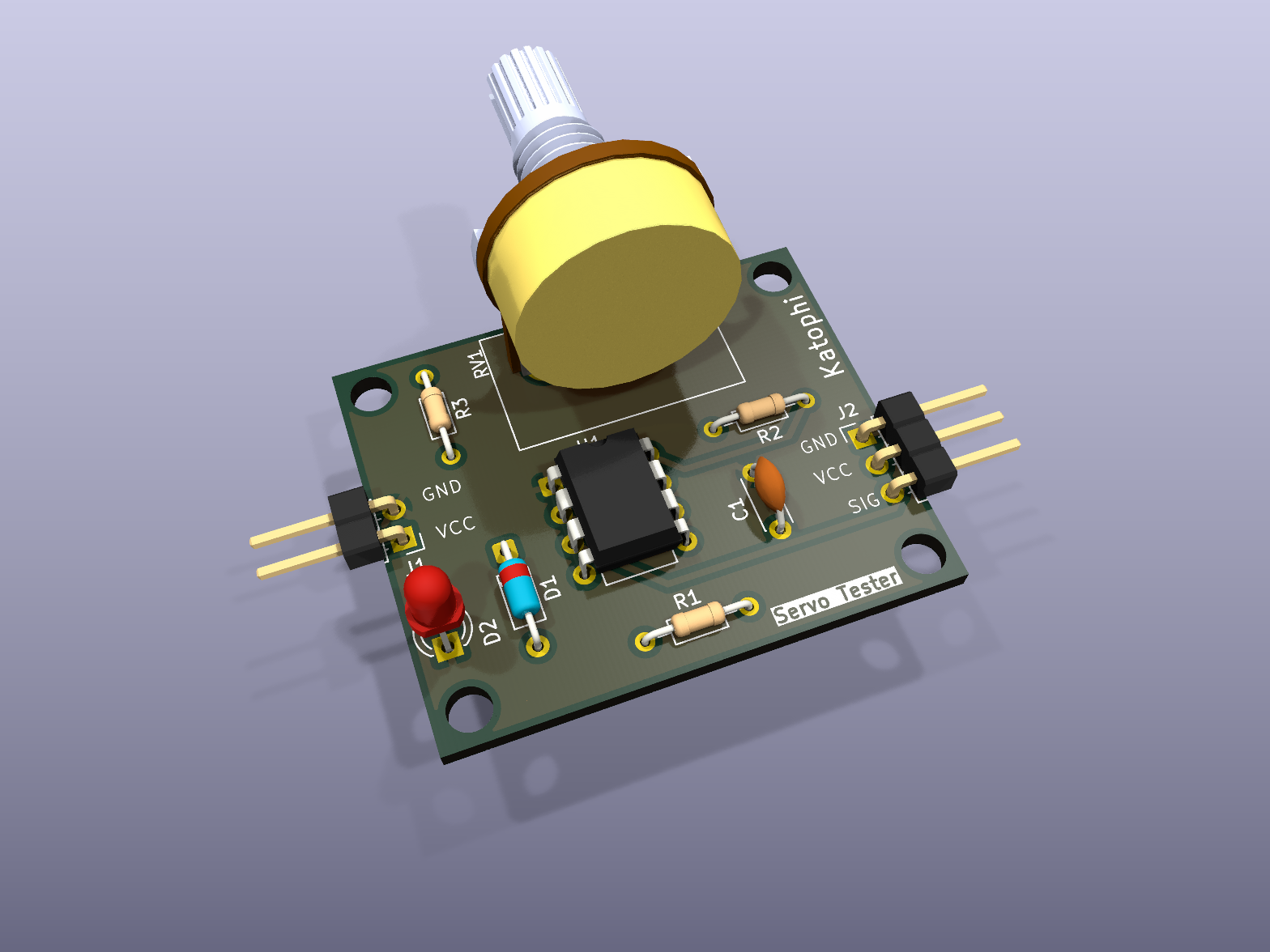
| Qty | Value | Footprint | References |
|---|---|---|---|
| 1 | 100k | Potentiometer_THT:Potentiometer_Alps_RK163_Single_Horizontal | RV1 |
| 1 | 1N4148 | Diode_THT:D_DO-35_SOD27_P7.62mm_Horizontal | D1 |
| 1 | 1k | Resistor_THT:R_Axial_DIN0204_L3.6mm_D1.6mm_P7.62mm_Horizontal | R3 |
| 1 | 22nF | Capacitor_THT:C_Disc_D4.3mm_W1.9mm_P5.00mm | C1 |
| 1 | 3.3M | Resistor_THT:R_Axial_DIN0204_L3.6mm_D1.6mm_P7.62mm_Horizontal | R1 |
| 1 | 56k | Resistor_THT:R_Axial_DIN0204_L3.6mm_D1.6mm_P7.62mm_Horizontal | R2 |
| 1 | Conn_01x02_Pin | Connector_PinHeader_2.54mm:PinHeader_1x02_P2.54mm_Horizontal | J1 |
| 1 | Conn_01x03_Pin | Connector_PinHeader_2.54mm:PinHeader_1x03_P2.54mm_Horizontal | J2 |
| 1 | LED | LED_THT:LED_D3.0mm | D2 |
| 1 | NE555P | Package_DIP:DIP-8_W7.62mm | U1 |
baldengineer/bit-preserve
Project for capturing vintage, classic, aka old computer schematics in KiCad.

The-Invent0r/8-bit-Computer-PCB
These are the KiCAD files for my 8-Bit Computer.

DarcyJProjects/touchtone555
An open-source DIY, NE555-based analogue synthesizer - play notes with a stylus


benjiaomodular/SynthCard
I designed this project with the help of PCBWay. You can get a copy of these cards through the PCBWay Shared Projects page.

fortinsylvain/MyCpu
Home brew CPU Hardware with 1-bit ALU implementation using 74LSxx, a micro-code and assembler coded in C#.

hackup/C128Diag
Replica of the Commodore C128 Diagnostic Test cartridge Assy No. 325093-01.
It measures 38.3 × 31.8 mm and has 2 copper layers, 1.6 mm thick.
10 parts, built around the NE555P. The full list of its parts is on this page, with links to each part's symbol and footprint where PCBKit's library has them.
From the VikramR3/Servo_Tester repository on GitHub, at the commit this page was made from: the board is Servo_Tester.kicad_pcb and its schematic Servo_Tester.kicad_sch. PCBKit opens the board in the browser, with nothing to install.
Its repository publishes it under the MIT licence: you may reuse it on that licence's terms (keep the author's notice, and for a copyleft licence share your changes alike).