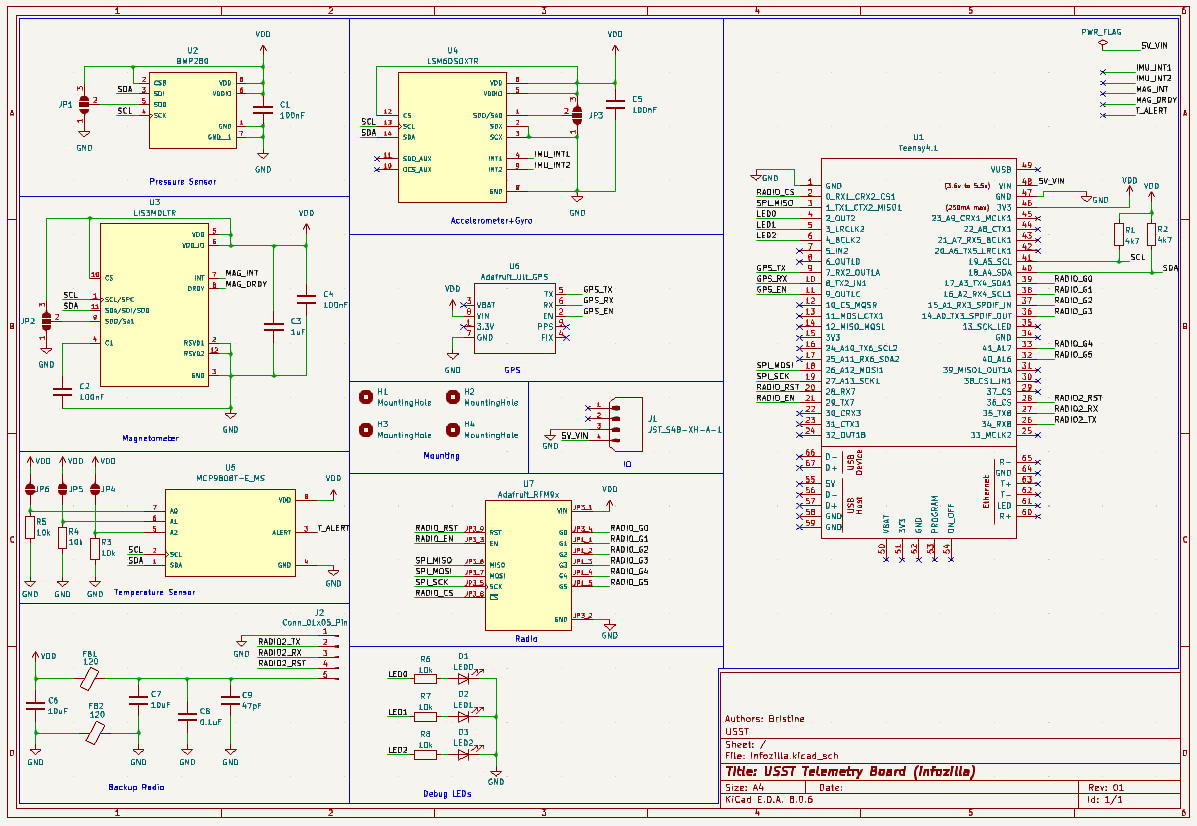
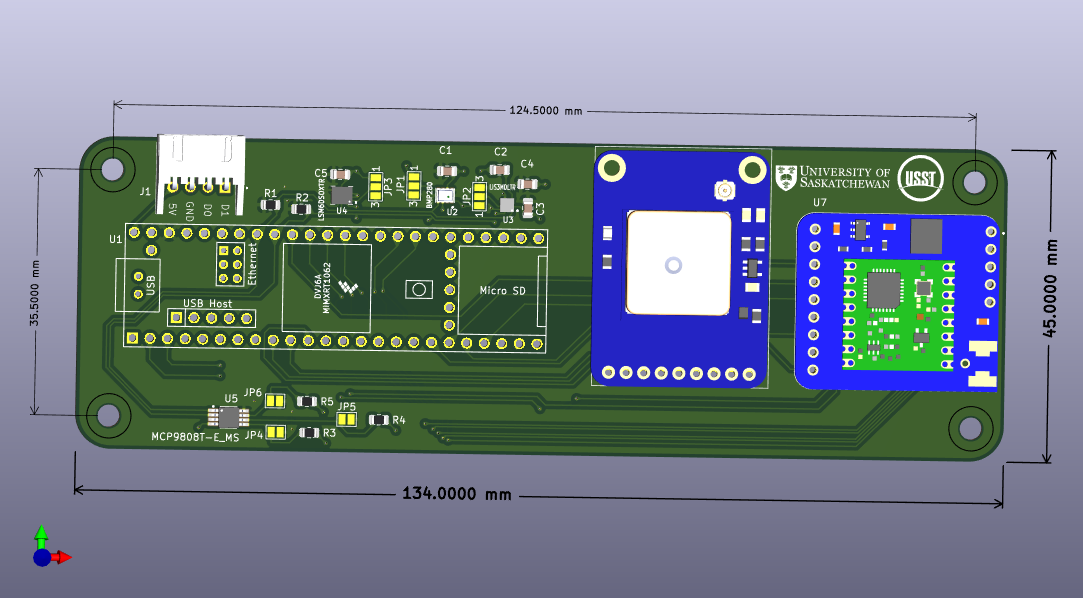
2 layers134 × 45 mm

 USSTRocketry/hardware1
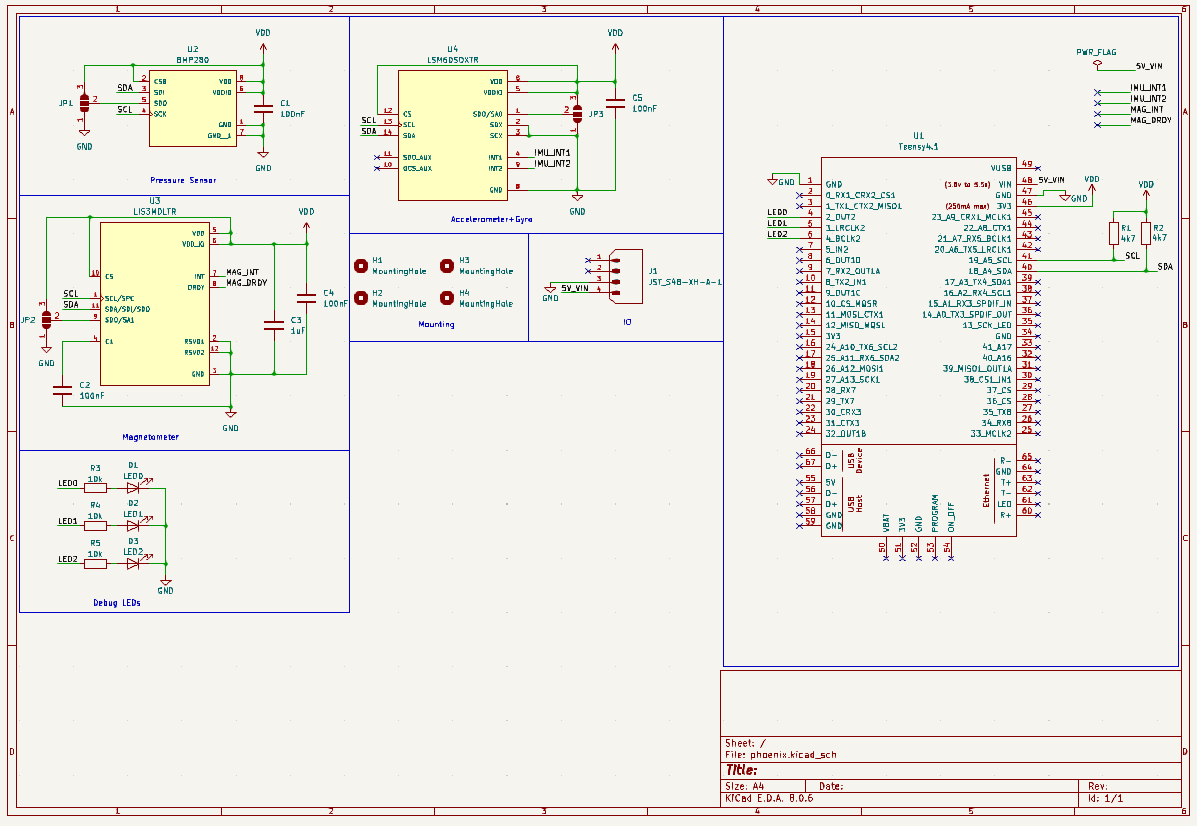
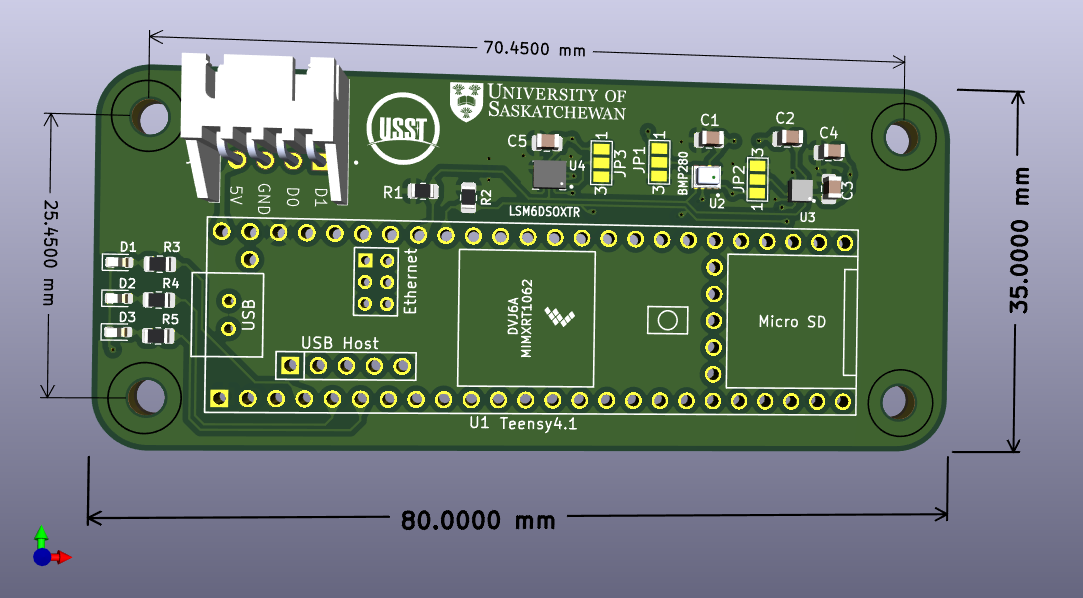
Phoenix is an open-source printed circuit board by USSTRocketry, from the USSTRocketry/hardware repository on GitHub, published under the MIT licence. It is a 2-layer board of 80 × 35 mm with 29 parts on 81 nets, routed with 179 tracks and 23 vias.
It is built around the TEENSY 4.1 and BMP280. Its parts include 5 capacitors, 5 resistors, 4 ICs, 3 diodes and 1 connector. It belongs with the NXP (LPC, Kinetis, i.MX RT) boards of this library.


USST Rocketry Avionics hardware
Telemetry board (Infozilla)
SRAD flight computer board (Phoenix)
| Qty | Value | Footprint | References |
|---|---|---|---|
| 4 | 100nF | Capacitor_SMD:C_0805_2012Metric | C1, C2, C4, C5 |
| 4 | MountingHole | MountingHole:MountingHole_3.2mm_M3 | H1, H2, H3, H4 |
| 3 | 10k | Resistor_SMD:R_0805_2012Metric | R3, R4, R5 |
| 3 | SolderJumper_3_Open | Jumper:SolderJumper-3_P1.3mm_Open_Pad1.0x1.5mm_NumberLabels | JP1, JP2, JP3 |
| 2 | 4k7 | Resistor_SMD:R_0805_2012Metric | R1, R2 |
| 1 | 1uF | Capacitor_SMD:C_0805_2012Metric | C3 |
| 1 | BMP280 | custom_library:BMP280 | U2 |
| 1 | JST_S4B-XH-A-1 | custom_library:JST_S4B-XH-A-1 | J1 |
| 1 | LED0 | LED_SMD:LED_0603_1608Metric | D1 |
| 1 | LED1 | LED_SMD:LED_0603_1608Metric | D2 |
| 1 | LED2 | LED_SMD:LED_0603_1608Metric | D3 |
| 1 | LIS3MDLTR | custom_library:LIS3MDLTR | U3 |
| 1 | LOGO | USST_logo:USST_logo_Small | G*** |
| 1 | LOGO | USST_logo:usask_logo_15x3.4_silkscreen | G*** |
| 1 | LOGO | custom_library:rocket_avionics_logo | G*** |
| 1 | LOGO | custom_library:phoenix_logo | P** |
| 1 | LSM6DSOXTR | custom_library:LSM6DSOXTR | U4 |
| 1 | Teensy4.1 | custom_library:Teensy41 | U1 |

RedNicStone/CosmicWatch-ventidue
The following modules have been written so far: - Custom rendering pipeline - OLED driver [Needs push to support DMA] - On-chip coincidence detection - Example for testing peripherals


pms67/LittleBrain-STM32F4-Sensorboard
STM32F4-based PCB interfacing with a variety of sensors.

aeonSolutions/AeonLabs-AI-Volvo-MKII-Open-Hardware
Volvo MKII Open Hardware


phonght32/OpenDrone_HW_AIO_FC_F405
OpenDrone Project - AIO Brushless FC F405.

TheNoobInventor/pi-pico-drone
A micro drone is made using the Raspberry Pi Pico W. It is fitted with the MPU6050 IMU module and BMP280 barometric sensor. The drone will be controlled using TinyMPC and employ a Micro-ROS client on FreeRTOS.
It measures 80 × 35 mm and has 2 copper layers, 1.6 mm thick.
29 parts, built around the TEENSY 4.1 and BMP280. The full list of its parts is on this page, with links to each part's symbol and footprint where PCBKit's library has them.
From the USSTRocketry/hardware repository on GitHub, at the commit this page was made from: the board is phoenix/phoenix.kicad_pcb and its schematic houston/houston.kicad_sch. PCBKit opens the board in the browser, with nothing to install.
Its repository publishes it under the MIT licence: you may reuse it on that licence's terms (keep the author's notice, and for a copyleft licence share your changes alike).
