2 layers28.5 × 53.6 mm

 ThatGuyCodes605/TGC-Core-ULTRA32-v1
My fastest and best devboard I ever made
TGC Core ULTRA32-v1 is an open-source printed circuit board by ThatGuyCodes605, from the ThatGuyCodes605/TGC-Core-ULTRA32-v1 repository on GitHub, published under the GPL-3.0 licence. It is a 4-layer board of 38.8 × 63 mm with 32 parts on 70 nets, routed with 546 tracks and 57 vias.
It is built around the ESP32-WROOM-32, AMS1117-3.3 and LESD5D5.0CT1G, with the SS8050-G and BAT760-7 among its other parts. Its parts include 10 resistors, 7 capacitors, 5 diodes, 3 connectors and 2 ICs. It belongs with the microcontroller boards boards and the ESP32 boards of this library.


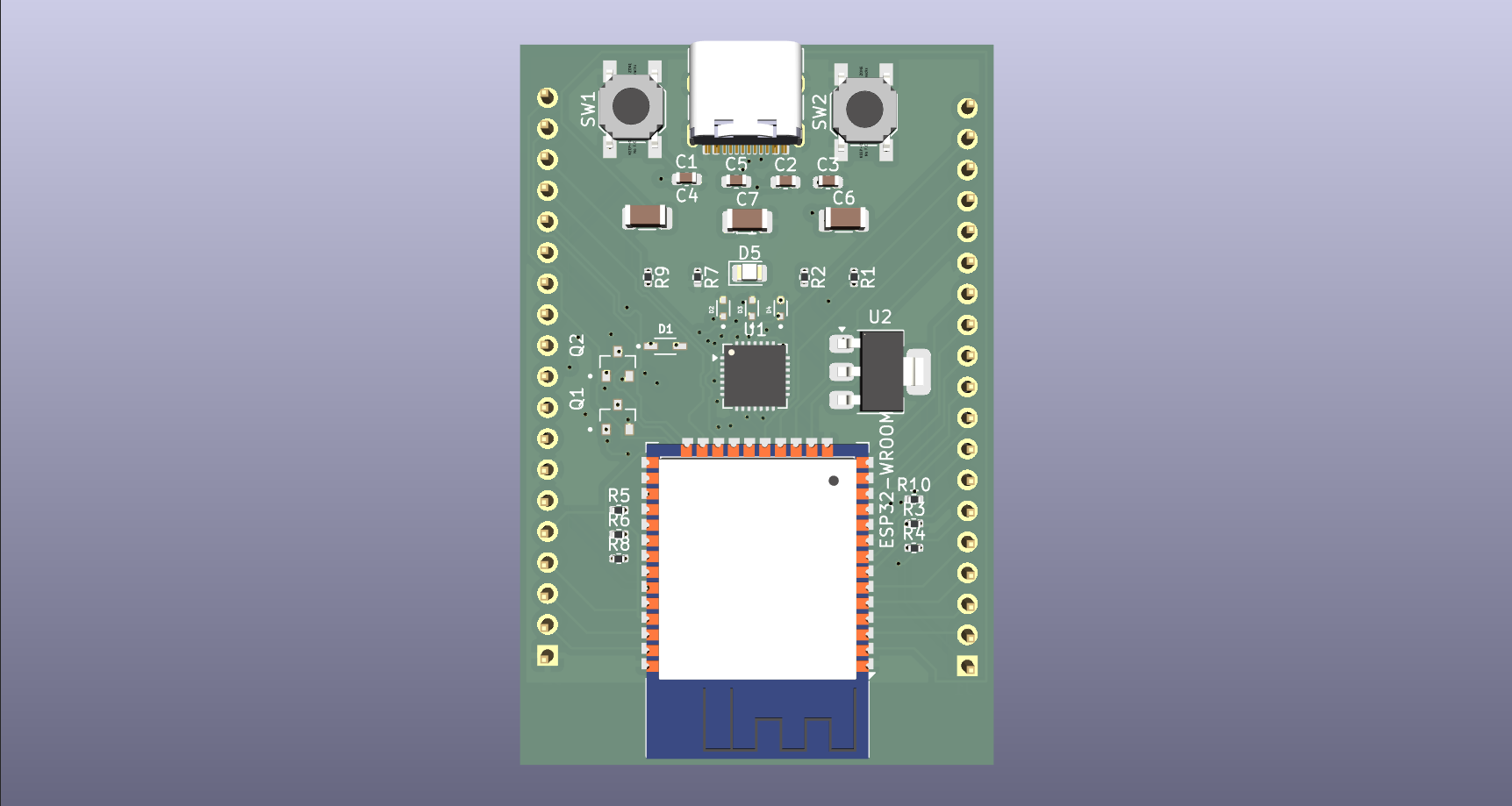
The TGC-Core-ULTRA32-v1 is an open-source, high-performance hardware development core board based on the ESP32 platform. Engineered for wireless application prototyping and IoT deployment, [...]
This repository contains the complete set of KiCad EDA files (version 10.0) necessary to view, modify, or manufacture the printed circuit board (PCB).
Conn_01x19).The project is entirely self-contained within the following native KiCad design files:
| File Name | Description |
|---|---|
TGC-Core-ULTRA32-v1.kicad_pro | The main KiCad Project file. Open this file to initialize the system workspace. |
TGC-Core-ULTRA32-v1.kicad_sch | The Schematic file. Outlines the logical connections between the ESP32, CP2102N bridge, and power stages. |
TGC-Core-ULTRA32-v1.kicad_pcb | The PCB Layout file. Houses the physical 4-layer trace configurations, via sizing, and physical board outlines. |
image_3c0a04.png | A visual reference render of the completed board layout. |
To view or modify the hardware design layout:
TGC-Core-ULTRA32-v1.kicad_pro file.Because this core board uses standard ESP32-WROOM-32 pinouts and a CP2102N UART controller, it functions natively inside the ESP32 firmware environment:
This hardware design and its accompanying documentation are licensed under the GNU General Public License v3.0 (GPL-3.0-or-later).
Summary of your rights under GPLv3:
For the full legal text, see the GNU licenses page: https://www.gnu.org/licenses/gpl-3.0.html
Note: To make the change complete, consider adding a LICENSE file containing the full GPLv3 text and an explicit copyright line (for example: "Copyright (c) 2026 ThatGuyCodes605"). I can add that file for you if you want.
| Qty | Value | Footprint | References |
|---|---|---|---|
| 4 | 0.1uF | Capacitor_SMD:C_0603_1608Metric | C1, C2, C3, C5 |
| 4 | 10k | Resistor_SMD:R_0402_1005Metric | R1, R2, R9, R10 |
| 3 | 22uF | Capacitor_SMD:C_1206_3216Metric | C4, C6, C7 |
| 3 | LESD5D5.0CT1G | custom:TVS_LESD5D5.0CT1G | D2, D3, D4 |
| 2 | 0R | Resistor_SMD:R_0402_1005Metric | R5, R6 |
| 2 | 2k | Resistor_SMD:R_0402_1005Metric | R4, R8 |
| 2 | Conn_01x19 | Connector_PinHeader_2.54mm:PinHeader_1x19_P2.54mm_Vertical | J1, J2 |
| 2 | SS8050-G | custom:TRANS_SS8050-G | Q1, Q2 |
| 2 | SW_Push | Button_Switch_SMD:SW_SPST_SKQG_WithoutStem | SW1, SW2 |
| 1 | 22.1k | Resistor_SMD:R_0402_1005Metric | R3 |
| 1 | 5.1k | Resistor_SMD:R_0402_1005Metric | R7 |
| 1 | AMS1117-3.3 | Package_TO_SOT_SMD:SOT-223-3_TabPin2 | U2 |
| 1 | BAT760-7 | custom:SOD2513X120N | D1 |
| 1 | CP2102N-Axx-xQFN28 | Package_DFN_QFN:QFN-28-1EP_5x5mm_P0.5mm_EP3.35x3.35mm | U1 |
| 1 | ESP32-WROOM-32 | RF_Module:ESP32-WROOM-32 | ESP32-WROOM-32 |
| 1 | LED | LED_SMD:LED_0805_2012Metric | D5 |
| 1 | USB_C_Plug_USB2.0 | Connector_USB:USB_C_Receptacle_HRO_TYPE-C-31-M-12 | P1 |

daguilar43/proyectoEmbebidos
Aquí pueden encontrarse todos los archivos del proyecto Amiplanta realizado para la materia Sistemas Embebidos durante el semestre 2022-2 en la Universidad Nacional de Colombia.


valeriyproklov/ESP32-devboard
An ESP32 devboard I designed in KiCad.


koopero/Plato
PlatoA1 is a regular triangle, made of light and plastic, with a dimension of about an inch. This subassembly is meant as an experiment in:


It measures 38.8 × 63 mm and has 4 copper layers, 1.6 mm thick.
32 parts, built around the ESP32-WROOM-32, AMS1117-3.3, LESD5D5.0CT1G and SS8050-G. The full list of its parts is on this page, with links to each part's symbol and footprint where PCBKit's library has them.
From the ThatGuyCodes605/TGC-Core-ULTRA32-v1 repository on GitHub, at the commit this page was made from: the board is TGC-Core-ULTRA32-v1.kicad_pcb and its schematic TGC-Core-ULTRA32-v1.kicad_sch. PCBKit opens the board in the browser, with nothing to install.
Its repository publishes it under the GPL-3.0 licence: you may reuse it on that licence's terms (keep the author's notice, and for a copyleft licence share your changes alike).