4 layers
Hush main
Terryzhao-dev/Hush
Bluetooth dictation mic in an aluminium cup that keeps people nearby from hearing you (ESP32, KiCad, CadQuery)
57 parts
 Terryzhao-dev/Hush
Bluetooth dictation mic in an aluminium cup that keeps people nearby from hearing you (ESP32, KiCad, CadQuery)
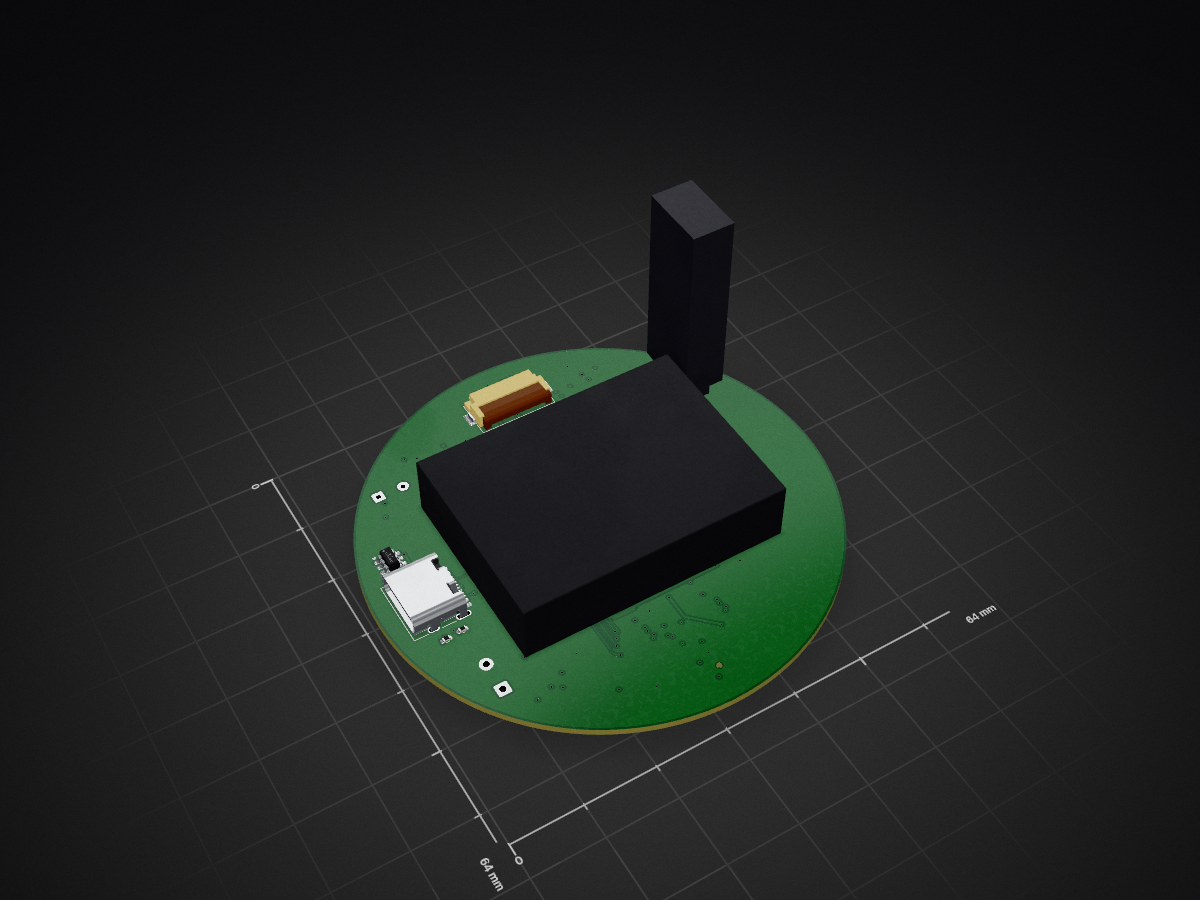
Hush main is an open-source printed circuit board by Terryzhao-dev, from the Terryzhao-dev/Hush repository on GitHub. It is a 4-layer board with 108 parts on 264 nets, routed with 1,384 tracks and 209 vias.
It is built around the MDBT53-U1M, TPS63020DSJR and APS6404L-3SQR-SN, with the XC6206P332MR, BQ51050BRHLR and IM69D130 among its other parts. Its parts include 41 capacitors, 29 resistors, 13 ICs, 7 connectors and 4 transistors. It belongs with the radio and wireless boards and the ESP32 boards of this library.


A dictation mic you hold up to your mouth, built so the people around you can't hear what you're saying. It's an aluminium cup with a sealed acoustic chamber inside. It connects as a normal Bluetooth mic for Wispr Flow or any dictation app, and holds push-to-talk while it's against your face. There are no buttons or ports; it charges on a Qi puck.
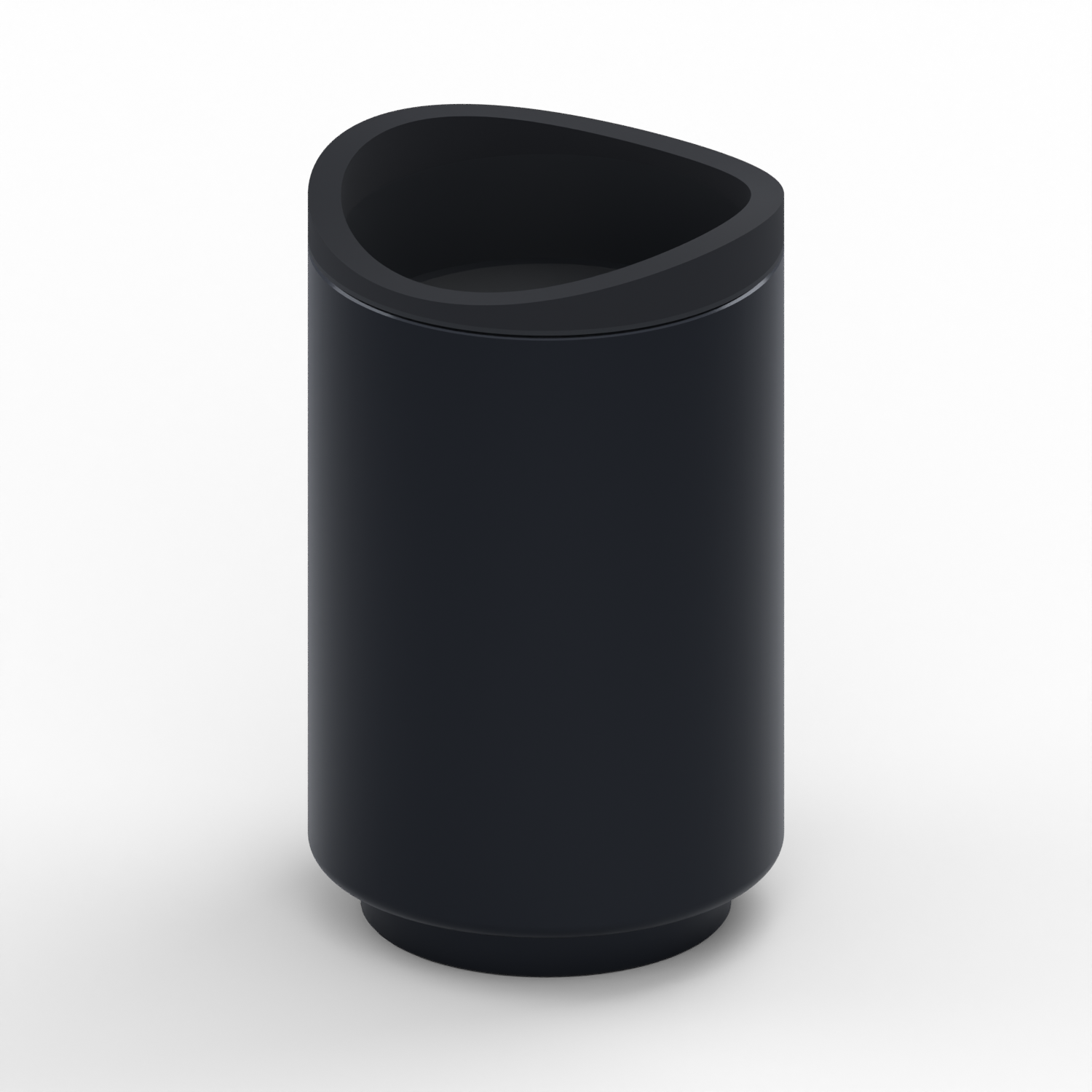
Dictation is faster than typing, but not something you can do in a library or an open office. Hush is my attempt at fixing that with hardware.
Status: design stage, nothing built yet. The exterior CAD is done, the charging puck PCB passes ERC and DRC and is ready to order, and the main board is about 95% routed. Next is printing the acoustic test rig to see if the privacy target holds up.
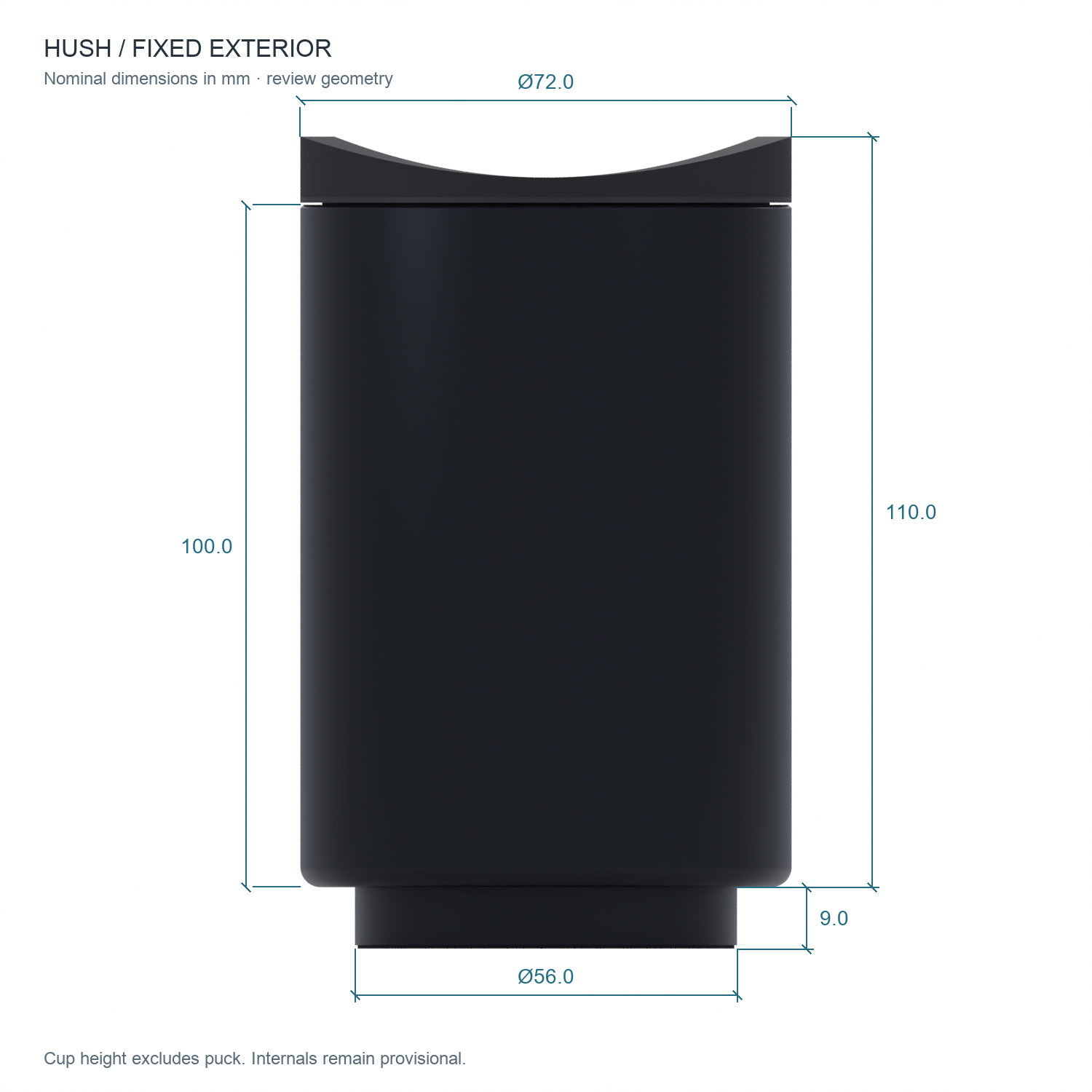
| Size | Ø72 x 110 mm, under 200 g |
| Body | Anodised aluminium (CNC), 3D-printed for the prototype |
| Privacy target | Normal speech at least 20 dB quieter at 1 m |
| Audio | Bluetooth HFP with mSBC (16 kHz), so it works as a mic on Mac, Windows, iPhone and Android |
| Push-to-talk | Bluetooth HID, holds Mouse5 while the cup is lifted and on your face |
| Chip | ESP32-WROOM-32UE |
| Sensors | 2x ICS-43434 mics, FDC1004 capacitive face sensing, LIS2DH12 accelerometer |
| Power | 1,900 mAh cell, BQ51050B Qi receiver, TPS63020 buck-boost, LC709203F fuel gauge |
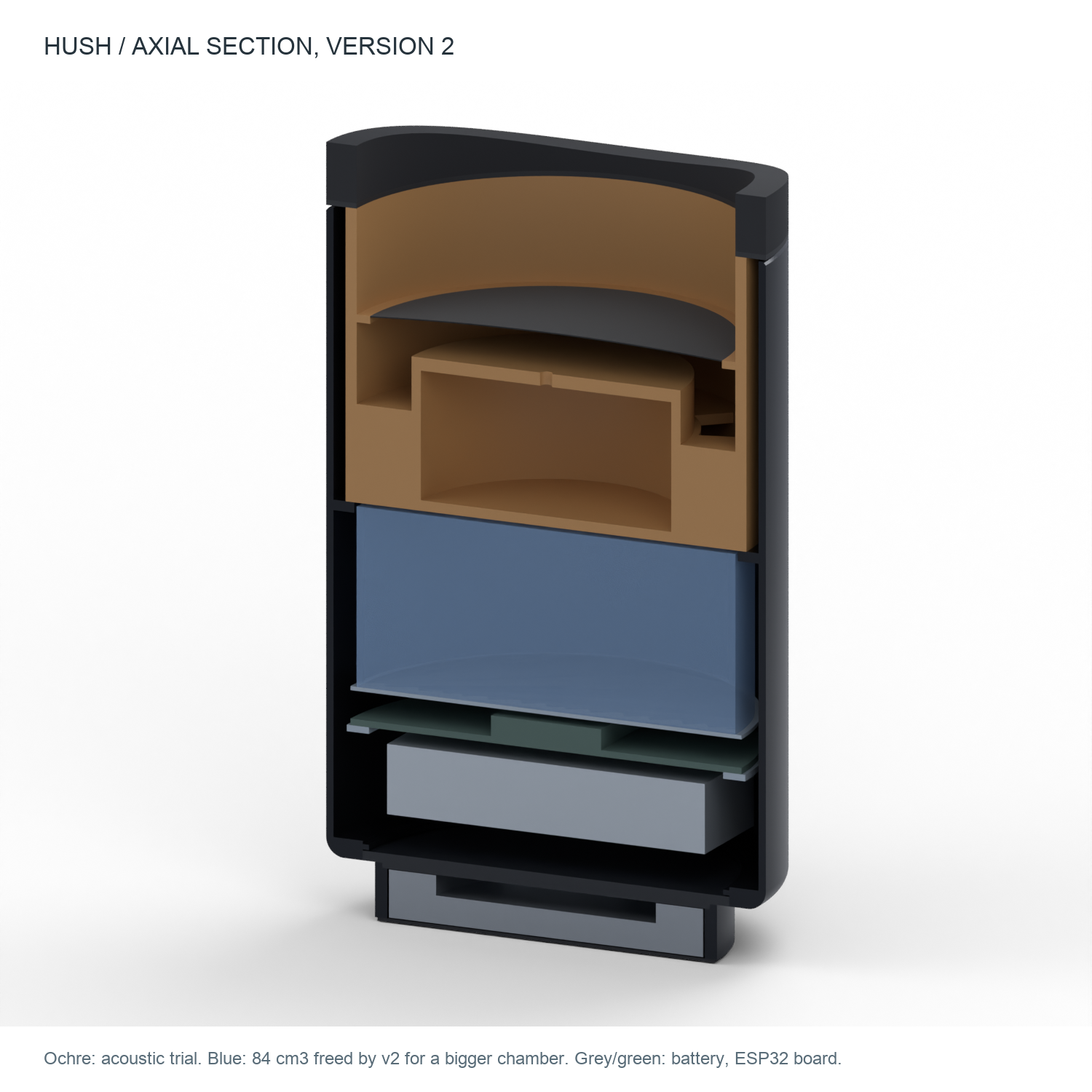
Once sound is out in the room, software can't take it back, so the privacy has to be physical. A silicone cushion seals around the mouth (even a 1% leak would cap privacy at 20 dB). Behind a fabric dome there's absorber material, plus Helmholtz resonators tuned to 300 to 3,000 Hz, where foam is weakest and most of what makes speech intelligible sits. Breath escapes through a long lined labyrinth, and the aluminium wall reflects the rest back inside. The mic sits about 2 cm from your lips, so it still gets a clean signal.
The KiCad schematics and layouts are generated from Python (design.py in each board folder), so every connection can be reviewed as code. One script runs the schematic, ERC, placement, the Freerouting autorouter and DRC, then writes Gerbers, the BOM and renders for JLCPCB.
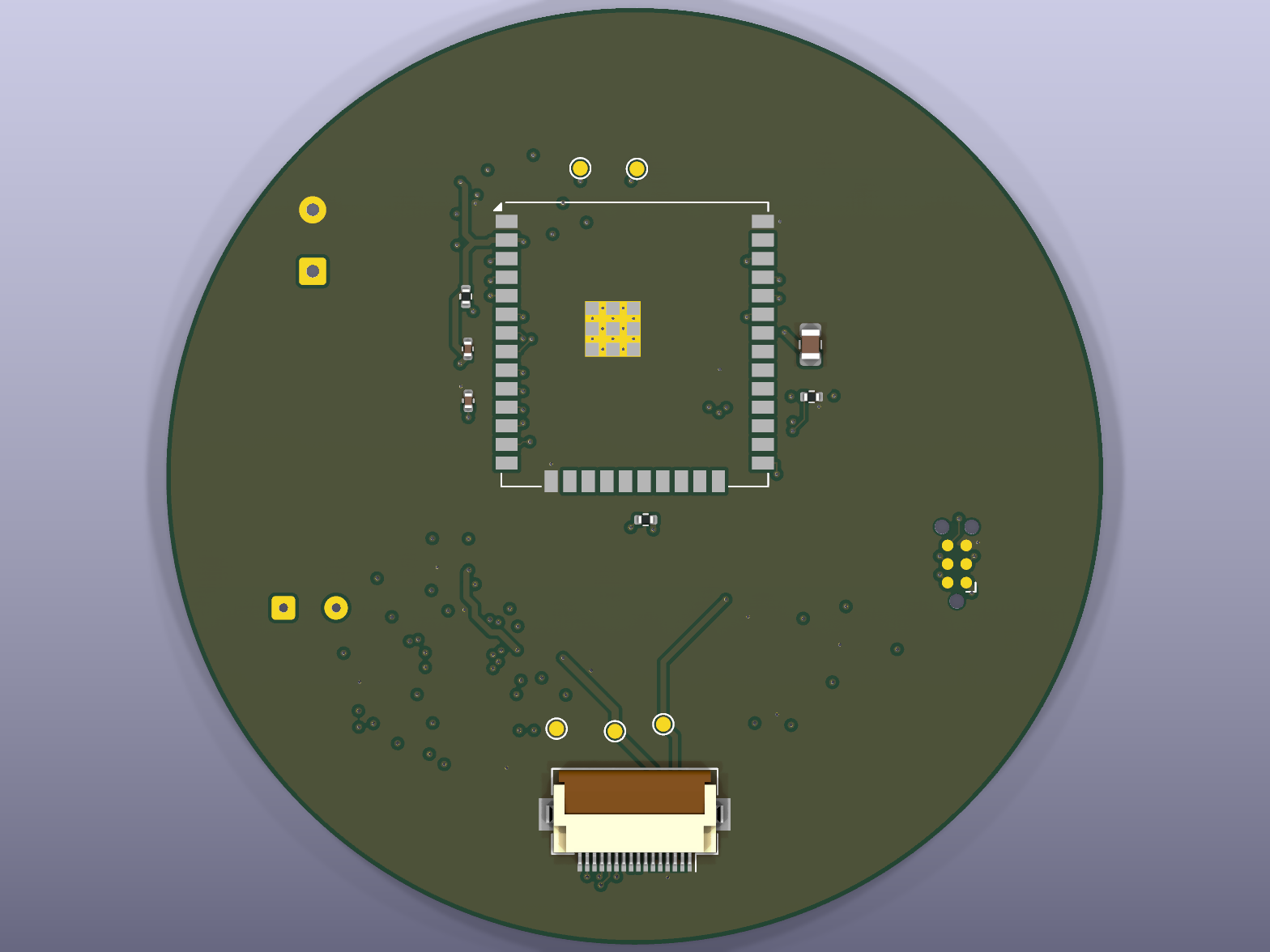
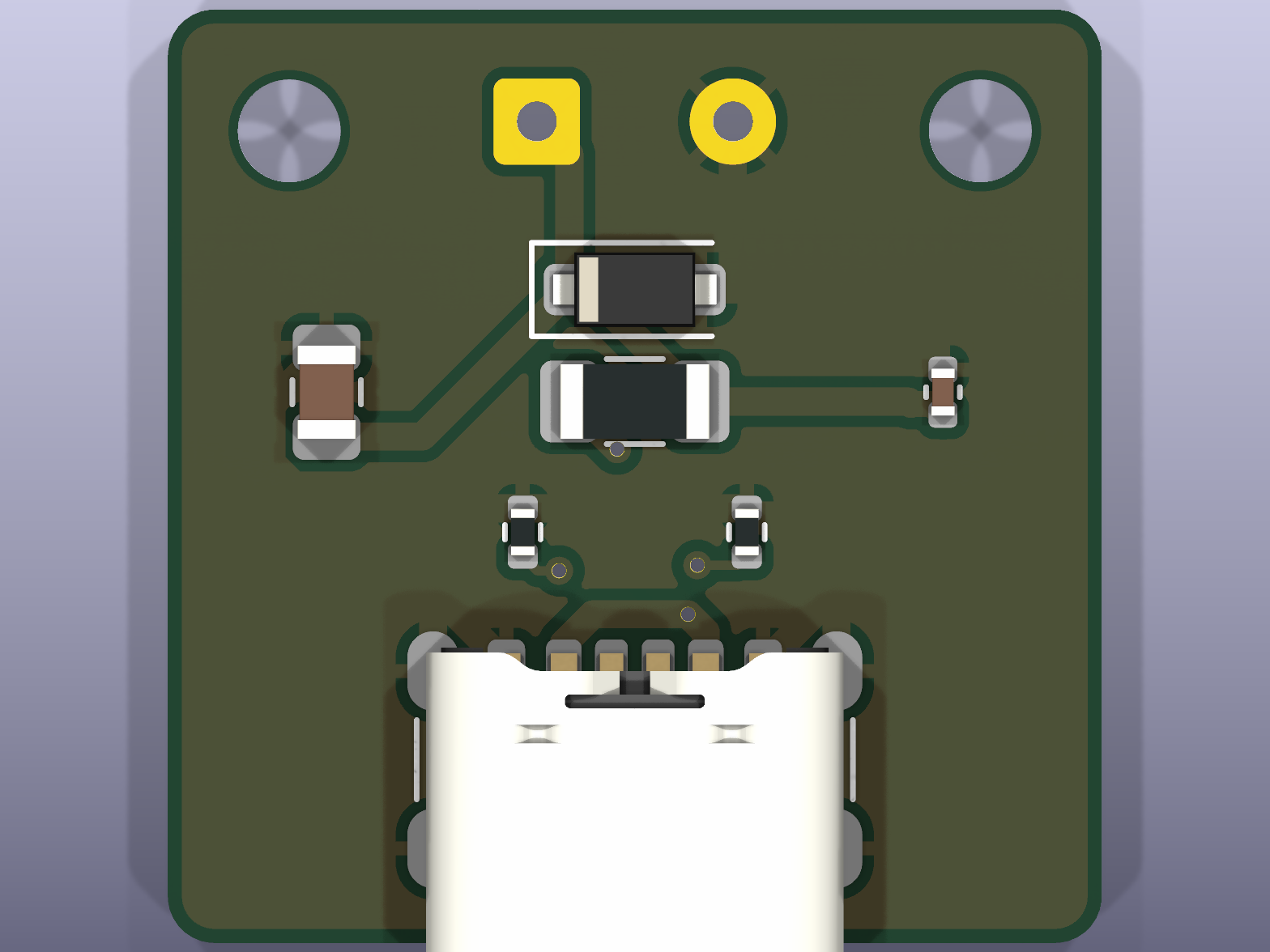
pcb/hush_puck: USB-C to a 5 V Qi transmitter. 20 x 20 mm, 2 layers. Done.pcb/hush_main: ESP32, Qi charging, fuel gauge, accelerometer and buck-boost. Ø64 mm, 4 layers, 57 parts. About 95% routed.pcb/hush_ring: light ring, face sensing and the two mics. Schematic only; the layout waits on the acoustic insert.
Parametric CadQuery scripts in cad/source build the cup and a separate test rig with no electronics in it; renders are done in Blender. They output STEP files for CNC, STL for printing and an 11-part print kit for the acoustic test (docs/acoustic-test.md).
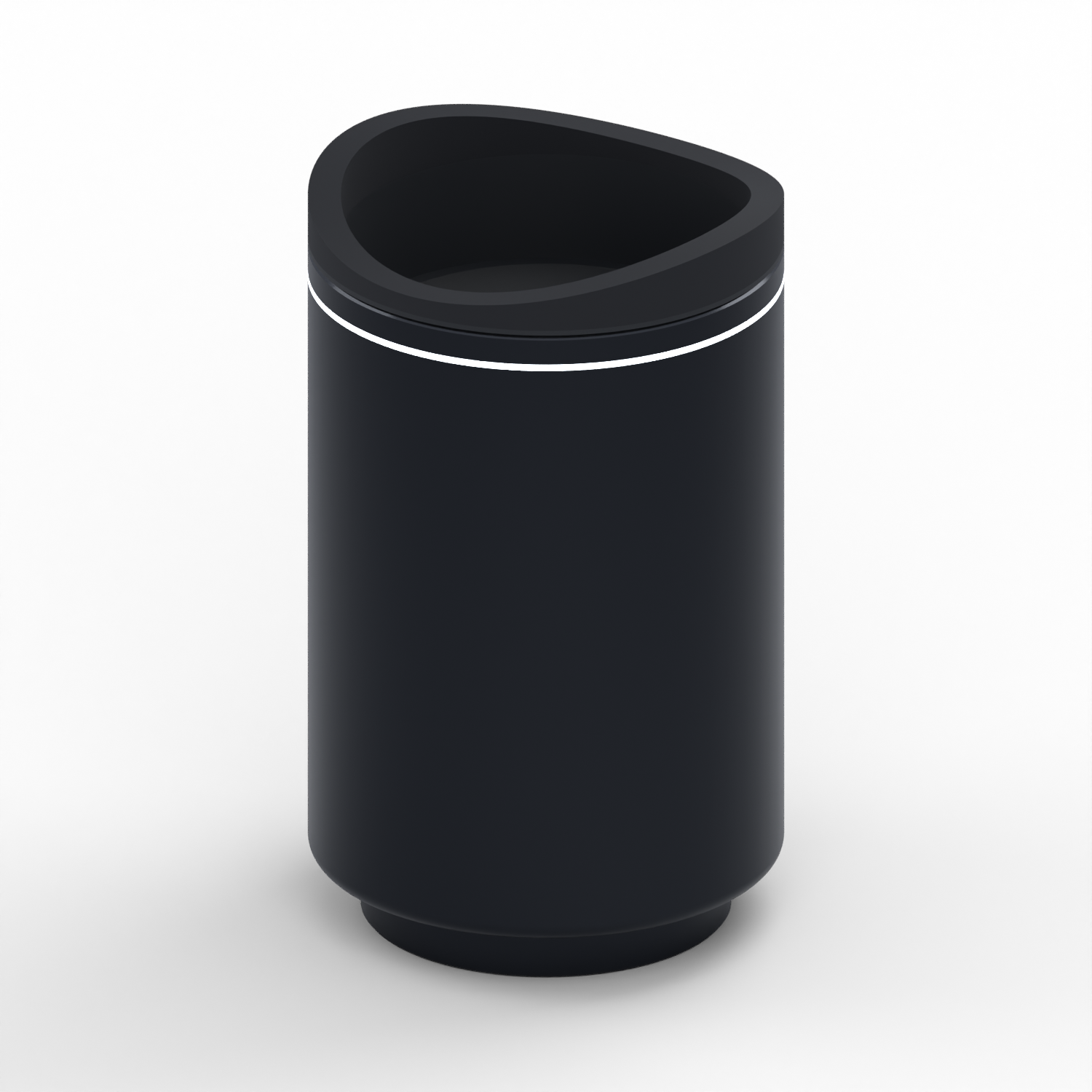
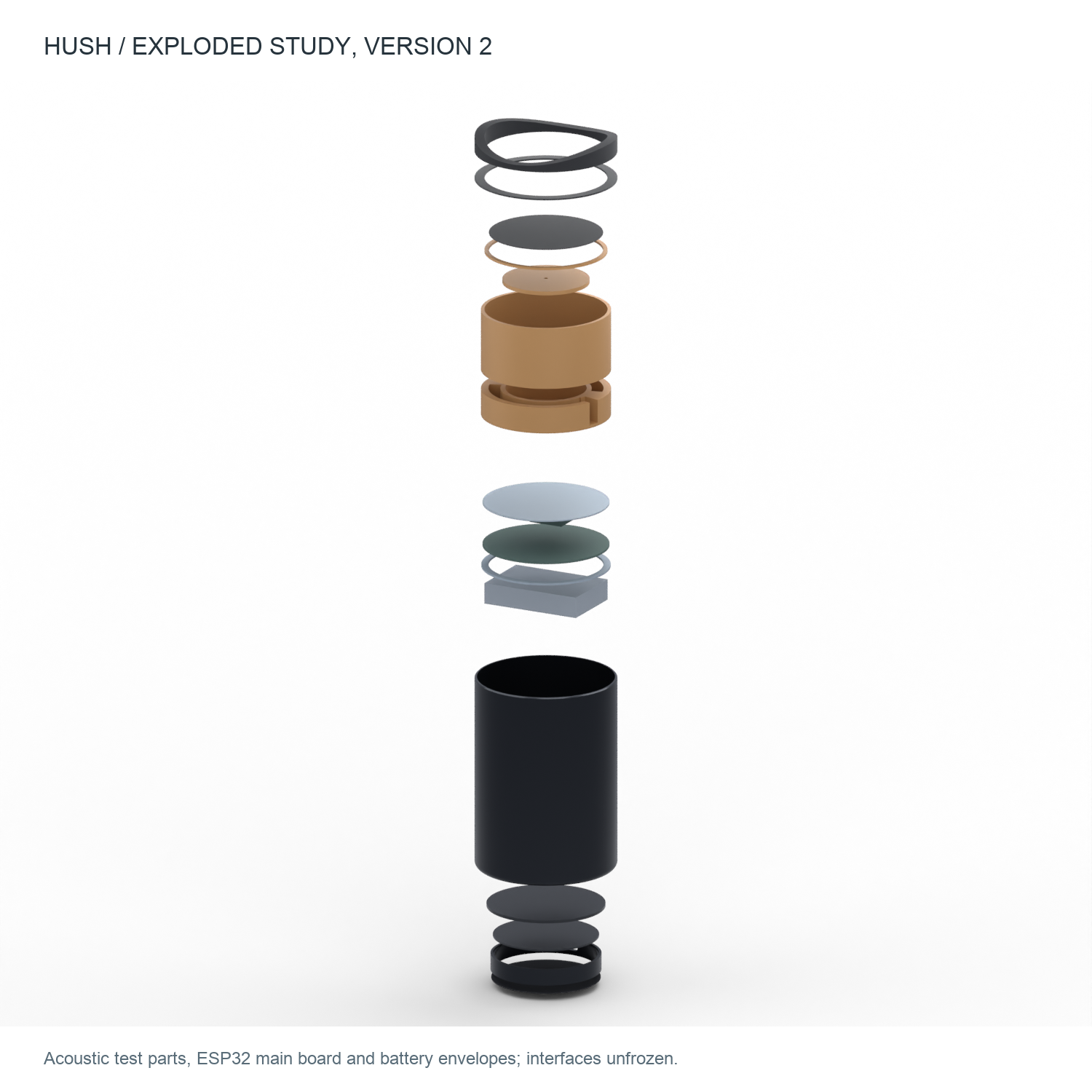
The first version ran speech-to-text (Moonshine) on an i.MX 8M Plus inside the cup and typed the result as a Bluetooth keyboard. When I worked out the power and heat (docs/architecture.md), it would sit at or above 43 °C against your face, last under two hours and weigh over 200 g. So v2 is just a mic, and the computer does the transcription. That also freed about 84 cm³ for a bigger acoustic chamber. The v1 board and CAD are in pcb/archive and cad/source/archive_v1, and firmware/bench is the speech model benchmark I wrote for it.
docs/decisions.md: every design decision and change, in orderdocs/architecture.md: power, thermal and mass calculationsdocs/research/: supplier, antenna and sourcing notesASTRA.md: the original design brief| Qty | Value | Footprint | References |
|---|---|---|---|
| 13 | 100k | Resistor_SMD:R_0402_1005Metric | R5, R7, R17, R18, R19, R20, R21, R22, R23, R24, R25, R26, R29 |
| 13 | 100nF | Capacitor_SMD:C_0402_1005Metric | C15, C16, C20, C23, C24, C25, C26, C29, C32, C34, C35, C36, C37 |
| 7 | 10k | Resistor_SMD:R_0402_1005Metric | R6, R10, R11, R12, R13, R14, R15 |
| 7 | 1uF | Capacitor_SMD:C_0402_1005Metric | C14, C17, C18, C21, C22, C40, C41 |
| 6 | 10uF 25V | Capacitor_SMD:C_0805_2012Metric | C11, C12, C27, C28, C38, C39 |
| 4 | 2N7002 | Package_TO_SOT_SMD:SOT-23 | Q1, Q2, Q3, Q4 |
| 2 | 10k B3380 | Resistor_SMD:R_0402_1005Metric | NTC1, NTC2 |
| 2 | 10nF | Capacitor_SMD:C_0402_1005Metric | C5, C6 |
| 2 | 10uH | Inductor_SMD:L_0603_1608Metric | L1, L2 |
| 2 | 22nF 50V | Capacitor_SMD:C_0402_1005Metric | C7, C8 |
| 2 | 22uF 25V | Capacitor_SMD:C_0805_2012Metric | C30, C31 |
| 2 | 4.7k | Resistor_SMD:R_0402_1005Metric | R8, R9 |
| 2 | 470nF 25V | Capacitor_SMD:C_0603_1608Metric | C9, C10 |
| 2 | 5.1k | Resistor_SMD:R_0402_1005Metric | R27, R28 |
| 2 | APS6404L-3SQR-SN | Package_SO:SOIC-8_3.9x4.9mm_P1.27mm | U5, U6 |
| 2 | TXB0104PWR | Package_SO:TSSOP-14_4.4x5mm_P0.65mm | U10, U11 |
| 2 | XC6206P332MR | Package_TO_SOT_SMD:SOT-23-3 | U3, U13 |
| 1 | 1.5uH Isat>=4.5A | Inductor_SMD:L_Abracon_ASPIAIG-F4020 | L3 |
| 1 | 100nF 50V | Capacitor_SMD:C_0402_1005Metric | C13 |
| 1 | 100nF C0G 50V | Capacitor_SMD:C_0805_2012Metric | C1 |
| 1 | 100uF 10V | Capacitor_SMD:C_1206_3216Metric | C33 |
| 1 | 2.2nF C0G 50V | Capacitor_SMD:C_0402_1005Metric | C4 |
| 1 | 2.4k | Resistor_SMD:R_0402_1005Metric | R4 |
| 1 | 200R | Resistor_SMD:R_0402_1005Metric | R2 |
| 1 | 20k DNP | Resistor_SMD:R_0402_1005Metric | R3 |
| 1 | 39nF C0G 50V | Capacitor_SMD:C_0603_1608Metric | C3 |
| 1 | 3V3 | TestPoint:TestPoint_Pad_D1.0mm | TP6 |
| 1 | 4.7uF | Capacitor_SMD:C_0402_1005Metric | C19 |
| 1 | 430R | Resistor_SMD:R_0402_1005Metric | R1 |
| 1 | 47nF C0G 50V | Capacitor_SMD:C_0603_1608Metric | C2 |
| 1 | 680k | Resistor_SMD:R_0402_1005Metric | R16 |
| 1 | ALT_BOOT | Jumper:SolderJumper-2_P1.3mm_Open_RoundedPad1.0x1.5mm | JP1 |
| 1 | BQ51050BRHLR | Package_DFN_QFN:Texas_VQFN-RHL-20 | U1 |
| 1 | Battery 1900 mAh (Jauch LP103450JH) | Connector_Wire:SolderWire-0.25sqmm_1x02_P4.2mm_D0.65mm_OD1.7mm | J2 |
| 1 | DBG_RX | TestPoint:TestPoint_Pad_D1.0mm | TP2 |
| 1 | DBG_TX | TestPoint:TestPoint_Pad_D1.0mm | TP1 |
| 1 | DF40HC(3.0)-100DS-0.4V (P1) | Hush:CompuLab_UCM_P1_DF40HC3.0-100DS | J4 |
| 1 | DF40HC(3.0)-100DS-0.4V (P2) | Hush:CompuLab_UCM_P2_DF40HC3.0-100DS | J7 |
| 1 | FFC to ring board | Connector_FFC-FPC:Hirose_FH12-16S-0.5SH_1x16-1MP_P0.50mm_Horizontal | J6 |
| 1 | GND | TestPoint:TestPoint_Pad_D1.0mm | TP8 |
| 1 | IM69D130 | Sensor_Audio:Infineon_PG-LLGA-5-1 | U7 |
| 1 | LC709203FQH-01TWG | Package_DFN_QFN:WDFN-8-1EP_4x3mm_P0.65mm_EP2.4x1.8mm | U2 |
| 1 | LIS2DH12TR | Package_LGA:LGA-12_2x2mm_P0.5mm | U8 |
| 1 | MDBT53-U1M | Hush:Raytac_MDBT53-U1M | U4 |
| 1 | RX coil WR303050-15F5-G | Connector_Wire:SolderWire-0.1sqmm_1x02_P3.6mm_D0.4mm_OD1mm | J1 |
| 1 | SOM_UART_RX | TestPoint:TestPoint_Pad_D1.0mm | TP4 |
| 1 | SOM_UART_TX | TestPoint:TestPoint_Pad_D1.0mm | TP3 |
| 1 | SWD Tag-Connect | Connector:Tag-Connect_TC2030-IDC-NL_2x03_P1.27mm_Vertical | J3 |
| 1 | TPS63020DSJR | Hush:TI_VSON-14_DSJ_3x4mm | U9 |
| 1 | TYPE-C-31-M-12 | Connector_USB:USB_C_Receptacle_HRO_TYPE-C-31-M-12 | J5 |
| 1 | USBLC6-2SC6 | Package_TO_SOT_SMD:SOT-23-6 | U12 |
| 1 | VBAT | TestPoint:TestPoint_Pad_D1.0mm | TP5 |
| 1 | VSOM | TestPoint:TestPoint_Pad_D1.0mm | TP7 |
Terryzhao-dev/Hush
Bluetooth dictation mic in an aluminium cup that keeps people nearby from hearing you (ESP32, KiCad, CadQuery)

Terryzhao-dev/Hush
Bluetooth dictation mic in an aluminium cup that keeps people nearby from hearing you (ESP32, KiCad, CadQuery)


PaoloJN/sensei-puck
Drop-in BLE water sensor puck. College proof of concept, archived before the first board order.

enkhbold470/ice-core
iCE40UP5K FPGA board with 8 MB PSRAM and three Pmods, programmed over USB-C by an RP2040. 6-layer KiCad 10 board.


dataehora/beatconfused
A small web studio of fast, elegant, install-free music tools. Every tool is plain HTML, CSS and vanilla JavaScript with the Web Audio API — no build step, no dependencies, no accounts, works offline after first load.

Mokeded/Symm60HE
Symmetrical Hall effect Alice keyboard based off of the Doe

byrantech/powercoin
powercoin is an ultra-compact Qi-certified wireless power transfer receiver

108 parts, built around the MDBT53-U1M, TPS63020DSJR, APS6404L-3SQR-SN and XC6206P332MR. The full list of its parts is on this page, with links to each part's symbol and footprint where PCBKit's library has them.
From the Terryzhao-dev/Hush repository on GitHub, at the commit this page was made from: the board is pcb/archive/hush_main_v1_ondevice/hush_main.kicad_pcb and its schematic pcb/archive/hush_main_v1_ondevice/hush_main.kicad_sch. PCBKit opens the board in the browser, with nothing to install.
Its repository states no licence, so its author keeps all rights: ask Terryzhao-dev before reusing the design.