Skip to the content
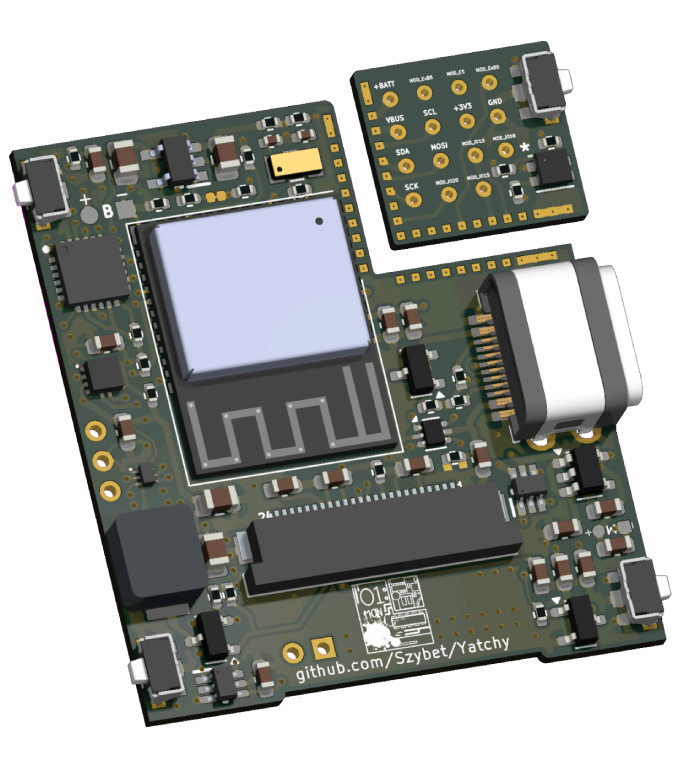
4 layers33.8 × 38 mmYatchy, the printed circuit board in 3D

A modular, hackable, improved watchy like watch

Size
33.8 × 38 mm
Copper layers
4
Thickness
1 mm
Parts
92
Nets
80
Pads
321
Tracks, vias
1,195, 200
Pours
685
Routed
Yes
KiCad
KiCad 9.0 (file 20241229)
Created
18 Jun 2024
Updated
27 Sep 2026

Overview

Yatchy is an open-source printed circuit board by Szybet, from the Szybet/Yatchy repository on GitHub. It is a 4-layer board of 33.8 × 38 mm with 92 parts on 80 nets, routed with 1,195 tracks and 200 vias.

It is built around the ESP32-C6-MINI-1-N4, MCP73831T-2ATI/OT-HXY and TLV75533PDBV, with the AO3400A, BC817-25,215-CN and BMA456 among its other parts. Its parts include 27 connectors, 22 capacitors, 19 resistors, 5 diodes and 4 ICs. It belongs with the wearables and lEDs and displays boards and the ESP32 and RISC-V boards of this library.

Main components

10

README

README.md

Chat on Matrix Chat on Discord

Yatchy

Your Watchy, fixed and improved, even made modular

Yatchy is a DIY watch, heavily inspired by the well known watchy. It focuses on fixing known issues and expanding the potential of it.

Key points:
  • USBC instead of micro usb
  • Better buttons, they won't break easily
  • Better battery life
  • Hardware hackable, easier to self assemble from scratch
  • Fixed many issues and improved minor things
  • A backlight is possible, kind of and many other "extensions"
  • Smaller form factor

Pictures

The coolest yatchy, contributed by a community member! image

My Yatchy, with a titanium anodized case, the rotated variant

The battery is on the side because it's easier for me to measure power consumption, there are cases with the battery inside

A clean soldering job, with some alternative components (compability!), yes, I know there is a short on the flex cable, it fell off when cleaning after the picture image

Watchy one the left yatchy on the right, yatchy is smaller (yes, the battery is outside, but it would only increase height, not width/length

image

Picture contributed, thanks!

Yatchy features in more detail:

For regular users
  • Heavy increase in battery life, even with the screen updating every minute (The esp32c6 has a riscv lp core, which i connected to the screen, which means the device never really wakes up fully to only update the screen, not only that i fixed sqfmi flaws (Using 2 voltage dividers for example) I also use the external crystal clock for the RTC which means no RTC IC... and many more such things)
  • Better buttons, more solid, shouldn't and probably won't break that much if at all. They are also very quiet. If you like the tactile feel of the original buttons, you won't like these ones. Luckly vibration motor feedback is possible.
  • Solid USB-C port (It's THT soldered)
  • no more usb compability problems (Because the esp32c6 uses native jtag programming)
  • better detection of charging, charge finishing. (In software it was hacky on the original watchy, there were problems with it, never worked good)
  • support for more wireless protocols, home automation ones, wifi 6 too
  • TVS diodes, voltage spike protection - which means no more destroyed devices because watchy doesn't follow any USB spec and allows your device to burn down...
  • More precise time, based on some loose math and experiments, it should drift only a minute after a month, compared to the watchy its a lot better, from experience it's even better than that
For advanced users
  • Detailed ordering and assembly guide
  • Detailed soldering and testing guide
  • A module area, with almost all exposed pins from the esp, power lines, and many gpio pins thanks to the expander IC - You can create your own module, increase the capability of you yatchy without modifying everything inside - solar panel module, encoder instead of the button, sd card module, frontlight module, torchlight module, speaker module, microphone module, some environmental sensors. The only limitation is your imagination (And the size of the module)
    • The default module (In the picture above) allows for for attaching small things without the need for a custom PCB
  • All the components are newer, still available and produced. They are also listed, with links to mauser / tme. Ordering a Yatchy PCB and the parts, soldering them themself is possible and easier than the watchy
  • All QFN packages IC's on the board have increased pad sizes, so if you are skilled enough to solder QFN packages, here it will be easier
  • I used traces teardrops, so more solid traces & pads
  • A hardware test program, which allows testing if all the pads of the esp32c6, which is the hardest part to solder are soldered correctly
  • JTAG debugging via usb, yay
Flaws
  • No battery connector, the module pads are small - so it's not for everyone, harder to use / assembly (solder!) for beginners
  • There is no dedicated place for the motor, it needs a dedicated place in the case. Soldering the motor cables also is not easy
  • It's watchy like but not watchy case compatible, the size and form factor is the same but the obvious obstacle is USBC, even with it the buttons are different and placed a little off to save some space
  • It's a 4 layer PCB, so a bit more costly (With JLCPCB it's still cheap)
  • No easy hard reset option, you will need to short pins, but you probably won't need it. When developing the Yatchy, I only once needed a full reset
  • A complicated license (but still open source!)

Software

It's fully supported by InkWatchy. Maybe a rust firmware in the future? We will see...

Hardware sources, buying, reselling, license, battery life, time accuracy

Everything explained here

Cases, 3D files of the pcb

Cases here and pcb 3D model here

FAQ

Community

Create a github issue or get in touch with me on the discord server or matrix space (on top of this read are links)

Parts

92
QtyValueFootprintReferences
22MOD_CONNYatchy:mod_ConnectorJ1, J2, J10, J11, J12, J13, J14, J15, J16, J19, J20, J21, J22, J23, J24, J25 +6
71uF/50VCapacitor_SMD:C_0603_1608MetricC2, C5, C6, C7, C8, C9, C10
50.1uFCapacitor_SMD:C_0603_1608MetricC1, C11, C14, C21, C23
55.1kResistor_SMD:R_0402_1005MetricR3, R4, R5, R6, R15
3100KResistor_SMD:R_0402_1005MetricR10, R13, R20
31uFCapacitor_SMD:C_0603_1608MetricC12, C13, C22
3D_TVSDiode_SMD:D_SOD-523D1, D3, D4
3EVP-AKE31AYatchy:SW_EVP-AKE31A_PANSW1, SW2, SW3
2100kResistor_SMD:R_0402_1005MetricR1, R2
210KResistor_SMD:R_0402_1005MetricR7, R8
219pFCapacitor_SMD:C_0402_1005MetricC19, C20
21KResistor_SMD:R_0402_1005MetricR17, R19
24.7uFCapacitor_SMD:C_0805_2012MetricC25, C26
24.7uF/50VCapacitor_SMD:C_0805_2012MetricC3, C4
2800kResistor_SMD:R_0402_1005MetricR16, R18
2BAT54TW-7-FYatchy:SOT65P222X110-6ND2, D5
110MResistor_SMD:R_0402_1005MetricR21
110uFCapacitor_SMD:C_0603_1608MetricC24
110uH 1AYatchy:HPI0530-100L1
13Resistor_SMD:R_0402_1005MetricR9
1300kResistor_SMD:R_0402_1005MetricR11
132.768KHzYatchy:XTAL_9HT10_TXCY2
1AO3400APackage_TO_SOT_SMD:SOT-23Q1
1BC817-25.215Package_TO_SOT_SMD:SOT-23Q5
1BMA456Yatchy:BOSCH_LGA-12AC1
1BMA530Yatchy:BMA530AC2
1Battery_CellYatchy:Battery_HeaderBT1
1Conn_01x01_PinYatchy:testpointJ17
1Conn_01x02_PinYatchy:PinHeader_1x02_P2.00mm_VerticalJ28
1Conn_01x03_PinYatchy:PinHeader_1x03_P2.00mm_Horizontal_SmallJ26
1ESP32-C6-MINI-1-N4Yatchy:XCVR_ESP32-C6-MINI-1-N4U3
1FDN304PZPackage_TO_SOT_SMD:SOT-23Q4
1LOGOYatchy:yatchy-silkG***
1MCP23018-E_MJYatchy:QFN50P400X400X90-25N-DIC2
1MCP73831T-2ATI_OTYatchy:SOT95P270X145-5NIC3
1SFV24R-4STBE1HLFYatchy:SFV24R4STBE1HLFJ5
1SolderJumper_2_BridgedYatchy:SolderJumper_Bridged_SmallJP2
1TLV75533PDBVYatchy:TLV75733PDYDRU2
1USB4730-GF-A-KITYatchy:USB4730GFAKITJ4
1Vibration_MotorYatchy:Motor_HeaderM1

The 91 most common of 92 parts.

More from Szybet/Yatchy

2
  • 4 layers12.7 × 11.6 mmModule, the printed circuit board in 3D

    Module

    Szybet/Yatchy

    A modular, hackable, improved watchy like watch

    41 parts184
  • 4 layers12.7 × 11.6 mmModule, the printed circuit board in 3D

    Module

    Szybet/Yatchy

    A modular, hackable, improved watchy like watch

    34 parts184

Similar boards

  • 2 layers69.4 × 89.9 mmPanel, the printed circuit board in 3D

    Panel

    themkoi/esp32-alarm-clock

    94 parts2
  • 4 layers26.3 × 16 mmLED Earrings, the printed circuit board in 3D

    LED Earrings

    sandgum/Triangulate-MS_01-Matrix-LED-Studs

    Tiny 8x8mm ear studs (inspired by Mitxela) with 16 LEDs on each, arranged in a 4x4 matrix. Each matrix is controlled by a MAX32660 microcontroller paired with an accelerometer to react to orientation changes.

    54 parts
  • 4 layers46 × 46 mmPlacement, the printed circuit board in 3D

    Placement

    anil08607/stm32-smartwatch

    A 46 × 46 mm, four-layer Bluetooth smartwatch PCB with a Nordic nRF52810-QFAA, 240 × 240 SPI LCD interface, BMA456 accelerometer, battery-backed PCF8563 RTC, USB-C 5 V charging, protected single-cell battery interface…

    71 parts
  • 4 layers60 × 35 mmOpenScent, the printed circuit board in 3D

    OpenScent

    anxndsgn/OpenScent

    an olfactory interface development board

    61 parts
  • 2 layers58.5 × 85 mmUnisense, the printed circuit board in 3D

    Unisense

    mburger82/unisense

    121 parts
  • 6 layers15.2 × 34 mmPlajtime main, the printed circuit board in 3D

    Plajtime main

    Plajta/PlajTime-Hardware

    Here lays the current and past HW designs of our PlajTime smartwatch. That includes all the boards and the chassis.

    85 parts3CC-BY-SA-4.0
  • 6 layers38 × 39 mmWatch, the printed circuit board in 3D

    Watch

    cruzsbrian/smartwatch

    61 parts1
  • 2 layers65.8 × 21.8 mmRear light, the printed circuit board in 3D

    Rear light

    c4deszes/bike-rear-light

    Rear light for the bicycle with braking indication

    109 parts

Questions

How big is the Yatchy PCB?

It measures 33.8 × 38 mm and has 4 copper layers, 1 mm thick.

What parts does the Yatchy use?

92 parts, built around the ESP32-C6-MINI-1-N4, MCP73831T-2ATI/OT-HXY, TLV75533PDBV and AO3400A. The full list of its parts is on this page, with links to each part's symbol and footprint where PCBKit's library has them.

Where can I download the Yatchy KiCad files?

From the Szybet/Yatchy repository on GitHub, at the commit this page was made from: the board is hardware/kicad/Yatchy/Yatchy.kicad_pcb and its schematic hardware/kicad/Yatchy/Yatchy.kicad_sch. PCBKit opens the board in the browser, with nothing to install.

Can I use the Yatchy design in my own project?

Its repository states no licence, so its author keeps all rights: ask Szybet before reusing the design.