2 layers46 × 77.3 mm
 Sooner-Rover-Team/pcb
CAD designs for various rover parts (likely archival)
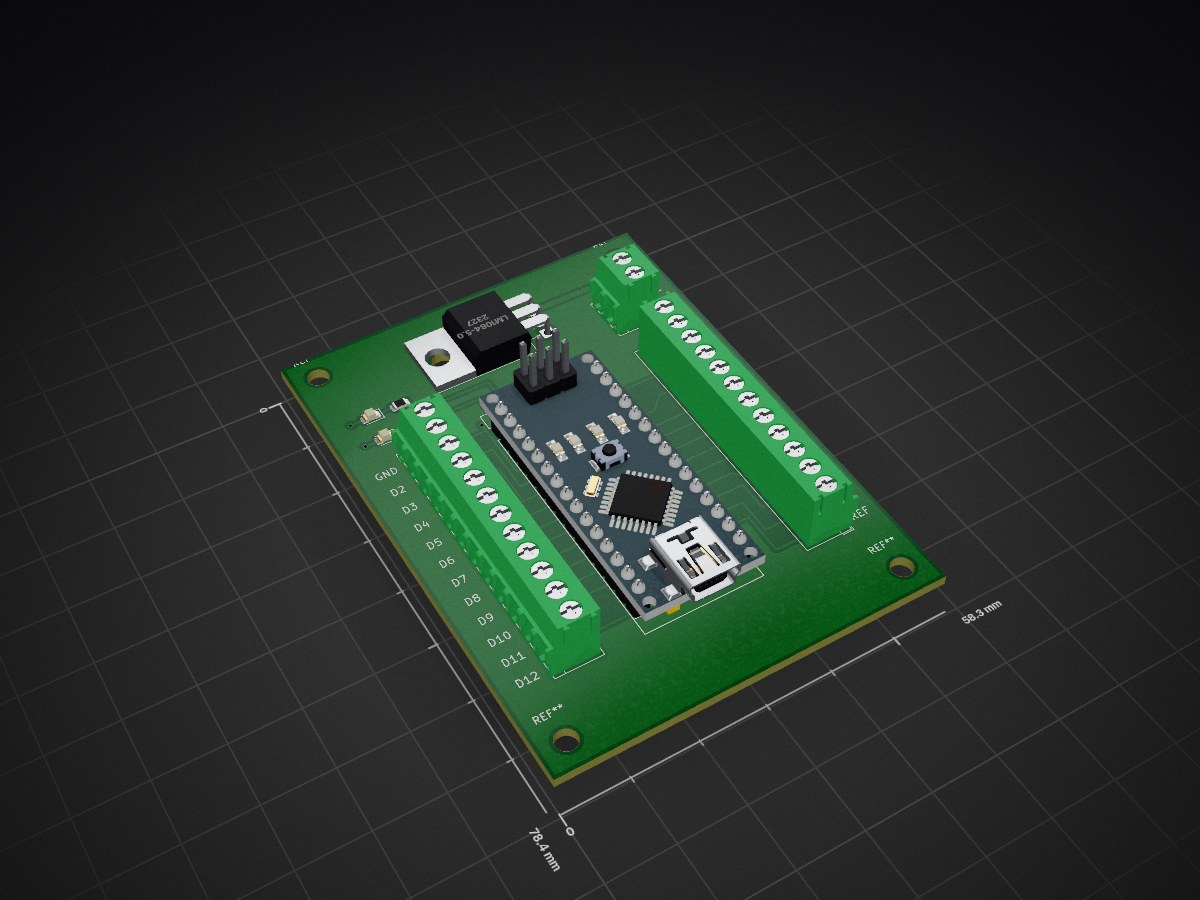
Science is an open-source printed circuit board by Sooner-Rover-Team, from the Sooner-Rover-Team/pcb repository on GitHub, published under the MIT licence. It is a 2-layer board of 58.3 × 78.4 mm with 13 parts on 24 nets, routed with 118 tracks and 3 vias.
Its parts include 3 connectors, 2 resistors and 1 IC. It belongs with the AVR (ATmega, ATtiny) boards of this library.
It seems that this repo was/is(?) being used to store CAD files. 34 MiB isn't that bad, but if we're using git anyways, I don't see why there's 100 backup zips..? In general, git isn't used to store files like this. I suggest moving Google Drive or another cloud storage solution.
This repo might be archived if a move occurs.
| Qty | Value | Footprint | References |
|---|---|---|---|
| 2 | R_US | Resistor_SMD:R_0805_2012Metric | R3, R3 |
| 2 | Screw_Terminal_01x12 | TerminalBlock_4Ucon:TerminalBlock_4Ucon_1x12_P3.50mm_Horizontal | J1, J2 |
| 1 | Arduino_Nano_v3.x | Module:Arduino_Nano | A1 |
| 1 | LED_0805_2012Metric | LED_SMD:LED_0805_2012Metric | CAN |
| 1 | LM1084-5.0 | Package_TO_SOT_THT:TO-220F-3_Horizontal_TabDown | U1 |
| 1 | Screw_Terminal_01x02 | TerminalBlock_4Ucon:TerminalBlock_4Ucon_1x02_P3.50mm_Horizontal | J3 |
The 8 most common of 13 parts.


samyk/magspoof
A portable device that can spoof/emulate any magnetic stripe, credit card or hotel card "wirelessly", even on standard magstripe (non-NFC/RFID) readers.

fossasia/pslab-scripts
Pocket Science Lab - Scripts for Sensor Experiments


willem-pennings/balancing-cube
A cube that balances itself in a corner or edge using reaction wheels

VoronDesign/Voron-Hardware
Cool Hardware designed by the Voron Design group

hoglet67/RGBtoHDMI
Bare-metal Raspberry Pi project that provides pixel-perfect sampling of Retro Computer RGB/YUV video and conversion to HDMI
It measures 58.3 × 78.4 mm and has 2 copper layers, 1.6 mm thick.
13 parts. The full list of its parts is on this page, with links to each part's symbol and footprint where PCBKit's library has them.
From the Sooner-Rover-Team/pcb repository on GitHub, at the commit this page was made from: the board is Science/Science.kicad_pcb and its schematic Arm/lowerArm_upperArm/lowerArm.kicad_sch. PCBKit opens the board in the browser, with nothing to install.
Its repository publishes it under the MIT licence: you may reuse it on that licence's terms (keep the author's notice, and for a copyleft licence share your changes alike).
