
2 layers91.2 × 82.6 mm
Buck converter
Niels-Clayton/self-tuning-buck-converter
Variable frequency and PWM buck converter, controlling for both output voltage and inductor ripple current of the converter.
54 parts2
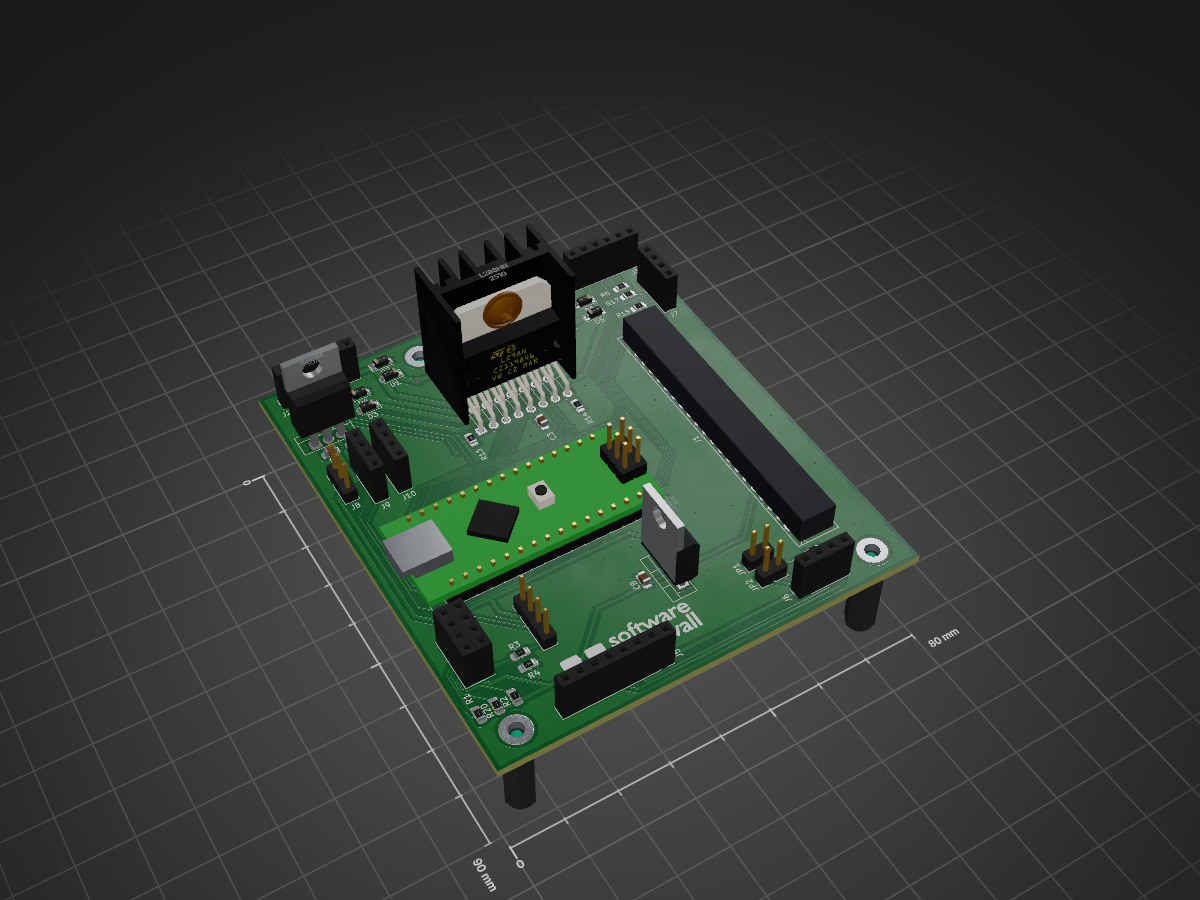
Design and build instructions for the Software Cornwall Mission to Mars Rovers
M2MRover is an open-source printed circuit board by SoftwareCornwall, from the SoftwareCornwall/Mission-to-Mars-Rover repository on GitHub. It is a 2-layer board of 80 × 90 mm with 61 parts on 103 nets, routed with 345 tracks and 68 vias.
It is built around the L298HN, LD1117V33 and LD1117V50. Its parts include 20 resistors, 10 connectors, 8 capacitors, 8 diodes and 4 ICs. It belongs with the ESP8266 and AVR (ATmega, ATtiny) boards of this library.


| Qty | Value | Footprint | References |
|---|---|---|---|
| 14 | 10K | Resistor_SMD:R_0805_2012Metric_Pad1.15x1.40mm_HandSolder | R1, R2, R5, R6, R7, R8, R9, R10, R11, R12, R17, R18, R19, R20 |
| 8 | 45V, 2A | Diode_SMD:D_SOD-123 | D1, D2, D3, D4, D5, D6, D7, D8 |
| 4 | 100nF | Capacitor_SMD:C_0805_2012Metric_Pad1.15x1.40mm_HandSolder | C3, C4, C5, C7 |
| 4 | MountingHole | MountingHole:MountingHole_2.7mm_Pad | H1, H2, H3, H4 |
| 2 | 10pF | Capacitor_SMD:C_0805_2012Metric_Pad1.15x1.40mm_HandSolder | C1, C2 |
| 2 | 10uF | Capacitor_SMD:C_0805_2012Metric_Pad1.15x1.40mm_HandSolder | C6, C8 |
| 2 | 1R | Resistor_SMD:R_0805_2012Metric_Pad1.15x1.40mm_HandSolder | R13, R14 |
| 2 | 4.7K | Resistor_SMD:R_0805_2012Metric_Pad1.15x1.40mm_HandSolder | R15, R16 |
| 2 | Jumper_2_Open | Connector_PinHeader_2.54mm:PinHeader_1x02_P2.54mm_Vertical | JP1, JP2 |
| 1 | 1K | Resistor_SMD:R_0805_2012Metric_Pad1.15x1.40mm_HandSolder | R3 |
| 1 | 2K | Resistor_SMD:R_0805_2012Metric_Pad1.15x1.40mm_HandSolder | R4 |
| 1 | Arduino_Nano_v3.x | Module:Arduino_Nano | A1 |
| 1 | Battery | Connector_PinHeader_2.54mm:PinHeader_1x02_P2.54mm_Vertical | BT1 |
| 1 | Compass GY-273 | Connector_PinSocket_2.54mm:PinSocket_1x04_P2.54mm_Vertical | J6 |
| 1 | ESP8266-ESP-01 | Connector_PinSocket_2.54mm:PinSocket_2x04_P2.54mm_Vertical | U1 |
| 1 | JLCPCB_Order_Number | Software_Cornwall:JLCPCBOrderNumber | ORDERNO1 |
| 1 | L298HN | Package_TO_SOT_THT:TO-220-15_P2.54x2.54mm_StaggerOdd_Lead4.58mm_Vertical | U2 |
| 1 | LD1117V33 | Package_TO_SOT_THT:TO-220-3_Vertical | U4 |
| 1 | LD1117V50 | Package_TO_SOT_THT:TO-220-3_Vertical | U3 |
| 1 | Left Motor | Connector_PinSocket_2.54mm:PinSocket_1x06_P2.54mm_Vertical | J2 |
| 1 | Light Detection | Connector_PinSocket_2.54mm:PinSocket_1x04_P2.54mm_Vertical | J7 |
| 1 | MPU6050 Gyro & Acc GY-521 | Connector_PinSocket_2.54mm:PinSocket_1x08_P2.54mm_Vertical | J5 |
| 1 | Right Motor | Connector_PinSocket_2.54mm:PinSocket_1x06_P2.54mm_Vertical | J3 |
| 1 | SW_SPST | Connector_PinHeader_2.54mm:PinHeader_1x02_P2.54mm_Vertical | SW1 |
| 1 | Serial (Bluetooth) | Connector_PinHeader_2.54mm:PinHeader_1x04_P2.54mm_Vertical | J4 |
| 1 | Servo | Connector_PinHeader_2.54mm:PinHeader_1x03_P2.54mm_Vertical | J8 |
| 1 | Software_Cornwall_Logo | Software_Cornwall:SoftwareCornwallLogo | LOGO1 |
| 1 | Ultrasonic Down | Connector_PinSocket_2.54mm:PinSocket_1x04_P2.54mm_Vertical | J9 |
| 1 | Ultrasonic Forward | Connector_PinSocket_2.54mm:PinSocket_1x04_P2.54mm_Vertical | J10 |
| 1 | microbit_edge_connector | Software_Cornwall:4UCON_10156_B3_Horizontal | J1 |
Niels-Clayton/self-tuning-buck-converter
Variable frequency and PWM buck converter, controlling for both output voltage and inductor ripple current of the converter.


JonathanBheri/USB-to-UART-I2C-pogo-pins-
This PCB will help with production EOL testing or electrical Functional test (FCT)

kai-carlin/STM-Needle-Fab-Controller
College of Marin Physics Club Needle Fabrication Unit Controller Project


It measures 80 × 90 mm and has 2 copper layers, 1.6 mm thick.
61 parts, built around the L298HN, LD1117V33 and LD1117V50. The full list of its parts is on this page, with links to each part's symbol and footprint where PCBKit's library has them.
From the SoftwareCornwall/Mission-to-Mars-Rover repository on GitHub, at the commit this page was made from: the board is KiCad/M2MRover.kicad_pcb. PCBKit opens the board in the browser, with nothing to install.
Its repository states no licence, so its author keeps all rights: ask SoftwareCornwall before reusing the design.