2 layers120 × 85 mm
3 nodes 3 hid
Socolin/KVM-Switch
A KVM Switch for any HID built with multiple Raspberry Pi Pico 2
24 parts1MIT
 Socolin/KVM-Switch1
A KVM Switch for any HID built with multiple Raspberry Pi Pico 2
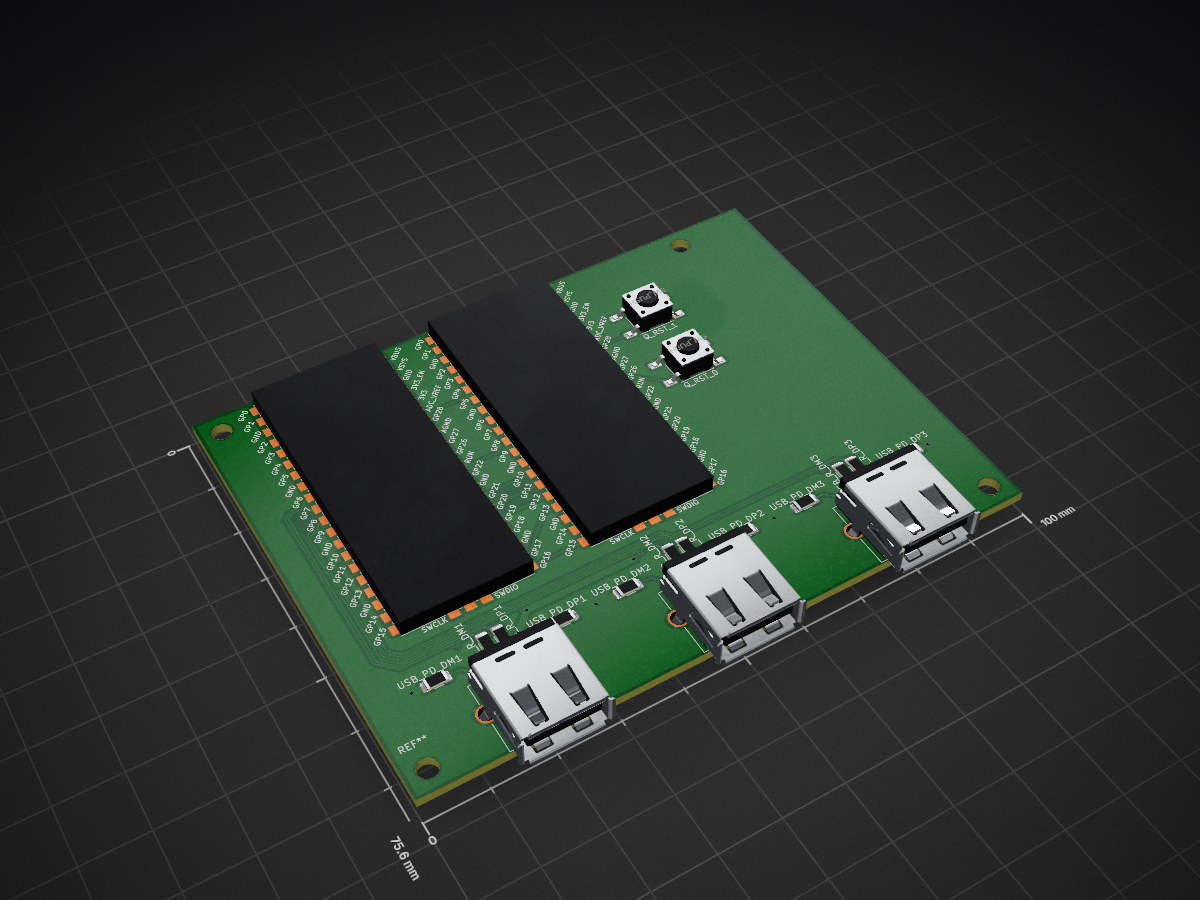
2 nodes 3 hid is an open-source printed circuit board by Socolin, from the Socolin/KVM-Switch repository on GitHub, published under the MIT licence. It is a 2-layer board of 100 × 75.6 mm with 26 parts on 67 nets, routed with 171 tracks and 15 vias.
It belongs with the RP2040 boards of this library.
A KVM Switch for any HID device built with multiple Raspberry Pi Pico 2
This project is still in development. The code is almost done, and I need to design the PCB.
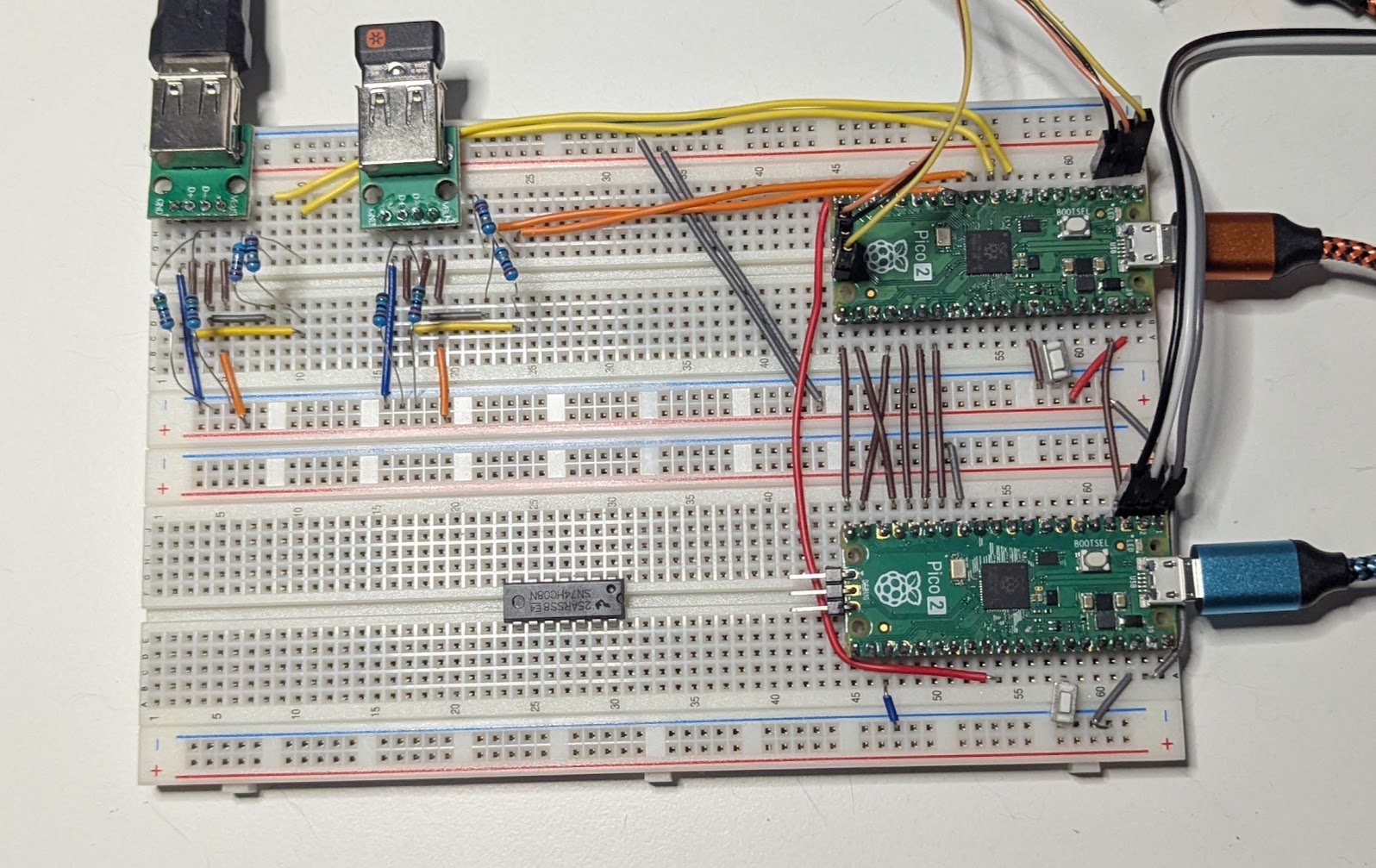
So far I can use it as a KVM switch. I can select the computer to use with a keyboard shortcut. I was not able to test with exotic keyboard / mouse yet, but those should be supported.
The detailed documentation is available at doc/technical.md.
The remaining tasks are:
TUD_OPT_HIGH_SPEEDgit clone git@github.com:Socolin/KVM-Switch.git
cd KVM-Switch
git submodule update --init --recursive
mkdir build
cd build
cmake .. -DPICO_BOARD=pico2 -DPICO_SDK_PATH={PATH_TO_PICOSDK} -DPICOTOOL_FETCH_FROM_GIT_PATH={PATH_TO_PICOTOOL}
make -j
# Then output is in src/node and src/controllerTo simplify flashing both, you can use the serial number of your pico with picotool info -a the serial will look like 46AA0E6255B66826
picotool load --ser $PICO_PI_NODE_SERIAL -f -x src/node/kvm_node.uf2;
picotool load --ser $PICO_PI_CONTROLLER_SERIAL -f -x src/controller/kvm_controller.uf2;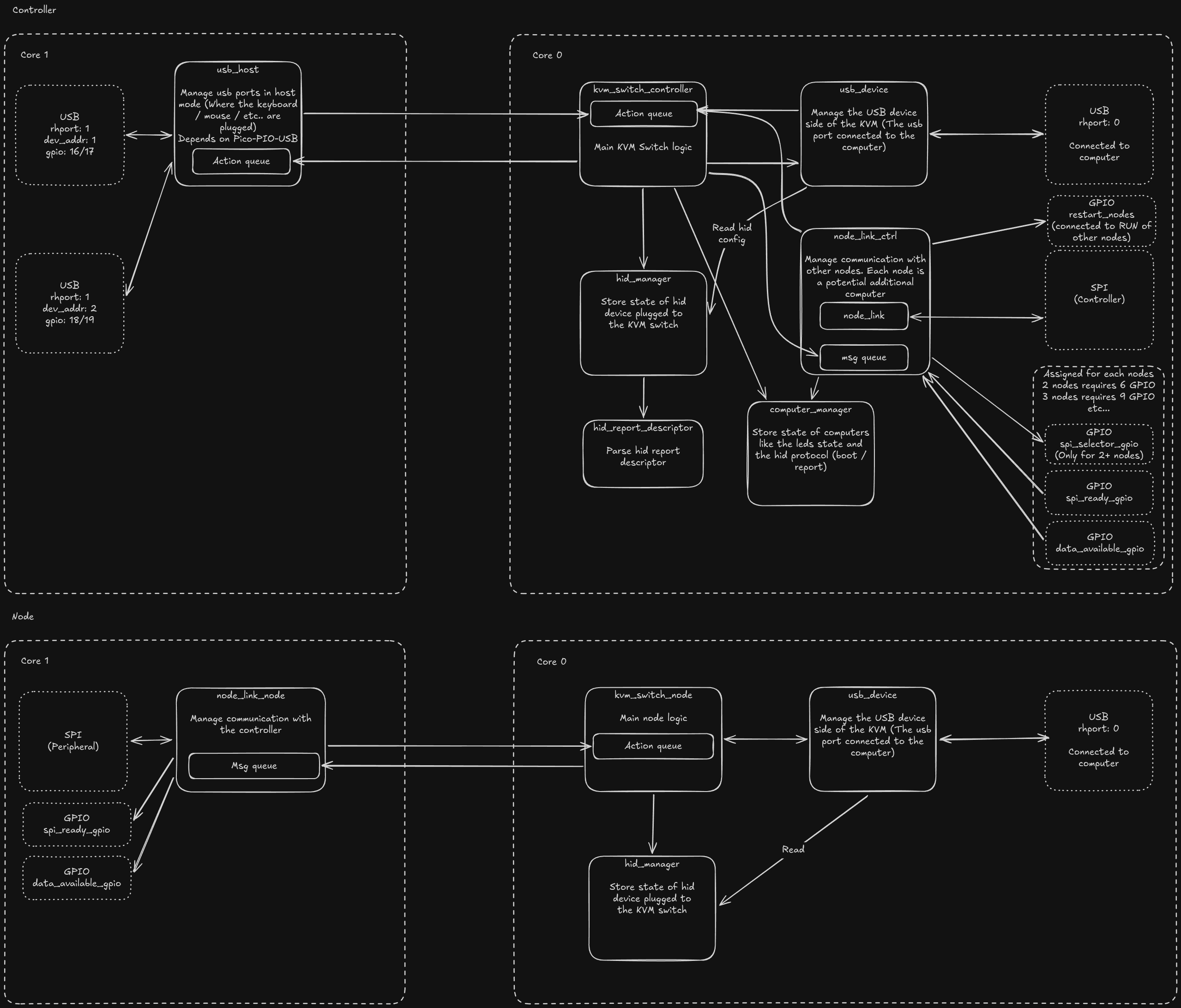
The KVM Switch can be configured through a web UI. It can be accessed with a web browser supporting WebUSB.
You can access it at https://socolin.github.io/KVM-Switch/ (You need to use a browser supporting WebUSB)
The code of the config UI is in tools/configurator
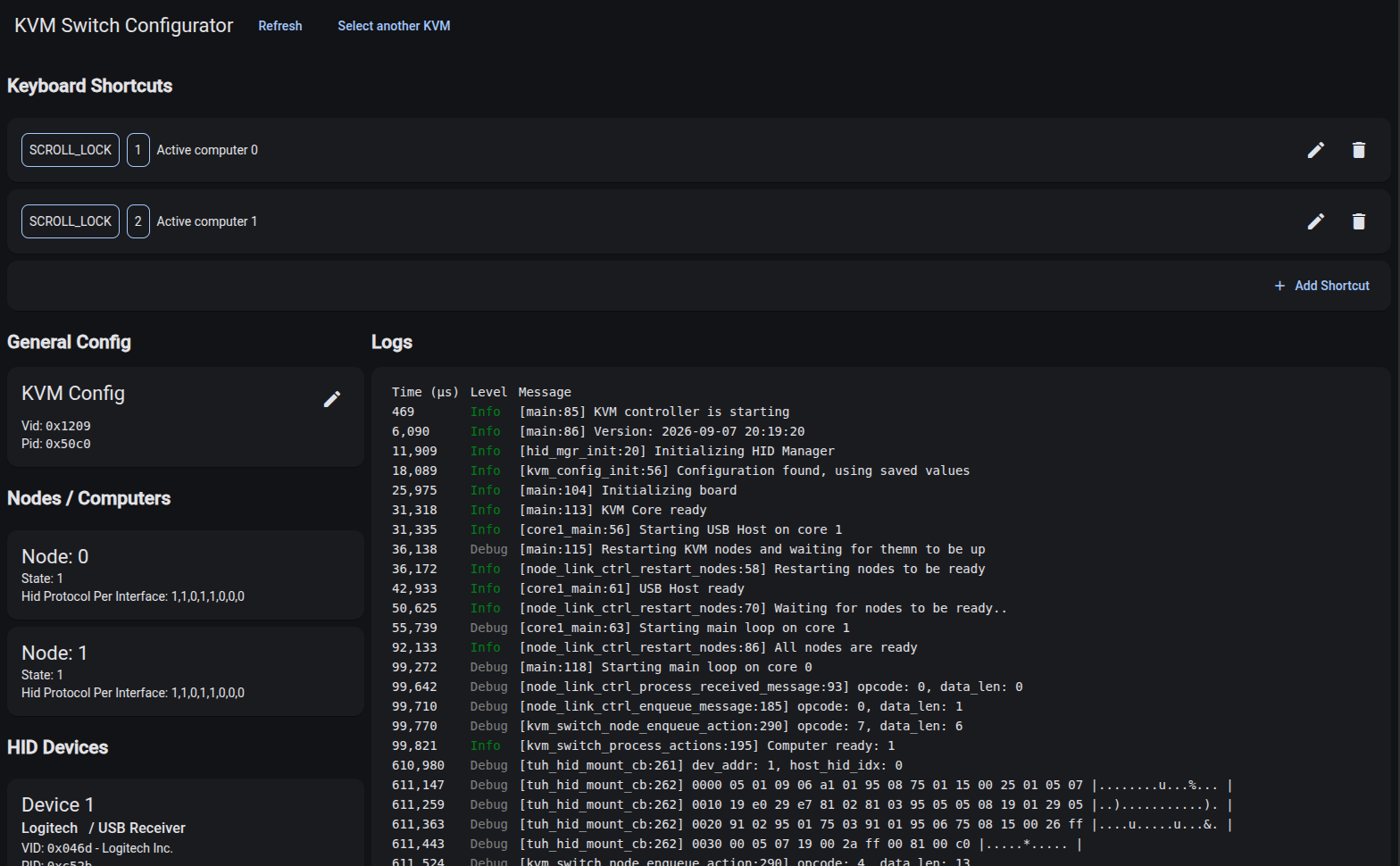
If you need to build the tool, you need Node.js 24 then run those commands
cd tools/configurator
npm install
npm run start
Then access it at http://localhost:4200 (You need to use a browser supporting WebUSB)
Basically, I see AI as a tool, and I have fun writing code, so:
src/ is written by a human.AI-generated comments).This project started to fix an issue I had with my current commercial KVM switch, that is the delay to switch between 2 computers; I wanted a shortcut to switch instantaneously. This project is also an opportunity for me to learn a some few things with electronic and discover dev on a microcontroller. Feel free to provide any feedback, as I'm still learning.
I first tried to use CH9329 and CH9350 to avoid all the USB parts and get this done quickly. However, during
my testing I discovered that the CH9329 has a HID descriptor that does not expose all the features I wanted (like the
mouse pan) and the CH9350 felt the same way. So I learnt a lot about HID descriptors, tinyUSB, etc… And, now this project
should support any HID device (not just keyboard and mouse) like Gamepad etc… I kept the code I used to use those chips
in src/legacy if anyone need this, feel free to use it
| Qty | Value | Footprint | References |
|---|---|---|---|
| 6 | 15K | Resistor_SMD:R_1206_3216Metric_Pad1.30x1.75mm_HandSolder | USB_PD_DM1, USB_PD_DM2, USB_PD_DM3, USB_PD_DP1, USB_PD_DP2, USB_PD_DP3 |
| 6 | 22 | Resistor_SMD:R_1206_3216Metric_Pad1.30x1.75mm_HandSolder | USB_R_DM1, USB_R_DM2, USB_R_DM3, USB_R_DP1, USB_R_DP2, USB_R_DP3 |
| 3 | 10 µF | Capacitor_SMD:C_1206_3216Metric_Pad1.33x1.80mm_HandSolder | USB_C1, USB_C2, USB_C3 |
| 3 | USB_A | Connector_USB:USB_A_Molex_67643_Horizontal | HID_DEV_1, HID_DEV_2, HID_DEV_3 |
| 2 | Pico | MCU_RaspberryPi_and_Boards:RPi_Pico_SMD_TH | Controller1, Node1 |
| 2 | SW_Push | Button_Switch_SMD:SW_Push_1P1T_NO_E-Switch_TL3301NxxxxxG | Q_RST_0, Q_RST_1 |
The 22 most common of 26 parts.
Socolin/KVM-Switch
A KVM Switch for any HID built with multiple Raspberry Pi Pico 2

Socolin/KVM-Switch
A KVM Switch for any HID built with multiple Raspberry Pi Pico 2


hackclub/OnBoard
💡 Join 1,000 teenagers and make your first PCB with a $100 grant!


harbaum/galagino
A Galaga, Pac-Man and Donkey Kong arcade emulator for the ESP32

Luos-io/luos_engine
Open-source and real-time orchestrator for cyber-physical-systems, to easily design, test and deploy embedded applications and digital twins.

google/walt
A device for measuring latency of physical sensors and outputs on phones and computers

It measures 100 × 75.6 mm and has 2 copper layers, 1.6 mm thick.
26 parts. The full list of its parts is on this page, with links to each part's symbol and footprint where PCBKit's library has them.
From the Socolin/KVM-Switch repository on GitHub, at the commit this page was made from: the board is kicad/2_nodes_3_hid/2_nodes_3_hid.kicad_pcb and its schematic kicad/2_nodes_2_hid/2_nodes_2_hid.kicad_sch. PCBKit opens the board in the browser, with nothing to install.
Its repository publishes it under the MIT licence: you may reuse it on that licence's terms (keep the author's notice, and for a copyleft licence share your changes alike).