2 layers105 × 80 mm

 Socketto/wifi-awning
wifi-awning
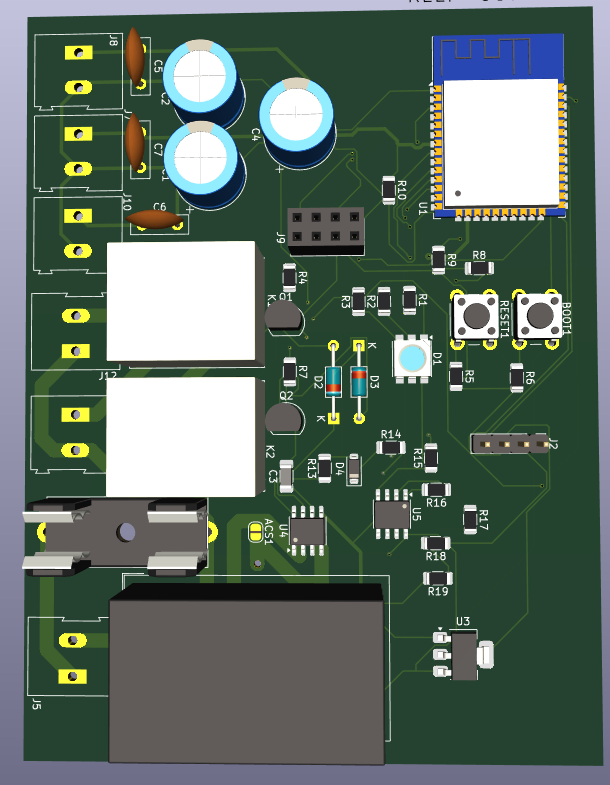
Test end a is an open-source printed circuit board by Socketto, from the Socketto/wifi-awning repository on GitHub. It is a 2-layer board of 105 × 80 mm with 49 parts on 62 nets, routed with 503 tracks and 41 vias.
It is built around the ESP32-WROOM-32, HLK-PM01 and LM358, with the AMS1117-3.3, BC547 and 1N4148W among its other parts. Its parts include 17 resistors, 8 connectors, 7 capacitors, 4 ICs and 4 diodes. It belongs with the radio and wireless boards and the ESP32 boards of this library.


This project was developed to replace a faulty awning control board that is triggered in case of high wind conditions. The system uses an anemometer to detect wind speed, and through a control board equipped with an onboard trimmer, it allows the user to set a wind speed threshold. Once this threshold is exceeded, the awning is automatically retracted to prevent wind damage.
The original board, while functional in normal conditions, presents a critical firmware issue. Below is a step-by-step breakdown of the standard operation and the bug scenario:
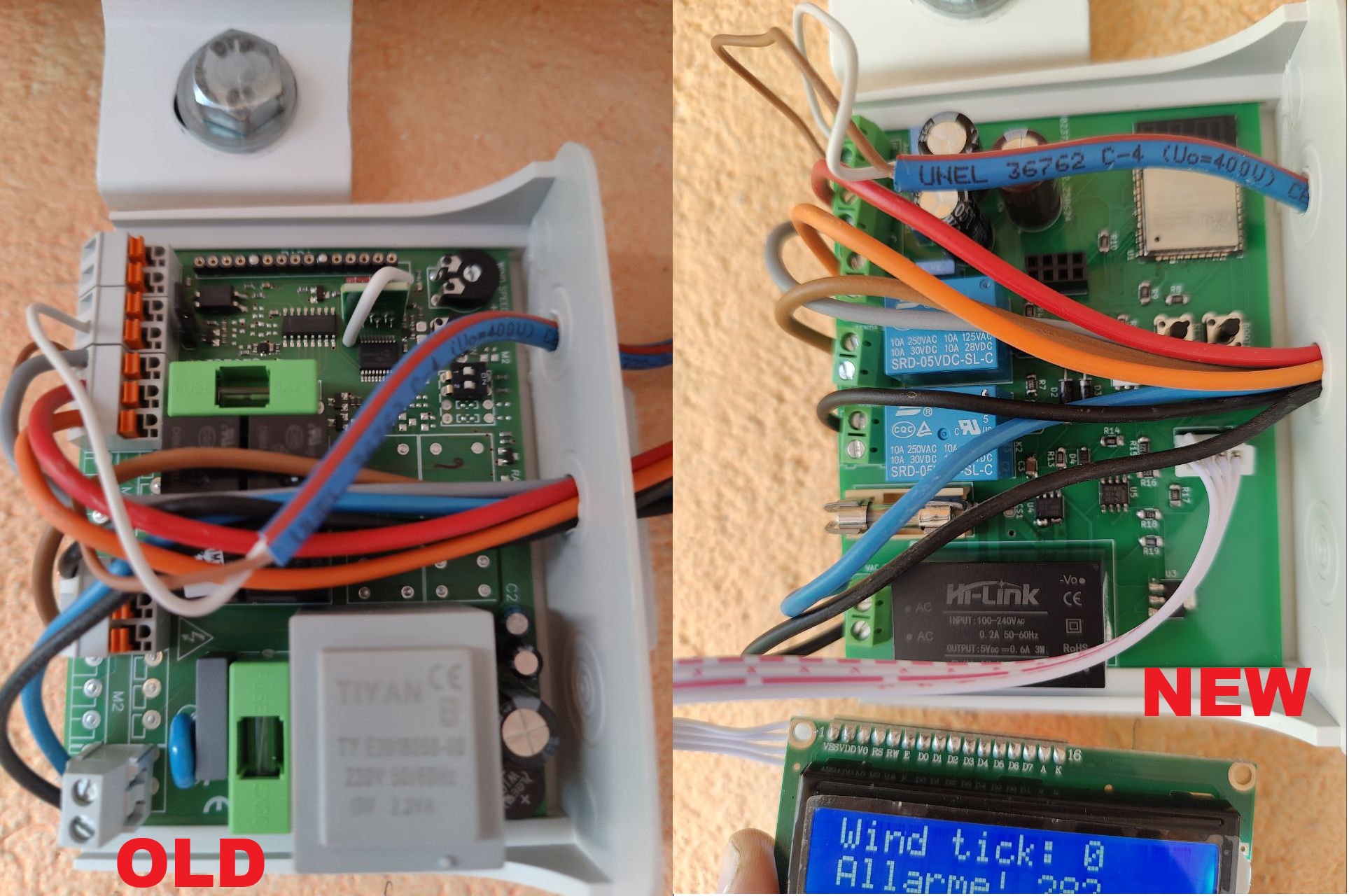
The replacement board is fully programmable, supporting both Arduino and ESP-IDF environments. This flexibility allows for quick and permanent fixes to firmware bugs like the one described above. Additionally, the board natively supports Wi-Fi connectivity for remote monitoring and updates.
Current Sensor Integration:
A current sensor is integrated directly on the board and connected to an ADC1 pin. This feature enables the system to control the awning opening to a specific percentage. Once programmed with a calibration sequence, the system can learn and control precise positions.
Debug and Display Capabilities:
| Qty | Value | Footprint | References |
|---|---|---|---|
| 5 | R10K | Resistor_SMD:R_1206_3216Metric | R5, R6, R8, R9, R10 |
| 4 | R100 | Resistor_SMD:R_1206_3216Metric | R1, R2, R3, R13 |
| 3 | C | Capacitor_THT:C_Disc_D8.0mm_W2.5mm_P5.00mm | C5, C6, C7 |
| 2 | BC547 | Package_TO_SOT_THT:TO-92_Inline | Q1, Q2 |
| 2 | C_Polarized | Capacitor_THT:CP_Radial_D10.0mm_P5.00mm | C1, C2 |
| 2 | Diode | Diode_THT:D_DO-35_SOD27_P10.16mm_Horizontal | D2, D3 |
| 2 | FINDER-36.11 | Relay_THT:Relay_SPDT_Finder_36.11 | K1, K2 |
| 2 | R10k | Resistor_SMD:R_1206_3216Metric | R14, R17 |
| 2 | R12k | Resistor_SMD:R_1206_3216Metric | R15, R16 |
| 2 | R330 | Resistor_SMD:R_1206_3216Metric | R4, R7 |
| 1 | 1N4148W | Diode_SMD:D_SOD-123 | D4 |
| 1 | 1nF | Inductor_SMD:L_1206_3216Metric_Pad1.22x1.90mm_HandSolder | C3 |
| 1 | 56uF | Capacitor_THT:CP_Radial_D10.0mm_P5.00mm | C4 |
| 1 | ACS712xLCTR-05B | Package_SO:SOIC-8_3.9x4.9mm_P1.27mm | U4 |
| 1 | AMS1117-3.3 | Package_TO_SOT_SMD:SOT-223-3_TabPin2 | U3 |
| 1 | Anemometer | TerminalBlock:TerminalBlock_Altech_AK300-2_P5.00mm | J8 |
| 1 | BOOT | Button_Switch_THT:SW_PUSH_6mm_H4.3mm | BOOT1 |
| 1 | ESP32-WROOM-32 | RF_Module:ESP32-WROOM-32 | U1 |
| 1 | Fuse | Fuse:Fuseholder_Cylinder-5x20mm_Schurter_0031_8201_Horizontal_Open | F1 |
| 1 | HLK-PM01 | Converter_ACDC:Converter_ACDC_Hi-Link_HLK-PMxx | PS1 |
| 1 | I2C connector | Connector_PinHeader_2.54mm:PinHeader_1x04_P2.54mm_Vertical | J2 |
| 1 | JUMP | Jumper:SolderJumper-2_P1.3mm_Open_RoundedPad1.0x1.5mm | ACS1 |
| 1 | LED RGB | LED_SMD:LED_RGB_5050-6 | D1 |
| 1 | LM358 | Package_SO:SOIC-8-1EP_3.9x4.9mm_P1.27mm_EP2.29x3mm | U5 |
| 1 | R180 | Resistor_SMD:R_1206_3216Metric | R19 |
| 1 | R470 | Resistor_SMD:R_1206_3216Metric | R18 |
| 1 | RESET | Button_Switch_THT:SW_PUSH_6mm_H4.3mm | RESET1 |
| 1 | SW1 | TerminalBlock:TerminalBlock_Altech_AK300-2_P5.00mm | J7 |
| 1 | SW2 | TerminalBlock:TerminalBlock_Altech_AK300-2_P5.00mm | J10 |
| 1 | TENDA_1 | TerminalBlock:TerminalBlock_Altech_AK300-2_P5.00mm | J12 |
| 1 | TENDA_2 | TerminalBlock:TerminalBlock_Altech_AK300-2_P5.00mm | J11 |
| 1 | TX RX - + | Connector_PinSocket_2.54mm:PinSocket_2x04_P2.54mm_Vertical | J9 |
| 1 | VAC 230V | TerminalBlock:TerminalBlock_Altech_AK300-2_P5.00mm | J5 |


VinayGopi-PK/ESP32-4-Channel-WiFi-Home-Automation
ESP32-based 4-channel Wi-Fi Home Automation Controller designed in KiCad. Includes schematic, PCB layout, Gerber files, BOM and 3D visualization.

AgustinPrietoValdez/competition-robots
Custom competition robots — maze/micromouse (MISA), sumo (TATAMI 1) & mini-sumo (RUCHO). KiCad PCBs, STM32/Arduino firmware, Fusion 360. National champion & international prizes — by EDNAROBOTICS.


epim/circsim
Post-routed PCB+Schematic circuit simulator. Because I have trust issues.

haripradhap14/ESP32-4CH-Relay-Controller-
4-channel IoT relay controller using ESP32-WROOM-32E for home automation.


R-Mutura/DISHWASHER
Contains hardware and Software implementation of a dishwasher product
It measures 105 × 80 mm and has 2 copper layers, 1.6 mm thick.
49 parts, built around the ESP32-WROOM-32, HLK-PM01, LM358 and AMS1117-3.3. The full list of its parts is on this page, with links to each part's symbol and footprint where PCBKit's library has them.
From the Socketto/wifi-awning repository on GitHub, at the commit this page was made from: the board is Board/test-end-a/test-end-a.kicad_pcb and its schematic Board/test-end-a-12/test-end-a.kicad_sch. PCBKit opens the board in the browser, with nothing to install.
Its repository states no licence, so its author keeps all rights: ask Socketto before reusing the design.