4 layers218.4 × 114 mm
Video v2.0
ksr/YACC1-D
YACC1 (Yet Another Custom CPU) - definitive tree: hardware, firmware, software, tools and docs for the hand-built TTL computer. Supersedes ksr/YACC1-2020.
121 parts

 Shyri/gba-bt-hid98
Turn your Game Boy Advance into a Bluetooth Gamepad.
Gba bt hid is an open-source printed circuit board by Shyri, from the Shyri/gba-bt-hid repository on GitHub, published under the GPL-3.0 licence. It is a 2-layer board with 13 parts on 41 nets.
It is built around the ATMEGA328P-PU and 74LS157PC. Its parts include 4 ICs, 3 capacitors, 3 connectors, 2 resistors and 1 crystal. It belongs with the AVR (ATmega, ATtiny) boards of this library.


Turn your Game Boy Advance into a Bluetooth Controller :)
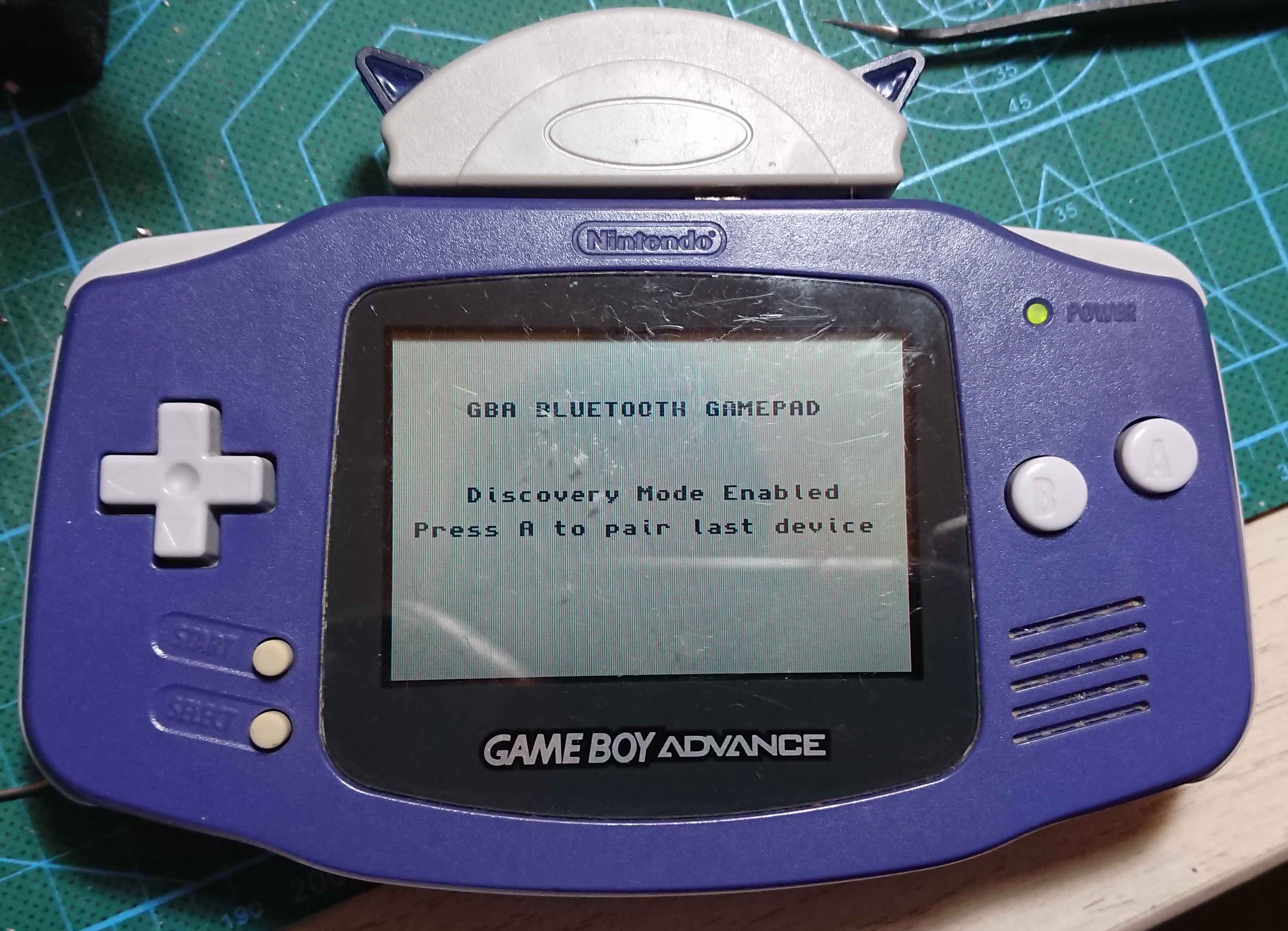
After launching the rom the bluetooth module enters discoverable mode. This means you can pair to it from whatever device you are going to use it with (PC, phone, Android TV...). After pairing the program will start sending keys to the device. The device address is stored so next time you launch you just have to press A to automatically connect to that device.
The project is basically an ESP32 connected to the GBA through the link port. With the device connected and without any cartridge inserted in the GBA, once the GBA turns on the ESP32 sends a small rom to be loaded in the GBA. This rom is a program made to enable communication between the ESP32 and GBA for both handling bluetooth conneciton and sending the user input to the ESP32 when it is connected to a bluetooth host and act as a gamepad. Unfortunatelly it only works with traditional GBA as I couln't make it work with GBA SP. I think GBA SP just doesn't give enough current.
When turned on the ESP32 (using the code found in esp32 peforms a multiboot sequence through the SPI to the GBA sending a rom that the ESP32 has stored in the flash memory. The code for this rom can be found in gba. Once loaded the ESP32 enables the UART port in the same pins and the rom communicates with the ESP32 using UART through the link port.
This project was tested with ESP-IDF v3.3.2 that you can find here:
https://github.com/espressif/esp-idf/releases
You also will need to install btstack. Commit https://github.com/bluekitchen/btstack/commit/a0a4507b35ea396d076a62a67efb1a5a800c5ff9 is the most recent version that is proved to work in this project.
Just follow the ESP32 environment instructions here
The ESP32 is powered by the 3.3V the GBA gives through the port.
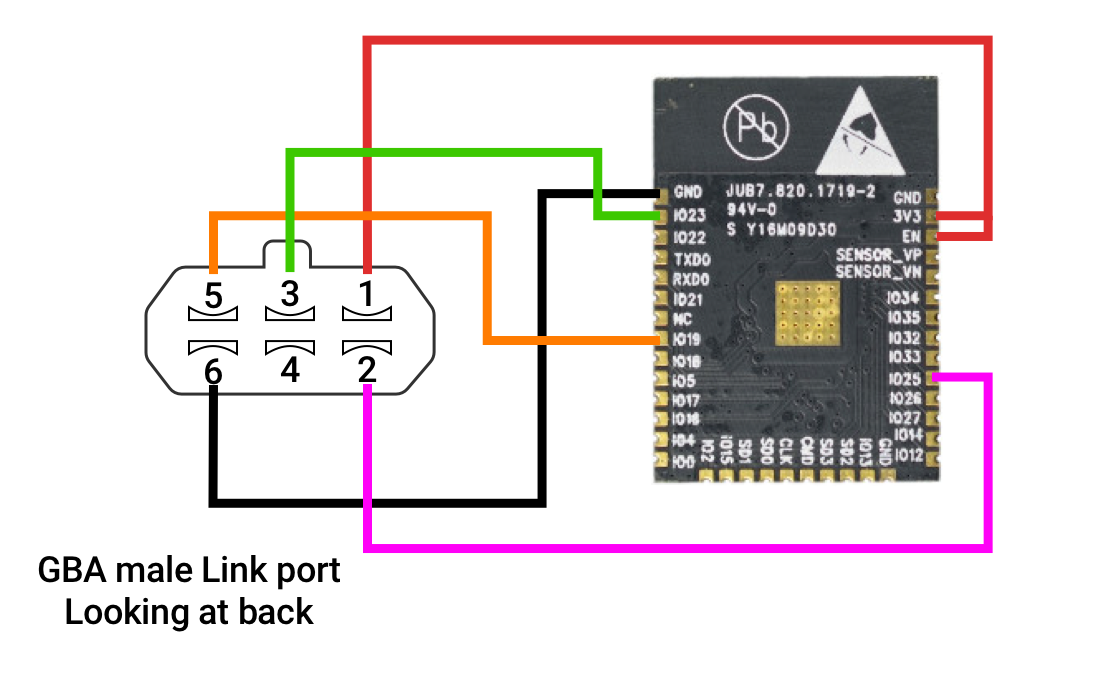
Once the ESP32 is programmed the male link port connector should be wired to it like the following diagram:
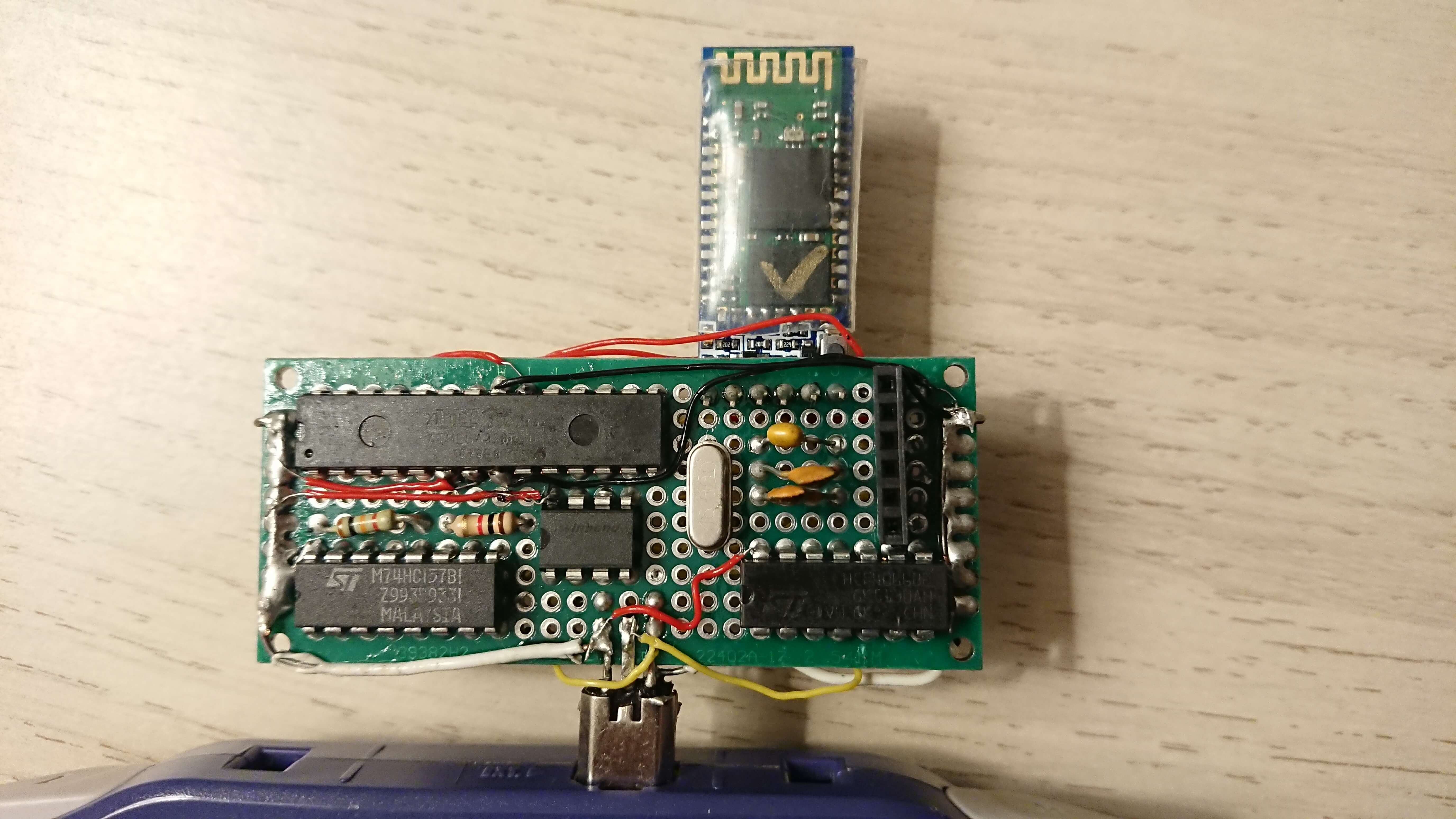
The first prototype was made with an Atmega and HC-05:
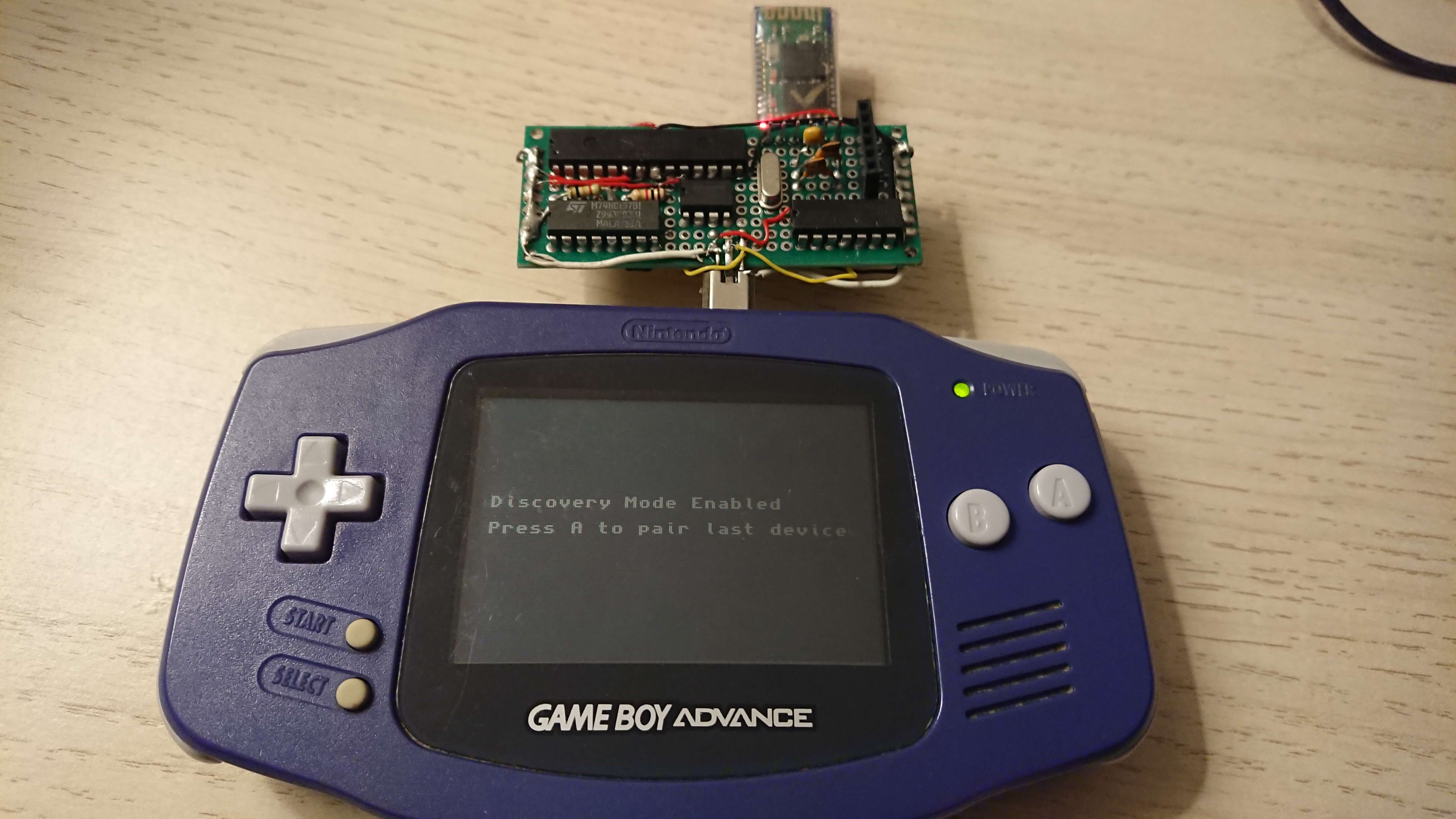 The gba contains the code for a GBA program that uses the link port to communicate with a HC-05 bluetooth module using UART (HC-05 flashed with RN-42 firmware, find how to do it in the links at the bottom).
This rom is stored in a W25Q32 flash chip. An Atmega328P performs a multiboot sequence reading from this chip and sending to the GBA through the link port. You can find the Atmega code here (It is actually written for arduino so you'll need to burn arduino's bootloader if you want to use it).
Once multiboot ends, the gba program runs and talks to the HC-05 to handle bluetooth connection, and key presses.
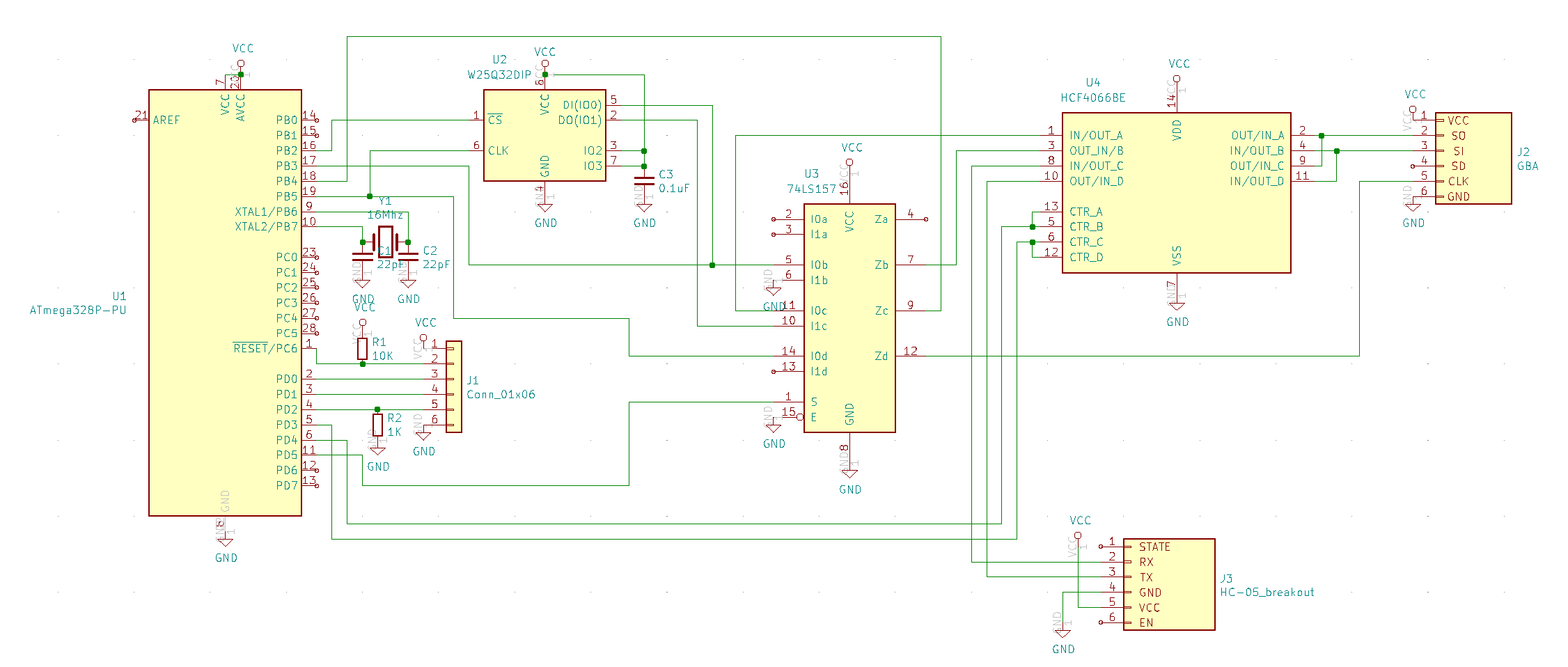
Additional 74XX157 quad 2-input multiplexer makes possible to multiplex SPI to read from the flash chip and send the multiboot, it alternates byte reads from the flash chip and send them to the GBA. Then using hcf4066 switch link port pins are switched from the spi to the HC-05 uart pins.
The whole circuit runs at 3.3V provided by GBA through the link port.
Final version of the circuit includes a 6 pin port that allows to reprogram the atmega if necessary. Also it lets to turn the atmega into a special write mode to reprogram the flash memory. You can find the code for the memory programmer here it needs to run in a separate board (not arduino due to the large size of the rom to program, I used a Stellaris Launchpad)
There's a KiCad project here that includes this diagram:
ESP32 as a bluetooth Gamepad: Thanks to the Bluecubemod from Nathan Reeves I learned how to turn ESP32 into a bluetooth gamepad https://github.com/NathanReeves/BlueCubeMod
HC-05 as bluetooth HID device:
https://www.youtube.com/watch?v=y8PcNbAA6AQ
https://www.youtube.com/watch?v=BBqsVKMYz1I
GBA Multiboot:
http://www.akkit.org/info/gbatek.htm
https://github.com/akkera102/gba_01_multiboot
https://github.com/ataulien/elm-gba-multiboot
https://github.com/cartr/MSMCcable
| Qty | Value | Footprint | References |
|---|---|---|---|
| 2 | 22pF | Capacitor_THT:C_Disc_D4.7mm_W2.5mm_P5.00mm | C1, C2 |
| 1 | 0.1uF | Capacitor_THT:C_Disc_D4.7mm_W2.5mm_P5.00mm | C3 |
| 1 | 10K | Resistor_THT:R_Axial_DIN0207_L6.3mm_D2.5mm_P10.16mm_Horizontal | R1 |
| 1 | 16Mhz | Crystal:Resonator-2Pin_W10.0mm_H5.0mm | Y1 |
| 1 | 1K | Resistor_THT:R_Axial_DIN0207_L6.3mm_D2.5mm_P10.16mm_Horizontal | R2 |
| 1 | 74LS157 | Package_DIP:DIP-16_W7.62mm | U3 |
| 1 | ATmega328P-PU | Package_DIP:DIP-28_W7.62mm | U1 |
| 1 | Conn_01x06 | Connector_PinSocket_2.00mm:PinSocket_1x06_P2.00mm_Vertical | J1 |
| 1 | GBA | Connector_PinSocket_2.00mm:PinSocket_1x06_P2.00mm_Vertical | J2 |
| 1 | HC-05_breakout | Sensor:HC-05_breakout | J3 |
| 1 | HCF4066BE | Package_DIP:DIP-14_W7.62mm | U4 |
| 1 | W25Q32DIP | Package_DIP:DIP-8_W7.62mm | U2 |
ksr/YACC1-D
YACC1 (Yet Another Custom CPU) - definitive tree: hardware, firmware, software, tools and docs for the hand-built TTL computer. Supersedes ksr/YACC1-2020.

Raggii/RocketryIgniter
To design and prototype a dual ignition system that can receive commands over UART and CANBUS. The device must be able to receive commands that arm and fire two separate but identical ignition circuits while also…


Nakazoto/CenturionComputer
This is just a simple backup of all the files related to the Centurion that I have stored on my HD. The Wiki itself has far more in-depth information about the Centurion and it's individual cards.

The-Invent0r/8-bit-Computer-PCB
These are the KiCAD files for my 8-Bit Computer.

SukkoPera/OpenAmiga500FastRamExpansion
4/8 MB Fast RAM Expansion for the Commodore Amiga 500

RetroStack/TRS-80-Model-I-G-E1
Hardware Replica of the TRS-80 Model I Revision G

SukkoPera/OpenAmiga600FastRamExpansion
4 MB Fast RAM Expansion for the Commodore Amiga 600
13 parts, built around the ATMEGA328P-PU and 74LS157PC. The full list of its parts is on this page, with links to each part's symbol and footprint where PCBKit's library has them.
From the Shyri/gba-bt-hid repository on GitHub, at the commit this page was made from: the board is circuit/GBA-BT-HID.kicad_pcb. PCBKit opens the board in the browser, with nothing to install.
Its repository publishes it under the GPL-3.0 licence: you may reuse it on that licence's terms (keep the author's notice, and for a copyleft licence share your changes alike).