
2 layers51.5 × 42 mm
SolarBasedRealTimeGreenHouseAutomation
prashantbhandary/SolarBasedRealTimeGreenHouseAutomation
13 parts1

 Sanjog34/SignLanguage_Glove1
This repository contains the source code, hardware design files, datasets, and documentation for the Smart Glove for Real-Time Nepali Sign Language (NSL) to Speech Translation system.
SignLanguage Glove is an open-source printed circuit board by Sanjog34, from the Sanjog34/SignLanguage_Glove repository on GitHub. It is a 2-layer board of 56.8 × 50.4 mm with 19 parts on 29 nets, routed with 95 tracks and 0 vias.
It is built around the ESP32-WROOM-32E-N8R2. Its parts include 10 connectors, 8 resistors and 1 IC. It belongs with the ESP32 boards of this library.


This repository contains the source code, hardware design files, datasets, and documentation for the Smart Glove for Real-Time Nepali Sign Language (NSL) to Speech Translation system. Developed as a final engineering project at Pashchimanchal Campus, Tribhuvan University, this wearable system translates static and dynamic Nepali Sign Language gestures into spoken audio output in real time to bridge the communication gap between the deaf/hard-of-hearing community and non-signers.
Communication is essential, yet most non-signers in Nepal do not understand Nepali Sign Language (NSL). This project presents a wearable smart glove system integrating 8 flex sensors (capturing joint flexion across MCP and PIP finger joints) and an MPU6050 6-axis IMU mounted on an ESP32 microcontroller. Sensor data is transmitted via Bluetooth to a host environment, where a dual machine learning model pipeline performs real-time classification:
Across 320 real-time trials, the full system achieved an overall accuracy of 93.1%, with average translation latencies of 0.5 seconds for static gestures and ~2.0 seconds for dynamic gestures.
+-------------------------------------------------------------+
|                     WEARABLE SMART GLOVE                    |
|  [8x Flex Sensors (PIP/MCP Joints)]  [MPU6050 6-Axis IMU]   |
+------------------------------+------------------------------+
                               | Analog/I2C
                               v
+-------------------------------------------------------------+
|                     ESP32 MICROCONTROLLER                   |
|   - Signal Acquisition & Filtering                          |
|   - Feature Vector Assembly & Gyroscope Accumulation        |
+------------------------------+------------------------------+
                               | Bluetooth Serial Stream
                               v
+-------------------------------------------------------------+
|                      HOST COMPUTER                          |
|  +-------------------------------------------------------+  |
|  |             Motion Detection Logic                    |  |
|  |     (Rolling Buffer Gyro Variance Thresholding)       |  |
|  +---------------------------+---------------------------+  |
|                              |                              |
|              +---------------+---------------+              |
|              | Static                        | Dynamic      |
|              v                               v              |
| +---------------------+ +---------------------+ |NumPy, Pandas, Scikit-Learn, TensorFlow / Keras.gTTS (Google Text-to-Speech) library.idxUp, idxLow, midUp, midLow, ringUp, ringLow).thumb, pinky).Sampling is executed at 60 ms intervals. Each feature vector consists of 17 parameters:
x = [idxUp, idxLow, midUp, midLow, ringUp, ringLow, thumb, pinky, a_x, a_y, a_z, g_x, g_y, g_z, acc_g_x, acc_g_y, acc_g_z]
.csv format). Dynamic gyro parameters were excluded during static training.Static Gestures (Random Forest Classifier)
StandardScaler. Hyperparameters tuned using GridSearchCV.n_estimators=30, max_samples=0.70, Train/Test Split: 70/30.Dynamic Gestures (LSTM Network)
MinMaxScaler..joblib) $
ightarrow$ Output static gesture..h5) $
ightarrow$ Output dynamic gesture.Predicted labels map to pre-synthesized Devanagari audio files generated via the gTTS library. The system executes immediate audio playback upon gesture classification completion.
The complete hardware-software system was evaluated across 320 real-time trials (20 trials per gesture across 16 gestures).
| Gesture Class | Gesture Type | Correct | Incorrect | Accuracy (%) |
|---|---|---|---|---|
| Namaste | Dynamic | 15 | 5 | 75.0% |
| Mero | Dynamic | 16 | 4 | 80.0% |
| Naam | Dynamic | 20 | 0 | 100.0% |
| Sanjog | Dynamic | 18 | 2 | 90.0% |
| Ho | Dynamic | 20 | 0 | 100.0% |
| Malai | Dynamic | 18 | 2 | 90.0% |
| Chinnu | Dynamic | 19 | 1 | 95.0% |
| ek (1) | Static | 19 | 1 | 95.0% |
| dui (2) | Static | 20 | 0 | 100.0% |
| tin (3) | Static | 20 | 0 | 100.0% |
| char (4) | Static | 17 | 3 | 85.0% |
| ka | Static | 20 | 0 | 100.0% |
| kha | Static | 20 | 0 | 100.0% |
| ga | Static | 18 | 2 | 90.0% |
| gha | Static | 18 | 2 | 90.0% |
| nga | Static | 20 | 0 | 100.0% |
| OVERALL | System Total | 298 | 22 | 93.1% |
The minimal delta between training and test metrics confirms high model generalization with minimal risk of overfitting.
An end-to-end video demonstration showing real-time sign recognition, dual-model inference switching, and instant audio vocalization is available below:
The complete academic major project report submitted to the Department of Electronics and Computer Engineering, Pashchimanchal Campus, IOE, Tribhuvan University, is included in this repository:
📄 Download Full Major Project Report (PDF)
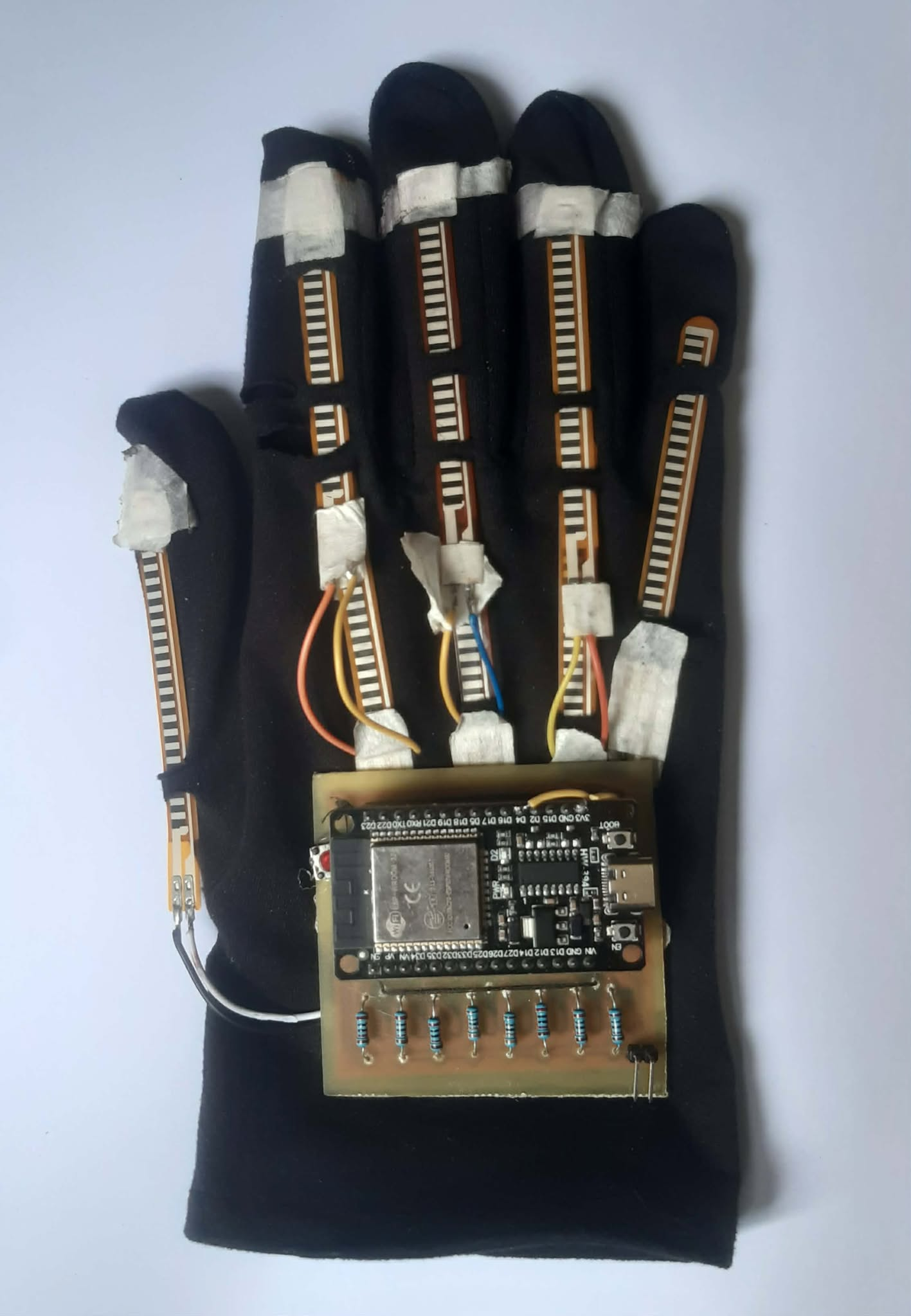
Physical wearable prototype featuring 8 integrated flex sensors, custom wiring harness, and glove-mounted ESP32/MPU6050 enclosure.
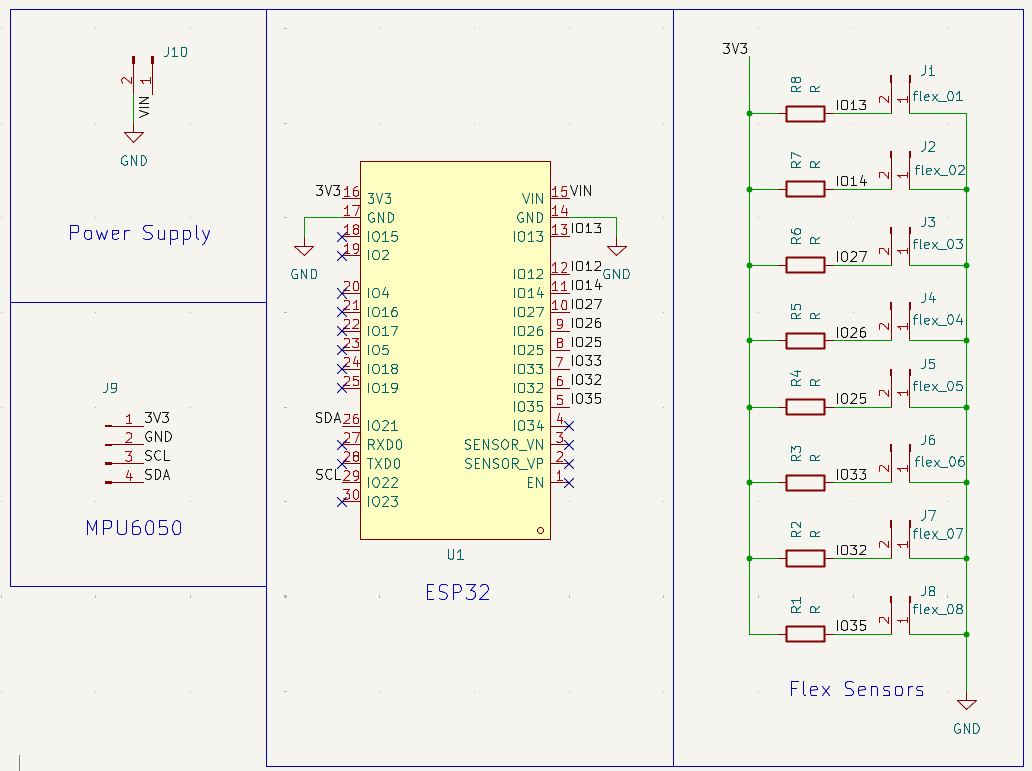
KiCad EDA PCB schematic showing power regulation, ESP32 ADC pin routing for flex sensor voltage dividers, and I2C lines for MPU6050.
Project Team (PAS078BEI Batch):
Supervisor: Asst. Prof. Khem Raj Koirala
Department: Department of Electronics and Computer Engineering, Pashchimanchal Campus, IOE, Tribhuvan University.
| Qty | Value | Footprint | References |
|---|---|---|---|
| 8 | Conn_01x02_Pin | symbols_footprint:PinHeader_1x02_P2.54mm_Vertical smd custom | J1, J2, J3, J4, J5, J6, J7, J8 |
| 8 | R | Resistor_THT:R_Axial_DIN0207_L6.3mm_D2.5mm_P10.16mm_Horizontal | R1, R2, R3, R4, R5, R6, R7, R8 |
| 1 | Conn_01x02_Pin | Connector_PinHeader_2.54mm:PinHeader_1x02_P2.54mm_Horizontal | J10 |
| 1 | Conn_01x04_Pin | Connector_PinHeader_2.54mm:PinHeader_1x04_P2.54mm_Vertical | J9 |
| 1 | ESP32-WROOM-32E-N8R2 | symbols_footprint:esp32 dev board | U1 |
prashantbhandary/SolarBasedRealTimeGreenHouseAutomation


awakesid/MARS---Multi-agent-Robot-for-Warehouse-Automation
Modular multi-robot warehouse automation system using sensor fusion (encoders + overhead camera/ArUco) for localization, with ROS 2 based central coordination and ESP32-based robot firmware.


sumit123hub/Mobile-PCB-Files-
I always dreamed of building my own mobile system. This repo documents my journey designing a custom ESP32 PCB featuring a GSM module, display interface, and complete Battery Management System (BMS).

tristan-yk/Aroma
PCB design files and firmware for multi-channel diffuser driver board.

It measures 56.8 × 50.4 mm and has 2 copper layers, 1.6 mm thick.
19 parts, built around the ESP32-WROOM-32E-N8R2. The full list of its parts is on this page, with links to each part's symbol and footprint where PCBKit's library has them.
From the Sanjog34/SignLanguage_Glove repository on GitHub, at the commit this page was made from: the board is PCB/PCB.kicad_pcb and its schematic PCB/PCB.kicad_sch. PCBKit opens the board in the browser, with nothing to install.
Its repository states no licence, so its author keeps all rights: ask Sanjog34 before reusing the design.