
2 layers33.3 × 6.3 mm
Stm8s001rs485
TG9541/stm8s001rs485
A narrow KiCad made PCB with STM8S001J3, RS485 driver and DS1621S Thermometer, e.g., for STM8EF-MODBUS
21 parts20MIT
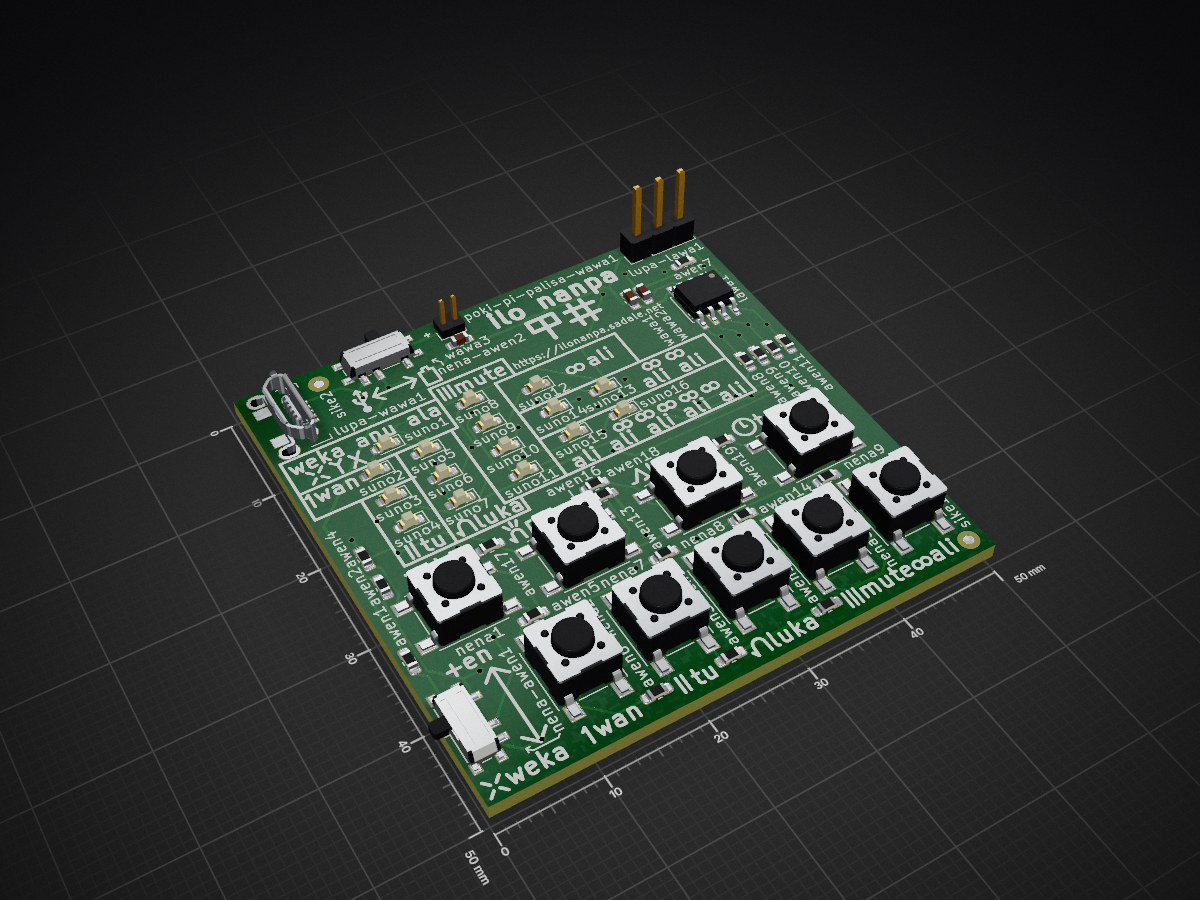
 SadaleNet/ilonanpa13
ilo nanpa li ilo pi nasin nanpa pi toki pona.
Ilonanpa is an open-source printed circuit board by SadaleNet, from the SadaleNet/ilonanpa repository on GitHub, published under the BSD-2-Clause licence. It is a 2-layer board of 50 × 50 mm with 81 parts on 29 nets, routed with 402 tracks and 48 vias.
It is built around the STM8S001J3M3. It belongs with the STM8 boards of this library.
| Qty | Value | Footprint | References |
|---|---|---|---|
| 26 | oko | TestPoint:TestPoint_Pad_D1.0mm | oko1, oko2, oko10, oko11, oko12, oko13, oko14, oko15, oko16, oko17, oko18, oko19, oko20, oko21, oko22, oko23 +10 |
| 6 | 20k | Resistor_SMD:R_0603_1608Metric_Pad1.05x0.95mm_HandSolder | awen5, awen6, awen14, awen15, awen18, awen19 |
| 5 | 120 | Resistor_SMD:R_0603_1608Metric_Pad1.05x0.95mm_HandSolder | awen7, awen8, awen9, awen10, awen11 |
| 5 | 470k | Resistor_SMD:R_0603_1608Metric_Pad1.05x0.95mm_HandSolder | awen1, awen2, awen4, awen13, awen17 |
| 4 | mute | LED_SMD:LED_0603_1608Metric_Pad1.05x0.95mm_HandSolder | suno8, suno9, suno10, suno11 |
| 3 | 10k | Resistor_SMD:R_0603_1608Metric_Pad1.05x0.95mm_HandSolder | awen3, awen12, awen16 |
| 3 | luka | LED_SMD:LED_0603_1608Metric_Pad1.05x0.95mm_HandSolder | suno5, suno6, suno7 |
| 2 | Fiducial_1mm_Dia_2mm_Outer | Fiducial:Fiducial_1mm_Dia_2mm_Outer | sike1, sike2 |
| 2 | ali ali | LED_SMD:LED_0603_1608Metric_Pad1.05x0.95mm_HandSolder | suno13, suno14 |
| 2 | ali ali ali ali ali | LED_SMD:LED_0603_1608Metric_Pad1.05x0.95mm_HandSolder | suno15, suno16 |
| 2 | tu | LED_SMD:LED_0603_1608Metric_Pad1.05x0.95mm_HandSolder | suno3, suno4 |
| 1 | 100n | Capacitor_SMD:C_0603_1608Metric_Pad1.05x0.95mm_HandSolder | wawa1 |
| 1 | 10u | Capacitor_SMD:C_0603_1608Metric_Pad1.05x0.95mm_HandSolder | wawa3 |
| 1 | 2u2 | Capacitor_SMD:C_0603_1608Metric_Pad1.05x0.95mm_HandSolder | wawa2 |
| 1 | STM8S001J3 | Package_SO:SOIC-8_3.9x4.9mm_P1.27mm | lawa1 |
| 1 | USB_B_Micro | USB_Micro_B:USB_Micro-B_A01SB141B1-067 | lupa-wawa1 |
| 1 | ala | Button_Switch_SMD:SW_SPST_PTS645 | nena1 |
| 1 | ali | Button_Switch_SMD:SW_SPST_PTS645 | nena6 |
| 1 | ali | LED_SMD:LED_0603_1608Metric_Pad1.05x0.95mm_HandSolder | suno12 |
| 1 | ante wawa | Button_Switch_SMD:SW_SPDT_PCM12 | nena-awen2 |
| 1 | en anu weka | Button_Switch_SMD:SW_SPDT_PCM12 | nena-awen1 |
| 1 | kama | Button_Switch_SMD:SW_SPST_PTS645 | nena8 |
| 1 | luka | Button_Switch_SMD:SW_SPST_PTS645 | nena4 |
| 1 | lupa lawa | Connector_PinHeader_2.54mm:PinHeader_1x03_P2.54mm_Vertical | lupa-lawa1 |
| 1 | mute | Button_Switch_SMD:SW_SPST_PTS645 | nena5 |
| 1 | pana | Button_Switch_SMD:SW_SPST_PTS645 | nena7 |
| 1 | tenpo | Button_Switch_SMD:SW_SPST_PTS645 | nena9 |
| 1 | tu | Button_Switch_SMD:SW_SPST_PTS645 | nena3 |
| 1 | wan | Button_Switch_SMD:SW_SPST_PTS645 | nena2 |
| 1 | wan | LED_SMD:LED_0603_1608Metric_Pad1.05x0.95mm_HandSolder | suno2 |
| 1 | wawa palisa "AAA" tu wan | Connector_PinHeader_1.27mm:PinHeader_1x02_P1.27mm_Vertical | poki-pi-palisa-wawa1 |
| 1 | weka anu ala | LED_SMD:LED_0603_1608Metric_Pad1.05x0.95mm_HandSolder | suno1 |
TG9541/stm8s001rs485
A narrow KiCad made PCB with STM8S001J3, RS485 driver and DS1621S Thermometer, e.g., for STM8EF-MODBUS


TG9541/stm8s001ch330
USB Dongle STM8S001J3M3 with CH330N, e.g. for STM8 eForth


slu4coder/Minimal-UART-Computer-1-2
Legacy: Version 1 and 2 of my TTL-only CPU featuring UART I/O, an expansion port, 512KB SSD at up to 10MHz clock speed


zynthian/zynthian-hw
Zynthian hardware stuff: PCBs, schemes, parts specifications, pin assignment, ...
It measures 50 × 50 mm and has 2 copper layers, 1.6 mm thick.
81 parts, built around the STM8S001J3M3. The full list of its parts is on this page, with links to each part's symbol and footprint where PCBKit's library has them.
From the SadaleNet/ilonanpa repository on GitHub, at the commit this page was made from: the board is pcb/ilonanpa.kicad_pcb. PCBKit opens the board in the browser, with nothing to install.
Its repository publishes it under the BSD-2-Clause licence: you may reuse it on that licence's terms (keep the author's notice, and for a copyleft licence share your changes alike).