16 layers25.4 × 14.1 mm

 Sacul518/DeskGuy
Click here to purchase one from the Adafruit shop
BH1750 reference is an open-source printed circuit board by Sacul518, from the Sacul518/DeskGuy repository on GitHub. It is a 2-layer board of 25.4 × 17.8 mm with 26 parts on 10 nets, routed with 155 tracks and 16 vias.
It is built around the AP2112K-3.3, SM04B-SRSS-TB and BSS138BKS. Its parts include 4 capacitors, 4 resistors, 2 ICs, 1 diode and 1 transistor.


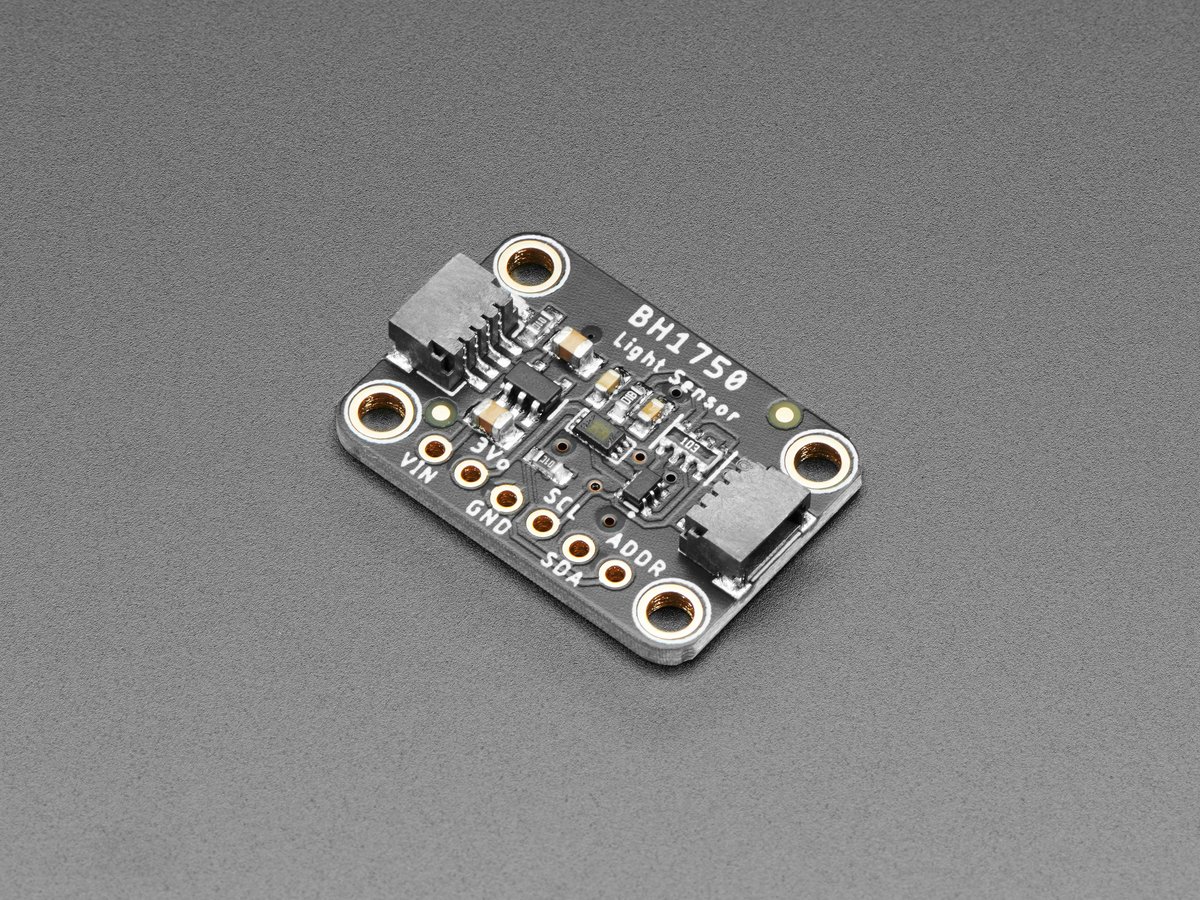
Click here to purchase one from the Adafruit shop
PCB files for the Adafruit BH1750 Light Sensor - STEMMA QT / Qwiic.
Format is EagleCAD schematic and board layout
This is the BH1750 16-bit Ambient Light Sensor from Rohm. Because of how important it is to humans and most other living things, sensing the amount of light in an environment is a common place to get started when learning to work with microcontrollers and sensors. Should we turn up the brightness of our display or dim it to save power? Which direction should your robot move to stay in an area with the most light? Is it day or night? All of these questions can be answered with the help of the BH1750. It's a small, capable and inexpensive light sensor that you can include into your next project to add the detection and measurement of light.
Adafruit invests time and resources providing this open source design, please support Adafruit and open-source hardware by purchasing products from Adafruit!
Designed by Limor Fried/Ladyada for Adafruit Industries.
Creative Commons Attribution/Share-Alike, all text above must be included in any redistribution. See license.txt for additional details.
| Qty | Value | Footprint | References |
|---|---|---|---|
| 4 | MOUNTINGHOLE2.5 | MOUNTINGHOLE_2.5_PLATED | U$1, U$17, U$19, U$21 |
| 2 | STEMMAQT | U$30, U$31 | |
| 2 | 10K | 0603-NO | R1, R2 |
| 2 | 10uF | 0805-NO | C2, C3 |
| 2 | FIDUCIAL_1MM | FIDUCIAL_1MM | FID3, FID4 |
| 2 | SM04B-SRSS-TB | JST_SH4 | CONN3, CONN4 |
| 1 | SOLDERJUMPER_ARROW_NOPASTE | SJ1 | |
| 1 | ADAFRUIT_3.5MM | U$22 | |
| 1 | PCBFEAT-REV-040 | U$25 | |
| 1 | 1X06_ROUND_70 | JP1 | |
| 1 | 0.1uF | 0603-NO | C1 |
| 1 | 10K | RESPACK_4X0603 | R3 |
| 1 | 1K | 0603-NO | R4 |
| 1 | 1uF | 0603-NO | C4 |
| 1 | AP2112K-3.3 | SOT23-5 | U2 |
| 1 | BH1750 | WSOF-6 | IC1 |
| 1 | BSS138BKS | SOT363 | Q2 |
| 1 | GREEN | CHIPLED_0603_NOOUTLINE | D1 |


wszeto9/ESP32-S3-HUB75-Driver
This board serves as the Matrix Display driver for MIT's 2.007 gameboards in Spring 2024 and Spring 2025. The board can take 4 button inputs, Stemma-QT I2C sensors, and breaks out 8 GPIO pins for future use.

CatoLynx/Kettcar_Control_HW
Central controller for my hoverboard-powered Kettcar


radutolontan/BASM_Pocket_Museum
The Pocket Lab is the next-generation approach to science education. Designed by the Bucharest Applied STEAM Museum, it brings scientific exploration into anyone's hands.

atuleu/aristeus
Yet another Open Source Hardware Apiary project for monitoring bees.

It measures 25.4 × 17.8 mm and has 2 copper layers, 1.6 mm thick.
26 parts, built around the AP2112K-3.3, SM04B-SRSS-TB and BSS138BKS. The full list of its parts is on this page, with links to each part's symbol and footprint where PCBKit's library has them.
From the Sacul518/DeskGuy repository on GitHub, at the commit this page was made from: the board is hardware/pcb/libs/BH1750/Adafruit-BH1750-PCB/BH1750_reference.kicad_pcb and its schematic hardware/pcb/DeskGuy/DeskGuy.kicad_sch. PCBKit opens the board in the browser, with nothing to install.
Its repository states no licence, so its author keeps all rights: ask Sacul518 before reusing the design.