2 layers66.9 × 74.5 mm
 Robert-Riordan-UCD/8_Bit_CPU_FPGA1
An 8-bit CPU running on a TangNano 9k FPGA. Written in SystemVerilog and tested with PYUVM.
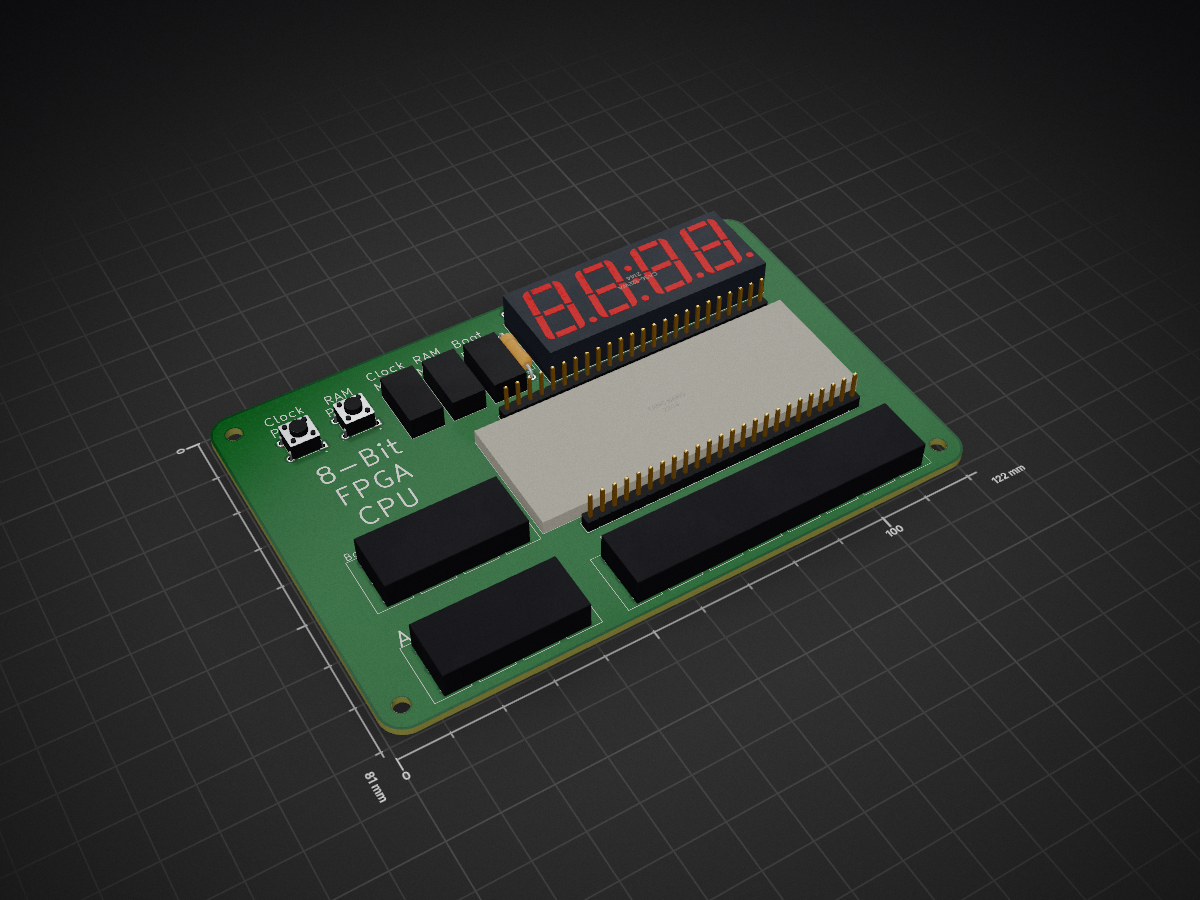
8-bit cpu is an open-source printed circuit board by Robert-Riordan-UCD, from the Robert-Riordan-UCD/8_Bit_CPU_FPGA repository on GitHub. It is a 2-layer board of 122 × 81 mm with 20 parts on 52 nets, routed with 165 tracks and 0 vias.
Its parts include 8 switches, 4 resistors, 2 ICs and 2 connectors. It belongs with the fPGA and programmable logic and retro computing and games boards and the FPGA and CPLD boards of this library.
This is an 8-bit CPU design running on a Tang Nano 9k FPGA. The CPU design is based on Ben Eaters Breadboard CPU, which is based on the Simple As Possible Computer.
The CPU is made of 11 modules, which are designed in SystemVerilog and verified using pyuvm.
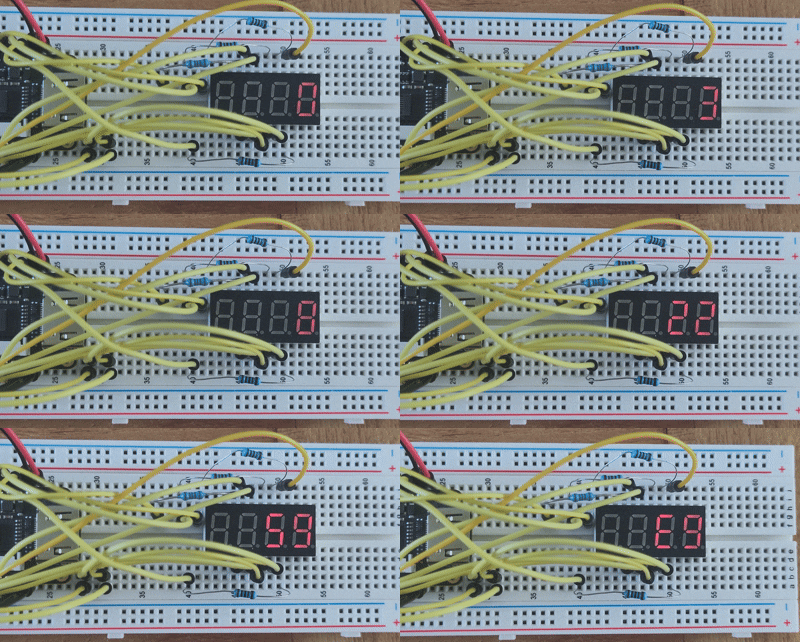
This is a gif of the CPU calculating the fibonacci sequence and displaying it (in hexadecimal).
This project is not fully complete yet and is currently only tested on my personal laptop and raspberry pi. However, this is the current process. (I am developing on Ubuntu 24 and used this guide to get up and running using an open source toolchain)
The following programs are required:
yosys for synthisis.nextpnr for place and route, and bitstream generation.openFPGALoader for loading the bitstream.sudo apt insatll yosys nextpnr-gowin openfpgaloader
Clone and navigate to the repository
git clone https://github.com/Robert-Riordan-UCD/8_Bit_CPU_FPGA
cd ./8_Bit_CPU_FPGA/make all upload
pyuvm is required for testing.
sudo apt install pyuvm
To test each module navigate to the verif directory for that module and run make.
cd ./verif/<module>/
make| Module | RTL | Verified | Runs on FPGA |
|---|---|---|---|
| Clock | ✅ | ✅ | ✅ |
| Program Counter | ✅ | ✅ | ✅ |
| A register | ✅ | ✅ | ✅ |
| B Register | ✅ | ✅ | ✅ |
| Memory Address Register | ✅ | ✅ | ✅ |
| Instruction Register | ✅ | ✅ | ✅ |
| Random Access Memory | ✅ | ✅ | ✅ |
| Arithmetic Logic Unit | ✅ | ✅ | ✅ |
| Control | ✅ | ✅ | ✅ |
| Output | ✅ | ✅ | ✅ |
| Bus | ✅ | ✅ | ✅ |
| Bootloader | ✅ | ✅ | ✅ |
| Top | ✅ | ❌ | ✅ |
The output is currently in hexadecimal, because there was not enough LUTs on the Tang Nano 9k to implement a naive approach to decimal conversion using division. I will hopefully update this to a better approach soon.
| Qty | Value | Footprint | References |
|---|---|---|---|
| 4 | 1k | Resistor_THT:R_Axial_DIN0309_L9.0mm_D3.2mm_P12.70mm_Horizontal | R1, R2, R3, R4 |
| 4 | MountingHole | MountingHole:MountingHole_3.2mm_M3 | H1, H2, H3, H4 |
| 2 | Conn_01x24_Socket | Connector_PinHeader_2.54mm:PinHeader_1x24_P2.54mm_Vertical | J1, J2 |
| 2 | ~ | footprints:4xDoubleThrowSwitch | SW7, SW8 |
| 1 | BOOTLOAD EN | footprints:DoubleThrowSwitch | SW3 |
| 1 | CA56-12EWA | Display_7Segment:CA56-12EWA | U2 |
| 1 | CLK MODE | footprints:DoubleThrowSwitch | SW1 |
| 1 | CLK PULSE | footprints:tactile_switch | SW2 |
| 1 | RAM MODE | footprints:DoubleThrowSwitch | SW4 |
| 1 | RAM PULSE | footprints:tactile_switch | SW5 |
| 1 | Tang Nano | footprints:TangNano | U1 |
| 1 | ~ | footprints:8xDoubleThrowSwitch | SW6 |


atopile/atopile
Design circuit boards with code! ✨ Get software-like design reuse 🚀, validation, version control and collaboration in hardware; starting with electronics ⚡️

davidphilipbarr/Sweep
Sweep - a small promicro based keyboard inspired by the Ferris.

rusefi/rusefi
rusefi - GPL internal combustion engine control unit

hoglet67/RGBtoHDMI
Bare-metal Raspberry Pi project that provides pixel-perfect sampling of Retro Computer RGB/YUV video and conversion to HDMI

hackclub/OnBoard
💡 Join 1,000 teenagers and make your first PCB with a $100 grant!

FreeYourStream/freedeck-hardware
all the stuff you need to build your own FreeDeck
It measures 122 × 81 mm and has 2 copper layers, 1.6 mm thick.
20 parts. The full list of its parts is on this page, with links to each part's symbol and footprint where PCBKit's library has them.
From the Robert-Riordan-UCD/8_Bit_CPU_FPGA repository on GitHub, at the commit this page was made from: the board is pcb/8-bit-cpu.kicad_pcb and its schematic pcb/8-bit-cpu.kicad_sch. PCBKit opens the board in the browser, with nothing to install.
Its repository states no licence, so its author keeps all rights: ask Robert-Riordan-UCD before reusing the design.