4 layers93 × 53.4 mm
HL2IOBoard
jimahlstrom/HL2IOBoard
A PCB added to the HL2 with IO resources to control filters and antennas
117 parts56

 Rahix/pavu-mixer25
"Hardware Mixer" for PulseAudio
Pavu Mixer Prototype is an open-source printed circuit board by Rahix, from the Rahix/pavu-mixer repository on GitHub. It is a 2-layer board of 155.9 × 91.9 mm with 81 parts on 99 nets, routed with 581 tracks and 151 vias.
It is built around the 74HC595, PCA9536D and PCA9555D. Its parts include 42 resistors, 7 capacitors, 5 ICs, 1 diode and 1 connector. It belongs with the audio and music boards of this library.


 Pavu Mixer
 is a hardware mixing desk for controlling
PulseAudio streams on
a connected computer. Think of it as a hardware version of
pavucontrol.
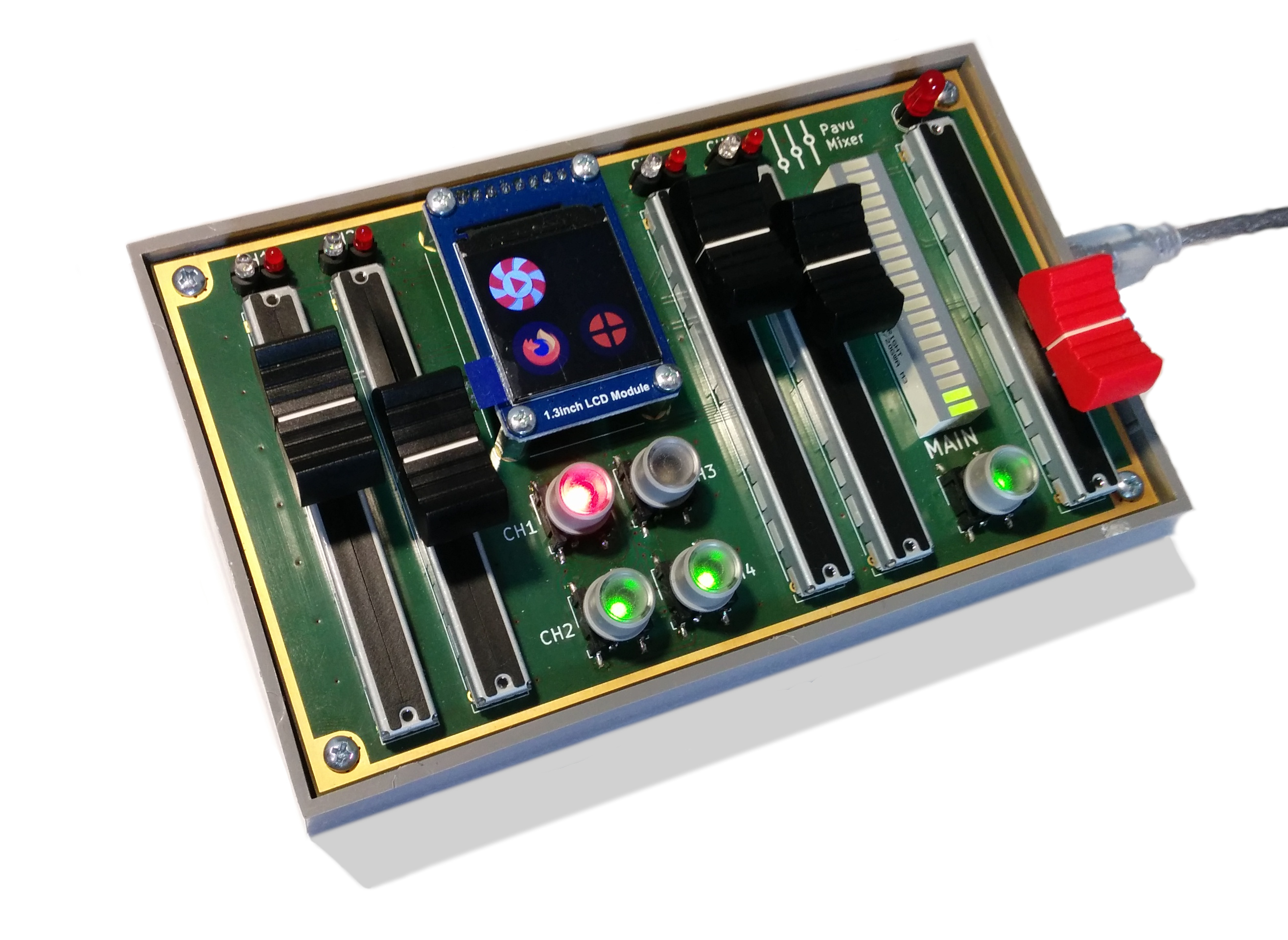
More pictures in Eyecandy/.
The Pavu Mixer is currently just a PCB fitted as the front plate of a console enclosure. This remedies the need for a custom front plate. Beneath it, an STM32F3DISCOVERY eval board is used as the controller. Connection to the computer is done over USB.
Following are the capabilities of the current hardware:
waveshare-display/ subdirectory)The firmware on the STM32F3DISCOVERY board exposes all of the "UI"
(faders, buttons, indicators, display) to the host via a custom USB class.
Messages are serialized using postcard.
On the host, a daemon is running which communicates to the hardware and keeps track of PulseAudio state. It has a configuration file for selecting which channel controls which applications. Streams are then attached to the mixer channels automatically when they appear.
The firmware and host-side software are still in development - these features are subject to change.
Right now, only the Pavu Mixer hardware is supported. As this board is not commercially available, but a hardware mixer for PulseAudio could be interesting for other people as well, I am open to extend the host-daemon to support other boards as well. For example, there are a lot of MIDI-based digital audio mixers which would be a good candidate for support. Please open an issue on GitHub or contact me directly if interested.
| Path | Contents |
|---|---|
Eyecandy/ | Pictures and "rendered" schematic (Pavu-Mixer-Schematic.pdf). |
Hardware/ | KiCAD project for the interface board & other hardware related files. |
hardware-tests/ | Test-firmware for demonstrating functionality of all parts of the hardware. |
common/ | Definitions shared between firmware and host-software (for postcard serdes). |
firmware/ | Firmware for the STM32F3DISCOVERY board. |
host-daemon/ | Host-side daemon for mixer communication and PulseAudio interaction. |
waveshare-display/ | Driver for the LCD screen (see its README for details). |
It is a difficult story... Individual parts of this project are licensed under different terms:
Hardware/ directory (exception below) are licensed under
the CERN-OHL-W.Hardware/3D are licensed under MIT.waveshare-display/ is dual licensed under Apache 2/MIT
as detailed in its own README.common/, firmware/,
hardware-tests/, and host-daemon/) are licensed under the
GPL v3.Unless you explicitly state otherwise, any contribution intentionally submitted for inclusion in the work by you, as defined in the Apache-2.0 license, shall be licensed as above, without any additional terms or conditions.
| Qty | Value | Footprint | References |
|---|---|---|---|
| 30 | 220 | Resistor_SMD:R_0805_2012Metric_Pad1.20x1.40mm_HandSolder | R1, R2, R10, R11, R12, R13, R14, R15, R16, R17, R18, R19, R20, R22, R24, R26 +14 |
| 6 | 100n | Capacitor_SMD:C_0805_2012Metric_Pad1.18x1.45mm_HandSolder | C1, C2, C3, C4, C5, C6 |
| 6 | 10k | Resistor_SMD:R_0805_2012Metric_Pad1.20x1.40mm_HandSolder | R32, R34, R36, R38, R40, R42 |
| 5 | 10k | Pavu-Mixer-Prototype:Potentiometer_Alps_RS60_Double_Slide | VOL_CH1, VOL_CH2, VOL_CH3, VOL_CH4, VOL_MAIN1 |
| 5 | SW_MEC_5G_2LED | Pavu-Mixer-Prototype:SW_MEC_5GSH9 | MUTE_CH1, MUTE_CH2, MUTE_CH3, MUTE_CH4, MUTE_MAIN1 |
| 4 | 100 | Resistor_SMD:R_0805_2012Metric_Pad1.20x1.40mm_HandSolder | R21, R23, R25, R27 |
| 4 | LED | LED_THT:LED_D3.0mm | DS1, DS2, DS3, DS4 |
| 4 | LED | LED_THT:LED_D3.0mm_Clear | DA1, DA2, DA3, DA4 |
| 4 | MountingHole_Pad | MountingHole:MountingHole_3.5mm_Pad_Via | H1, H2, H3, H4 |
| 3 | 74HC595 | Package_SO:SOIC-16_3.9x9.9mm_P1.27mm | U1, U2, U3 |
| 2 | 1k | Resistor_SMD:R_0805_2012Metric_Pad1.20x1.40mm_HandSolder | R29, R30 |
| 1 | 100u | Capacitor_SMD:CP_Elec_5x5.8 | C7 |
| 1 | Conn_02x16_Odd_Even | Connector_PinHeader_2.54mm:PinHeader_2x16_P2.54mm_Vertical | J1 |
| 1 | LED | LED_THT:LED_D5.0mm | DS_MAIN1 |
| 1 | LED_BARGRAPH_20 | Pavu-Mixer-Prototype:LED_BARGRAPH_20 | D1 |
| 1 | PCA9536D | Package_SO:SOIC-8_3.9x4.9mm_P1.27mm | U5 |
| 1 | PCA9555D | Package_SO:SOIC-24W_7.5x15.4mm_P1.27mm | U4 |
| 1 | Waveshare_LCD_240X240 | Pavu-Mixer-Prototype:Waveshare_LCD_240X240 | DISP1 |
The 80 most common of 81 parts.
jimahlstrom/HL2IOBoard
A PCB added to the HL2 with IO resources to control filters and antennas

hb020/batterymeter
Handheld Battery AC and Time Domain characterization tool on Attiny series 2


etet100/cnc_pendant
This project was designed with simplicity and practicality in mind, focusing on essential functions like jogging and basic machine control (start/stop/pause) rather than attempting to replicate all CNC controller…

joshitha-c/rf_detector
A portable, custom-built RF signal scanner and power detector designed for knowing wireless signals, measuring signal strength and can be used to be safe.
It measures 155.9 × 91.9 mm and has 2 copper layers, 1.6 mm thick.
81 parts, built around the 74HC595, PCA9536D and PCA9555D. The full list of its parts is on this page, with links to each part's symbol and footprint where PCBKit's library has them.
From the Rahix/pavu-mixer repository on GitHub, at the commit this page was made from: the board is Hardware/Pavu-Mixer-Prototype.kicad_pcb. PCBKit opens the board in the browser, with nothing to install.
Its repository states no licence, so its author keeps all rights: ask Rahix before reusing the design.