This is ProGenEDA’s public engineering record. It makes the work behind the product inspectable—from circuit requests and qualification reports through to native files that open in Proteus, KiCad, EasyEDA Pro, and…
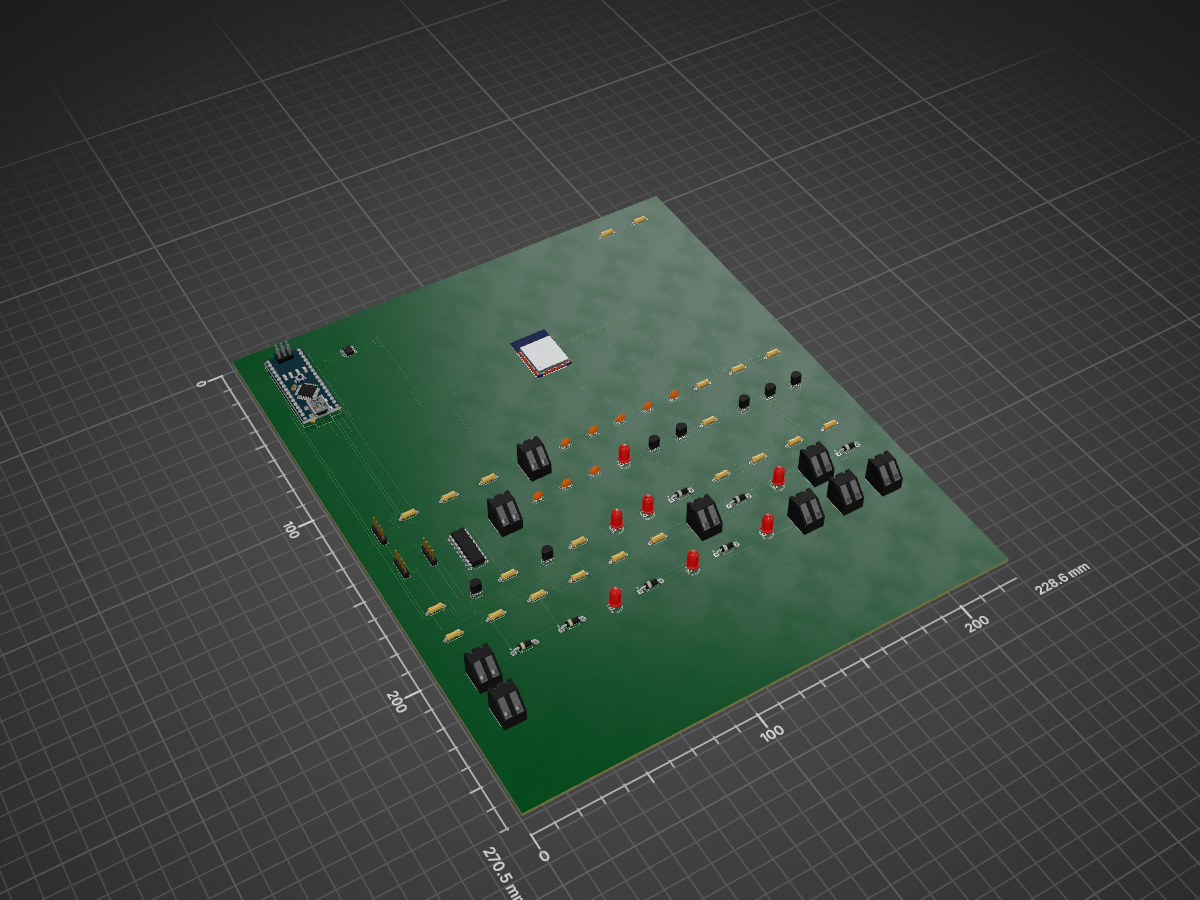
OPEN THIS PROJECT mj036 COMBINATION is an open-source printed circuit board by ProGenEDA, from the ProGenEDA/Public repository on GitHub. It is a 2-layer board of 228.6 × 270.5 mm with 67 parts on 56 nets, routed with 818 tracks and 83 vias.
It is built around the ESP32-WROOM-32, IRLZ44N and BC547, with the 74HC595 among its other parts. It belongs with the ESP32 boards of this library.
A reviewable body of native EDA work: 10,138 editor-ready project artifacts, 1,000 canonical circuit inputs, and 26,959 indexed Proteus research artifacts.
This is ProGenEDA’s public engineering record. It makes the work behind the product inspectable—from circuit requests and qualification reports through to native files that open in Proteus, KiCad, EasyEDA Pro, and LTspice.
Every release is organised for serious review:
canonical circuit-input corpora for four backend tracks;
recorded qualification, validation, and experiment evidence;
real native EDA projects, not screenshots or mockups; and
SHA-256 integrity records so reviewers can verify the published files.
Precise, evidence-linked public language for the archive.
Exact contents
Actual native files — native-artifacts/
These are real files produced for, and opened by, their named EDA editor—direct evidence of native project generation rather than screenshots or converted placeholders.
Editable project settings, schematics, and board outputs from recorded qualification runs.
EasyEDA Pro
2 .eprj
Recorded native EasyEDA Pro project outputs for regulated 5 V supply generation.
LTspice
431 .asc, .net
Native schematic previews and associated netlists across stock-component families.
Every native file is listed with its byte size and SHA-256 hash in native-artifacts/manifest.json. Open copies in their matching editor; use the manifest to confirm they were not changed after publication.
Test inputs — test-jsons/
This contains exactly 1,000 input descriptions used to exercise the backend tracks:
200 Proteus placement-control inputs;
400 KiCad common-circuit inputs;
300 EasyEDA Pro qualification inputs; and
100 LTspice website-corpus inputs.
These JSON files describe requested circuits; they are not the native outputs themselves. The native outputs are in native-artifacts/.
Proteus research history — experiments/proteus/
8,308 readable reports, manifests, validation records, audits, and experiment records;
a complete SHA-256 index of all 26,959 local Proteus artifacts reviewed; and
the actual .pdsprj files from that work in native-artifacts/proteus/.
This is a complete engineering history rather than a highlights reel: it preserves the diagnostic work that led to the current release boundaries alongside the successful evidence.
Supporting evidence and public-safe explanations
evidence/reports/ — backend qualification reports and the Altium research-only pilot report.
claims/ — evidence-linked public language for every major backend claim.
templates/ and snapshots/ — public-safe architectural and validation examples that communicate system shape without exposing private generator code, prompts, keys, or donor archives.
Evidence scope
ProGenEDA publishes exact, backend-specific evidence instead of broad generic promises. The record below identifies the strongest verified scope for each editor.
Each backend has a different release boundary. In particular:
Proteus: native placement-control evidence with separately documented terminal and value/property experiments.
KiCad: validation-gated editable schematic and PCB evidence.
EasyEDA Pro: a recorded, fully qualified 300-input release run with native output evidence.
LTspice: native .asc preview evidence across the observed stock catalogue.
Altium: active research evidence supporting the future adapter roadmap.
Reproduce the public package locally
The private source repositories and local experiment archives are intentionally required to rebuild this archive. From a checkout with those sources available at the paths declared in scripts/build-public-evidence.mjs:
The public JSON corpus and documentation are shared for transparent evaluation. The private generator, model prompts, donor packs, credentials, and production infrastructure remain protected. See LICENSE.
This is ProGenEDA’s public engineering record. It makes the work behind the product inspectable—from circuit requests and qualification reports through to native files that open in Proteus, KiCad, EasyEDA Pro, and…
This is ProGenEDA’s public engineering record. It makes the work behind the product inspectable—from circuit requests and qualification reports through to native files that open in Proteus, KiCad, EasyEDA Pro, and…
An autonomous IoT-based mobile system for soybean pre-processing, integrating embedded systems, industrial automation, solar energy and cloud connectivity.
How big is the OPEN THIS PROJECT mj036 COMBINATION PCB?
It measures 228.6 × 270.5 mm and has 2 copper layers, 1.6 mm thick.
What parts does the OPEN THIS PROJECT mj036 COMBINATION use?
67 parts, built around the ESP32-WROOM-32, IRLZ44N, BC547 and 74HC595. The full list of its parts is on this page, with links to each part's symbol and footprint where PCBKit's library has them.
Where can I download the OPEN THIS PROJECT mj036 COMBINATION KiCad files?
From the ProGenEDA/Public repository on GitHub, at the commit this page was made from: the board is native-artifacts/kicad/qualified-projects/progen_kicad_executable_run_2026_07_13_002708_pcb_near_complete_rescue_2026_07_13_group_a/generation/outputs/mj036/user_pcb/OPEN_THIS_PROJECT__mj036__COMBINATION.kicad_pcb. PCBKit opens the board in the browser, with nothing to install.
Can I use the OPEN THIS PROJECT mj036 COMBINATION design in my own project?
Its repository states no licence, so its author keeps all rights: ask ProGenEDA before reusing the design.