2 layers155 × 71 mm
Panel
PHS-SMCS/Falconia-Beacon
Falconia Beacon is an ATTINY816-based, CR2032-powered LED beacon board used to make the Falconia rover visible to the SMCS Pi-in-the-sky satellite.
395 parts
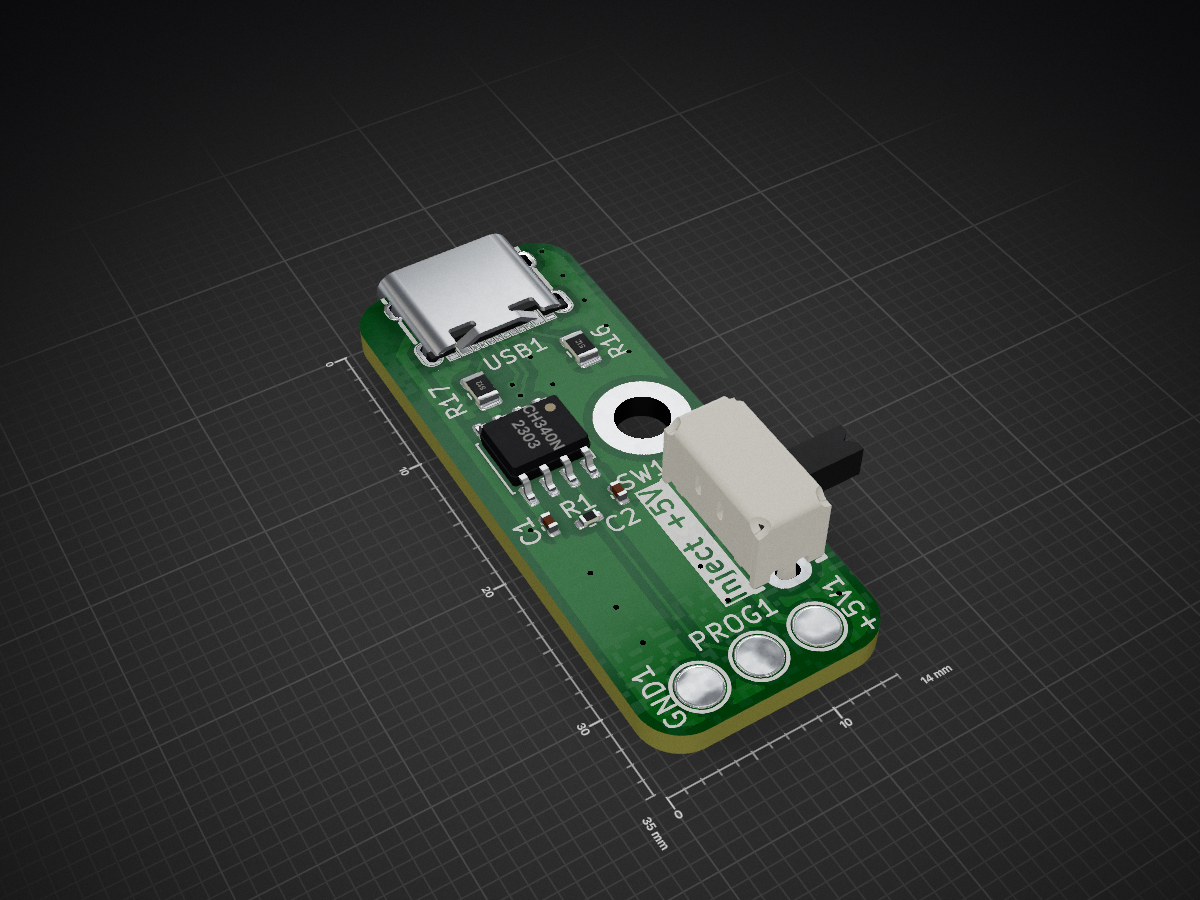
 PHS-SMCS/Falconia-Beacon
Falconia Beacon is an ATTINY816-based, CR2032-powered LED beacon board used to make the Falconia rover visible to the SMCS Pi-in-the-sky satellite.
Programmer is an open-source printed circuit board by PHS-SMCS, from the PHS-SMCS/Falconia-Beacon repository on GitHub. It is a 2-layer board of 14 × 35 mm with 13 parts on 20 nets, routed with 59 tracks and 21 vias.
It is built around the CH340N and YTC1P-6030-01. Its parts include 3 resistors, 2 capacitors, 1 IC and 1 switch. It belongs with the interfaces and adapters boards of this library.


Falconia Beacon is an ATTINY816-based, CR2032-powered LED beacon board used to make the Falconia rover visible to the SMCS Pi-in-the-sky satellite.
0x42.PCB/
Hardware design and manufacturing assets:
src/
Firmware source flashed to the board by default:
0x42)The default board firmware lives in src/ and is intended to be the code programmed onto production boards unless otherwise noted.
Typical workflow:
src/ directory.0x42.PCB/.src/.| Qty | Value | Footprint | References |
|---|---|---|---|
| 3 | YTC1P-6030-01 | JLCPCB_GLOBAL_Footprints:SMD-1_BD2.0-H10.0 | +5V1, GND1, PROG1 |
| 2 | 100nF | Capacitor_SMD:C_0402_1005Metric | C1, C2 |
| 2 | 5.1kΩ | Resistor_SMD:R_0805_2012Metric | R16, R17 |
| 1 | 10kΩ | Resistor_SMD:R_0402_1005Metric | R1 |
| 1 | CH340N | Package_SO:JEITA_SOIC-8_3.9x4.9mm_P1.27mm | U1 |
| 1 | LOGO | JLCPCB_Footprints:SMCS-Logo | G*** |
| 1 | MountingHole | MountingHole:MountingHole_3.2mm_M3_DIN965_Pad | H1 |
| 1 | SK12D07VG3_C431547 | JLCPCB_GLOBAL_Footprints:SW-TH_SK12D07VG3 | SW1 |
| 1 | TYPE-C_16PIN_2MD_073_ | JLCPCB_GLOBAL_Footprints:USB-C-SMD_TYPE-C-6PIN-2MD-073 | USB1 |
PHS-SMCS/Falconia-Beacon
Falconia Beacon is an ATTINY816-based, CR2032-powered LED beacon board used to make the Falconia rover visible to the SMCS Pi-in-the-sky satellite.

PHS-SMCS/Falconia-Beacon
Falconia Beacon is an ATTINY816-based, CR2032-powered LED beacon board used to make the Falconia rover visible to the SMCS Pi-in-the-sky satellite.

PHS-SMCS/Falconia-Beacon
Falconia Beacon is an ATTINY816-based, CR2032-powered LED beacon board used to make the Falconia rover visible to the SMCS Pi-in-the-sky satellite.

gili-yankovitch/SwordOfSecrets
To solve the challenge you will need to discover a series of flags, hidden inside the sword. Each one will help you unlock the next step in the challenge, to finally reveal the ultimate secret the sword holds.


OpenLogicEFI/Hardware
Hardware is based off an open source project called Speeduino by Josh Stewart.


tjclement/ecsc23-badge
This repo contains the hardware designs and firmware developed for the ECSC23 hardware challenge by Curious Supplies.

baoqi-zhong/Awesome-SMT-Machine
A single head 🔥SMT Machine🔥 based on FOC stepper motors. Pure self-developed and fully open-sourced.

dilshan/24ch-usb-high-voltage-driver
24-Channel USB high voltage driver.
It measures 14 × 35 mm and has 2 copper layers, 1.6 mm thick.
13 parts, built around the CH340N and YTC1P-6030-01. The full list of its parts is on this page, with links to each part's symbol and footprint where PCBKit's library has them.
From the PHS-SMCS/Falconia-Beacon repository on GitHub, at the commit this page was made from: the board is PCB/Programmer/programmer.kicad_pcb and its schematic PCB/Charger/charger.kicad_sch. PCBKit opens the board in the browser, with nothing to install.
Its repository states no licence, so its author keeps all rights: ask PHS-SMCS before reusing the design.