2 layers75 × 100 mm
Speaker driver
Orange-Murker/parametric_speaker
A directional speaker with a driver based on STM32
25 parts103

 Orange-Murker/parametric_speaker103
A directional speaker with a driver based on STM32
Parametric speaker is an open-source printed circuit board by Orange-Murker, from the Orange-Murker/parametric_speaker repository on GitHub. It is a 2-layer board of 164 × 151 mm with 103 parts on 2 nets, routed with 2 tracks and 0 vias.
It belongs with the audio and music boards of this library.
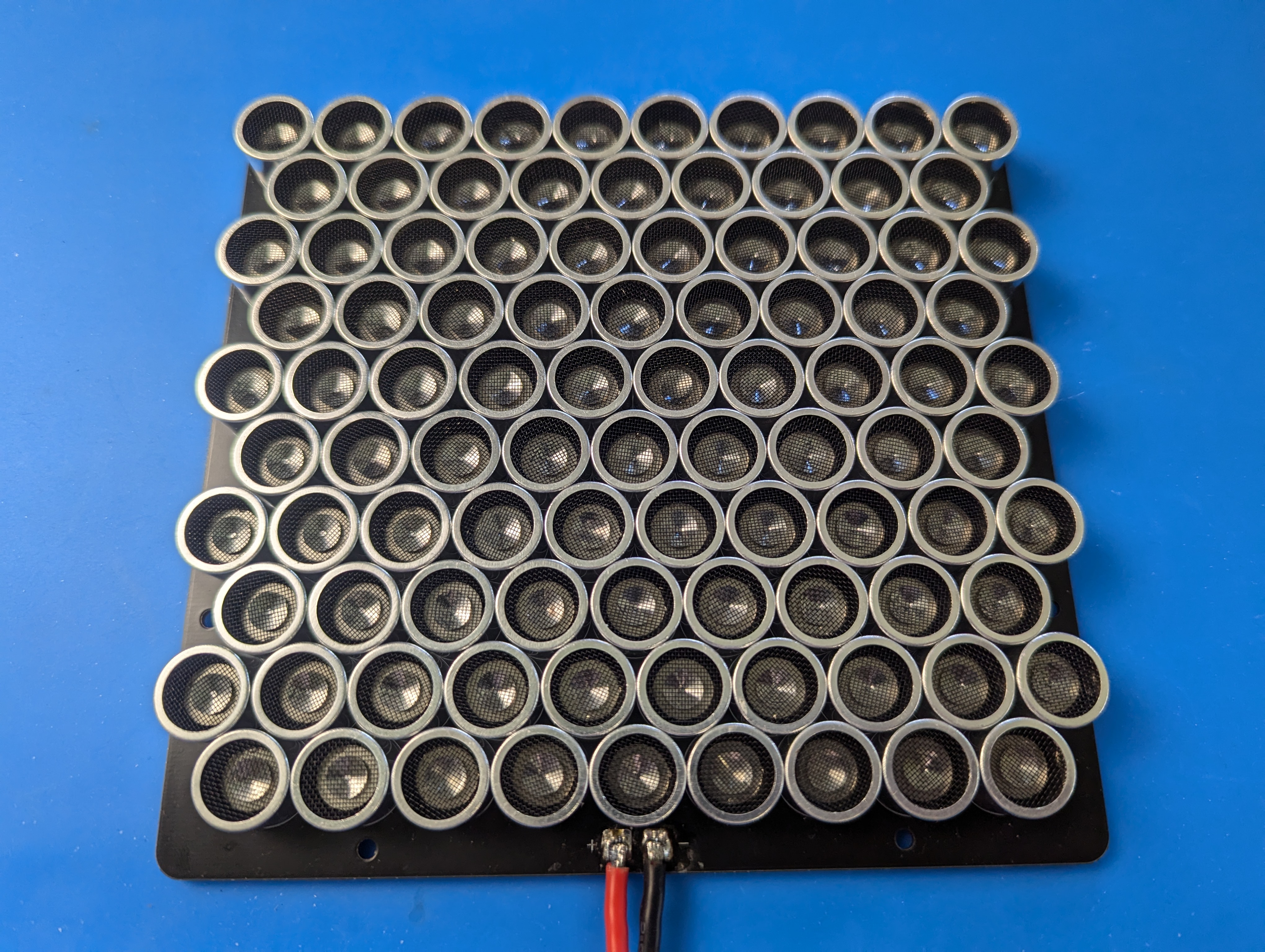
This is a directional speaker based on a parametric array of 95x 16mm 40kHz ultrasonic transducers.
The driver part of this design is currently only a working proof of concept and has some issues. It consists of a single H-bridge directly driving the transducers with a 40kHz square wave without any additional filtering or matching. The MOSFETs get really hot during the operation.
Some transducers come with their polarity flipped even if they are from the same batch. Thus it is important to match the phase of all of the transducers using the steps below:
The PCB assumes that the transducer bodies are electrically isolated from each of the 2 pins. Not checking this may result in an unusable array due to a short. Get transducers with a plastic housing if you want to avoid this.
| Qty | Value | Footprint | References |
|---|---|---|---|
| 95 | Speaker_Ultrasound | Library:TCT40-16T | LS1, LS2, LS10, LS11, LS12, LS13, LS14, LS15, LS16, LS17, LS18, LS19, LS20, LS21, LS22, LS23 +79 |
| 1 | LOGO | LOGO | G*** |
| 1 | Transducer Board Pads | Library:Power_Pads | J1 |
The 97 most common of 103 parts.
Orange-Murker/parametric_speaker
A directional speaker with a driver based on STM32

pierrechevalier83/ferris
A low profile split keyboard designed to satisfy one single use case elegantly

shorepine/tulipcc
The Tulip Creative Computer and AMYboard - portable Python synthesizers


LouWii/ErgoMax
Custom ergo split keyboard project, based on ErgoDox, with hot swap sockets

afternoonlabs/BreezeKeyboard
Breeze is a split mechanical keyboard with a column-staggered layout. With a focus on productivity, Breeze features a full 6x4 alphanumeric layout, arrow keys, and an extra 6 key cluster for typing and coding.

tebl/BulkyMIDI-32
A HW build of the MT32-PI project, allowing you to emulate a Roland MT-32 using a Raspberry Pi. Includes enough additional modules to build a MIDI-mountain as well as adapters for connecting to most things retro.


mirdej/synkie
The Synkie is a modular open source analog video processor, developed by Michael Egger, Max Egger and Flo Kaufmann
It measures 164 × 151 mm and has 2 copper layers, 1.6 mm thick.
103 parts. The full list of its parts is on this page, with links to each part's symbol and footprint where PCBKit's library has them.
From the Orange-Murker/parametric_speaker repository on GitHub, at the commit this page was made from: the board is pcb/parametric_speaker.kicad_pcb and its schematic pcb/parametric_speaker.kicad_sch. PCBKit opens the board in the browser, with nothing to install.
Its repository states no licence, so its author keeps all rights: ask Orange-Murker before reusing the design.