2 layers52.7 × 80.7 mm
 OpenAVNS/OpenAVNS5
Hardware, firmware, and mechanical design
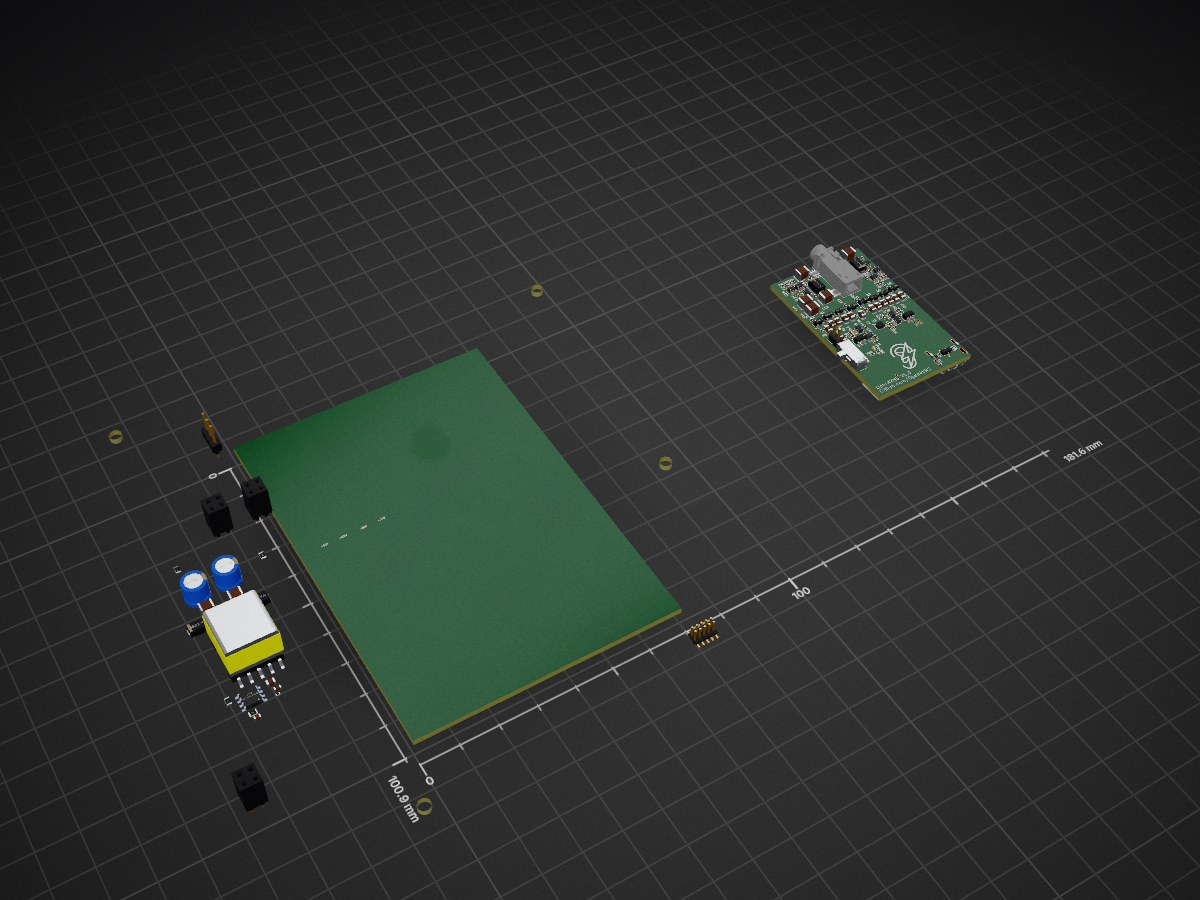
OpenAVNS KiCad Project compact is an open-source printed circuit board by OpenAVNS, from the OpenAVNS/OpenAVNS repository on GitHub, published under the CC-BY-4.0 licence. It is a 4-layer board of 181.6 × 100.9 mm with 227 parts on 171 nets.
It is built around the MC33172D, TS5A3159DCKR-TP and LIS2DH12, with the MBR0530, BC847 and BC857 among its other parts. Its parts include 71 resistors, 55 capacitors, 17 ICs, 10 diodes and 9 connectors.


To develop an open-source, open-architecture auricular vagus nerve stimulator under a distributed development model.
Auricular vagus nerve stimulation (aVNS) is a method of neuromodulation that uses electrical pulses applied to nerves near the ear to create a vagus nerve response. This response can lead to reduced sympathetic (fight or flight) and increased parasympathetic (relaxation / everything ok) tone. Adjusting vagal tone using aVNS has been explored by clinical researchers for a number of potential therapeutic applications, including for depression [1], opioid withdraws [2], chronic pain [3], and gastrointestinal issues [4]. In addition, aVNS has been explored in wellness for applications such as stress reduction [5]. We believe an open-source, open-architecture aVNS system would be helpful for users, students, medical researchers, and community members around the world to explore aVNS and to learn more about developing neuromodulation devices under an open source model.
| User Need | Design Input |
|---|---|
| The device shall apply neuromodulation to the auricular vagus branches at the tragus and cymba concha | Device shall provide two independent biphasic current-controlled stimulation outputs |
| The user shall easily activate, modify, and deactivate stimulation on the device | App shall allow adjustment of stimulation parameters (frequency, pulse width, amplitude) within specified ranges. App shall allow initiating and stopping stimulation Physical button on device to deactivate stimulation if needed App shall be intuitive and easy to use |
| The user shall comfortably wear the device | Weight less than 40g Device fits behind ear Remains securely in place for 30 minutes of typical non-athletic activity without discomfort |
| The user shall apply neuromodulation typical of clinical studies reported in literature | Adjustable outputs between 1-50Hz, 100-500us pulse width, 0-2mA amplitude Capable of outputting at maximum settings on one channel for a minimum of 30min |
| The device is open and accessible to a large range of users in different situations | Rechargeable by USB-C Uses commercial off the shelf replaceable electrodes App available on iOS and Android platforms |
| The device is safe to use | Device hardware prevents DC charge or amplitudes outside of the operating parameters from presenting at the electrode sites Physical button on device to stop stimulation Impedance measurement on output used to stop stimulation if electrodes are disconnected (short or open circuit) Stimulation stops if wireless connection to app is interrupted Firmware automatically stops stimulation after 30min regardless of other factors |
2025
Last updated 10/31/2025
The contents of this document, the OpenAVNS repository on GitHub, and any other documents or communication released by the OpenAVNS project (the “Materials”) are subject to revision. No representation or warranty, express or implied, is provided in relation to the accuracy, correctness, completeness, or reliability of the information, opinions, or conclusions expressed in this repository.
The Materials are experimental in nature and should be used with prudence and appropriate caution. Any use is voluntary and at your own risk.
The Materials are made available “as is” by the contributors to this repository (collectively, “Providers”). Providers expressly disclaim all warranties, express or implied, arising in connection with the Materials, or arising out of a course of performance, dealing, or trade usage, including, without limitation, any warranties of title, noninfringement, merchantability, or fitness for a particular purpose.
Any user of the Materials agrees to forever indemnify, defend, and hold harmless Providers from and against, and to waive any and all claims against Providers for any and all claims, suits, demands, liability, loss or damage whatsoever, including attorneys' fees, whether direct or consequential, on account of any loss, injury, death or damage to any person or (including without limitation all agents and employees of Providers and all property owned by, leased to or used by either Providers) or on account of any loss or damages to business or reputations or privacy of any persons, arising in whole or in part in any way from use of the Materials or in any way connected therewith or in any way related thereto.
The Materials, any related materials, and all intellectual property therein, are owned by Providers.
| Qty | Value | Footprint | References |
|---|---|---|---|
| 35 | TestPoint | TestPoint:TestPoint_Pad_D2.0mm | TP1, TP2, TP10, TP11, TP12, TP13, TP14, TP15, TP16, TP17, TP18, TP19, TP20, TP21, TP25, TP26 +19 |
| 16 | 100nF | Capacitor_SMD:C_0402_1005Metric | C2, C7, C9, C19, C22, C24, C25, C30, C50, C51, C52, C53, C54, C55, C56, C57 |
| 11 | 100k | Resistor_SMD:R_0402_1005Metric | R21, R34, R39, R42, R43, R44, R58, R59, R64, R67, R68 |
| 11 | TS5A3159DCKR | Footprints:SOT65P210X110-6N | U18, U19, U20, U21, U22, U23, U24, U25, U26, U27, U28 |
| 8 | 100 Ohm | Capacitor_SMD:C_0402_1005Metric | R3, R5, R8, R10, R22, R24, R29, R31 |
| 6 | 100k | Capacitor_SMD:C_0402_1005Metric | R17, R18, R49, R52, R53, R54 |
| 6 | 1M | Capacitor_SMD:C_0402_1005Metric | R4, R9, R11, R14, R23, R30 |
| 5 | 22uF | Capacitor_SMD:C_1210_3225Metric | C12, C15, C16, C17, C23 |
| 4 | 100k | Resistor_SMD:R_0805_2012Metric_Pad1.20x1.40mm_HandSolder | R69, R70, R71, R72 |
| 4 | 150 Ohm | Capacitor_SMD:C_0805_2012Metric | R2, R16, R20, R33 |
| 4 | 1k | Capacitor_SMD:C_0805_2012Metric | R1, R15, R19, R32 |
| 4 | 4.4k | Capacitor_SMD:C_0805_2012Metric | R6, R7, R27, R28 |
| 4 | 500 Ohm | Capacitor_SMD:C_0402_1005Metric | R55, R60, R73, R74 |
| 4 | MBR0530 | Diode_SMD:D_SOD-123 | D7, D8, D10, D12 |
| 4 | MountingHole | MountingHole:MountingHole_3.2mm_M3_DIN965 | H1, H2, H3, H4 |
| 3 | 10uF | Capacitor_SMD:C_0603_1608Metric | C18, C26, C29 |
| 3 | 4.7uF | Capacitor_SMD:C_0603_1608Metric | C5, C6, C8 |
| 3 | Conn_02x02_Top_Bottom | Connector_PinSocket_2.54mm:PinSocket_2x02_P2.54mm_Vertical | J3, J8, J9 |
| 2 | 0.1uF | Capacitor_SMD:C_0603_1608Metric | C31, C33 |
| 2 | 10uF, 100V electrolytic | Capacitor_THT:CP_Radial_D6.3mm_P2.50mm | C38, C41 |
| 2 | 12pF | Capacitor_SMD:C_0402_1005Metric | C14, C21 |
| 2 | 1uF | Capacitor_SMD:C_0805_2012Metric | C36, C39 |
| 2 | 1uF | Capacitor_SMD:C_0603_1608Metric | C1, C46 |
| 2 | 220k | Resistor_SMD:R_0402_1005Metric | R50, R51 |
| 2 | 22uF | Capacitor_SMD:C_0805_2012Metric | C34, C44 |
| 2 | 22uF, 200V | Capacitor_SMD:C_1210_3225Metric | C37, C40 |
| 2 | 22uF, 25V | Capacitor_SMD:C_1210_3225Metric | C35, C45 |
| 2 | 33 Ohm | Resistor_SMD:R_0402_1005Metric | R25, R26 |
| 2 | 4.7k | Resistor_SMD:R_0402_1005Metric | R12, R13 |
| 2 | 4.7uF | Capacitor_SMD:C_0805_2012Metric | C48, C49 |
| 2 | 5.1k | Resistor_SMD:R_0402_1005Metric | R36, R37 |
| 2 | 680pF | Capacitor_SMD:C_0402_1005Metric | C13, C20 |
| 2 | BC847 | Package_TO_SOT_SMD:SOT-23 | Q2, Q6 |
| 2 | BC857 | Package_TO_SOT_SMD:SOT-23 | Q3, Q7 |
| 2 | BCV61 | Package_TO_SOT_SMD:SOT-143 | Q4, Q8 |
| 2 | BCV62 | Package_TO_SOT_SMD:SOT-143 | Q1, Q5 |
| 2 | MCP4725xxx-xCH | Package_TO_SOT_SMD:SOT-23-6 | U3, U7 |
| 2 | SMAJ54CA | Diode_SMD:D_SMA | D1, D2 |
| 2 | SS3200 | Diode_SMD:D_SMA | D9, D11 |
| 1 | 0.5pF | Capacitor_SMD:C_0402_1005Metric | C10 |
| 1 | 0.8pF | Capacitor_SMD:C_0402_1005Metric | C11 |
| 1 | 1.2M | Resistor_SMD:R_0402_1005Metric | R48 |
| 1 | 1.8nH, 5% | Inductor_SMD:L_0402_1005Metric | L5 |
| 1 | 100pF | Capacitor_SMD:C_0402_1005Metric | C4 |
| 1 | 10k | Resistor_SMD:R_0805_2012Metric_Pad1.20x1.40mm_HandSolder | R61 |
| 1 | 10k | Resistor_SMD:R_1206_3216Metric | R38 |
| 1 | 10pF | Capacitor_SMD:C_0603_1608Metric | C47 |
| 1 | 10uF | Capacitor_SMD:C_0805_2012Metric | C32 |
| 1 | 10uH | Inductor_SMD:L_7.3x7.3_H3.5 | L3 |
| 1 | 130k | Resistor_SMD:R_0603_1608Metric | R62 |
| 1 | 1M | Resistor_SMD:R_0402_1005Metric | R35 |
| 1 | 1k | Resistor_SMD:R_0402_1005Metric | R65 |
| 1 | 2.7nH, 5% | Inductor_SMD:L_0402_1005Metric | L4 |
| 1 | 200k | Resistor_SMD:R_0805_2012Metric_Pad1.20x1.40mm_HandSolder | R56 |
| 1 | 2171790001 | Footprints:MOLEX_2171790001 | J7 |
| 1 | 22uF, 6.3V | Capacitor_SMD:C_0805_2012Metric | C42 |
| 1 | 2450AT43B100E | OpenAVNS:ANTENNA_2450AT43B100E | AT1 |
| 1 | 2M | Resistor_SMD:R_0402_1005Metric | R47 |
| 1 | 2M | Resistor_SMD:R_0603_1608Metric | R57 |
| 1 | 2k | Resistor_SMD:R_0402_1005Metric | R66 |
| 1 | 32MHz - X322532MOB4SI | Crystal:Crystal_SMD_3225-4Pin_3.2x2.5mm | Y1 |
| 1 | 330 | Resistor_SMD:R_0402_1005Metric | R63 |
| 1 | 4.7nH, 5% | Inductor_SMD:L_0402_1005Metric | L1 |
| 1 | 4.7pF | Capacitor_SMD:C_0805_2012Metric | C43 |
| 1 | 4.7uH, 1.2A | Inductor_SMD:L_1008_2520Metric_Pad1.43x2.20mm_HandSolder | L2 |
| 1 | 5-1437565-0 | Button_Switch_SMD:SW_SPST_PTS647_Sx38 | S1 |
| 1 | 811 Ohm | Resistor_SMD:R_1206_3216Metric | R40 |
| 1 | 820pF | Capacitor_SMD:C_0402_1005Metric | C3 |
| 1 | AudioPlug3 | Connector_Audio:Jack_3.5mm_CUI_SJ-3523-SMT_Horizontal | J2 |
| 1 | Conn_01x01_Pin | Connector_PinHeader_1.00mm:PinHeader_1x01_P1.00mm_Horizontal | J6 |
| 1 | Conn_01x02_Pin | Connector_PinHeader_2.00mm:PinHeader_1x02_P2.00mm_Vertical | J4 |
| 1 | Conn_01x03_Pin | Connector_PinHeader_2.54mm:PinHeader_1x03_P2.54mm_Vertical | J5 |
| 1 | Conn_ARM_JTAG_SWD_10 | Connector_PinHeader_1.27mm:PinHeader_2x05_P1.27mm_Vertical_SMD | J1 |
| 1 | LED Green | LED_SMD:LED_0402_1005Metric | D14 |
| 1 | LED Yellow | LED_SMD:LED_0402_1005Metric | D13 |
| 1 | LIS2DH12 | Package_LGA:LGA-12_2x2mm_P0.5mm | U11 |
| 1 | LOGO | LOGO | G*** |
| 1 | LT1615ES5_TRPBF | OpenAVNS:SOT95P280X145-5N | U15 |
| 1 | LT8304IS8E_PBF | OpenAVNS:SOIC127P599X175-9N | U16 |
| 1 | MC33172 | Package_SO:SOIC-8_3.9x4.9mm_P1.27mm | U1 |
The 218 most common of 227 parts.

4ms/openventilator
OpenVentilator project, this repo is just tests and noodlings


davidholmes1066/LPM_Production_TT
tool for testing transus instrument test tool

Immanueldavidckp/schematics
CAN-connected GPS/LTE tracker for rental MEWPs (boom/scissor lifts). Powered from machine batteries with internal Li-ion backup, 2 isolated digital inputs, 2 low-side outputs, ignition sense, 6-axis IMU, and ≥6 days of…

nhallsny/faraday-rescue
Open source battery for e-bikes made by the now-defunct Faraday Bicycles


botblox/RouterCoreCore-Baseboard-Designs
Open source design files for the breakout board (baseboard) for RouterCore.

It measures 181.6 × 100.9 mm and has 4 copper layers, 1.61 mm thick.
227 parts, built around the MC33172D, TS5A3159DCKR-TP, LIS2DH12 and MBR0530. The full list of its parts is on this page, with links to each part's symbol and footprint where PCBKit's library has them.
From the OpenAVNS/OpenAVNS repository on GitHub, at the commit this page was made from: the board is hardware/OpenAVNS KiCad Project_compact.kicad_pcb and its schematic Electrode/Electrode_FlexPCB/Electrode_FlexPCB.kicad_sch. PCBKit opens the board in the browser, with nothing to install.
Its repository publishes it under the CC-BY-4.0 licence: you may reuse it on that licence's terms (keep the author's notice, and for a copyleft licence share your changes alike).