
4 layers98 × 75 mm
PiFinder4
brickbots/PiFinder
A plate solving telescope finder based around a Raspberry PI and RPI HQ Camera
157 parts257GPL-3.0
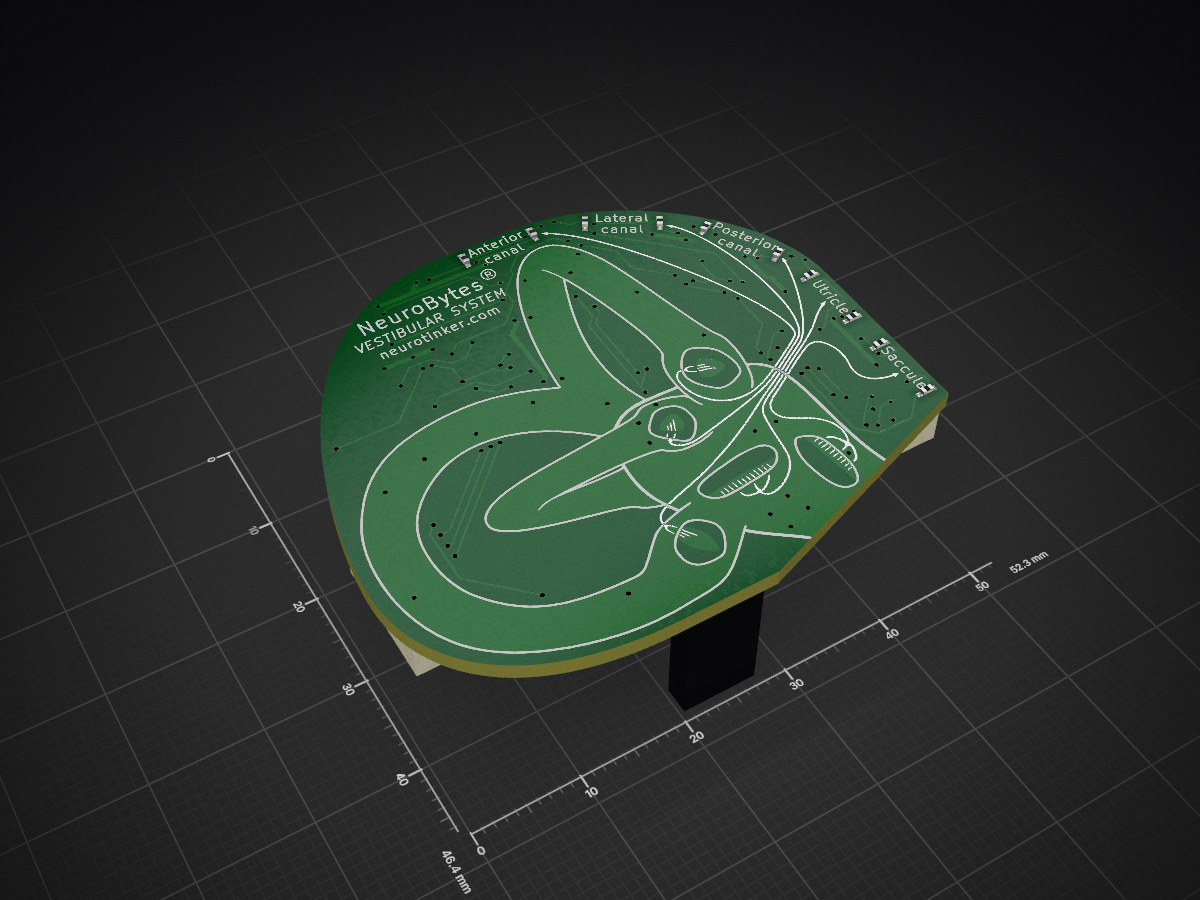
 NeuroTinker/NeuroBytes_Vestibular_System1
All NeuroBytes products are based on the ST32L0x series of ARM Cortex-M0+ 32-bit microcontrollers. The boards were designed in KiCad and Inkscape and are released under the terms of the GPL, v3.0.
NeuroBytes Vestibular System is an open-source printed circuit board by NeuroTinker, from the NeuroTinker/NeuroBytes_Vestibular_System repository on GitHub, published under the GPL-3.0 licence. It is a 2-layer board of 52.3 × 46.4 mm with 50 parts on 57 nets, routed with 738 tracks and 113 vias.
It is built around the BNO055. Its parts include 12 diodes, 9 capacitors, 8 resistors, 6 connectors and 3 ICs. It belongs with the STM32 boards of this library.
NeuroBytes are open-source hardware neuron simulators designed and sold by NeuroTinker, LLC. The Vestibular System boards emulate the portion of the inner ear responsible for orientation.
All NeuroBytes products are based on the ST32L0x series of ARM Cortex-M0+ 32-bit microcontrollers. The boards were designed in KiCad and Inkscape and are released under the terms of the GPL, v3.0.
This repository is a continuation of the 8-bit ATtiny design called NeuroBytes v0.91. The two series are not compatible.
This project is in alpha. The firmware is in progress and the API may change at any time. The PCB design is physically tested but has not yet been manufactured at scale.
The NeuroBytes GitHub repositories store engineering information and make the design history of the project available to the public. Hardware- and firmware-specific README.md files can be found in their appropriate subdirectories.
We encourage community involvement in our efforts, keeping in mind that hardware availability is currently quite limited. For product availability, operating guidelines, curricula, and information about NeuroTinker, LLC, head to neurotinker.com. Further technical logs are also at https://hackaday.io/project/3339-neurobytes.
| Qty | Value | Footprint | References |
|---|---|---|---|
| 12 | LED | KiCad_Footprints:ZF_SMD_NonPol_0402 | D1, D2, D3, D4, D5, D6, D7, D8, D9, D10, D11, D12 |
| 5 | JST GH 4-POS | KiCad_Footprints:ZF_CONN_JST_GH | P1, P2, P5, P6, P7 |
| 4 | 10k | KiCad_Footprints:ZF_SMD_NonPol_0402 | R5, R6, R7, R8 |
| 3 | R | KiCad_Footprints:ZF_SMD_NonPol_0402 | R1, R2, R3 |
| 2 | 0u1 | KiCad_Footprints:ZF_SMD_NonPol_0402_cap | C3, C5 |
| 2 | 100 x4 | KiCad_Footprints:ZF_RN_4iso_CTS-0804 | RN1, RN3 |
| 2 | 100n | KiCad_Footprints:ZF_SMD_NonPol_0402_cap | C6, C7 |
| 2 | 1u0 | KiCad_Footprints:ZF_SMD_NonPol_0603 | C1, C4 |
| 2 | NPN_dual | KiCad_Footprints:ZF_SMD_SOT-363 | Q1, Q2 |
| 1 | 10u | KiCad_Footprints:ZF_SMD_pol_1206 | C2 |
| 1 | 120n | KiCad_Footprints:ZF_SMD_NonPol_0402_cap | C9 |
| 1 | 150 x4 | KiCad_Footprints:ZF_RN_4iso_CTS-0804 | RN4 |
| 1 | 6n8 | KiCad_Footprints:ZF_SMD_NonPol_0402_cap | C8 |
| 1 | BNO_055 | KiCad_Footprints:ZF_IC_28LGA | U3 |
| 1 | JMP | KiCad_Footprints:ZF_SMD_NonPol_0402 | R4 |
| 1 | JST GH 7-POS | KiCad_Footprints:ZF_CONN_JST_GH_7POS | P8 |
| 1 | LD3985G33R | KiCad_Footprints:ZF_SOT23-5L | U2 |
| 1 | LOGO | KiCad_Footprints:ZF_LOGO_OSHW | G*** |
| 1 | LOGO | KiCad_Footprints:ZF_LOGO_Vestibular_System | G*** |
| 1 | LOGO | KiCad_Footprints:ZF_LOGO_face | G*** |
| 1 | STM32L011Gx | KiCad_Footprints:ZF_IC_UFQFPN28-050 | U1 |
| 1 | SW_PUSH_TL3330AF130QG | KiCad_Footprints:ZF_SW_Momentary_SideMtg | SW1 |
The 47 most common of 50 parts.
brickbots/PiFinder
A plate solving telescope finder based around a Raspberry PI and RPI HQ Camera


01binary/str1ker
A human-scale mech integrated with Robot Operating System


Aharoni-Lab/Miniscope-LFOV
Large field-of-view miniature microscope for rats and larger animals.
It measures 52.3 × 46.4 mm and has 2 copper layers, 1.6 mm thick.
50 parts, built around the BNO055. The full list of its parts is on this page, with links to each part's symbol and footprint where PCBKit's library has them.
From the NeuroTinker/NeuroBytes_Vestibular_System repository on GitHub, at the commit this page was made from: the board is HARDWARE/NeuroBytes_Vestibular_System.kicad_pcb. PCBKit opens the board in the browser, with nothing to install.
Its repository publishes it under the GPL-3.0 licence: you may reuse it on that licence's terms (keep the author's notice, and for a copyleft licence share your changes alike).