
6 layers12.8 × 11.4 mm
Main PCB
Neurallabware/Airscope_toolbox
A 1-gram wireless mesoscope for cortex-wide, single-cell-resolution imaging during unrestricted behaviour
31 parts10

A 1-gram wireless mesoscope for cortex-wide, single-cell-resolution imaging during unrestricted behaviour
Ext IMU is an open-source printed circuit board by Neurallabware, from the Neurallabware/Airscope_toolbox repository on GitHub. It is a 4-layer board of 7.9 × 9.3 mm with 15 parts on 22 nets, routed with 146 tracks and 32 vias.
It is built around the CSNP32GCR01-AOW and QMC6310U. Its parts include 6 capacitors, 5 resistors, 3 ICs and 1 connector. It belongs with the sensors and measurement boards of this library.


A 1-gram wireless mesoscope for cortex-wide, single-cell-resolution imaging during unrestricted behaviour
Device Docs · Software Docs · Data Release
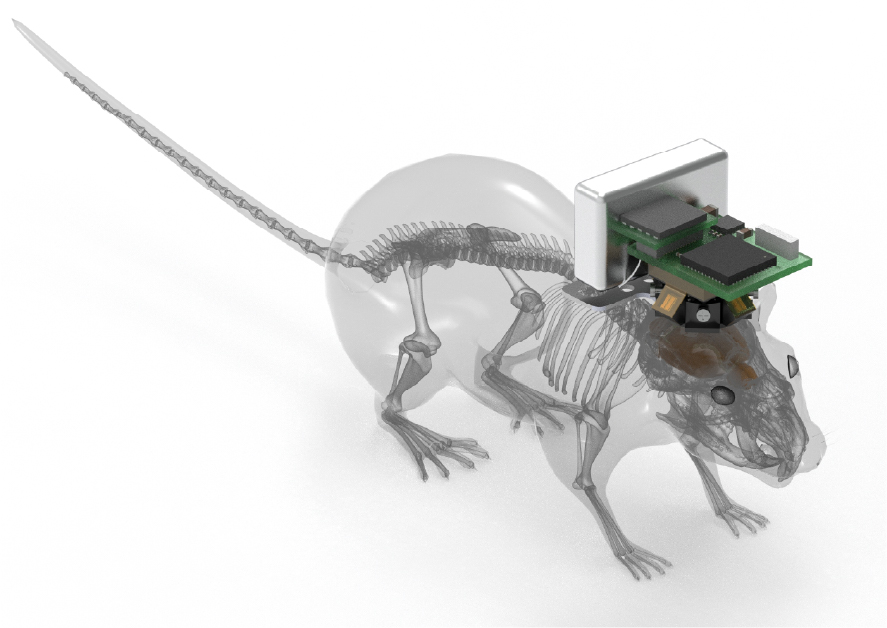
Airscope is an open hardware and software platform for wireless mesoscopic calcium imaging in freely behaving mice. The device achieves a 6 mm field of view at ~4 µm lateral resolution, streams or logs 1600 × 1200 px images at 10 Hz, and weighs approximately 1 g.
This repository accompanies the manuscript:
Deciphering cortex-wide neural dynamics of naturally behaving mice by a 1-gram wireless mesoscope Zhang et al., Nature, 2025 (Manuscript in preparation)
| Directory | Description |
|---|---|
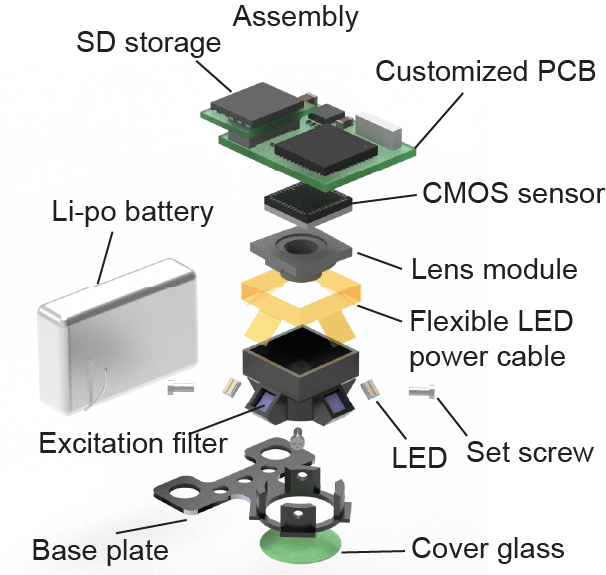
Structure/ | SolidWorks assemblies and part files — housing, baseplate, optical mount, PCB carrier, flexible LED board |
Zemax/ | Zemax optical design files for the aspheric module |
Electronics/ | KiCad projects for the main PCB and auxiliary boards |
Firmware/ | Embedded code for wireless control, camera acquisition, and device configuration |
DAQ_software/ | Python host software and Windows installer for device discovery, preview, and recording |
Software/ | Calcium-imaging processing, behavioural segmentation, and neural-decoding pipelines |
Data_release/ | Example datasets, visualization notebooks, and download instructions |
Software/Airscope_ca_processingEnd-to-end pipeline from raw frames to segmented ROI traces. Accepts image sequences, TIFF stacks, and MP4 input; configured with Hydra for reproducible batch runs.
cd Software/Airscope_ca_processing
conda create -n PICO python=3.10 && conda activate PICO
pip install -r requirements.txt && pip install -e .airscope-process \
data_path=/path/to/session/frames \
out_path=/path/to/session/analysis \
rmbg.gpu_ids=0 rmbg.multi_gpu=falsePrimary outputs: seg_results_filtered.mat, infer_results_filtered.mat, cm_filtered.mat
Software/SAM2MiceSAM 2–based mouse segmentation and tracking. Supports manual prompts, YOLOv11 auto-prompts, and bootstrapped inference for videos that exceed GPU memory.
cd Software/SAM2Mice
pip install torch==2.6.0 torchvision==0.21.0 torchaudio==2.6.0 --index-url https://download.pytorch.org/whl/cu124
pip install -e ".[notebooks]" && python setup.py build_ext --inplace
Notebooks in Software/SAM2Mice/notebooks_SAM2-MICE cover basic segmentation, long-video bootstrapping, automatic tracking, and public-dataset examples.
Software/Neuron_BERTTransformer-based decoder for predicting social-interaction outcomes from dual-animal neural activity recordings.
DAQ_software/Dependency-free Python backend — runs without any additional packages:
cd DAQ_software/airscope_pybackend
python server.py
# UI available at http://127.0.0.1:8765/
A packaged Windows installer is also provided at DAQ_software/airscope.msi.
Example datasets are hosted on Google Drive and documented in Data_release/README.md.
The Google Drive root README is maintained at Data_release/README_google_drive.md and can be uploaded to Drive as README_google_drive.md.
| Dataset | Contents |
|---|---|
| Enriched habitat | Calcium traces, multi-view behaviour videos, detection boxes, arena annotations, cortical labels, neuron centroids |
| Multi-animal interaction | Calcium traces, SAM2 instance masks, mouse trajectories, cortical labels, neuron centres |
| MCU timestamp | Frame-rate validation files; use calculate_frame_rate.ipynb to verify |
| Optical characterisation | USAF 1951 target images and fluorescent grid slides |
Each dataset directory includes a README.md and a visualize_data.ipynb notebook.
| Component | Environment |
|---|---|
| Host acquisition software | Python ≥ 3.9, standard library only |
| Calcium processing | Linux, Python 3.10, CUDA-enabled PyTorch recommended |
| SAM2Mice | Python 3.11, PyTorch 2.6.0, CUDA 12.4 |
| Neuron-BERT | Python 3.x, PyTorch, NumPy, scikit-learn, pandas, matplotlib |
See the component-level README.md files for exact commands and configuration.
Airscope is distributed as a multi-licence repository:
| Material | Licence |
|---|---|
Hardware design (Structure/, Electronics/, Zemax/) | CERN-OHL-S-2.0 |
Software (DAQ_software/, Firmware/, Software/) | GPL-3.0-only |
| Documentation, figures, notebooks, released data | CC-BY-4.0 |
See LICENSE, LICENSES/, and NOTICE.md for the authoritative licence map and third-party notices.
@article{airscope2025,
  title   = {Deciphering cortex-wide neural dynamics of naturally
             behaving mice by a 1-gram wireless mesoscope},
  author  = {Zhang, Yuanlong and Li, Angran and Yuan, Lekang and
             Wang, Mingrui and Zhao, Weihao and Wang, Zhenbo and
             Zang, Boyang and Zhou, Yangxuan and Yu, Tao and Gao, Lin
             and Wu, Yu and Zhu, Rongkang and Tian, Mengyi and Li, Kun
             and Wu, Jiamin and Dai, Pu and Dai, Qionghai},
  journal = {Nature},
  year    = {2025},
  note    = {Manuscript in preparation}
}Questions, bug reports, and suggestions can be submitted via the issue tracker or sent to the corresponding authors listed in the manuscript.
| Qty | Value | Footprint | References |
|---|---|---|---|
| 5 | 4.7k | Resistor_SMD:R_0201_Metric | R1, R2, R3, R5, R6 |
| 2 | 100n | Capacitor_SMD:C_0201_Metric | C4, C5 |
| 2 | 2.2u | Capacitor_SMD:C_0201_Metric | C2, C6 |
| 1 | 1u | Capacitor_SMD:C_0402_Metric | C3 |
| 1 | 4.7u | Capacitor_SMD:C_0201_Metric | C1 |
| 1 | CSNP32GCR01-AOW | Pico:SD_NAND_32 | U3 |
| 1 | DF40HC3.5-20DS-0.4V51 | Pico:CONN20_DF40HC_HIR | J1 |
| 1 | LSM6DSLTR | Snapeda:LSM6DSLTR_PQFN50P300X250X86-14N | U2 |
| 1 | QMC6310 | Pico:QMC6310 | U1 |
Neurallabware/Airscope_toolbox
A 1-gram wireless mesoscope for cortex-wide, single-cell-resolution imaging during unrestricted behaviour

Neurallabware/Airscope_toolbox
A 1-gram wireless mesoscope for cortex-wide, single-cell-resolution imaging during unrestricted behaviour

Neurallabware/Airscope_toolbox
A 1-gram wireless mesoscope for cortex-wide, single-cell-resolution imaging during unrestricted behaviour

Neurallabware/Airscope_toolbox
A 1-gram wireless mesoscope for cortex-wide, single-cell-resolution imaging during unrestricted behaviour

Neurallabware/Airscope_toolbox
A 1-gram wireless mesoscope for cortex-wide, single-cell-resolution imaging during unrestricted behaviour

Neurallabware/Airscope_toolbox
A 1-gram wireless mesoscope for cortex-wide, single-cell-resolution imaging during unrestricted behaviour


JanM321/esphome-lg-controller
Wired controller for LG HVAC units using ESPHome and ESP32


niklasekstrom/clockport_pi_interface
Amiga clock port to Raspberry Pi interface

RoboticsBrno/RB0005-UniversalStepDown
Universal step-down module

OpenDevicePartnership/pico-de-gallo
A tool for testing Embedded Rust drivers for discrete I2C/SPI components.
It measures 7.9 × 9.3 mm and has 4 copper layers, 1 mm thick.
15 parts, built around the CSNP32GCR01-AOW and QMC6310U. The full list of its parts is on this page, with links to each part's symbol and footprint where PCBKit's library has them.
From the Neurallabware/Airscope_toolbox repository on GitHub, at the commit this page was made from: the board is Electronics/Extension PCB/Ext_IMU/Ext_IMU.kicad_pcb and its schematic Electronics/Auxiliary/Burning/Burning.kicad_sch. PCBKit opens the board in the browser, with nothing to install.
Its repository states no licence, so its author keeps all rights: ask Neurallabware before reusing the design.