4 layers7.9 × 9.3 mm
Ext IMU
Neurallabware/Airscope_toolbox
A 1-gram wireless mesoscope for cortex-wide, single-cell-resolution imaging during unrestricted behaviour
15 parts10
 Neurallabware/Airscope_toolbox10
A 1-gram wireless mesoscope for cortex-wide, single-cell-resolution imaging during unrestricted behaviour
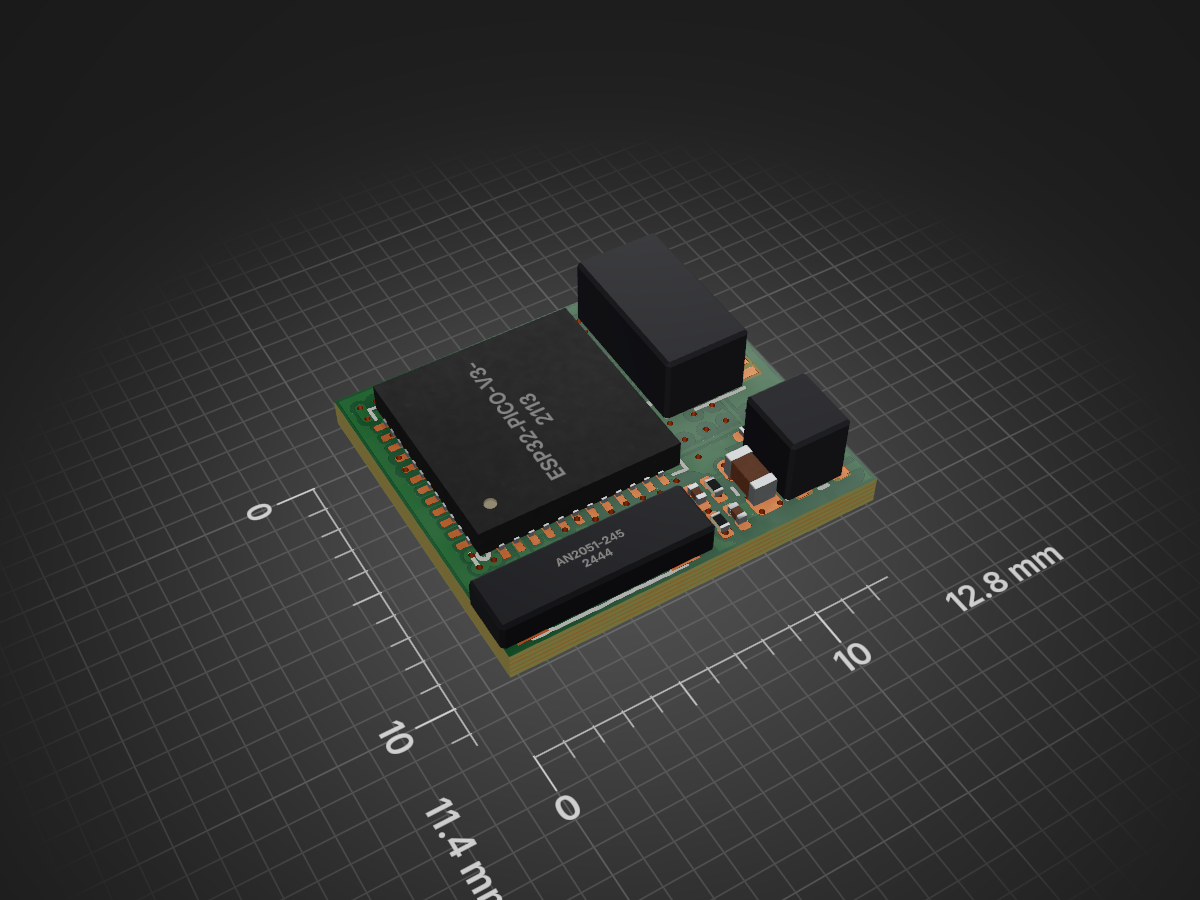
Main PCB is an open-source printed circuit board by Neurallabware, from the Neurallabware/Airscope_toolbox repository on GitHub. It is a 6-layer board of 12.8 × 11.4 mm with 31 parts on 58 nets, routed with 470 tracks and 113 vias.
It is built around the ESP32-PICO-V3-02, AN2051-245 and OV2640. Its parts include 12 capacitors, 9 resistors, 7 ICs and 3 connectors. It belongs with the ESP32 and RISC-V boards of this library.


A 1-gram wireless mesoscope for cortex-wide, single-cell-resolution imaging during unrestricted behaviour
Device Docs · Software Docs · Data Release
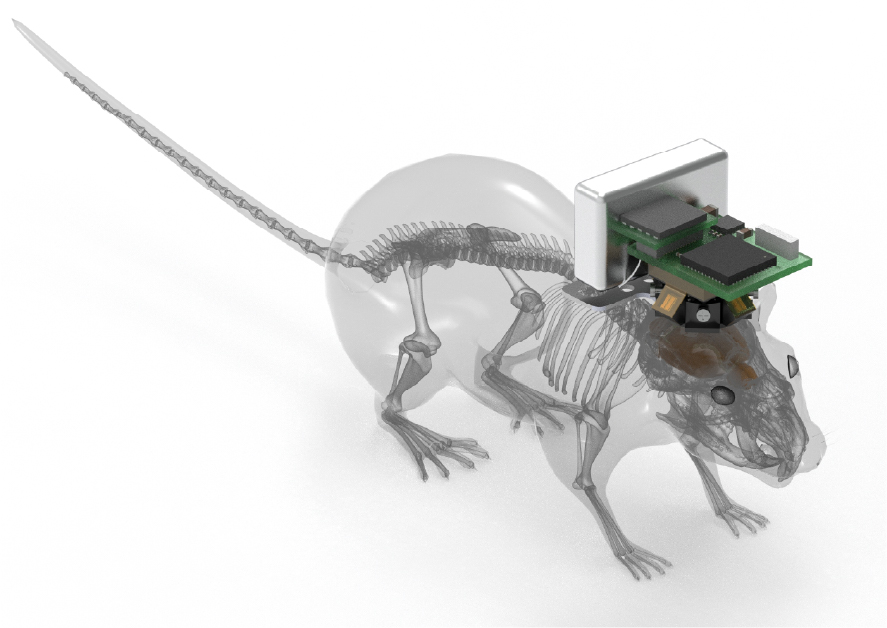
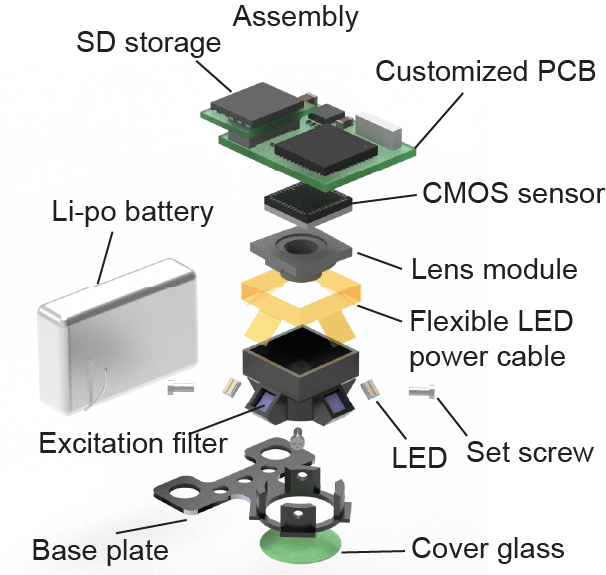
Airscope is an open hardware and software platform for wireless mesoscopic calcium imaging in freely behaving mice. The device achieves a 6 mm field of view at ~4 µm lateral resolution, streams or logs 1600 × 1200 px images at 10 Hz, and weighs approximately 1 g.
This repository accompanies the manuscript:
Deciphering cortex-wide neural dynamics of naturally behaving mice by a 1-gram wireless mesoscope Zhang et al., Nature, 2025 (Manuscript in preparation)
| Directory | Description |
|---|---|
Structure/ | SolidWorks assemblies and part files — housing, baseplate, optical mount, PCB carrier, flexible LED board |
Zemax/ | Zemax optical design files for the aspheric module |
Electronics/ | KiCad projects for the main PCB and auxiliary boards |
Firmware/ | Embedded code for wireless control, camera acquisition, and device configuration |
DAQ_software/ | Python host software and Windows installer for device discovery, preview, and recording |
Software/ | Calcium-imaging processing, behavioural segmentation, and neural-decoding pipelines |
Data_release/ | Example datasets, visualization notebooks, and download instructions |
Software/Airscope_ca_processingEnd-to-end pipeline from raw frames to segmented ROI traces. Accepts image sequences, TIFF stacks, and MP4 input; configured with Hydra for reproducible batch runs.
cd Software/Airscope_ca_processing
conda create -n PICO python=3.10 && conda activate PICO
pip install -r requirements.txt && pip install -e .airscope-process \
data_path=/path/to/session/frames \
out_path=/path/to/session/analysis \
rmbg.gpu_ids=0 rmbg.multi_gpu=falsePrimary outputs: seg_results_filtered.mat, infer_results_filtered.mat, cm_filtered.mat
Software/SAM2MiceSAM 2–based mouse segmentation and tracking. Supports manual prompts, YOLOv11 auto-prompts, and bootstrapped inference for videos that exceed GPU memory.
cd Software/SAM2Mice
pip install torch==2.6.0 torchvision==0.21.0 torchaudio==2.6.0 --index-url https://download.pytorch.org/whl/cu124
pip install -e ".[notebooks]" && python setup.py build_ext --inplace
Notebooks in Software/SAM2Mice/notebooks_SAM2-MICE cover basic segmentation, long-video bootstrapping, automatic tracking, and public-dataset examples.
Software/Neuron_BERTTransformer-based decoder for predicting social-interaction outcomes from dual-animal neural activity recordings.
DAQ_software/Dependency-free Python backend — runs without any additional packages:
cd DAQ_software/airscope_pybackend
python server.py
# UI available at http://127.0.0.1:8765/
A packaged Windows installer is also provided at DAQ_software/airscope.msi.
Example datasets are hosted on Google Drive and documented in Data_release/README.md.
The Google Drive root README is maintained at Data_release/README_google_drive.md and can be uploaded to Drive as README_google_drive.md.
| Dataset | Contents |
|---|---|
| Enriched habitat | Calcium traces, multi-view behaviour videos, detection boxes, arena annotations, cortical labels, neuron centroids |
| Multi-animal interaction | Calcium traces, SAM2 instance masks, mouse trajectories, cortical labels, neuron centres |
| MCU timestamp | Frame-rate validation files; use calculate_frame_rate.ipynb to verify |
| Optical characterisation | USAF 1951 target images and fluorescent grid slides |
Each dataset directory includes a README.md and a visualize_data.ipynb notebook.
| Component | Environment |
|---|---|
| Host acquisition software | Python ≥ 3.9, standard library only |
| Calcium processing | Linux, Python 3.10, CUDA-enabled PyTorch recommended |
| SAM2Mice | Python 3.11, PyTorch 2.6.0, CUDA 12.4 |
| Neuron-BERT | Python 3.x, PyTorch, NumPy, scikit-learn, pandas, matplotlib |
See the component-level README.md files for exact commands and configuration.
Airscope is distributed as a multi-licence repository:
| Material | Licence |
|---|---|
Hardware design (Structure/, Electronics/, Zemax/) | CERN-OHL-S-2.0 |
Software (DAQ_software/, Firmware/, Software/) | GPL-3.0-only |
| Documentation, figures, notebooks, released data | CC-BY-4.0 |
See LICENSE, LICENSES/, and NOTICE.md for the authoritative licence map and third-party notices.
@article{airscope2025,
  title   = {Deciphering cortex-wide neural dynamics of naturally
             behaving mice by a 1-gram wireless mesoscope},
  author  = {Zhang, Yuanlong and Li, Angran and Yuan, Lekang and
             Wang, Mingrui and Zhao, Weihao and Wang, Zhenbo and
             Zang, Boyang and Zhou, Yangxuan and Yu, Tao and Gao, Lin
             and Wu, Yu and Zhu, Rongkang and Tian, Mengyi and Li, Kun
             and Wu, Jiamin and Dai, Pu and Dai, Qionghai},
  journal = {Nature},
  year    = {2025},
  note    = {Manuscript in preparation}
}Questions, bug reports, and suggestions can be submitted via the issue tracker or sent to the corresponding authors listed in the manuscript.
| Qty | Value | Footprint | References |
|---|---|---|---|
| 9 | 4.7k | Resistor_SMD:R_0201_Metric | R1, R2, R3, R4, R5, R6, R7, R8, R9 |
| 5 | 0.1u | Capacitor_SMD:C_0201_Metric | C1, C2, C6, C7, C8 |
| 5 | 1u | Capacitor_SMD:C_0201_Metric | C10, C11, C12, C13, C14 |
| 2 | BM29B0.6-2DS_2-0.35V_51_ | Snapeda:BM29B0.6-2DS_2-0.35V_51__HRS_BM29B0.6-2DS_2-0.35V_51_ | J2, J3 |
| 1 | 10u | Capacitor_SMD:C_0603_Metric | C3 |
| 1 | 15p | Capacitor_SMD:C_0201_Metric | C9 |
| 1 | AN2051-245 | Pico:AN2051 | U1 |
| 1 | DF40C-20DP-0.4V_51_ | Pico:HRS_DF40C-20DP-0.4V_51_ | J1 |
| 1 | ESP32-PICO-V3-02 | Pico:Pico-QFN-48 | U2 |
| 1 | LM36011 | Pico:LM36011_BGA24 | U7 |
| 1 | MAX31875 | Pico:BGA4N40P2X2_83X83X37N | U4 |
| 1 | OV2640 | Pico:OV2640_BGA38 | U3 |
| 1 | PTPS7A2015PDQNR | Pico:PTPS7A20185PDQNR | U6 |
| 1 | PTPS7A2028PDQNR | Pico:PTPS7A20185PDQNR | U5 |
Neurallabware/Airscope_toolbox
A 1-gram wireless mesoscope for cortex-wide, single-cell-resolution imaging during unrestricted behaviour

Neurallabware/Airscope_toolbox
A 1-gram wireless mesoscope for cortex-wide, single-cell-resolution imaging during unrestricted behaviour

Neurallabware/Airscope_toolbox
A 1-gram wireless mesoscope for cortex-wide, single-cell-resolution imaging during unrestricted behaviour

Neurallabware/Airscope_toolbox
A 1-gram wireless mesoscope for cortex-wide, single-cell-resolution imaging during unrestricted behaviour

Neurallabware/Airscope_toolbox
A 1-gram wireless mesoscope for cortex-wide, single-cell-resolution imaging during unrestricted behaviour

Neurallabware/Airscope_toolbox
A 1-gram wireless mesoscope for cortex-wide, single-cell-resolution imaging during unrestricted behaviour


jackshisd/EoC-Lab
ESP32-based infant wearable for audio and video data acquisition with SD storage, BLE-triggered recording, and USB mass storage support.


LimesOrLemons/Macropaduno
An ESP32-S3 handheld controller with a custom PCB and 3D-printed enclosure for numerous programmable functions.

sequoia-hope/robot-link
RP2350A + ST60A3H1 60 GHz contactless link dev board (KiCad, generated)

It measures 12.8 × 11.4 mm and has 6 copper layers, 1 mm thick.
31 parts, built around the ESP32-PICO-V3-02, AN2051-245 and OV2640. The full list of its parts is on this page, with links to each part's symbol and footprint where PCBKit's library has them.
From the Neurallabware/Airscope_toolbox repository on GitHub, at the commit this page was made from: the board is Electronics/Main PCB/Main.kicad_pcb and its schematic Electronics/Auxiliary/Burning/Burning.kicad_sch. PCBKit opens the board in the browser, with nothing to install.
Its repository states no licence, so its author keeps all rights: ask Neurallabware before reusing the design.