4 layers24 × 75 mm
The guesser
Mines-Rocketry-Club/flight-computers
Fully open source high power rocketry flight computers.
117 parts7GPL-3.0
 Mines-Rocketry-Club/flight-computers7
Fully open source high power rocketry flight computers.
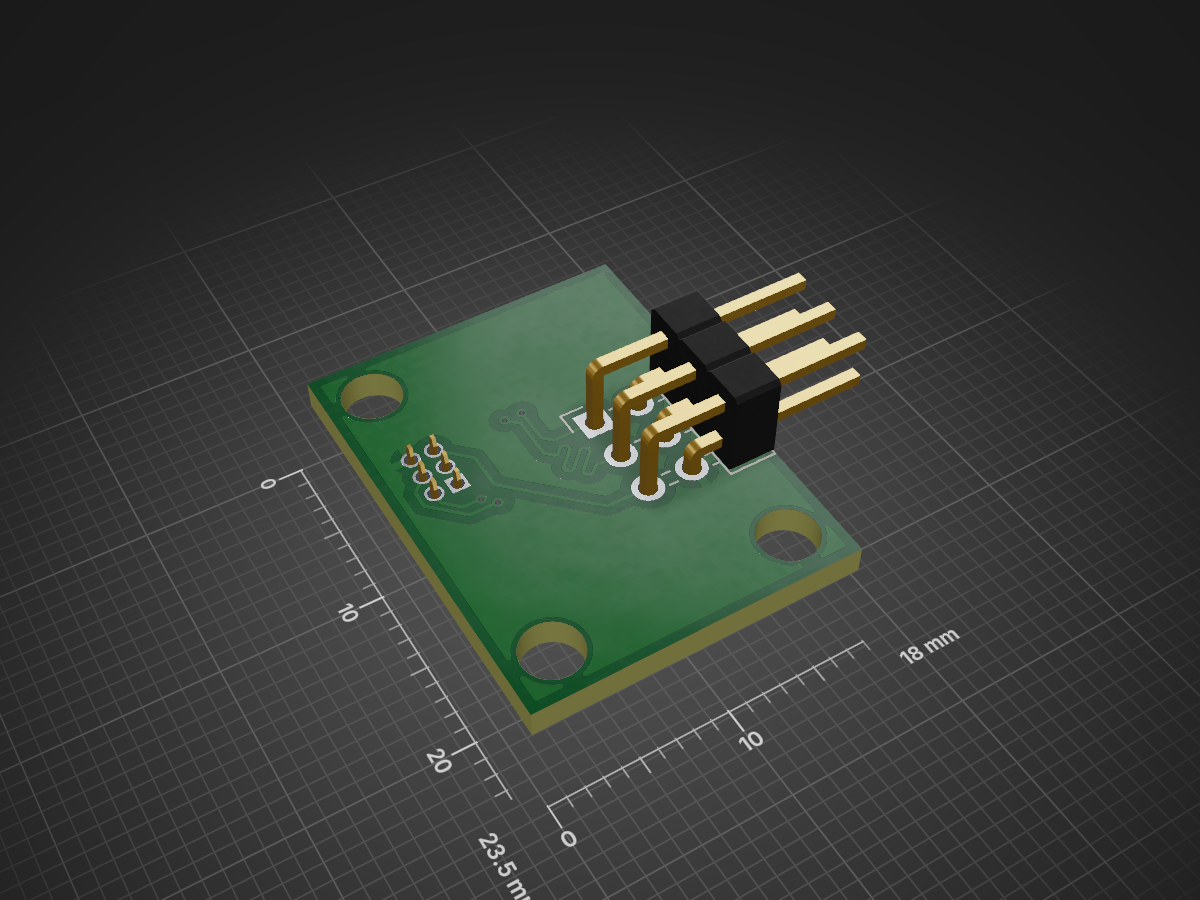
Timer programmer is an open-source printed circuit board by Mines-Rocketry-Club, from the Mines-Rocketry-Club/flight-computers repository on GitHub, published under the GPL-3.0 licence. It is a 2-layer board of 18 × 23.5 mm with 5 parts on 6 nets, routed with 71 tracks and 4 vias.
It belongs with the radio and wireless and interfaces and adapters boards of this library.
The series of flight computers produced as part of this project are inteneded to be useable for any low or high power rocketry applications. These will also span a large range of cost in order to provide flight computer capabilities for very high risk and experimental flights. The lowest possible trim level is a CW RF emmiter intended for use with radio direction finding equipment. The highest trim level will provide a platform for executing user space code asynchronously from the main event loop of the flight computer.
*The Screamer's CW Emmiter is lost as the other telemetry hardware on the board can be used to locate the device.
| Name | Features | Weight | Cost (2024) |
|---|---|---|---|
| The Screamer | CW RF Emitter | 5g | 5$ |
| The Timer | 3 Axis Accelerometer, Barometric Altimiter, CP1200 Transmitter, 4 Pyro Channels | 10g | 20$ |
| The Guesser | GPS, Onboard Data Logging, WIFI based configuration | 15g | 40$ |
| The Knower | User Code Execution, High Frequency Data Logging, 8 Pyro Channels | 20g | 60$ |
This board emits a constant signal at 146.660 MHz. This signal can be recived by many common low-cost trancievers, such as the Baofeng UV-5RA, UV8W, and AR-5RM. With a directional antenna any of these trancievers provides radio direction finding capabilities to the system.
The sysem does not have a microcontroller or any other regualtion system. It consistis of a power supply, based on the and the transmitter, which is a MAX2606 IF Oscillator. This component is not intended to be used to drive an antenna directly, however, the internal 50Ω matching and the -10dBm power output provide enough for this usage. In order to capture the full -10dBm output, a loop antenna must be attached to BOTH of the provided antenna pads. Bare copper wire or thin coat magnet wire is recommened for the antenna. a single loop in the wire should be adequate for most applicatons.
Due to the extremley low power consumption of the system, it can be powered parasitically off of any of the other computers in this series.
Attachement points will be added in the next revisions of each of the boards
- The Timer
- The Guesser
- The Knower
All hardware contained within this repository is under the TAPR Open Hardware License (OHL), which can be found, in full, in HW_LICENSE.
All software contained within this repository is under the GPL, which can be found, in full, in FW_LICENSE.
| Qty | Value | Footprint | References |
|---|---|---|---|
| 3 | MountingHole | MountingHole:MountingHole_3.2mm_M3 | H1, H2, H3 |
| 1 | AVR-ISP-6 | Connector_PinHeader_2.54mm:PinHeader_2x03_P2.54mm_Horizontal | J2 |
| 1 | AVR-ISP-6 | Connector_PinSocket_1.27mm:PinSocket_2x03_P1.27mm_Vertical | J1 |
Mines-Rocketry-Club/flight-computers
Fully open source high power rocketry flight computers.

Mines-Rocketry-Club/flight-computers
Fully open source high power rocketry flight computers.

Mines-Rocketry-Club/flight-computers
Fully open source high power rocketry flight computers.

Mines-Rocketry-Club/flight-computers
Fully open source high power rocketry flight computers.


joypad-ai/joypad-os
Universal controller firmware for building adapters, dongles, and custom controllers.

OLIMEX/OLINUXINO
OLINUXINO is Open Source / Open Hardware, low cost from EUR 24 Linux Industrial grade Single Board Computer capable to operate -25+85C

jamro/tiny-engineer
A small desktop robot that brings an AI coding assistant to life, physically acting out when it reads files, thinks, writes code, and finishes work.

hackclub/OnBoard
💡 Join 1,000 teenagers and make your first PCB with a $100 grant!


Luos-io/luos_engine
Open-source and real-time orchestrator for cyber-physical-systems, to easily design, test and deploy embedded applications and digital twins.
It measures 18 × 23.5 mm and has 2 copper layers, 1.6 mm thick.
5 parts. The full list of its parts is on this page, with links to each part's symbol and footprint where PCBKit's library has them.
From the Mines-Rocketry-Club/flight-computers repository on GitHub, at the commit this page was made from: the board is the_timer/timer_programmer/timer_programmer.kicad_pcb and its schematic the_guesser/Guesser_IO.kicad_sch. PCBKit opens the board in the browser, with nothing to install.
Its repository publishes it under the GPL-3.0 licence: you may reuse it on that licence's terms (keep the author's notice, and for a copyleft licence share your changes alike).