2 layers100 × 100 mm
Open65
Maverick-Shark/X65_BigMiST
The X65 is an ultimate computer for everyone interested in the venerable 65-series of 8-bit and 16-bit CPUs, i.e. the 6502 and 65816.
195 partsMIT

 Maverick-Shark/X65_BigMiST
The X65 is an ultimate computer for everyone interested in the venerable 65-series of 8-bit and 16-bit CPUs, i.e. the 6502 and 65816.
OpenX65-vabo is an open-source printed circuit board by Maverick-Shark, from the Maverick-Shark/X65_BigMiST repository on GitHub, published under the MIT licence. It is a 2-layer board of 100 × 100 mm with 235 parts on 237 nets, routed with 3,719 tracks and 400 vias.
It is built around the ICE40UP5K-SG48ITR50, W25Q16JVSNIQ and WM8524CGEDT, with the LM4890MX, THS7314D and DM1AA-SF-PEJ(82) among its other parts. Its parts include 108 resistors, 59 capacitors, 18 ICs, 12 connectors and 7 diodes. It belongs with the retro computing and games boards and the FPGA and CPLD boards of this library.


The X65 is an ultimate computer for everyone interested in the venerable 65-series of 8-bit and 16-bit CPUs, i.e. the 6502 and 65816. Specifically, it is built with the W65C02S or W65C816S CPU chips from Western Design Centre. The 16-bit 65816 (W65C816S) CPU variant is the default and preferred CPU, as all screen-shots shown below were done on the 16-bit system. The 65816 CPU powered the Super Nintendo Entertainment System (SNES) and the Apple IIGS. The older 8-bit 6502 CPU was the heart of NES, Apple I and II, many Ataris, Commodore 64, and many many more.
The design of X65 is fully open-source and open-hardware, and we also prefer to use just the open-source development tools whenever possible. The X65 computer hardware is designed with modern electronics parts, but with a little bit of retro feel. The computer is backward compatible with the 8-bit Commander X16 -- i.e. it can run their ROM, but since that ROM is copyrighted and non-free, this is a no-go in the long run. The goal is to build a fully open 8/16-bit system with good architecture and retro-gaming performance.
Compared with modern powerful platforms like x86, ARM or RISC-V, the small 65-series 8-bit or 16-bit system has the advantage that one person, a software programmer or electronics designer, can fully comprehend the whole system with all details. There are not many abstraction layers hidden in supporting libraries or big frameworks. (In fact, there are none. It is just bare metal.)
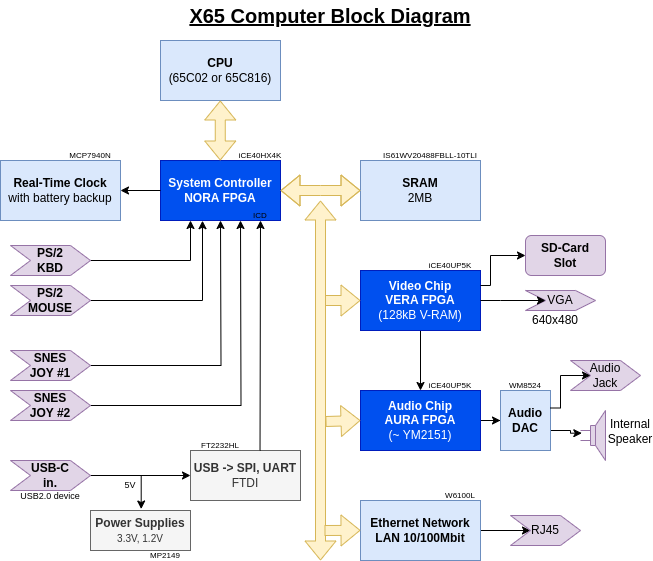
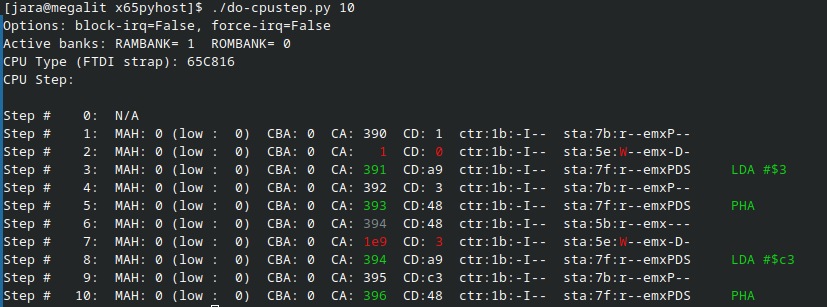
Interfaces: VGA 640x480 out, Stereo sound out (FM and PSG), PS/2 keyboard and mouse, SNES controller 2x ports, Ethernet LAN 10/100Mpbs with RJ45, SDHC card slot, power-in 5V USB-C port, In-Circuit Debugger (ICD) over the USB-C with PC host software in Python and supporting JTAG-like functions for the 65xx platform (CPU step, trace, memory dump & poke).
Project web pages: http://www.x65.eu -> currently links to http://www.jsykora.info
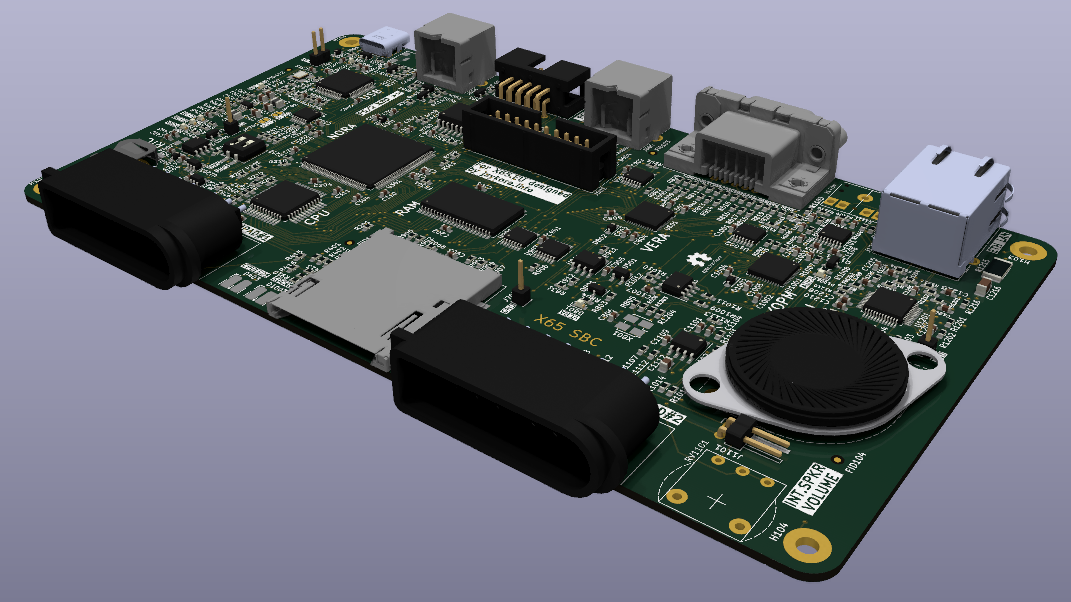
3D-render of the Single-Board Computer version:
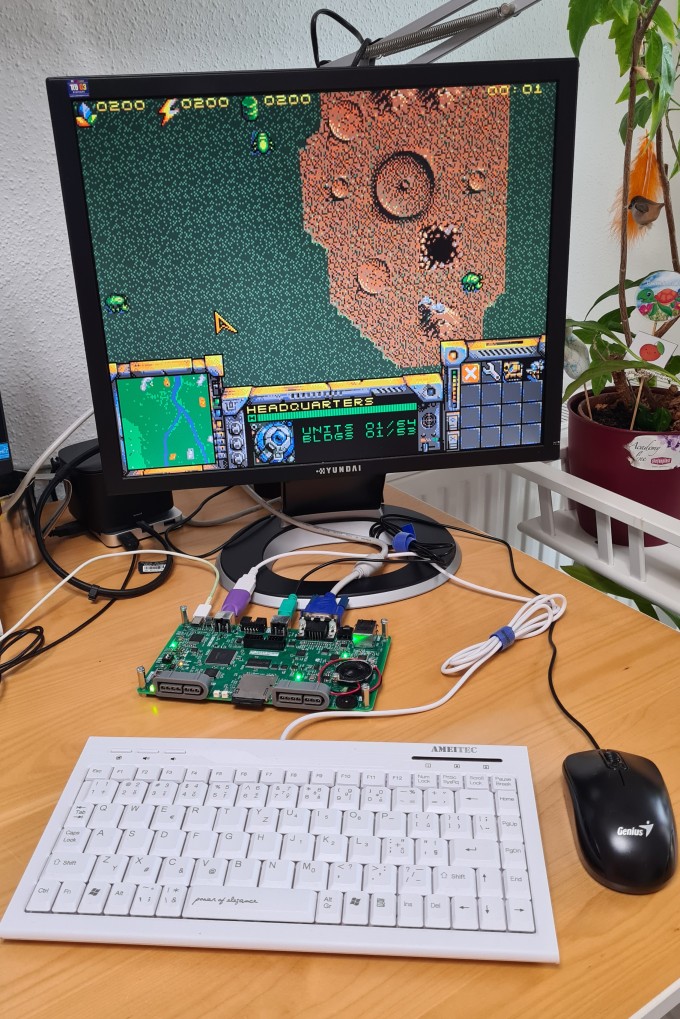
Desktop setup with X65-SBC, PS/2 mouse and keyboard and a VGA monitor. Running `Planet X16' by David Murray with CX16 ROMs:
Overview photos (2024/02) - Single-Board version:
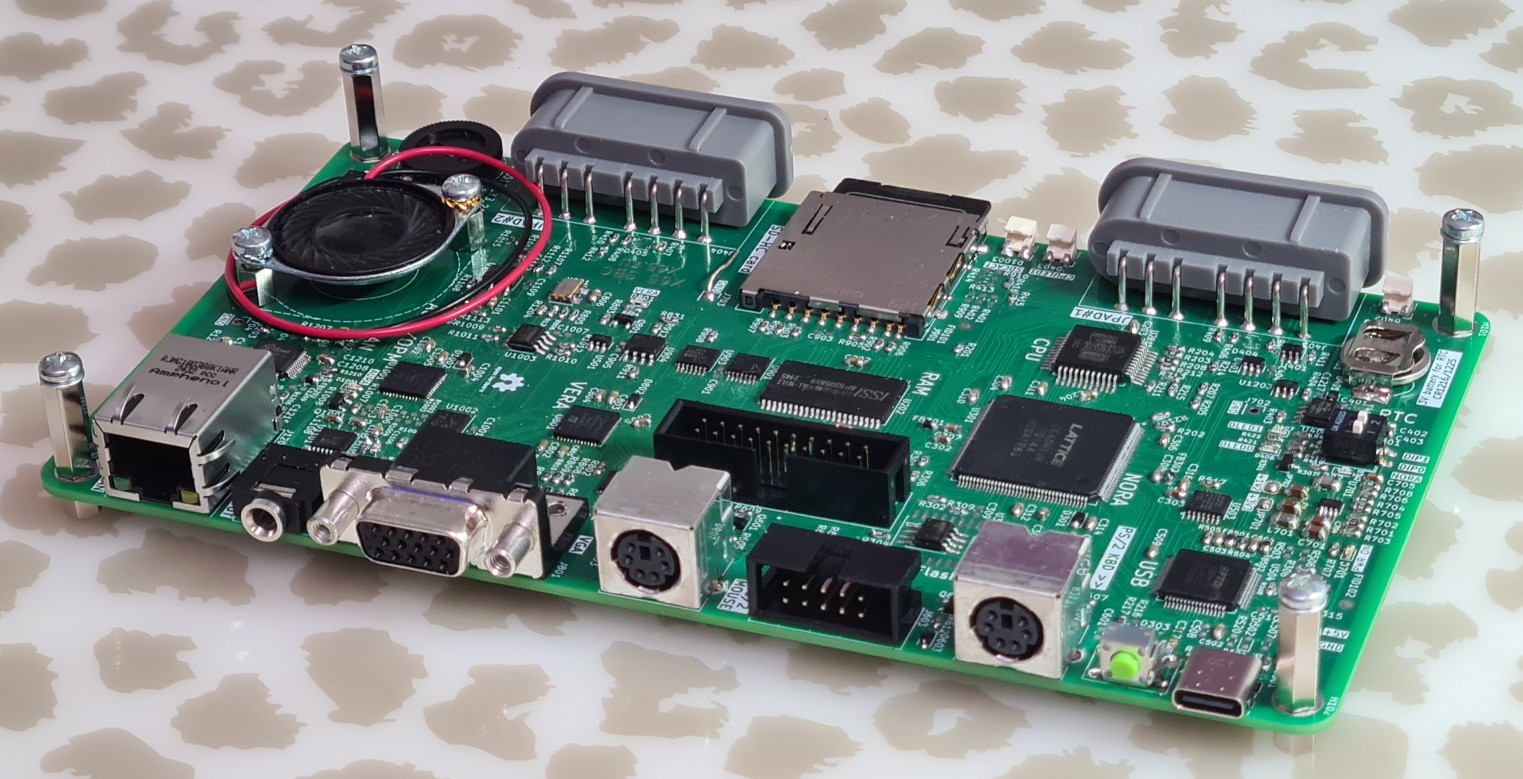
SBC Front view photo:
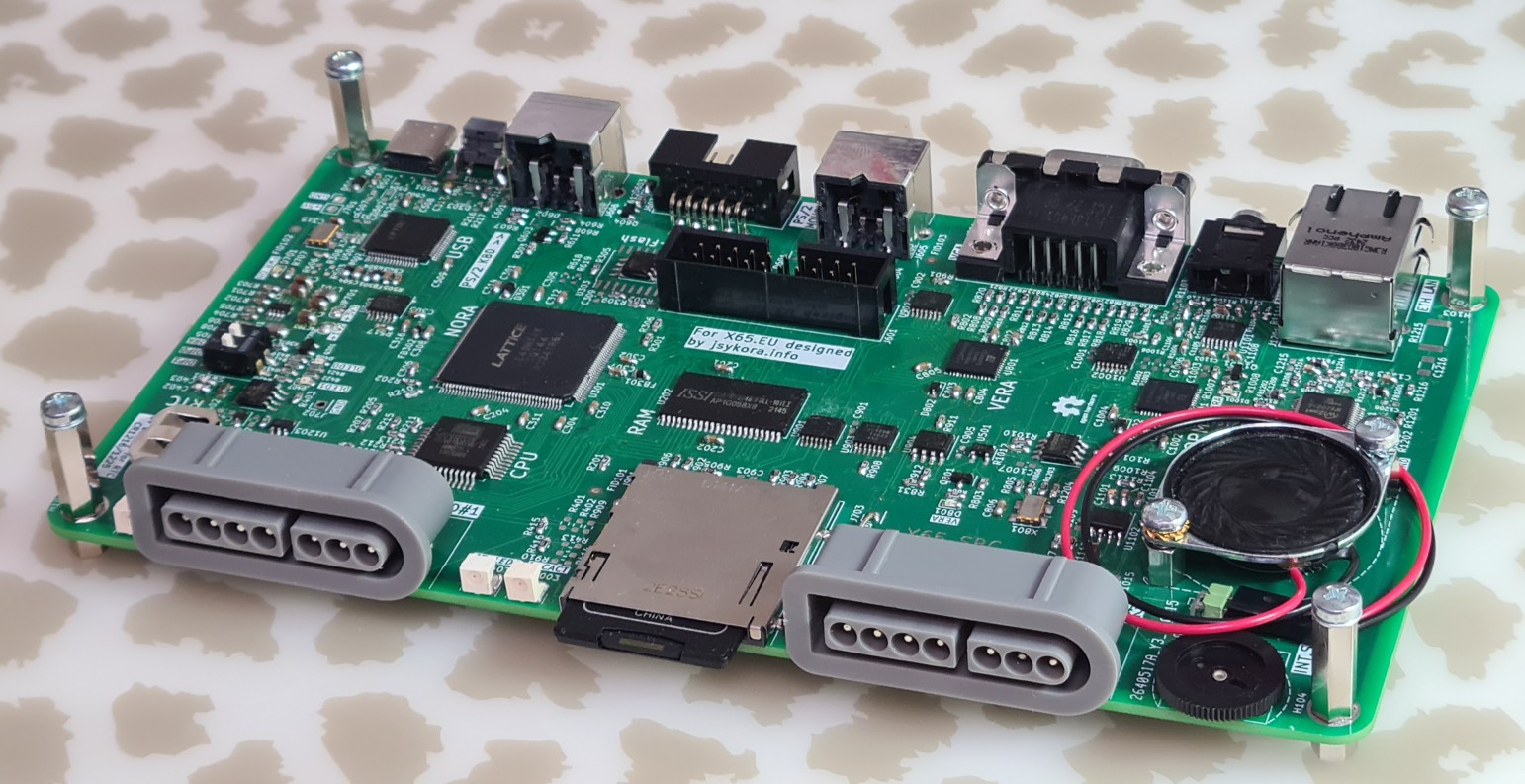
SBC Rear view photo:
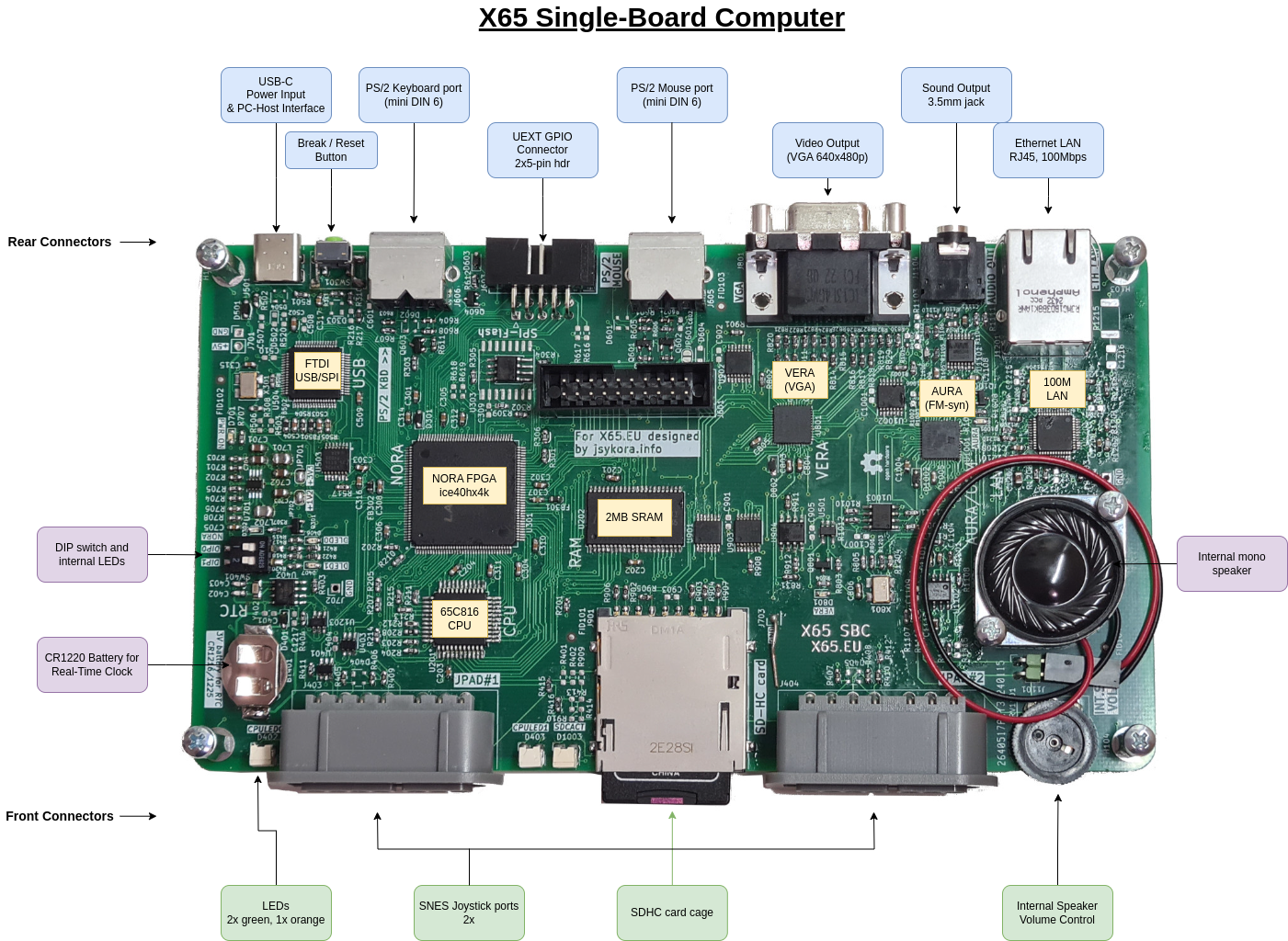
SBC Top view with labels:
Engineering testing samples, hand-assembled:
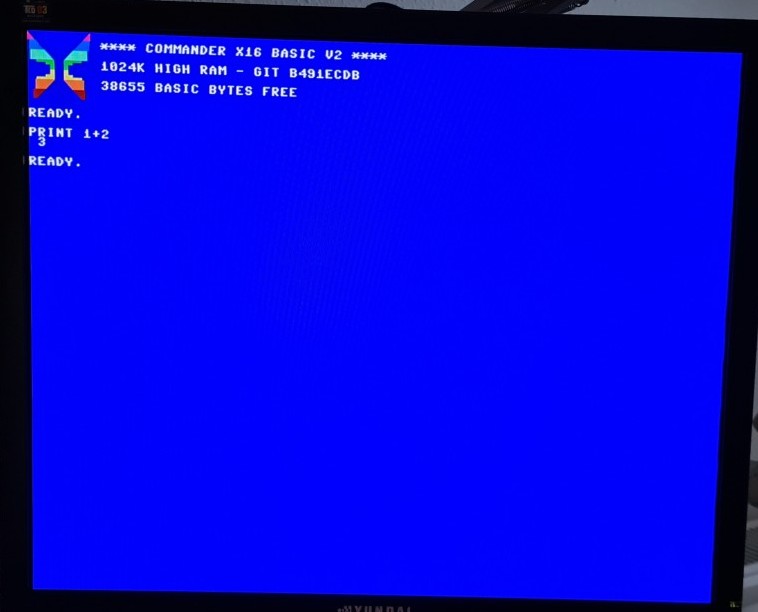
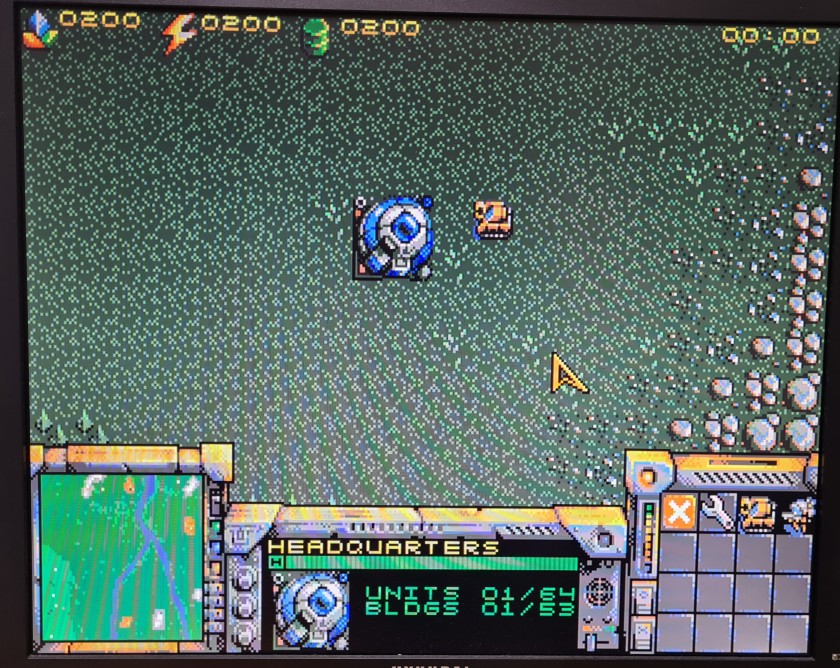
Running Commander X16 ROM and BASIC program (compatibility testing only, not allowed in production use due to a proprietary license):
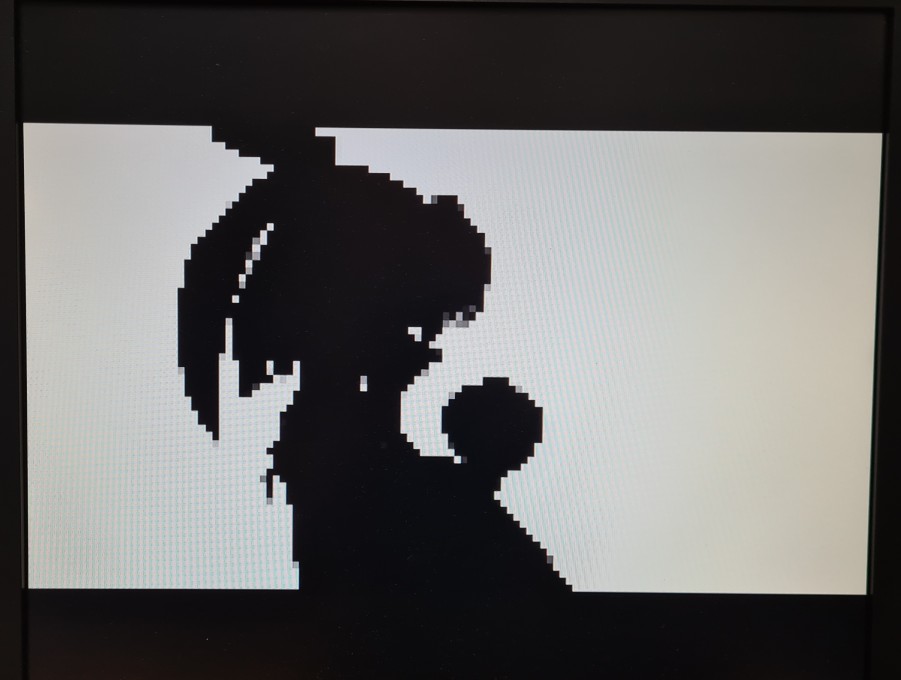
BAD METAL demo from CX16:
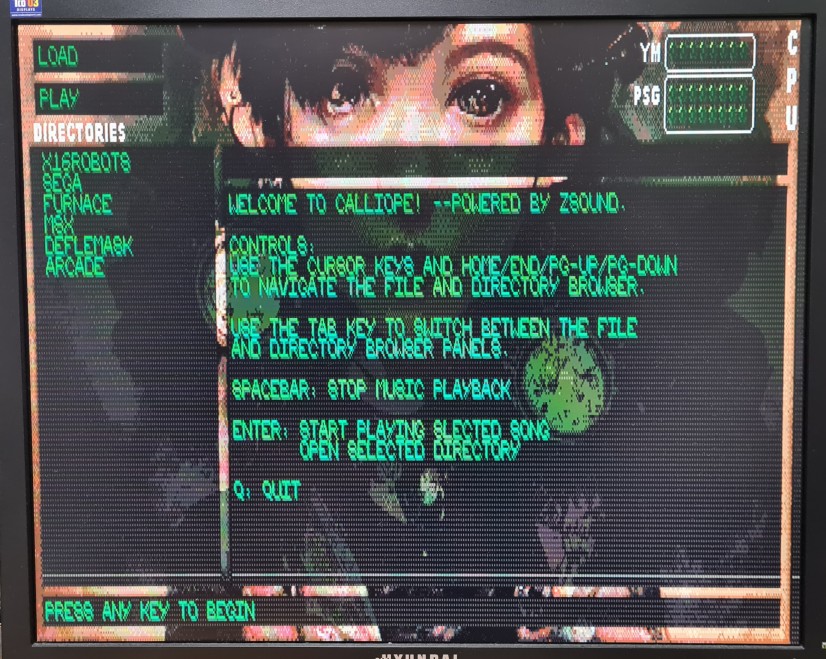
CALLIOPE music player from CX16:
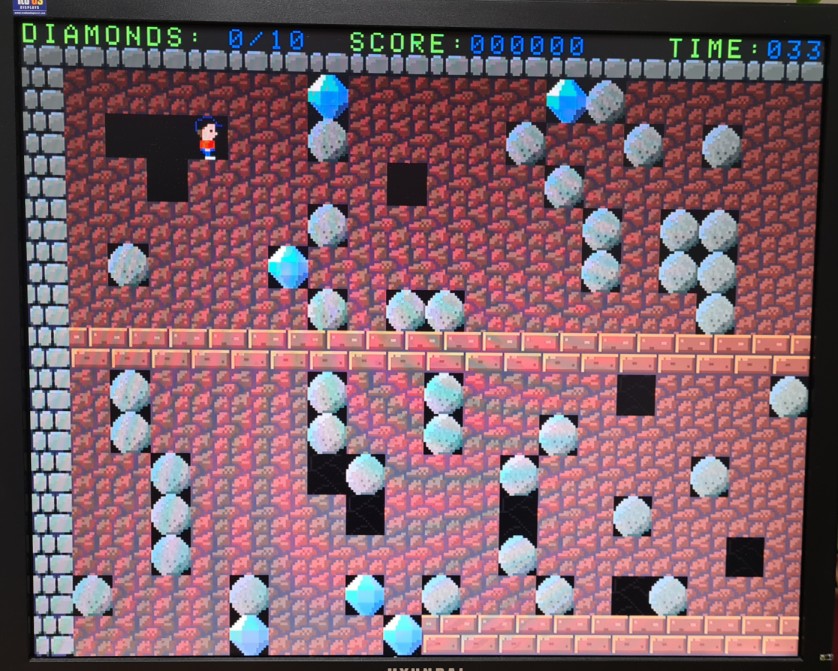
Crazy Boulders, a CX16 game by Dušan Štrakl:
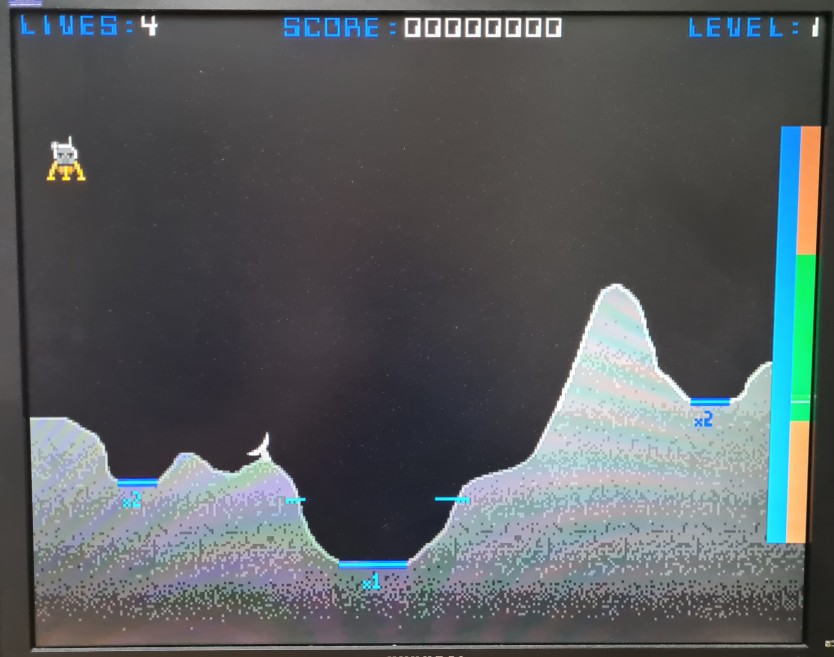
Crazy Lander, a CX16 game by Dušan Štrakl:
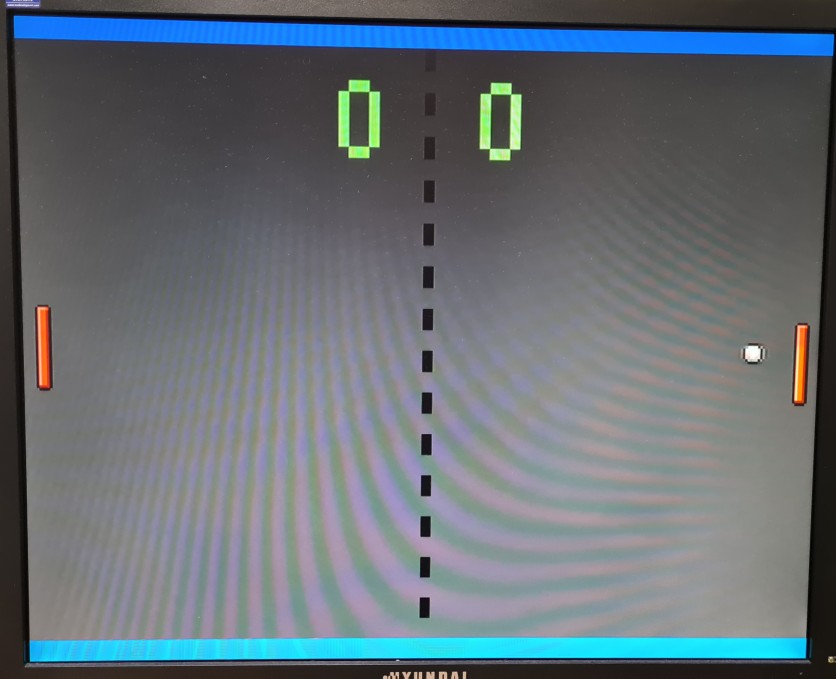
Crazy Pong, a CX16 game by Dušan Štrakl:
Planet X16, a CX16 game by David Murray:

Integrated In-Circuit Debugger can live-trace the CPU from a Linux PC over the USB:
SBC Revision A1:
SBC Revision B1:
The X65 is software-backwards-compatible with the Commander X16. It means the X65 could run unmodified CX16 ROM and programs, excluding programs depending on some of the hardware features in CX16 that are not supported here: cartridges, Commodore IEC port. However, the CX16 ROM is a proprietary, non-open-source and non-free, piece of software created by Commodore and (somehow) licensed to the CX16 creators. The licensees do not wish that the ROM runs on any other HW than their own. Therefore, I could not recommend running that ROM on the X65 computer.
Presently I am not decided which operating system or runtime shell would be the best / easiest to port to X65. There some existing systems that could be ported here, for example:
Why was this project started?
This project started in March 2023 when I saw a prototype of Commander X16 in one of the youtube videos of the 8-bit guy, David Murray. I immediately wanted to play with it but at the time his project was not released to the public, the hardware could not be bought. So I decided to build one myself, based on public information available about the CX16. And at the same time I was not too pleased with the architecture and implementation of the CX16, not satisfied with many design choices they did. Consequently, my X65 tries to improve in many areas while being software-compatible.
What is the relation to Commander X16 and its authors?
I have no relation or contact to the authors of Commander X16. The public discussion forums for CX16 on discord and reddit have the policy that any discussion or mention of any clones of CX16 is forbidden. While I find this policy strange for a community project, I respect it. Therefore I do not tell the guys about the X65 project.
What is the license of X65 project? Which copyrighted material was used?
I used publicly available information on wikipedia and in the X16Community's public forums and repositories to reconstruct the CX16 architecture. I don't have access to the schematics of X16, and I don't own that computer and never seen it in person. My analysis of the CX16 architecture is available in the file cx16.md. The VERA FPGA by Frank van den Hoef, also here, was reused as-is and it is covered by the open-source MIT license. The AURA FPGA is based on IKAOPM, a YM2151 reconstruction in verilog, and it is covered by the BSD 2-Clause License. All my documents and designs in this repository are covered by the MIT license. The restricted CX16 ROMs are not part of this repository.
What are the advantages of X65-SBC over other retro-modern-computers?
The X65-SBC is a complete computer system with ports for a keyboard and a mouse, a high-resolution VGA output (128kB Video-RAM), and high-quality stereo audio capable of PCM, PSG (Programmable Sound Generator) and FM-synthesis sound generation. Compared with other 65xx-based computers, we support the 16-bit processor 65C816 which is capable of direct addressing of up to 16MB of RAM; the X65-SBC includes 2MB of fast SRAM by default. System controller is realized by NORA FPGA (lattice ice40hx4k) and potentially allows experimenting with additional features like virtual memory or mathematical coprocessors. The hardware supports direct programming of FPGA bitstreams via the USB-C port from a Linux PC; in a way the X65-SBC is a self-contained FPGA development platform. The design is fully open-source.
Where can I get the hardware?
As all relevant HW design data is available in this repository, anybody with appropriate electronics knowledge and a lab can build own copy of the X65-SBC hardware. The cost of electronics components is around 130 EUR, plus the cost of board assembly (which can be done DIY if necessary). Maybe in the future I can run a very small series build for interested programmers and "hackers". However, as these builds surely will not have the requisite FCC / UL / CE approvals (that costs addional money), the resulting devices could only be used in a lab for development purposes by knowledgable users. I am open to the possibility that some company decides to commercionalize X65-SBC as a sellable product and puts it on the market :-)
Is there an emulator for PC?
Presently an emulator is not developed yet. It could be done perhaps based on the CX16 emulator; the CPU emulation has to be extended to 65C816 and new features (registers) available in NORA and in W6100 (ethernet interface) need be implemented.
Jaroslav Sýkora
| Qty | Value | Footprint | References |
|---|---|---|---|
| 32 | 1u | Capacitor_SMD:C_0603_1608Metric_Pad1.08x0.95mm_HandSolder | C201, C202, C203, C205, C206, C211, C401, C402, C404, C405, C501, C601, C602, C603, C604, C606 +16 |
| 29 | 10k | Resistor_SMD:R_0603_1608Metric_Pad0.98x0.95mm_HandSolder | R201, R203, R401, R402, R409, R410, R411, R412, R501, R502, R503, R504, R505, R506, R510, R511 +13 |
| 10 | 470R | Resistor_SMD:R_0603_1608Metric_Pad0.98x0.95mm_HandSolder | R207, R303, R304, R507, R508, R509, R619, R807, R808, R818 |
| 9 | CAY16-1001F4LF | Resistor_SMD:R_Array_Convex_4x0603 | RN301, RN302, RN303, RN304, RN305, RN306, RN307, RN308, RN309 |
| 7 | 0R | Resistor_SMD:R_0603_1608Metric_Pad0.98x0.95mm_HandSolder | R208, R305, R514, R607, R608, R609, R610 |
| 7 | 50R | Resistor_SMD:R_0603_1608Metric_Pad0.98x0.95mm_HandSolder | R204, R205, R206, R809, R810, R811, R812 |
| 6 | 47k | Resistor_SMD:R_0603_1608Metric_Pad0.98x0.95mm_HandSolder | R403, R404, R405, R406, R407, R408 |
| 6 | 560R | Resistor_SMD:R_0603_1608Metric_Pad0.98x0.95mm_HandSolder | R701, R702, R709, R710, R712, R713 |
| 5 | 22u/16V | Capacitor_SMD:C_0805_2012Metric_Pad1.18x1.45mm_HandSolder | C302, C502, C719, C816, C817 |
| 5 | 4u7 | Capacitor_SMD:C_0603_1608Metric_Pad1.08x0.95mm_HandSolder | C403, C706, C707, C717, C718 |
| 4 | 2n7 | Capacitor_SMD:C_0603_1608Metric_Pad1.08x0.95mm_HandSolder | C704, C705, C715, C716 |
| 4 | 3R3 | Resistor_SMD:R_0603_1608Metric_Pad0.98x0.95mm_HandSolder | R813, R814, R815, R816 |
| 4 | 74CBTLV3126PW,118 | Package_SO:TSSOP-14_4.4x5mm_P0.65mm | U402, U404, U504, U602 |
| 4 | BSS138 | Package_TO_SOT_SMD:SOT-23 | Q201, Q401, Q601, Q701 |
| 4 | GBK160808T-221Y-N | Resistor_SMD:R_0603_1608Metric_Pad0.98x0.95mm_HandSolder | FB801, FB802, FB803, FB804 |
| 4 | MountingHole | MountingHole:MountingHole_3.2mm_M3 | H101, H102, H103, H104 |
| 3 | 100n | Capacitor_SMD:C_0603_1608Metric_Pad1.08x0.95mm_HandSolder | C811, C812, C815 |
| 3 | 150R | Resistor_SMD:R_0603_1608Metric_Pad0.98x0.95mm_HandSolder | R325, R328, R331 |
| 3 | 160R | Resistor_SMD:R_0603_1608Metric_Pad0.98x0.95mm_HandSolder | R324, R327, R330 |
| 3 | 27R | Resistor_SMD:R_0603_1608Metric_Pad0.98x0.95mm_HandSolder | R323, R326, R329 |
| 3 | 2k | Resistor_SMD:R_0603_1608Metric_Pad0.98x0.95mm_HandSolder | R311, R315, R319 |
| 3 | 3u3 | Capacitor_SMD:C_0603_1608Metric_Pad1.08x0.95mm_HandSolder | C701, C712, C806 |
| 3 | 4k3 | Resistor_SMD:R_0603_1608Metric_Pad0.98x0.95mm_HandSolder | R312, R316, R320 |
| 3 | 4k7 | Resistor_SMD:R_0603_1608Metric_Pad0.98x0.95mm_HandSolder | R413, R414, R707 |
| 3 | 510R | Resistor_SMD:R_0603_1608Metric_Pad0.98x0.95mm_HandSolder | R309, R313, R317 |
| 3 | 75R | Resistor_SMD:R_0603_1608Metric_Pad0.98x0.95mm_HandSolder | R306, R307, R308 |
| 3 | 820R | Resistor_SMD:R_0603_1608Metric_Pad0.98x0.95mm_HandSolder | R321, R322, R821 |
| 3 | 910R | Resistor_SMD:R_0603_1608Metric_Pad0.98x0.95mm_HandSolder | R310, R314, R318 |
| 3 | Fiducial | Fiducial:Fiducial_1mm_Mask2mm | FID101, FID102, FID103 |
| 2 | 1k | Resistor_SMD:R_0603_1608Metric_Pad0.98x0.95mm_HandSolder | R301, R302 |
| 2 | 39k | Resistor_SMD:R_0603_1608Metric_Pad0.98x0.95mm_HandSolder | R703, R705 |
| 2 | 74LVC1G11 | Package_TO_SOT_SMD:SOT-23-6_Handsoldering | U501, U502 |
| 2 | 8p | Capacitor_SMD:C_0603_1608Metric_Pad1.08x0.95mm_HandSolder | C813, C814 |
| 2 | AA4040SESK | ledplcc2:PLCC2_4x4mm | D502, D503 |
| 2 | CUS10S30,H3F | Diode_SMD:D_SOD-323_HandSoldering | D201, D601 |
| 2 | Conn_01x01 | Connector_PinHeader_2.54mm:PinHeader_1x01_P2.54mm_Vertical | J503, J504 |
| 2 | LED_GREEN_0603 | LED_SMD:LED_0603_1608Metric_Pad1.05x0.95mm_HandSolder | D203, D605 |
| 2 | PINS 1x2 | Connector_PinHeader_2.54mm:PinHeader_1x02_P2.54mm_Vertical | J702, J703 |
| 2 | SOCK 2x10p 2,54mm | Connector_PinSocket_2.54mm:PinSocket_2x10_P2.54mm_Vertical | J501, J502 |
| 2 | SolderJumper_2_Bridged | Jumper:SolderJumper-2_P1.3mm_Bridged_RoundedPad1.0x1.5mm | JP402, JP601 |
| 2 | W25Q16JVSNIQ | Package_SO:SOIC-8_3.9x4.9mm_P1.27mm | U401, U603 |
| 2 | WM8524CGEDT | Package_SO:TSSOP-16_4.4x5mm_P0.65mm | U701, U703 |
| 1 | 10M | Resistor_SMD:R_2512_6332Metric_Pad1.40x3.35mm_HandSolder | R804 |
| 1 | 12k | Resistor_SMD:R_0603_1608Metric_Pad0.98x0.95mm_HandSolder | R801 |
| 1 | 1M | Resistor_SMD:R_0603_1608Metric_Pad0.98x0.95mm_HandSolder | R817 |
| 1 | 1k5 | Resistor_SMD:R_0603_1608Metric_Pad0.98x0.95mm_HandSolder | R820 |
| 1 | 1nF | Capacitor_SMD:C_0603_1608Metric_Pad1.08x0.95mm_HandSolder | C303 |
| 1 | 1nF/2kV | Capacitor_SMD:C_1206_3216Metric_Pad1.33x1.80mm_HandSolder | C818 |
| 1 | 1uF | Capacitor_SMD:C_0603_1608Metric_Pad1.08x0.95mm_HandSolder | C714 |
| 1 | 300R | Resistor_SMD:R_0603_1608Metric_Pad0.98x0.95mm_HandSolder | R802 |
| 1 | 330n | Capacitor_SMD:C_0603_1608Metric_Pad1.08x0.95mm_HandSolder | C708 |
| 1 | 5MS3S102AM6QE | switches:Switch_5M_M6 | SW701 |
| 1 | 74AHC00PW | Package_SO:TSSOP-14_4.4x5mm_P0.65mm | U403 |
| 1 | 74AHCT573PW | Package_SO:TSSOP-20_4.4x6.5mm_P0.65mm | U505 |
| 1 | 74LVC2G02 | Package_SO:TSSOP-8_3x3mm_P0.65mm | U503 |
| 1 | A6SN-4101 | Button_Switch_SMD:SW_DIP_SPSTx04_Slide_Omron_A6S-410x_W8.9mm_P2.54mm | SW501 |
| 1 | AA4040LCGCK-AMT | ledplcc2:PLCC2_4x4mm | D501 |
| 1 | ABM3-25.000MHZ-D2Y-T | Crystal:Crystal_SMD_Abracon_ABM3-2Pin_5.0x3.2mm_HandSoldering | Y801 |
| 1 | C | Capacitor_SMD:C_0603_1608Metric_Pad1.08x0.95mm_HandSolder | C710 |
| 1 | Composite | Connector_PinHeader_2.54mm:PinHeader_1x02_P2.54mm_Vertical | J301 |
| 1 | DM1AA-SF-PEJ | Connector_Card:SD_Hirose_DM1AA_SF_PEJ82 | J401 |
| 1 | DS1093-01-BN40 | vera-module:DS1093-01-BN40 | J302 |
| 1 | ICD15S13E4GV00LF | vera-module:ICD15S13E4GV00LF | J303 |
| 1 | ICE40UP5K-SG48ITR50 | Package_DFN_QFN:QFN-48-1EP_7x7mm_P0.5mm_EP5.3x5.3mm | U201 |
| 1 | ICE5LP{1,2,4}K-SG48 | Package_DFN_QFN:QFN-48-1EP_7x7mm_P0.5mm_EP5.6x5.6mm | U601 |
| 1 | LM4890MX | Package_SO:SOIC-8_3.9x4.9mm_P1.27mm | U702 |
| 1 | Lumberg 1503-07 | Connector_Audio:Jack_3.5mm_Lumberg_1503_07_Horizontal | J701 |
| 1 | PTS645VM13SMTR92 LFS | switches:PTS645VM13SMTR92 LFS | SW401 |
| 1 | RJMG1BD3B8K1ANR | Connector_RJ:RJ45_Amphenol_RJMG1BD3B8K1ANR | J801 |
| 1 | SG5032CAN_25.000000M-TJGA3 | Oscillator:Oscillator_SMD_SeikoEpson_SG8002LB-4Pin_5.0x3.2mm_HandSoldering | X201 |
| 1 | THS7314D | Package_SO:SOIC-8_3.9x4.9mm_P1.27mm | U301 |
| 1 | W6100L | Package_QFP:LQFP-48_7x7mm_P0.5mm | U801 |
Maverick-Shark/X65_BigMiST
The X65 is an ultimate computer for everyone interested in the venerable 65-series of 8-bit and 16-bit CPUs, i.e. the 6502 and 65816.

Maverick-Shark/X65_BigMiST
The X65 is an ultimate computer for everyone interested in the venerable 65-series of 8-bit and 16-bit CPUs, i.e. the 6502 and 65816.


ifilot/open-vera-module
VERA (Versatile Embedded Retro Adapter) is a self-contained FPGA video and audio module for retro-computing projects.


dmanla/SecureConnectivityDevelopmentPlatform
A development platform which provides secure connectivity and data logging support while maintaining compatibility with Arduino-Mega hardware and software.

MF-Room/mseq_pcb
KiCad 10 hardware design for MSeq embedded, the microcontroller implementation of the MSeq MIDI sequencer.


It measures 100 × 100 mm and has 2 copper layers, 1.6 mm thick.
235 parts, built around the ICE40UP5K-SG48ITR50, W25Q16JVSNIQ, WM8524CGEDT and LM4890MX. The full list of its parts is on this page, with links to each part's symbol and footprint where PCBKit's library has them.
From the Maverick-Shark/X65_BigMiST repository on GitHub, at the commit this page was made from: the board is pcb/vabo-rev01/openX65-vabo.kicad_pcb and its schematic pcb/ftdi-test/ftdi-test/ftdi-test.kicad_sch. PCBKit opens the board in the browser, with nothing to install.
Its repository publishes it under the MIT licence: you may reuse it on that licence's terms (keep the author's notice, and for a copyleft licence share your changes alike).