

2 layers67.4 × 42 mm
FlipperZeroModule
ComplacencyKillz/GhostMesh
Meshtastic + Flipper Zero integration for offline red team comms — remote Bad USB, killswitch, and mesh-based C2 over LoRa
23 parts5MIT

 Mateix10/Airmote
A ESP32-based home assistant IR remote
Airemote is an open-source printed circuit board by Mateix10, from the Mateix10/Airmote repository on GitHub. It is a 2-layer board of 31 × 58 mm with 16 parts on 29 nets, routed with 65 tracks and 1 via.
It is built around the BME280 and PN2222A. Its parts include 5 resistors, 4 diodes, 2 ICs and 1 transistor. It belongs with the home automation and IoT boards and the ESP32 and RISC-V boards of this library.
Control any IR device and monitor room temperature, pressure and humidity with Home Assistant.
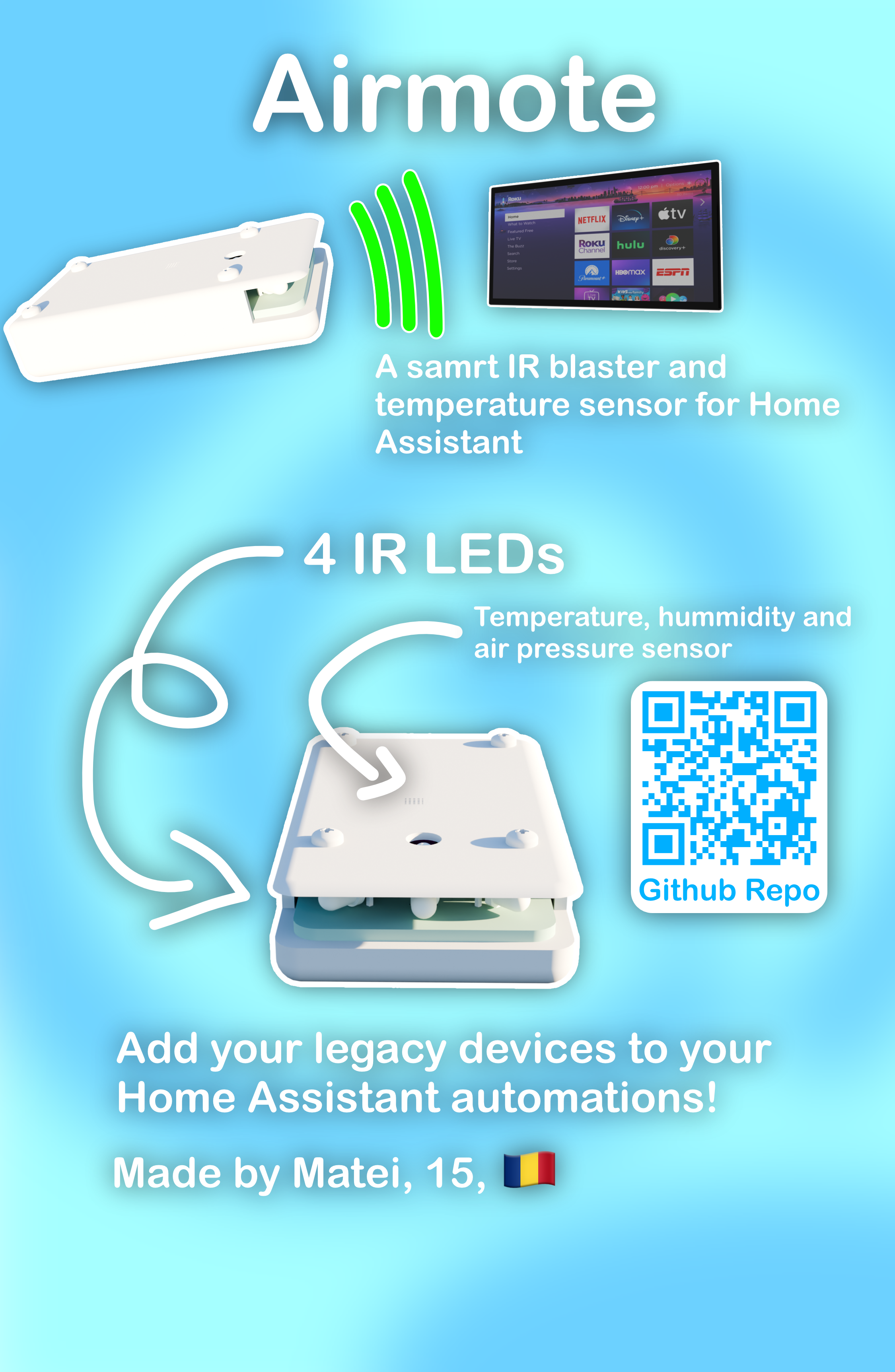
I always wanted to add my older devices that aren't compatible with Home Assistant to my automations. I want to turn my old stereo on when I start playing music, without having to reach for the half-broken remote.
For the firmware, use ESPHome
Code for the BME280 temperature sensor:
sensor:
  - platform: bme280_i2c
    temperature:
      name: "BME280 Temperature"
    pressure:
      name: "BME280 Pressure"
    humidity:
      name: "BME280 Humidity"
... and for the IR:
remote_transmitter:
  pin: GPIOXX
  carrier_duty_percent: 50%

climate:
  - platform: REPLACEME     # you need to replpace the platform to your AC. See esphome documentation for more
    name: "Living Room AC"
    sensor: room_temperature
    use_fahrenheit: false
Note: this is untested code.
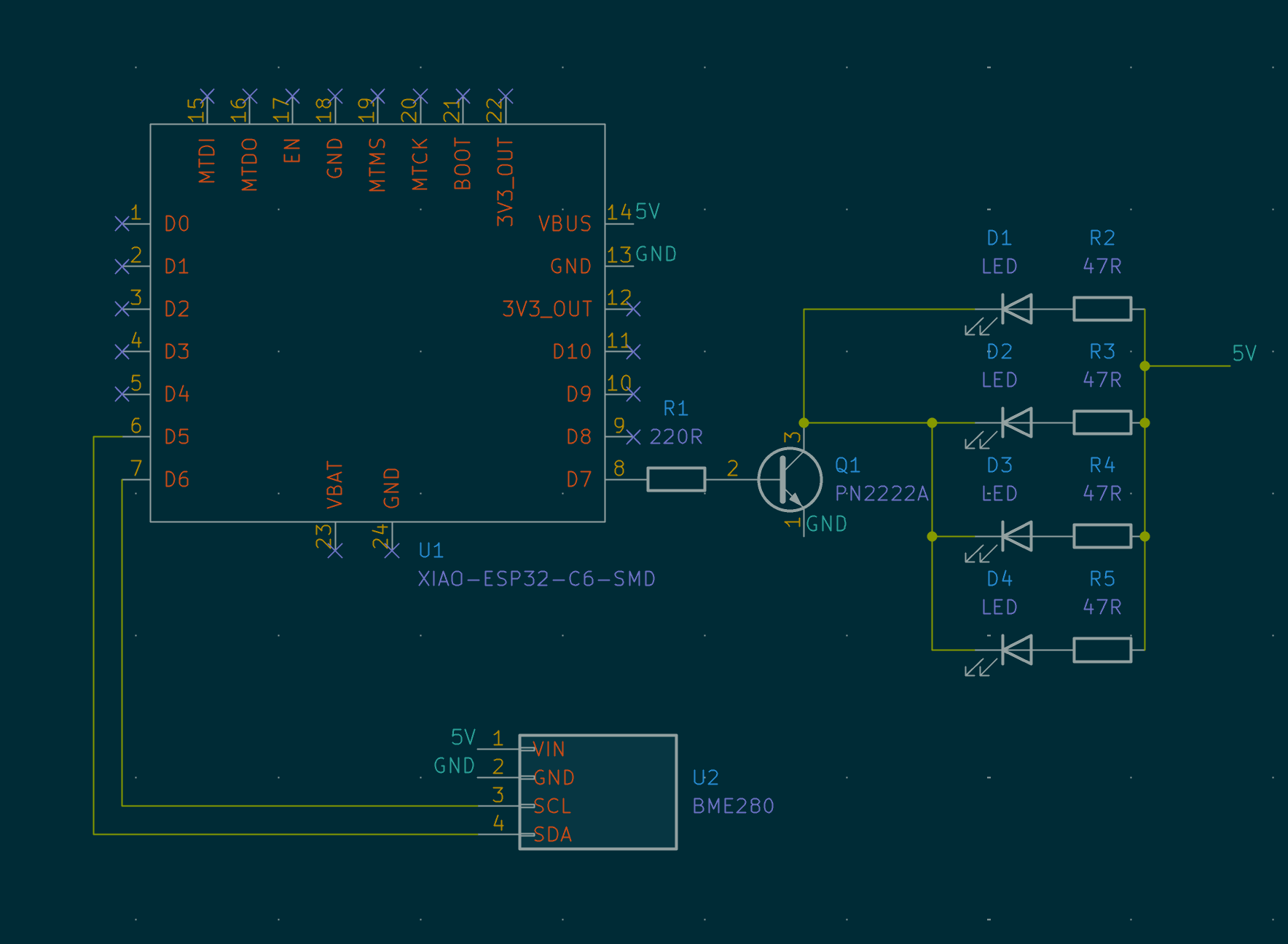
The schematic and PCB are pretty simple, just connecting the LEDs to a 2n2222 transistor and accompanying resistors for protection.
The BME 280 sensor is connected trough I2C. It's connected that way becaouse it simplifies the PCB and the sensor doesn't need fast data.
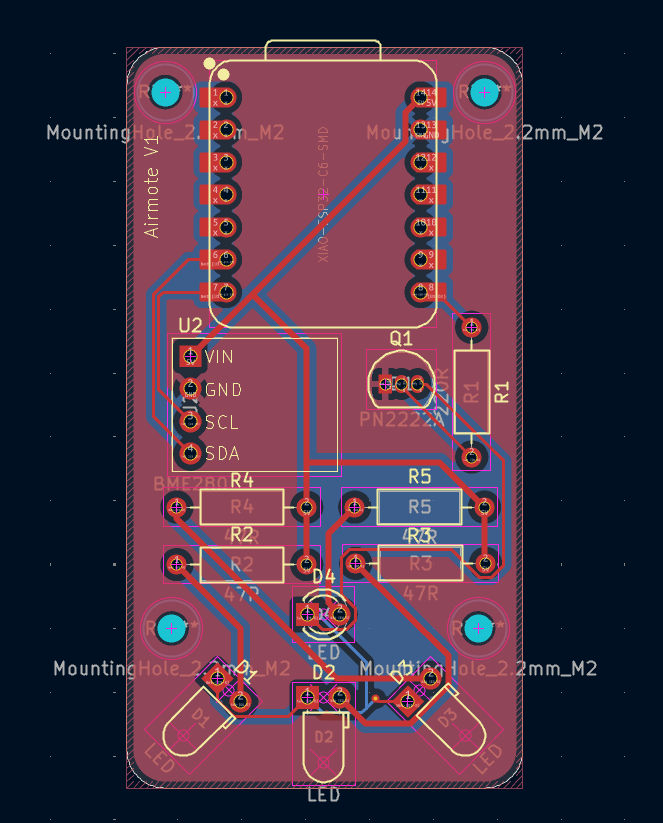
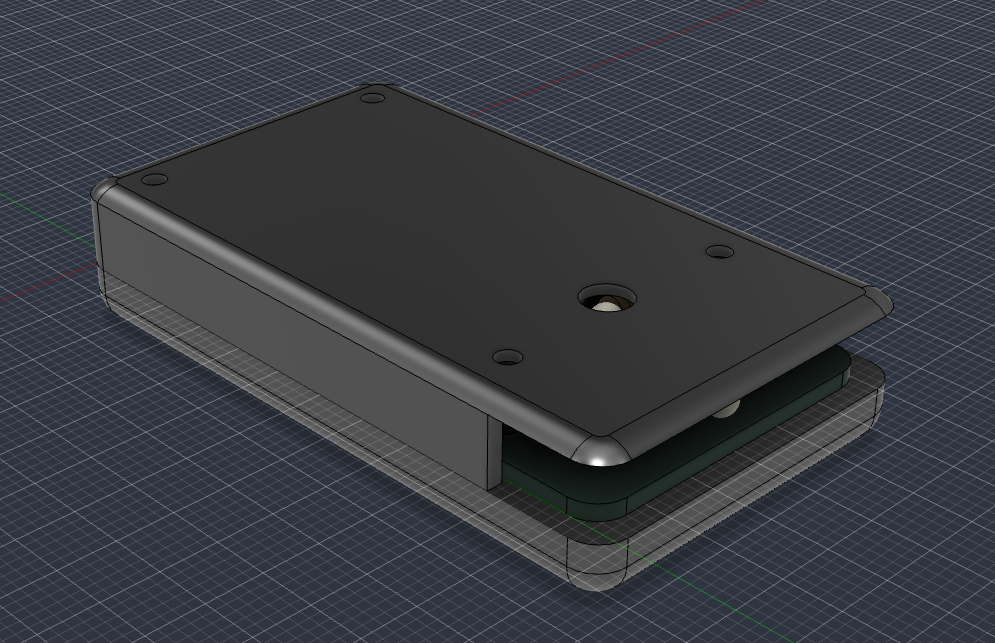
I went for a industrial design as this device is intended to be hidden away on a high surface, away from sight. The bottom and top of the case are held by m2 screws along side bolts and heat inserts.
Designed in Fusion 360. Files are available in 3D/Airmote.f3z
| Item | Count | Price | Link |
|---|---|---|---|
| Seeed Studio XIAO ESP32-C6 | 1 | $5.20 | Seeed Studio |
| 3mm 940nm IR LED* | 4 | $1.47/lot | Aliexpress |
| 2N2222 transistor* | 1 | $3.75/lot | Aliexpress (Select 2n2222 in the listing) |
| 220 Ohm resistor* | 1 | $0.63/lot | Aliexpress (Select 220R in the listing) |
| 47 Ohm resistor* | 4 | $0.63/lot | Aliexpress (Select 47R in the listing) |
| BME280 sensor breakout board | 1 | $4.00 | Aliexpress (Select 5V or else it won't fit) |
| Heat brass inserts* | 4 | $7.09/lot | Aliexpress (Select M2(OD3mm) and 2mm length) |
| M2 Screws* | 4 | $3.85/lot | Aliexpress (Select M2 10mm in the listing) |
| PCB | 1 | $2 | JLCPCB |
| Shipping | - | $69.39 | - |
| Total | - | $92.81 | - |
*ONLY buy the listing of bolded items ONCE. Those are sold as a lot and you will be getting 50/100pcs per listing bought.
Hackclub Fallout - Founding
Kicad - Schematic and PCB design
ESPHome - Firmware
| Qty | Value | Footprint | References |
|---|---|---|---|
| 4 | 47R | Resistor_THT:R_Axial_DIN0207_L6.3mm_D2.5mm_P10.16mm_Horizontal | R2, R3, R4, R5 |
| 3 | LED | LED_THT:LED_D3.0mm_Horizontal_O1.27mm_Z2.0mm_Clear | D1, D2, D3 |
| 1 | 220R | Resistor_THT:R_Axial_DIN0207_L6.3mm_D2.5mm_P10.16mm_Horizontal | R1 |
| 1 | BME280 | BME280:BME280_BreakOut | U2 |
| 1 | LED | LED_THT:LED_D3.0mm_Clear | D4 |
| 1 | PN2222A | Package_TO_SOT_THT:TO-92_Inline | Q1 |
| 1 | XIAO-ESP32-C6-SMD | Seeed Studio XIAO Series Library:XIAO-ESP32-C6-DIP | U1 |
The 12 most common of 16 parts.
ComplacencyKillz/GhostMesh
Meshtastic + Flipper Zero integration for offline red team comms — remote Bad USB, killswitch, and mesh-based C2 over LoRa


skiselev/micro_8088
Micro 8088 - IBM XT Compatible Processor Board based on Faraday FE2010 chipset

Staacks/there.oughta.be
Projects featured on my blog at https://there.oughta.be


plusvic/simplebus2-intercom
General description of the Simplebus2 protocol used by some Comelit's intercoms. Hardware for retransmitting Simplebus2 messages over UART.


It measures 31 × 58 mm and has 2 copper layers, 1.6 mm thick.
16 parts, built around the BME280 and PN2222A. The full list of its parts is on this page, with links to each part's symbol and footprint where PCBKit's library has them.
From the Mateix10/Airmote repository on GitHub, at the commit this page was made from: the board is PCB/Kicad/Airemote.kicad_pcb and its schematic PCB/Kicad/Airemote.kicad_sch. PCBKit opens the board in the browser, with nothing to install.
Its repository states no licence, so its author keeps all rights: ask Mateix10 before reusing the design.