

2 layers151.5 × 88.5 mm
Repelbridge
thorrak/repelbridge
An ESP32-based controller that manages Thermacell Liv Repeller devices over WiFi without using the cloud.
53 partsApache-2.0

 MartinP1/ESP8266_MQTT_THERMOSTAT1
Das Prototyp-System ist stillgelegt, aktuell läuft V1 einer Kicad-Leiterplatte. Mindestausstattung wäre ein Thermosensor für die Raumtemperatur und ein Schaltrelais für die Ansteuerung des Ventil-Stellgliedes...
Kicad test eurocard is an open-source printed circuit board by MartinP1, from the MartinP1/ESP8266_MQTT_THERMOSTAT repository on GitHub, published under the MIT licence. It is a 2-layer board of 110 × 60 mm with 27 parts on 23 nets, routed with 112 tracks and 1 via.
It is built around the WEMOS D1 MINI and IRFB3306PBF. Its parts include 7 connectors, 4 resistors, 3 diodes, 3 transistors and 2 ICs. It belongs with the ESP8266 boards of this library.
Das Projekt ist seit mehreren Jahren im operativen Einsatz.
ESP basierte Hardware - es werden drei Module unterstützt.
12 V DC Spannungsversorgung - Ein Tisch-Netzteil von der Resterampe von www.pollin.de 12V / 2,3A.
Danfoss Stellantrieb Thermot 230 V AC, M30x1,5 NC stromlos geschlossen 088H3220 ca 10 €
4 Arctic 80 mm Gehäuselüfter (3 Pin habe ich gekauft, wahrscheinlich wäre 4 Pin die bessere Wahl gewesen) blasen den Heizkörper von unten an
3 DS 18B20 Thermosensoren von Shelly https://www.pollin.de/p/shelly-temperMQTT_PUB_DEV_PREFIXatursensor-ds18b20-591021

Das Prototyp-System ist stillgelegt, aktuell läuft V1 einer Kicad-Leiterplatte. Mindestausstattung wäre ein Thermosensor für die Raumtemperatur und ein Schaltrelais für die Ansteuerung des Ventil-Stellgliedes...
Inzwischen laufen acht 80 mm Lüfter unter dem Heizkörper - Blasen in die Lücke zwischen den Platten Dazu noch 6 50 mm Lüfter, die in die Zwischenraum zwischen der Wand und dem Heizkörper blasen
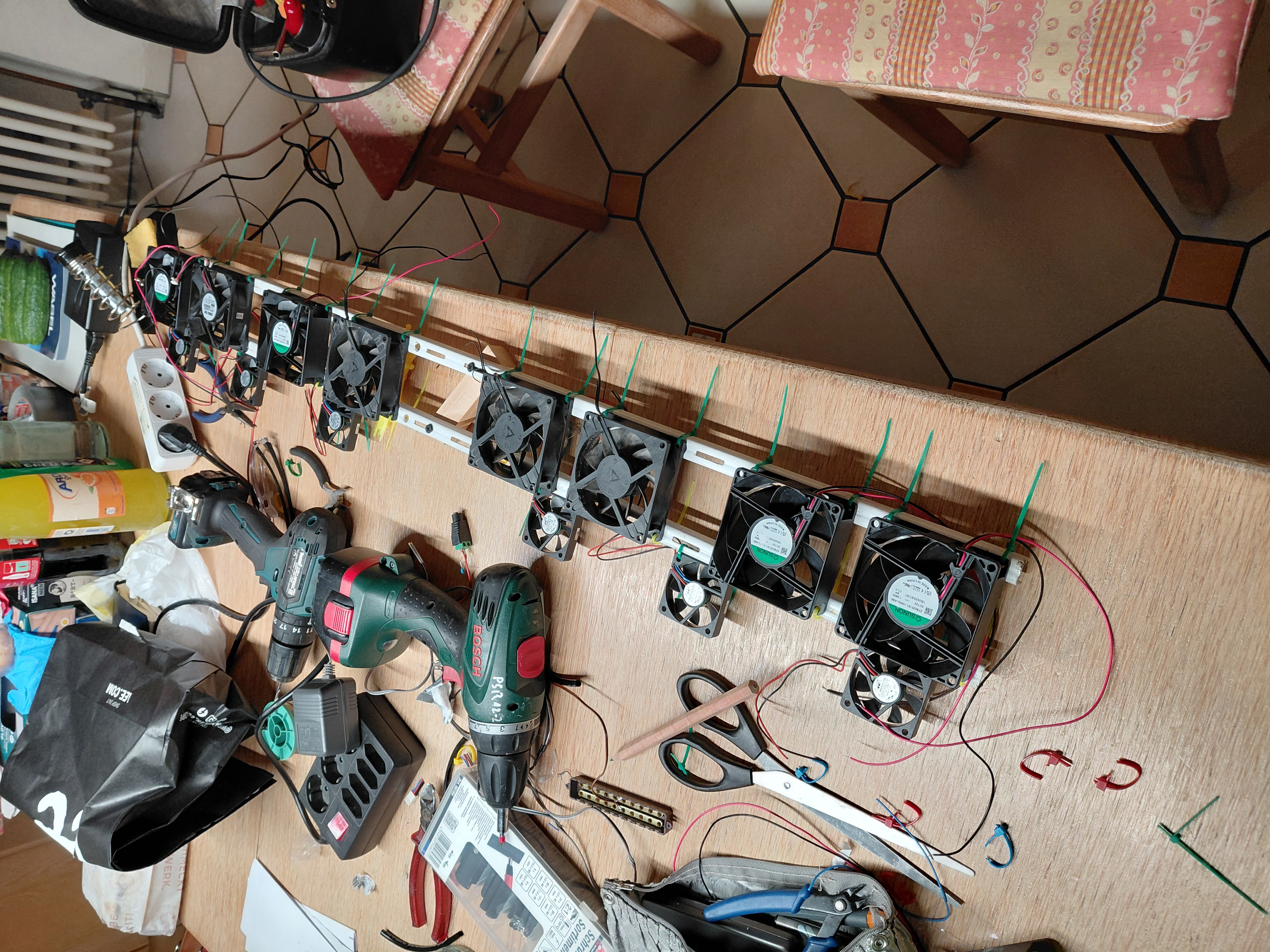
Stromaufnahme ca 1,2 A, 11,1 V PWM-Frequenz 8 kHz Die hinzugekommenen 80mm Lüfter sind BLDC Typen. Laufen nicht unter PWM -> Glätten ist angesagt..
Ein simpler 220 uF Elko schafft das. Wird aber heiß da fehlt wohl noch eine Induktivität, um die Stromspitzen vom Eko fernzuhalten...
Rechnung
1,2A/8000 Hz = 0,00015 As Spannungeinbruch um 7 V (Auf 5 V)
0,00015 As / 7 V = 22 μF
220 μF passt schon
Induktivität 2 A Max Vs/A - 220 μH????
Schaltung aufgebaut, funktioniert. Glättet das Signal ziemlich gut, Lüfter laufen alle, aber die Spannungen sind deutlich geringer, als ohne Induktivität
Elektrolytkondensator 220 μF, (Grabbelkiste) Induktivität 330 μH Von Amazon
sourcing map 5 Stück Ringkern Induktivität Kupferspule magnetische Induktivität 330uH 5A für DIY Platine
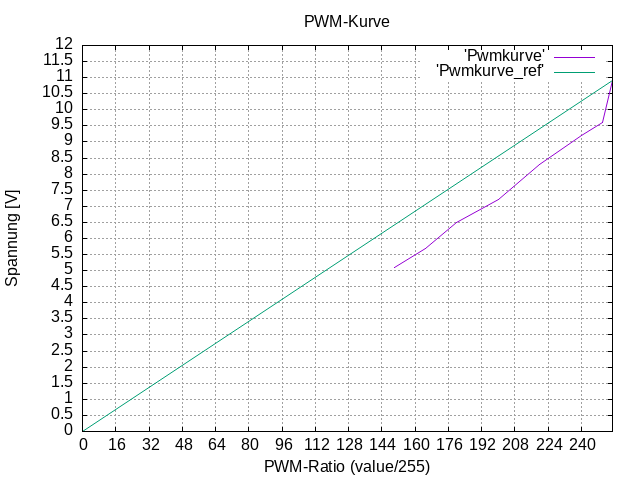
Messung: Full-Power Strom 1,16 A
| PWM | Spannung | Bemerkung |
|---|---|---|
| 255 | 10.9 V | Laut |
| 250 | 9.6 V | |
| 240 | 9.2 V | Hörbar |
| 220 | 8.3 V | |
| 200 | 7.2 V | Leise |
| 180 | 6.5 V | |
| 165 | 5.7 V | Unhörbar |
| 150 | 5.1 V | |
| Darunter | x | Verschiedene Lüfter stehen still |
Wenn man den Client an einen Mosquitto anschließt, und beim Schreiben des Mosquittos immer den Wert "Echoed" passieren komische Sachen. Beim MQTT-Adapter des ioBroker nicht ...
Wenn nach der Verbindungsaufnahme mit dem Broker vom Broker eine Null für den Wert kommt, ein Publish mit den "Werkseinstellungen" machen?
| Qty | Value | Footprint | References |
|---|---|---|---|
| 4 | Conn_01x03_Male | Connector_PinHeader_2.54mm:PinHeader_1x03_P2.54mm_Vertical | J1, J4, J5, J6 |
| 3 | 1N4007 | Diode_THT:D_DO-41_SOD81_P10.16mm_Horizontal | D2, D3, D4 |
| 3 | Conn_01x02_Male | Connector_PinHeader_2.54mm:PinHeader_1x02_P2.54mm_Vertical | J2, J3, J7 |
| 2 | BC549 | Package_TO_SOT_THT:TO-92_Inline | Q2, Q3 |
| 1 | 10K | Resistor_THT:R_Axial_DIN0207_L6.3mm_D2.5mm_P10.16mm_Horizontal | R2 |
| 1 | 10k | Resistor_THT:R_Axial_DIN0207_L6.3mm_D2.5mm_P10.16mm_Horizontal | R3 |
| 1 | 4K7 | Resistor_THT:R_Axial_DIN0207_L6.3mm_D2.5mm_P10.16mm_Horizontal | R5 |
| 1 | 4k7 | Resistor_THT:R_Axial_DIN0207_L6.3mm_D2.5mm_P10.16mm_Horizontal | R4 |
| 1 | IRFB3306PBF | Transistor_IRF:Infineon_Technologies-PG-TO220-3-02_2008-904-MFG | Q4 |
| 1 | WeMos_D1_mini | Module:WEMOS_D1_mini_light | U3 |
| 1 | YAAJ_DCDC_StepDown_LM2596 | Converter_DCDC_Add:YAAJ_DCDC_StepDown_LM2596 | U2 |
The 19 most common of 27 parts.
thorrak/repelbridge
An ESP32-based controller that manages Thermacell Liv Repeller devices over WiFi without using the cloud.

nkitanov/iaq_board
IAQ Board is a DIY (Do-It-Yourself) device for measuring internal air quality

bitfixer/bf-romulator
Romulator - RAM/ROM replacement and debug for 6502 CPU systems

alcar21/WemosEM
Cheap power monitor (STC013) with Home Assistant Discover and Wemos D1 Mini / PRO (esp8266)


kholia/Easy-Digital-Beacons-v1
A simple and easy Arduino / Pi Pico / ESP8266-powered WSPR, FT8, and FT4 beacon system which uses NTP + DS3231 RTC for timing. Super extensible! Now comes with optional GPS support.

htumanyan/navien
Navien water heater wire protocol for communication with NaviLink and other attached devices

It measures 110 × 60 mm and has 2 copper layers, 1.6 mm thick.
27 parts, built around the WEMOS D1 MINI and IRFB3306PBF. The full list of its parts is on this page, with links to each part's symbol and footprint where PCBKit's library has them.
From the MartinP1/ESP8266_MQTT_THERMOSTAT repository on GitHub, at the commit this page was made from: the board is Kicad/kicad_test_eurocard/kicad_test_eurocard.kicad_pcb and its schematic Kicad/kicad_test_eurocard/kicad_test_eurocard.kicad_sch. PCBKit opens the board in the browser, with nothing to install.
Its repository publishes it under the MIT licence: you may reuse it on that licence's terms (keep the author's notice, and for a copyleft licence share your changes alike).