2 layers61.8 × 21.6 mm
USBQuadMouse
PR77/CH554_USBQuadMouseKeyboard
CH554 based USB to Quadrature Mouse and Keyboard Interface
24 parts8MIT
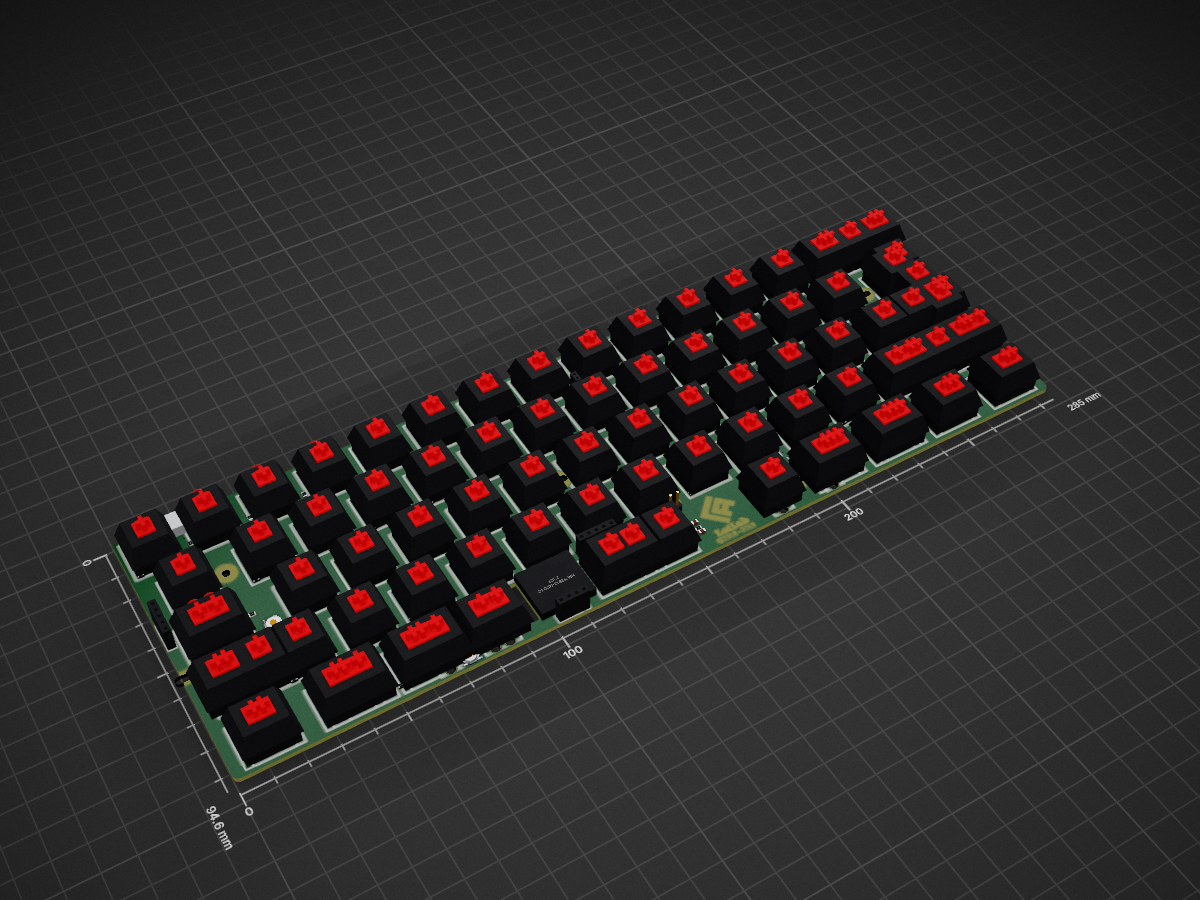
 Lotlab/Lot60-BLE-Keyboard167
A 60% bluetooth keyboard (Hardware)
Keyboard is an open-source printed circuit board by Lotlab, from the Lotlab/Lot60-BLE-Keyboard repository on GitHub, published under the CC-BY-SA-4.0 licence. It is a 2-layer board of 285 × 94.6 mm with 211 parts on 127 nets, routed with 1,230 tracks and 84 vias.
It is built around the CH554T, TP4057 and XC6206P332MR, with the FM-3528RGBA-HF among its other parts. Its parts include 86 switches, 74 diodes, 10 resistors, 8 capacitors and 6 connectors. It belongs with the keyboards and input and radio and wireless boards and the nRF52 and nRF5x and 8051 (CH55x, STC, AT89) boards of this library.


A 60% BLE/USB keyboard. License: CC-BY-SA
PLEASE REMOVE MY LOGO BEFORE SELLING THIS KEYBOARD.
Using nRF51822 as the main controller, CH554 as the USB chip.
Firmware see: lotlab/nrf51822-keyboard.
Using nRF52810 as the main controller, CH554 as the USB chip.
Firmware see: lotlab/nrf52-keyboard
一个60%的蓝牙USB双模开源键盘,授权协议:CC-BY-SA。
此键盘fork自GH60,沿用GH60的键盘孔位和阵列线路。
请不要直接使用此库制作硬件并售卖。若需要售卖,请至少做出一些改动并删除LOGO。
使用nRF51822作为键盘主控,CH552/4作为USB控制器。
键盘固件: lotlab/nrf51822-keyboard.
使用nRF52810作为键盘主控,CH552/4作为USB控制器。
键盘固件: lotlab/nrf52-keyboard
| Qty | Value | Footprint | References |
|---|---|---|---|
| 84 | MX1A | MX1A:MX1A-simple | S1, S2, S10, S11, S12, S13, S14, S15, S16, S17, S18, S19, S21, S101, S102, S151 +68 |
| 65 | 1N4148 | Diode_SMD:D_0805_2012Metric | D1, D2, D10, D11, D12, D13, D14, D15, D16, D17, D18, D19, D21, D22, D23, D24 +49 |
| 15 | VAL** | MX1A:MXST | MXST1, MXST2, MXST3, MXST4, MXST5, MXST6, MXST7, MXST8, MXST9, MXST10, MXST11, MXST12, MXST13, MXST14, MXST15 |
| 6 | LED | MX1A:MX1A-led | D100, D101, D102, D103, D1001, D1002 |
| 4 | 300 | Resistor_SMD:R_0805_2012Metric | R100, R101, R102, R103 |
| 3 | 0.1uF | Capacitor_SMD:C_0805_2012Metric | C1, C2, C4 |
| 3 | 1uF | Capacitor_SMD:C_0805_2012Metric | C5, C6, C9 |
| 3 | VAL** | PKRH | HOLE, HOLE1, MXLED |
| 2 | - | Connector_PinSocket_2.54mm:PinSocket_1x05_P2.54mm_Vertical | J2, J3 |
| 2 | 5.1K | Resistor_SMD:R_0805_2012Metric | R5, R6 |
| 2 | B5819W SL | Diode_SMD:D_SOD-123 | D20, D25 |
| 2 | SW | Button_Switch_SMD:SW_SPST_TL3342 | K1, K2 |
| 2 | VAL** | PKRHSL | HOLE, HOLE2 |
| 1 | 10K | Resistor_SMD:R_0805_2012Metric | R1 |
| 1 | 10M | Resistor_SMD:R_0805_2012Metric | R3 |
| 1 | 10nF | Capacitor_SMD:C_0805_2012Metric | C7 |
| 1 | 10uF | Capacitor_SMD:C_0805_2012Metric | C8 |
| 1 | 2.2M | Resistor_SMD:R_0805_2012Metric | R4 |
| 1 | 4.7K | Resistor_SMD:R_0805_2012Metric | R2 |
| 1 | BATT | Connector_PinSocket_2.00mm:PinSocket_1x02_P2.00mm_Vertical | P3 |
| 1 | BATT | Connector_PinHeader_2.54mm:PinHeader_1x02_P2.54mm_Vertical | P2 |
| 1 | CH554T | Package_SO:SSOP-20_4.4x6.5mm_P0.65mm | U2 |
| 1 | FM-3528RGBA | LED_SMD:LED_RGB_1210 | D104 |
| 1 | LOGO | Customv2:Cirno_38113046_mask | G*** |
| 1 | LOGO | Customv2:Lotlab_logo_mask | G*** |
| 1 | SWD | Connector_PinSocket_2.54mm:PinSocket_1x04_P2.54mm_Vertical | P1 |
| 1 | TP4057 | Package_TO_SOT_SMD:SOT-23-6 | U3 |
| 1 | USB_C_Receptacle_USB2.0 | Customv2:USB_C_SIMPLE | J1 |
| 1 | VAL** | PKRHC | HOLE3 |
| 1 | XC6206P33 | Package_TO_SOT_SMD:SOT-23 | U4 |
| 1 | nRF52810-ND04C | Customv2:nRF52810-ND04C | U1 |
PR77/CH554_USBQuadMouseKeyboard
CH554 based USB to Quadrature Mouse and Keyboard Interface


17o2/bluetooth-minidisc
Adding built-in bluetooth connectivity to a 20-year-old Mindisc player

Floyd-Fish/Noise-Amplifier
An ultra-low noise amplifier to measure low-noise LDO/OPA's wide band output noise, and many other interesting measurements. Referred to AN-159.

atomic14/esp32-tv-hardware
This is Work In Progress - I'm still working on this.
It measures 285 × 94.6 mm and has 2 copper layers, 1.6 mm thick.
211 parts, built around the CH554T, TP4057, XC6206P332MR and FM-3528RGBA-HF. The full list of its parts is on this page, with links to each part's symbol and footprint where PCBKit's library has them.
From the Lotlab/Lot60-BLE-Keyboard repository on GitHub, at the commit this page was made from: the board is keyboard.kicad_pcb. PCBKit opens the board in the browser, with nothing to install.
Its repository publishes it under the CC-BY-SA-4.0 licence: you may reuse it on that licence's terms (keep the author's notice, and for a copyleft licence share your changes alike).