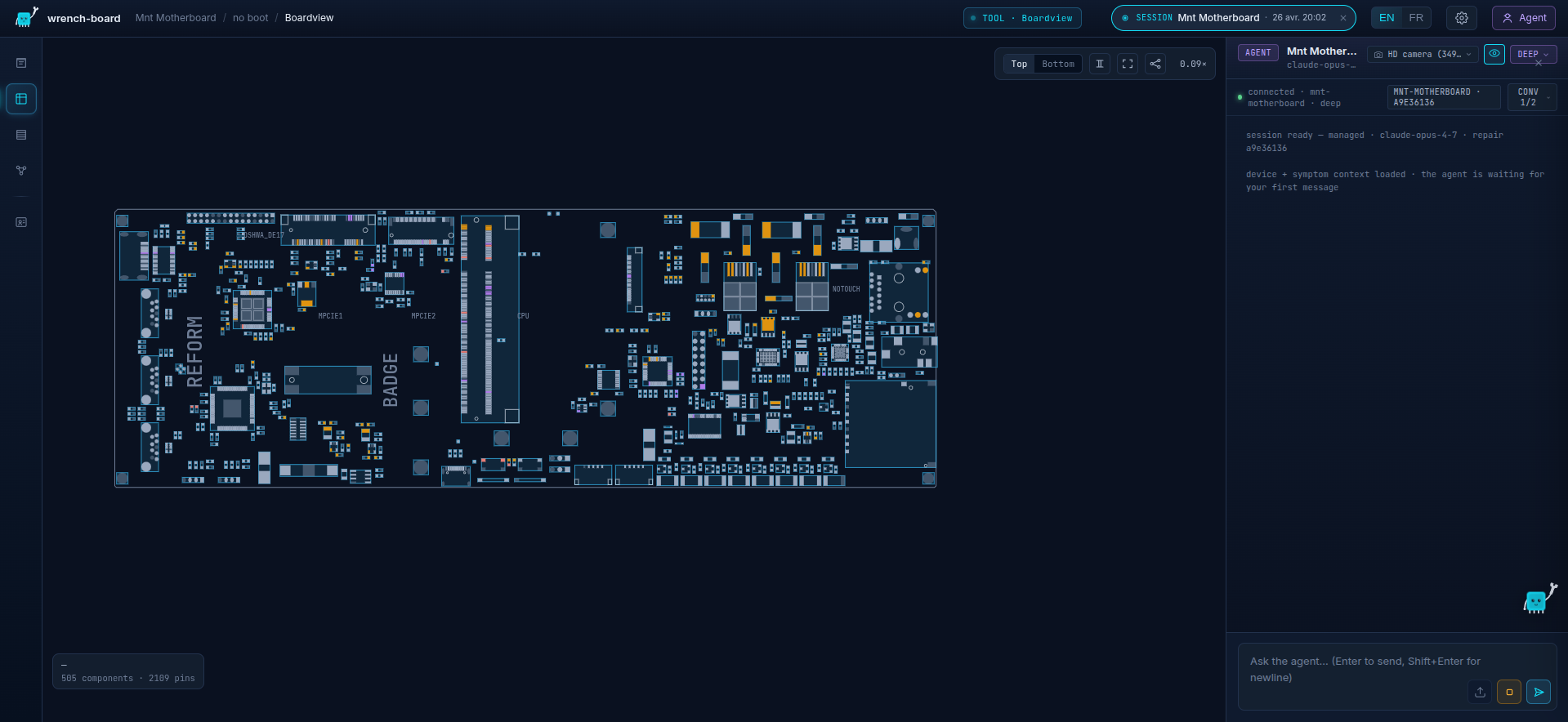
6 layers276 × 93.5 mm

 Junkz3/wrench-board259
A senior microsoldering technician, available to every repair shop from the seasoned pro to the apprentice. Powered by Claude Opus 5
Mnt reform motherboard is an open-source printed circuit board by Junkz3, from the Junkz3/wrench-board repository on GitHub. It is a 6-layer board of 276 × 93.5 mm with 505 parts on 647 nets, routed with 10,953 tracks and 1,081 vias.
It is built around the TLV62568DBV, AP22815AWT and SP3012-06UTG, with the PMEG60T10ELRX, PMV50EPEAR and SI7850DP among its other parts. Its parts include 178 resistors, 164 capacitors, 19 diodes, 14 transistors and 10 inductors. It belongs with the computers and single-board computers boards of this library.


English · Français · 中文 · हिन्दी




Agent-native diagnostic workbench for board-level electronics repair, powered by Claude Opus 4.8. Right-to-repair, built in the open, by the people who actually do the repairs.
🥈 2nd place at Anthropic's Build with Opus 4.7 hackathon, April 2026.
📺 Demo video (3 min): https://youtu.be/OZ2D_p82z6w
Try it online: open a boardview in the browser, free. No account, no install: .brd, .fz, .tvw, .pcb and more, parsed natively.
Tens of millions of tonnes of electronics end up as e-waste every year. A large share of that is recoverable at the board level: a dead capacitor, a blown diode, a bad PMIC, but only a microsoldering technician can find and fix it. We are the last mile of repair before the landfill, and there are not many of us.
Wrench Board is a senior microsoldering teammate built for that last mile. For the seasoned tech, it's a second pair of eyes that never gets tired. For the apprentice, it's a senior teammate who explains the boot sequence the tenth time, in their language, with their tools, without judgment. It ingests a schematic PDF and a boardview, builds a per-device knowledge pack in two minutes, and runs an Opus 4.8 diagnostic agent that pilots the board visually (highlights pins, traces nets, simulates failures) while the technician keeps the iron in their hand.
It is device-agnostic. Feed it a schematic and a boardview and it works the same on iPhone and MacBook logic boards, Android and Samsung phones, game console motherboards, laptops, and single-board computers. Anything with a schematic and a boardview is fair game.
The bet is precision over magic. The agent is not allowed to invent a reference designator. Every refdes it utters originates from a tool lookup, and a server-side sanitizer wraps any token it cannot verify before the text reaches the screen. The deterministic engines underneath produce verifiable causal chains, not vibes.
I've been a microsoldering technician for three years. For most of that time, I sent screenshots to Claude one at a time, manually, and pasted the answer into a paper notebook. I built the workbench I needed.
Four orthogonal workflows feed a single on-disk corpus per device under
memory/{slug}/:
ElectricalGraph: nets classified, boot
sequence inferred, quality report attached.global-patterns, global-playbooks,
device-{slug}, repair-{repair_id}), pilots the boardview through 17
bv_* tools and queries the pack, schematic graph, measurements,
validations and technician profile through 27 more: 44 custom tools
declared in api/agent/manifest.py. The agent never fabricates a
refdes: tool discipline plus a post-hoc sanitizer.sim), the schematic compiler (pipeline), the schematic vision
pass (pipeline-vision), and the diagnostic agent itself (agent).
Each loop proposes patches against an oracle benchmark and either
keeps them (evolve:-prefixed commit) or reverts. The loops have
been running and shipping improvements while I work on other things.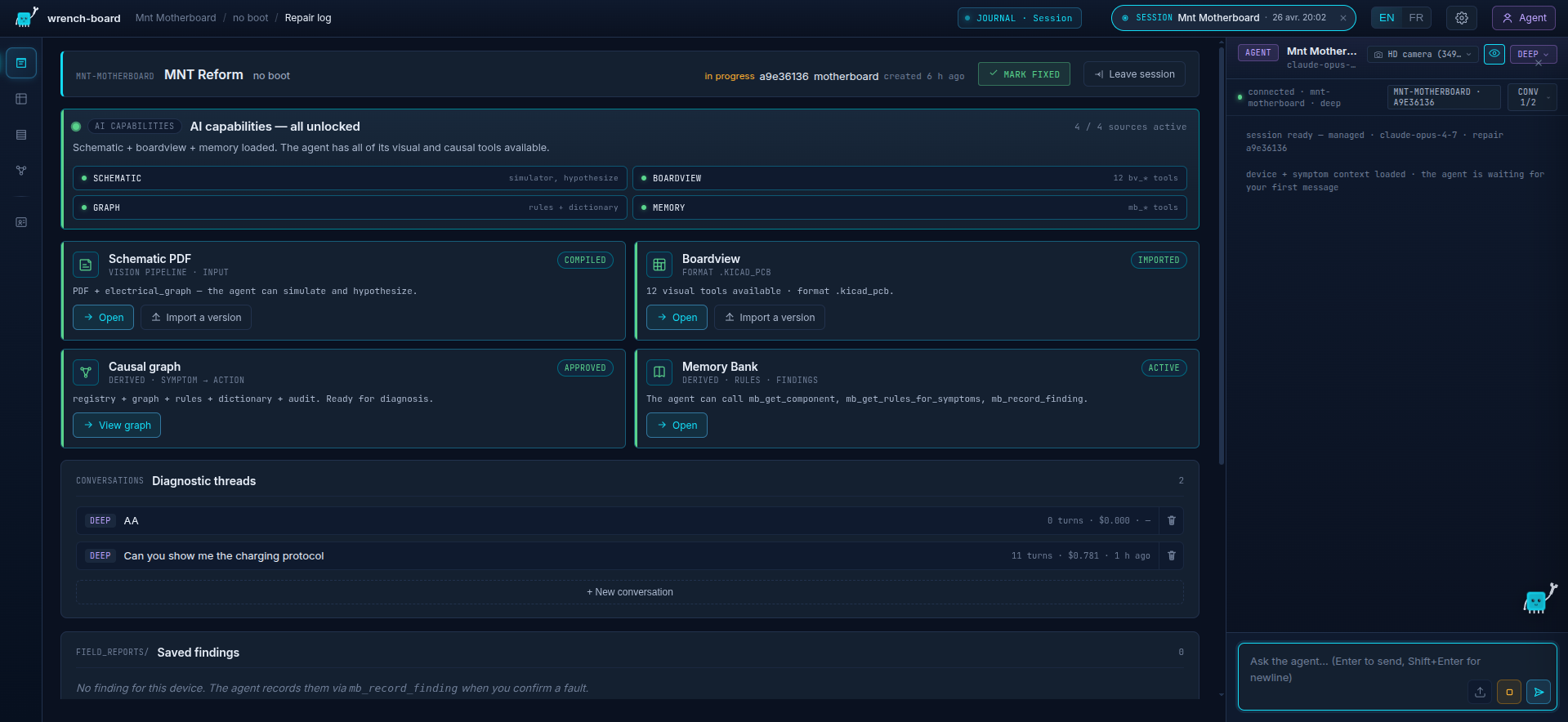
A microsoldering diagnosis lives or dies on what the probe is touching
right now, and a chat box can't carry that. The technician plugs a USB
microscope or webcam into the workbench and the agent requests a frame on
demand through the cam_capture tool, reads the image, and feeds it back
into its reasoning. The technician can also drop a macro shot or a close-up
of a suspect chip into the chat at any time. Captures and uploads are
persisted under the repair so a session can be replayed end-to-end:
words, decisions, and the actual photographs the agent looked at.
This closes the loop the screenshot-pasting workflow never could: the agent stops guessing what the board looks like and starts seeing it, on the technician's cue, on the technician's optics.
deep diagnostic tier), Claude Sonnet 4.6 (Scout, Registry, Mapper,
Lexicographe, normal tier), Claude Haiku 4.5 (intent classifier, phase
narrator, coverage gate, fast tier).state.md, decisions/, measurements/, open_questions.md)
instead of relying on an LLM-generated resume.api/board/parser/, dispatched
by extension: KiCad .kicad_pcb, OpenBoardView Test_Link .brd,
KiCad-boardview BRD2, plus .asc .bdv .bv .bvr .cad .cst
.f2b .fz .gr .pcb .tvw. Adding a format = one new file.@slow accuracy-gate suite,
including 10 deterministic invariants on the simulator + hypothesize
engines and frozen-oracle gates.make doctor runs 8 local health checks (env, packs,
parsers, camera) for atelier deployment. make eval-all orchestrates
the four eval surfaces (simulator, pipeline, vision, agent) with
cross-skill regression detection. make tools-inventory writes a
local agent-manifest index for offline review.{found: false, closest_matches: [...]} for unknown refdes; the system
prompt instructs the agent to pick from suggestions or ask the user.
(2) api/agent/sanitize.py scans every outbound text for refdes-shaped
tokens (\b[A-Z]{1,3}\d{1,4}\b) and wraps any unverified match as
⟨?U999⟩ before it reaches the technician.Two pure-sync deterministic engines (simulator.py, hypothesize.py) sit
at the core of the diagnostic stack. The simulator advances phase-by-phase
over a boot sequence and emits a timeline of dead rails, dead components,
and the cause of blocking per phase. The hypothesizer takes a partial
observation and enumerates 1- and 2-fault refdes-kill candidates that
explain it, ranked by F1 against the observation. Neither calls an LLM at
runtime.
The diagnostic agent has two interchangeable runtimes: managed via Anthropic Managed Agents, direct via the Messages API. Managed is the default and the production path; direct serves as a fallback when the MA beta is unavailable and as an on-disk inspection harness during development. The WebSocket protocol is identical so the frontend doesn't know which one is running.
Wrench Board runs locally. Each technician's instance can improve its deterministic simulator against their own field cases. When the evolve loop discovers a rule that holds up, it surfaces a candidate pull request to the upstream repo. Right-to-repair, built in the open, by the people who actually do the repairs.
git clone https://github.com/Junkz3/wrench-board
cd wrench-board
make install          # create .venv and install deps (incl. [dev])
cp .env.example .env  # then fill in ANTHROPIC_API_KEY
make run              # uvicorn --reload on http://localhost:8000
On the first make run in Managed Agents mode (default), the start
script prints a one-screen warning describing what it is about to create
on your Anthropic account (1 environment + 3 tier-scoped agents, idle,
no cost until used) and waits 5 seconds for Ctrl+C before bootstrapping.
The IDs land in managed_ids.json (gitignored) and subsequent runs go
straight to uvicorn.
Fallback to direct mode if the Managed Agents beta is unavailable on
your account, no bootstrap, plain messages.create tool loop:
make demo-fallback
# or: DIAGNOSTIC_MODE=direct make runSource-available under a proprietary license. See LICENSE.
Free for personal evaluation, study, and local use. Independent
electronics repair professionals may also use it as an internal tool
when servicing their own clients (commercial remuneration OK), with
no separate licence needed. Redistribution, hosted SaaS deployment,
sublicensing, and any use for training competing AI / ML models still
require written permission (contact: alexis@repairmind.co.uk).
Dependencies are MIT / Apache 2.0 / BSD only. The MNT Reform motherboard
used as the canonical test target is CERN-OHL-S-2.0. Built solo at
Repair Valley, an independent electronics repair workshop.
Wrench Board is open to contributors who care about right-to-repair. Field reports, new boardview parsers, simulator rules: open an issue or a PR.
| Qty | Value | Footprint | References |
|---|---|---|---|
| 73 | 0.1uF | Capacitor_SMD:C_0603_1608Metric | C11, C12, C13, C101, C103, C105, C106, C107, C108, C109, C110, C113, C115, C118, C119, C135 +57 |
| 40 | 0 | Resistor_SMD:R_0603_1608Metric | R1, R101, R104, R105, R106, R107, R108, R109, R111, R116, R124, R125, R126, R129, R130, R137 +24 |
| 23 | 10k | Resistor_SMD:R_0603_1608Metric | R2, R45, R54, R113, R115, R117, R118, R119, R128, R161, R168, R169, R170, R171, R172, R196 +7 |
| 23 | 10uF | Capacitor_SMD:C_0603_1608Metric | C34, C37, C46, C47, C63, C112, C120, C131, C132, C133, C134, C137, C150, C155, C164, C167 +7 |
| 17 | 1uF | Capacitor_SMD:C_0603_1608Metric | C1, C4, C5, C32, C73, C87, C100, C111, C114, C129, C130, C141, C145, C146, C162, C163 +1 |
| 16 | 100k | Resistor_SMD:R_0603_1608Metric | R3, R8, R46, R56, R58, R82, R86, R94, R103, R120, R160, R178, R179, R181, R188, R189 |
| 14 | 100@100MHz 3A | Inductor_SMD:L_0603_1608Metric | FB3, FB4, FB10, FB11, FB12, FB14, FB15, FB16, FB17, FB18, FB19, FB20, FB21, FB22 |
| 11 | 4.7k | Resistor_SMD:R_0603_1608Metric | R33, R43, R44, R68, R69, R131, R132, R135, R136, R164, R174 |
| 10 | 10nF | Capacitor_SMD:C_0603_1608Metric | C52, C58, C102, C104, C116, C117, C128, C148, C152, C153 |
| 9 | 100 | Resistor_SMD:R_0603_1608Metric | R10, R11, R12, R13, R14, R15, R16, R175, R176 |
| 9 | 1M | Resistor_SMD:R_0603_1608Metric | R4, R5, R6, R55, R61, R96, R97, R153, R156 |
| 8 | 1.5k | Resistor_SMD:R_0603_1608Metric | R35, R37, R38, R40, R42, R71, R122, R195 |
| 8 | 15 | Resistor_SMD:R_2512_6332Metric | R25, R26, R27, R28, R29, R30, R31, R32 |
| 8 | 3.3k | Resistor_SMD:R_0603_1608Metric | R17, R18, R19, R20, R21, R22, R23, R24 |
| 8 | 33 | Resistor_SMD:R_0603_1608Metric | R70, R72, R114, R121, R138, R139, R150, R151 |
| 8 | PMEG60T10ELR | Diode_SMD:Nexperia_CFP3_SOD-123W | D17, D18, D19, D24, D25, D26, D27, D28 |
| 8 | PMV50EPEAR | Package_TO_SOT_SMD:SOT-23 | Q5, Q6, Q7, Q8, Q9, Q10, Q11, Q12 |
| 7 | 220@100MHz 1.4A | Inductor_SMD:L_0603_1608Metric | FB1, FB2, FB5, FB6, FB7, FB8, FB9 |
| 7 | 47k | Resistor_SMD:R_0603_1608Metric | R47, R48, R80, R142, R143, R144, R197 |
| 6 | 18pF | Capacitor_SMD:C_0603_1608Metric | C8, C10, C48, C51, C62, C98 |
| 6 | 4.7uF | Capacitor_SMD:C_0603_1608Metric | C6, C33, C35, C139, C151, C170 |
| 5 | 47uF | Capacitor_SMD:C_0603_1608Metric | C83, C121, C123, C124, C126 |
| 4 | 15uH | Inductor_SMD:L_1210_3225Metric | L8, L9, L10, L11 |
| 4 | 1k | Resistor_SMD:R_0603_1608Metric | R67, R110, R183, R184 |
| 4 | 2.2uF | Capacitor_SMD:C_0603_1608Metric | C44, C82, C125, C160 |
| 4 | 27 | Resistor_SMD:R_0603_1608Metric | R90, R91, R92, R93 |
| 4 | 2nF | Capacitor_SMD:C_0603_1608Metric | C64, C68, C78, C79 |
| 4 | 49.9 | Resistor_SMD:R_0603_1608Metric | R123, R148, R198, R199 |
| 4 | MountingHole_Pad | footprints:WA-SMSI-M2 | H22, H24, H25, H27 |
| 4 | MountingHole_Pad | MountingHole:MountingHole_2.2mm_M2_DIN965_Pad | H5, H6, H7, H8 |
| 4 | Si7850DP | footprints:PowerPAK_SO-8_Single_8Pads | Q1, Q2, Q15, Q17 |
| 3 | 0157004.DR | footprints:fuse_smf | F1, F2, F3 |
| 3 | 51k | Resistor_SMD:R_0603_1608Metric | R53, R57, R64 |
| 3 | AP22815 | footprints:TSOT-25 | U20, U24, U27 |
| 3 | BAT46WJ,115 | Diode_SMD:D_SOD-323 | D2, D29, D30 |
| 3 | SBR0560S1 | Diode_SMD:D_SOD-123 | D3, D4, D6 |
| 3 | SP3012-06UTG | footprints:SON50P350X135X55-14N | U21, U25, U26 |
| 3 | USB3_A | footprints:692121030100 | J5, J6, J17 |
| 2 | 0.01 | Resistor_SMD:R_0612_1632Metric | R49, R50 |
| 2 | 0.02 | Resistor_SMD:R_0612_1632Metric | R41, R177 |
| 2 | 0.33uF | Capacitor_SMD:C_0603_1608Metric | C3, C31 |
| 2 | 100uF | Capacitor_SMD:CP_Elec_8x10 | C16, C17 |
| 2 | 100uF | Capacitor_SMD:CP_Elec_6.3x7.7 | C122, C161 |
| 2 | 150k | Resistor_SMD:R_0603_1608Metric | R34, R180 |
| 2 | 2.2uH | Inductor_SMD:L_1210_3225Metric | L6, L7 |
| 2 | 220 | Resistor_SMD:R_0603_1608Metric | R66, R112 |
| 2 | 220uF | Capacitor_SMD:C_1210_3225Metric | C127, C147 |
| 2 | 220uF | Capacitor_SMD:CP_Elec_8x10 | C18, C19 |
| 2 | 470nF | Capacitor_SMD:C_0603_1608Metric | C157, C159 |
| 2 | 6.8pF | Capacitor_SMD:C_0603_1608Metric | C36, C38 |
| 2 | 68uH | Inductor_SMD:L_Bourns_SRR1210A | L3, L4 |
| 2 | BZX584C3V3-G3-08 | Diode_SMD:D_SOD-523 | D15, D16 |
| 2 | SK54A-LTP | Diode_SMD:D_SMA | D20, D21 |
| 2 | SW_DIP_x01 | Button_Switch_SMD:SW_DIP_SPSTx01_Slide_Omron_A6S-110x_W8.9mm_P2.54mm | SW1, SW3 |
| 2 | SW_Push | footprints:UK-B0206-G3.8-250-JZ | SW2, SW6 |
| 2 | Si7461DP | footprints:PowerPAK_SO-8_Single_8Pads | Q3, Q18 |
| 2 | TLV62568DBV | Package_TO_SOT_SMD:SOT-23-5 | U13, U19 |
| 1 | 0.033uF | Capacitor_SMD:C_0603_1608Metric | C45 |
| 1 | 1-2199230-6 | footprints:TE_1-2199230-6 | J10 |
| 1 | 100k NTC | Resistor_SMD:R_0603_1608Metric | R79 |
| 1 | 10uH | Inductor_SMD:L_1210_3225Metric | L5 |
| 1 | 12MHz | Crystal:Crystal_SMD_Abracon_ABM8G-4Pin_3.2x2.5mm | Y2 |
| 1 | 22uH 5A | Inductor_SMD:L_12x12mm_H6mm | L1 |
| 1 | 24MHz | Crystal:Crystal_SMD_Abracon_ABM8G-4Pin_3.2x2.5mm | Y1 |
| 1 | 25MHz | Crystal:Crystal_SMD_Abracon_ABM8G-4Pin_3.2x2.5mm | Y3 |
| 1 | 27k | Resistor_SMD:R_0603_1608Metric | R192 |
| 1 | 32.768 kHz | Crystal:Crystal_SMD_3215-2Pin_3.2x1.5mm | Y4 |
| 1 | 475 | Resistor_SMD:R_0603_1608Metric | R36 |
| 1 | 48099-5701 | footprints:MOLEX_48099-5701 | J11 |
| 1 | 49.9k | Resistor_SMD:R_0603_1608Metric | R173 |
| 1 | 62 | Resistor_SMD:R_0603_1608Metric | R167 |
| 1 | 679105700 | footprints:MOLEX_67910-5700 | U11 |
| 1 | 680 | Resistor_SMD:R_0603_1608Metric | R140 |
| 1 | 680pF | Capacitor_SMD:C_0603_1608Metric | C65 |
| 1 | 9.09K 1% | Resistor_SMD:R_0603_1608Metric | R59 |
| 1 | 90.9K 1% | Resistor_SMD:R_0603_1608Metric | R60 |
| 1 | BADGE | footprints:reform2-motherboard-badge | H14 |
| 1 | BATCON1 | Connector_Molex:Molex_Pico-Lock_504050-0591_1x05-1MP_P1.50mm_Horizontal | J13 |
| 1 | BATCON2 | Connector_Molex:Molex_Pico-Lock_504050-0591_1x05-1MP_P1.50mm_Horizontal | J2 |
| 1 | BZT52C10 | Diode_SMD:D_SOD-123 | D1 |
The 442 most common of 505 parts.

panyam/agni-samples
This is the main repository for the MNT Reform open source laptop.

EPFLRocketTeam/SupersonicTestRocket
Repository for the avionics going on the supersonic test rocket


torlye/pocket-reform
My muscle memory requires me to have the Ctrl key at the bottom left corner of the keyboard!

baldengineer/VADC-visualized-adc
Building an SAR ADC from scratch. Circuit schematics, PCB design, KiCad files, and Arduino code.

ayaxan7/SolarAlert
SolarAlert is a compact embedded hardware project designed to monitor the health and performance of solar panels.

visionspacetec/VST104-Sierra
VST104 single OBC board - referred as board_sierra
It measures 276 × 93.5 mm and has 6 copper layers, 1.6 mm thick.
505 parts, built around the TLV62568DBV, AP22815AWT, SP3012-06UTG and PMEG60T10ELRX. The full list of its parts is on this page, with links to each part's symbol and footprint where PCBKit's library has them.
From the Junkz3/wrench-board repository on GitHub, at the commit this page was made from: the board is web/boards/mnt-reform-motherboard.kicad_pcb. PCBKit opens the board in the browser, with nothing to install.
Its repository states no licence, so its author keeps all rights: ask Junkz3 before reusing the design.