Skip to the content
2 layers40.9 × 65.5 mmReaction wheel 2, the printed circuit board in 3D

Reaction wheel 2

JourdanThomas/CubeSat

This project is divided into different stages. The first stage involved constructing a CubeSat using the information provided for the AMSAT CubeSatSim prototype, available at CubeSatSim repository.

Size
40.9 × 65.5 mm
Copper layers
2
Thickness
1.6 mm
Parts
8
Nets
35
Pads
58
Tracks, vias
59, 4
Pours
1
Routed
Yes
KiCad
KiCad 6 (file 20211014)
Created
11 Jun 2025
Updated
5 Sep 2025

Overview

Reaction wheel 2 is an open-source printed circuit board by JourdanThomas, from the JourdanThomas/CubeSat repository on GitHub. It is a 2-layer board of 40.9 × 65.5 mm with 8 parts on 35 nets, routed with 59 tracks and 4 vias.

It is built around the L293D.

Main components

1

README

README.md

CubeSat MTU

This project is the results of the work of five different interns, 3 in 2023 and 2 in 2025.

This project is divided into different stages. The first stage involved constructing a CubeSat using the information provided for the AMSAT CubeSatSim prototype, available at CubeSatSim repository. We followed the steps outlined and replicated the foundation. The second stage focused on enhancing the CubeSat in various ways to address specific problems.

  1. Real-time Visualization of CubeSat in Space using Gyroscope: We developed a 3D visualization of our CubeSat in real-time on a website. This visualization updates dynamically as the ground station receives information.

  2. Prototyping CubeSat Maneuverability using Reaction Wheels: We restructured the CubeSat to accommodate two motors and new electronic circuit components. This enhancement allows the CubeSat to orient itself in space based on reaction wheel principles.

  3. Decoding multiple CubeSats at the same time : We created a new software to receive the RF signals from multiple CubeSats at the same time using different SDRs. The RF signal is then decoded and sent to the web server for data visualization.

  4. Distributed computing : Work in progress. Setting up a distributed computing algorithm for image processing

For each of these separate projects, you'll find dedicated folders containing all the necessary information. Additionally, we undertook a thorough analysis of the base code available for CubeSatSim to interact effectively with our enhancements. We've added comments to certain sections of code in the 'soft' directory for the purpose of understanding. It's important to note that these commented code sections have not been altered; they serve merely as tools for comprehension.

Folder Structure

  • CubeSat_Troubleshooting: Contains details related to the construction phase following the AMSAT prototype and the solutions to different problems.
  • Visualisation_Improvement: Includes resources for the real-time 3D visualization of the CubeSat.
  • Reaction_Wheel_Improvement: Encompasses information regarding the CubeSat's ability to orient itself using reaction wheels.
  • Soft: Holds the original base code with additional comments for understanding purposes.
  • Web_Serveur: Contains all the files necessary to visualize various web pages related to the Cubesat, including the work done by other group members.
  • Web_Serveur_Public: Same as the web server but intended for deployment on a specific domain. It essentially serves as a copy of the initial repository, with adjustments made for public dissemination.
  • Swarm_decode Contains all the file to receive and decode RF signals from multiple CubeSats and how to display it on a web-server.
  • Module3_Camera_support: Allows the CubeSat to support raspberry pi module 3 cameras such as a the NoIR cameras. By default it only supports module 2.
  • Distributed computing: Work in progress for the development of a distributed computing network for image processing

Please refer to individual folders for specific details and resources related to each stage of the project.

Important Note

The commented sections in the 'soft' directory serve as aids for understanding the base code and should not be modified. They are solely intended to facilitate comprehension.

Contributors

Feel free to reach out to us for any inquiries or clarifications regarding this project.
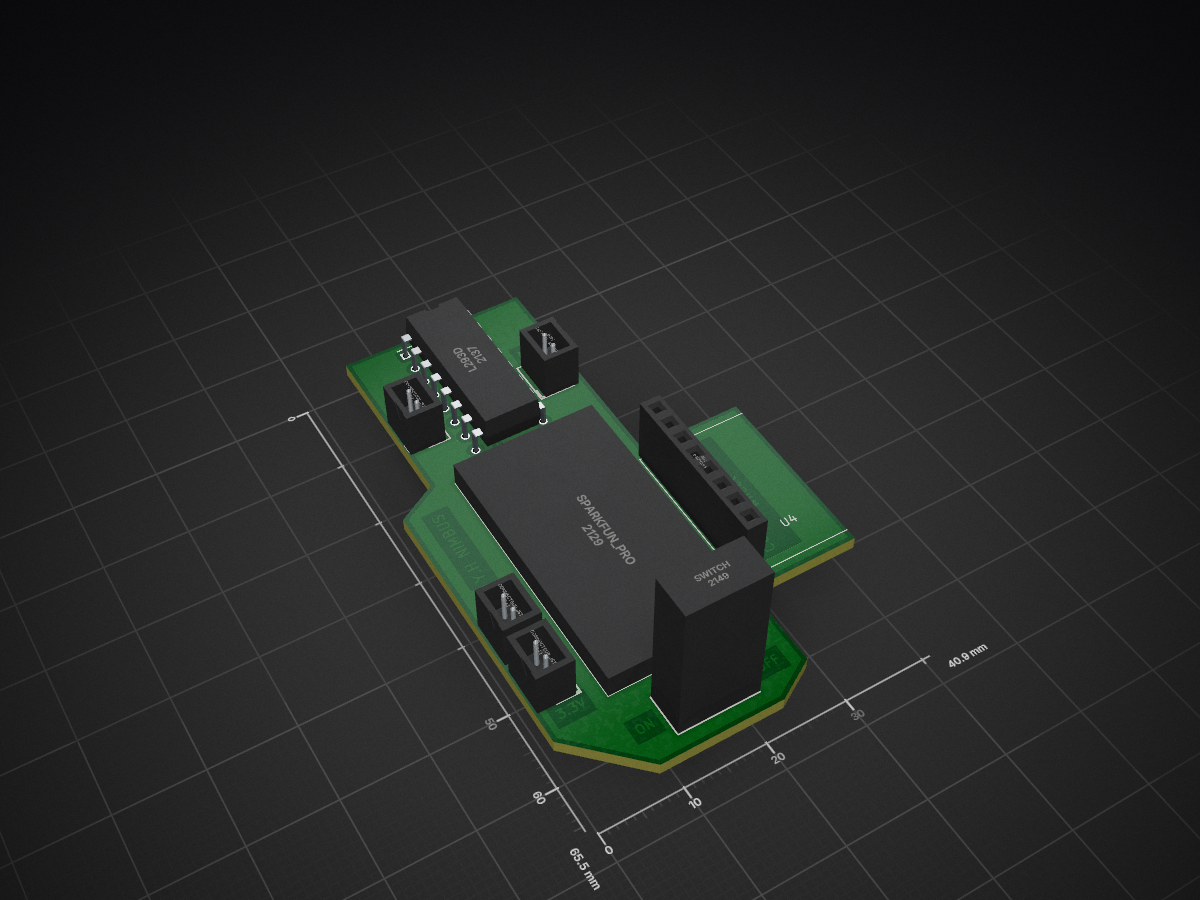
Parts

8
QtyValueFootprintReferences
4CONNECTEUR_JSTreaction_wheel:SHDR2W50P0X200_1X2_590X450X600PU1, U2, U3, U5
1L293Dreaction_wheel:DIP880W50P254L2000H510Q16NIC1
1MPU6050reaction_wheel:MPU6050U4
1SPARKFUN_PROreaction_wheel:DEV12587IC2
1Switchreaction_wheel:SwitchU6

More from JourdanThomas/CubeSat

1
  • 2 layers41.9 × 38.4 mmReaction wheel, the printed circuit board in 3D

    Reaction wheel

    JourdanThomas/CubeSat

    This project is divided into different stages. The first stage involved constructing a CubeSat using the information provided for the AMSAT CubeSatSim prototype, available at CubeSatSim repository.

    7 parts

Similar boards

  • 2 layers178 × 145 mmUltra DB X51 v1, the printed circuit board in 3D

    Ultra DB X51 v1

    ExploreEmbedded/8051_DevelopmentBoard

    Design files and sample code for 8051 development Ultra Boards

    145 parts70
  • 2 layers84.3 × 58.4 mmEnocderDriver, the printed circuit board in 3D

    EnocderDriver

    NikodemBartnik/Small-Projects

    All of smaller projects (Arduino, PCBs, electronics, code)

    35 parts55
  • 2 layers56.4 × 72.6 mmRas pi hat, the printed circuit board in 3D

    Ras pi hat

    geno543/Redropi_highway

    the project aims to detect asteroids and meteor movement using high-quality cameras and radar detection methods using an AI model for accurate analysis, and it classifies bodies be in three categories: non-meteor…

    8 parts13
  • 2 layers87.5 × 70 mmLaberinto, the printed circuit board in 3D

    Laberinto

    CRM-UAM/CRMaze

    Open source robot for maze solving + line following

    34 parts12
  • 2 layers92.5 × 62.5 mmDropGenPCB, the printed circuit board in 3D

    DropGenPCB

    harrislab-brown/DropGen

    DropGen uses a fluid reservoir and a piezoelectric buzzer to precisely and repeatably dispense small droplets on demand.

    25 parts12CC-BY-SA-4.0
  • 2 layers47.5 × 49.5 mmElectronic, the printed circuit board in 3D

    Electronic

    zosko/magspoof

    Magspoof with Arduino Pro Micro

    5 parts11
  • 2 layers120.7 × 184.1 mmBeachRover circuit, the printed circuit board in 3D

    BeachRover circuit

    wizardofrobots/roverCode

    Jetson Nano powered Arduino Rover

    11 parts10
  • 2 layers90 × 53.4 mmOpenOx, the printed circuit board in 3D

    OpenOx

    hacklabkyiv/openox-pcb

    PCB design for OpenOx - open source oxygen concentrator

    43 parts7GPL-3.0

Questions

How big is the Reaction wheel 2 PCB?

It measures 40.9 × 65.5 mm and has 2 copper layers, 1.6 mm thick.

What parts does the Reaction wheel 2 use?

8 parts, built around the L293D. The full list of its parts is on this page, with links to each part's symbol and footprint where PCBKit's library has them.

Where can I download the Reaction wheel 2 KiCad files?

From the JourdanThomas/CubeSat repository on GitHub, at the commit this page was made from: the board is Reaction_Wheel_Improvement/Kicad_V2/reaction_wheel_2.kicad_pcb and its schematic Reaction_Wheel_Improvement/Kicad/reaction_wheel.kicad_sch. PCBKit opens the board in the browser, with nothing to install.

Can I use the Reaction wheel 2 design in my own project?

Its repository states no licence, so its author keeps all rights: ask JourdanThomas before reusing the design.