
2 layers50 × 75 mm
HAMS hub
JakubFranek/Home-Air-Monitoring-System
Home Air Monitoring System (HAMS) is my personal hardware & embedded software development project designed to monitor indoor and outdoor air quality in my home.
32 parts
Home Air Monitoring System (HAMS) is my personal hardware & embedded software development project designed to monitor indoor and outdoor air quality in my home.
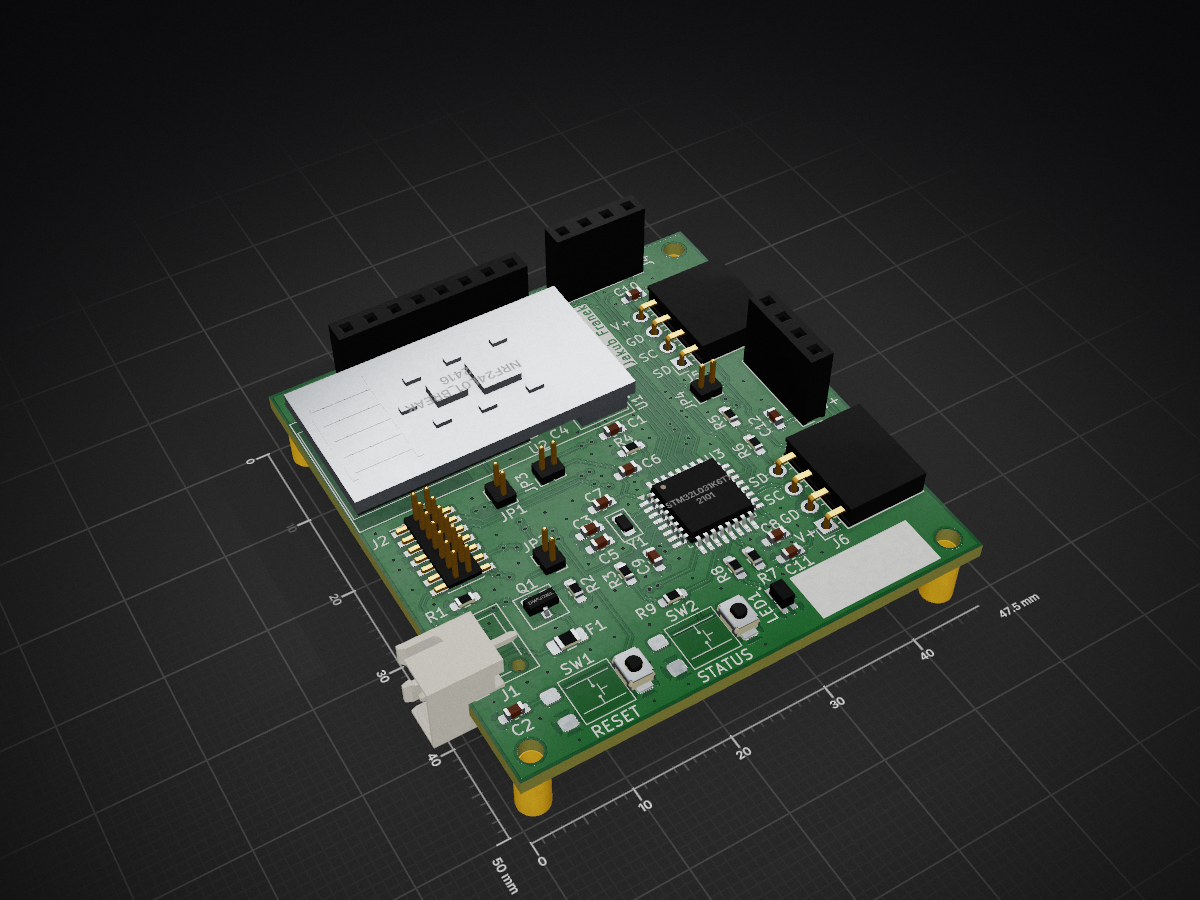
HAMS node is an open-source printed circuit board by JakubFranek, from the JakubFranek/Home-Air-Monitoring-System repository on GitHub. It is a 2-layer board of 47.5 × 50 mm with 45 parts on 44 nets, routed with 423 tracks and 150 vias.
It is built around the TL3305BF100QG, APHBM2012LSURKCGKC and DMP3099L, with the SMD0805B035TF among its other parts. Its parts include 12 capacitors, 9 resistors, 7 connectors, 3 ICs and 2 switches. It belongs with the sensors and measurement boards and the STM32 boards of this library.


Home Air Monitoring System (HAMS) is my personal hardware & embedded software development project designed to monitor indoor and outdoor air quality in my home.
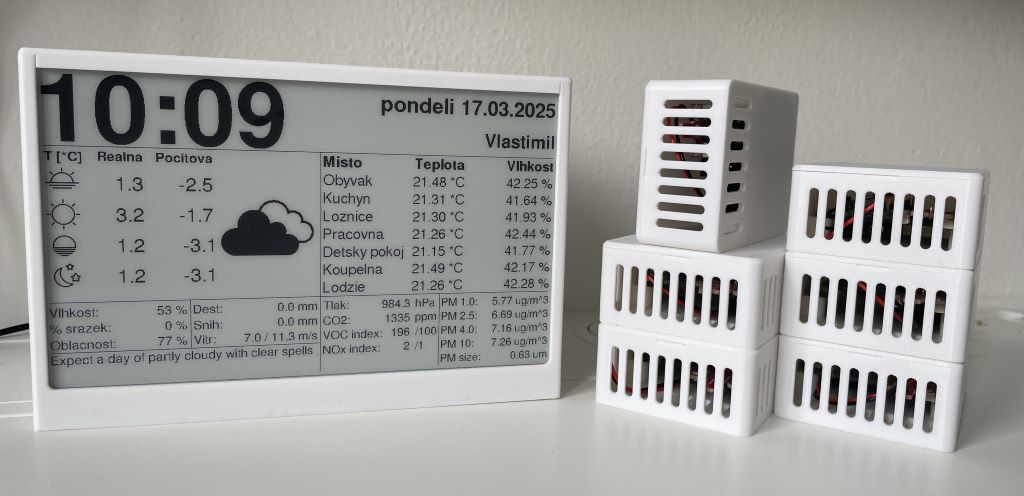
The system consists of a central hub and six wireless sensor nodes to measure:
Central Hub
Sensor Nodes
├── docs                         # Documentation for project setup, usage, etc.
├── utilities                    # Various auxiliary scripts, tools etc.
│   ├── sht_sensor_burn_in       # PlatformIO Arduino project for SHT40 sensor burn-in
│   └── sht_sensor_calibration   # PlatformIO Arduino project for SHT40 sensor calibration
├── hub
│   ├── hardware                 # PCB design and schematic for hub
│   ├── firmware                 # Firmware for the ESP32-based central hub
│   └── 3D_models                # 3D models for the hub's enclosure
├── node
│   ├── firmware                 # Firmware for the STM32-based sensor nodes
│   ├── hardware                 # PCB designs and schematics for nodes
│   └── 3D_models                # 3D models for the nodes' enclosures
├── README.md                    # Project overview (you are reading this now!)
└── TODO.md # Project task list| Qty | Value | Footprint | References |
|---|---|---|---|
| 6 | 10 uF | Capacitor_SMD:C_0603_1608Metric_Pad1.08x0.95mm_HandSolder | C1, C4, C6, C10, C11, C12 |
| 5 | 10 kOhm | Resistor_SMD:R_0603_1608Metric_Pad0.98x0.95mm_HandSolder | R3, R4, R5, R6, R9 |
| 4 | 100 nF | Capacitor_SMD:C_0603_1608Metric_Pad1.08x0.95mm_HandSolder | C2, C7, C8, C9 |
| 4 | Jumper_2_Bridged | Connector_PinHeader_1.27mm:PinHeader_1x02_P1.27mm_Vertical | JP1, JP2, JP3, JP4 |
| 4 | MountingHole | MountingHole:MountingHole_2.2mm_M2_ISO7380 | H1, H2, H3, H4 |
| 2 | 100 Ohm | Resistor_SMD:R_0603_1608Metric_Pad0.98x0.95mm_HandSolder | R1, R2 |
| 2 | 680 Ohm | Resistor_SMD:R_0603_1608Metric_Pad0.98x0.95mm_HandSolder | R7, R8 |
| 2 | 7 pF | Capacitor_SMD:C_0603_1608Metric_Pad1.08x0.95mm_HandSolder | C3, C5 |
| 2 | Conn_01x04 | Connector_PinSocket_2.54mm:PinSocket_1x04_P2.54mm_Horizontal | J5, J6 |
| 2 | Conn_01x04 | Connector_PinSocket_2.54mm:PinSocket_1x04_P2.54mm_Vertical | J4, J7 |
| 2 | TL3305BF100QG | Personal_Switches:E-Switch_TL3305BF100QG_Tactile_SPST | SW1, SW2 |
| 1 | APHBM2012LSURKCGKC | Personal_SamacSys:KPHBM2012QBDCGKC | LED1 |
| 1 | CM9V-T1A | PCM_Crystal_AKL:Crystal_SMD_MicroCrystal_CM9V-T1A-2Pin_1.6x1.0mm_BigPads | Y1 |
| 1 | Conn_01x02 | Connector_JST:JST_XH_B2B-XH-AM_1x02_P2.50mm_Vertical | J1 |
| 1 | Conn_01x08 | Connector_PinSocket_2.54mm:PinSocket_1x08_P2.54mm_Vertical | J3 |
| 1 | Conn_02x07_Odd_Even | Connector_PinHeader_1.27mm:PinHeader_2x07_P1.27mm_Vertical_SMD | J2 |
| 1 | DMP3099L | PCM_Package_TO_SOT_SMD_AKL:SOT-23 | Q1 |
| 1 | NRF24L01_Breakout | RF_Module:nRF24L01_Breakout | U1 |
| 1 | SMD0805B035TF | Personal_Fuses:YAGEO_SMD0805_Fuse | F1 |
| 1 | STM32L031K6Tx | Package_QFP:LQFP-32_7x7mm_P0.8mm | U3 |
| 1 | nRF24L01p SMD module | Personal_Modules:nRF24L01p_SMD_module | U2 |
JakubFranek/Home-Air-Monitoring-System
Home Air Monitoring System (HAMS) is my personal hardware & embedded software development project designed to monitor indoor and outdoor air quality in my home.

akoerner-dev/ClearBell
Selbst entwickeltes ESP32-Klingelsystem fuer ein Zweifamilienhaus - KiCad-Hardware und Arduino-Firmware (WLAN/UDP, HMAC-gesichert).

Maritime-Hacking-Village/Badge-2025
Public repository for the official MHV 2025 badge.

HydrogreenPollub/fuel_cell_control_unit_pcb_fccu_v2_1
Last FCCU version made by Michał Borkowski. All connections are similiar with FCCUv2. Add 2x n-mosfet with Wago conectors on the back side and 2x ADC on the same i2c line


Maltheren/Connectivity_3band_LoRaboard
The first revision lora testboards for the tunnel measurement project

N-Pulse/BMI-EMG-HW
Find the schematics and PCB layout for the hardware of the EMG Bracelet
It measures 47.5 × 50 mm and has 2 copper layers, 1.6 mm thick.
45 parts, built around the TL3305BF100QG, APHBM2012LSURKCGKC, DMP3099L and SMD0805B035TF. The full list of its parts is on this page, with links to each part's symbol and footprint where PCBKit's library has them.
From the JakubFranek/Home-Air-Monitoring-System repository on GitHub, at the commit this page was made from: the board is node/hardware/HAMS_node/HAMS_node.kicad_pcb and its schematic hub/hardware/HAMS_hub/HAMS_hub.kicad_sch. PCBKit opens the board in the browser, with nothing to install.
Its repository states no licence, so its author keeps all rights: ask JakubFranek before reusing the design.