2 layers
Maglev cv2
Hansolini/Take-home-Maglev-lab
A small lab for students in control engineering to learn control topics at home!
56 parts15MIT

 Hansolini/Take-home-Maglev-lab15
A small lab for students in control engineering to learn control topics at home!
Maglev26 is an open-source printed circuit board by Hansolini, from the Hansolini/Take-home-Maglev-lab repository on GitHub, published under the MIT licence. It is a 2-layer board with 60 parts on 60 nets, routed with 412 tracks and 61 vias.
It is built around the LM1117S-3.3, LM1117S-5.0 and SSM-124-L-SV, with the PJ-036AH-SMT-TR among its other parts. Its parts include 15 capacitors, 6 resistors, 3 connectors, 3 switches and 2 ICs.


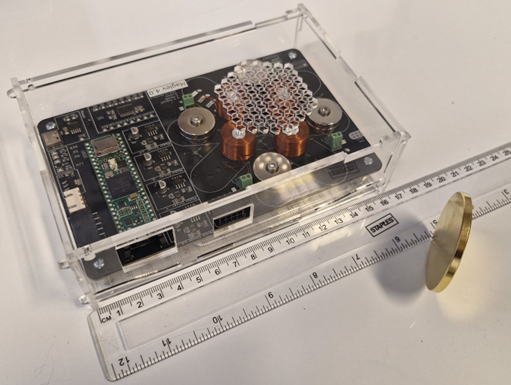 1) Current version of the hardware. |
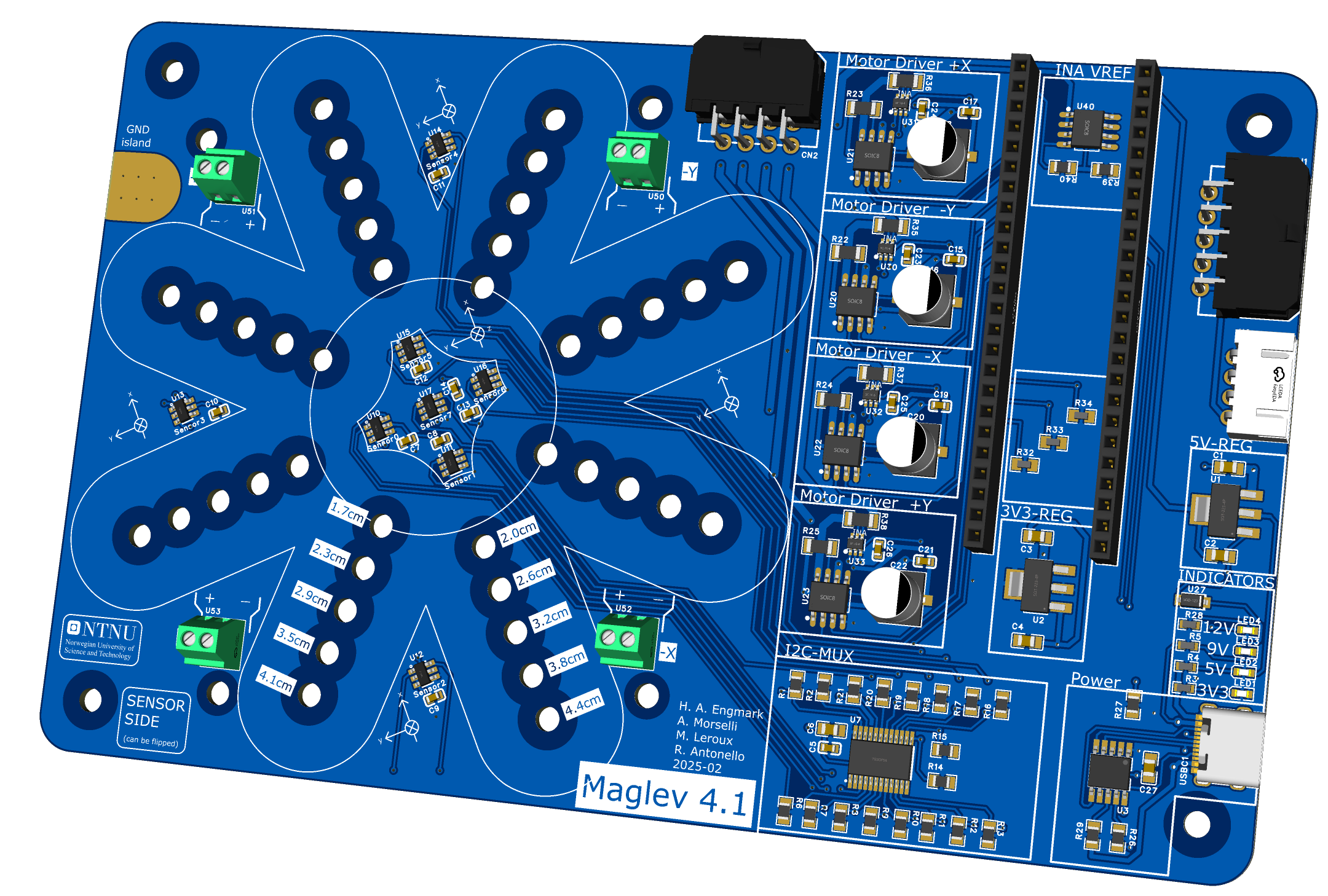 2) Overview of the current PCB. |
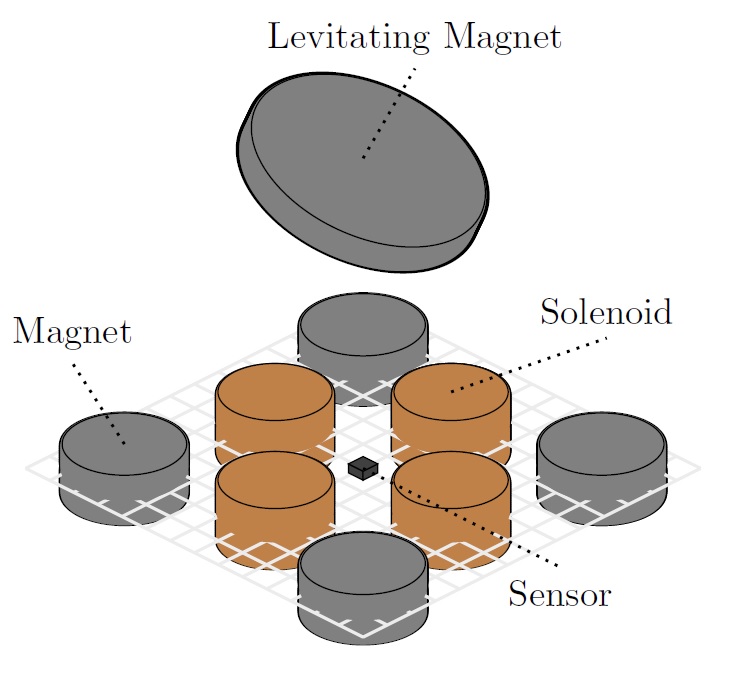 2) Magnetic structure of the system. |
The "Take-home Maglev lab" is a small lab in development at the Norwegian University of Science and Technology (NTNU), University of Padova, Italy, and University in Stavanger, Norway. The setup is tailored to help students learn control and related fields, and is intended as a kit that students can bring home and assemble independently, with additional lab assignments for teaching anything from fundamental to advanced concepts within control engineering.
If you want to see how the platform looks like and how effective it is to achieve levitation (actually with a PD controller in this case), see this and this videos.
As for this repository, it contains a
The following is a table about such student reports, summarizing also the hardware development history.
| Version | Developer | Goal | Development period | Status | Result |
|---|---|---|---|---|---|
| V1.0 | M. Brønstad J. O. Deila J. Dyrskog M. Langklopp | Levitaion | Spring 2022 | :white_check_mark: | Stable levitation ~ 2 min |
| V2.0 | M. Brønstad J. O. Deila J. Dyrskog | Smaller form factor, more robust | Summer 2022 | :white_check_mark: | Stable levitation >> 2 min |
| V2.5 | JH Technical AS | Fix minor bugs, improve heating and components | Spring 2024 | :white_check_mark: | Stable levitation >> 2 min |
| V2.6 | A. Morselli | Fix faulty wiring, changing sensors | Spring 2024 | :white_check_mark: | Stable levitation >> 30 min |
| V2.7 | A. Morselli | Modular design and testbench for V3.0 | Spring 2024 | :white_check_mark: | Decisions on design |
| V3.0 | A. Morselli | Modular redesign for first 'Take-home lab' | Summer 2024 | :white_check_mark: | Decisions on design |
| V3.1 | M. Leroux | Adding USB-C power | Fall 2024 | :white_check_mark: | Improved power delivery |
| V4.0 | M. Leroux | New form factor and additional sensing for improved stability | Fall 2024 | :white_check_mark: | Improved control |
| V4.1 | R. Antonello | Rerouting PCB tracks and updating components | Spring 2025 | :white_check_mark: | Meets IPC standards |
| V4.2 | K. Blom | Creating a MISO version of the board | Spring 2025 | :white_check_mark: | MISO board |
| V4.3 | A. Morselli | Improving EM compatibility via some rerouting | Fall 2025 | :white_check_mark: | Improved EM compatibility |
| Qty | Value | Footprint | References |
|---|---|---|---|
| 13 | MountingHole_3.2mm_M3 | MountingHole:MountingHole_3.2mm_M3 | PMAG, PMAG, PMAG, PMAG, PMAG, PMAG, REF2, REF3, REF4, Sol_1, Sol_2, Sol_3, Sol_4 |
| 8 | solenoid | TestPoint:TestPoint_Pad_1.5x1.5mm | 1_1, 1_2, 2_1, 2_2, 3_1, 3_2, 4_1, 4_2 |
| 7 | 100nF | Capacitor_SMD:C_0603_1608Metric | C5, C6, C7, C9, C11, C13, C15 |
| 5 | TestPoint_Pad_D1.5mm | TestPoint:TestPoint_Pad_D1.5mm | +5V, +5V, 3V3, 12V, GND |
| 4 | 0.45 | Resistor_SMD:R_1206_3216Metric_Pad1.30x1.75mm_HandSolder | R1, R2, R3, R4 |
| 4 | 100uF | Capacitor_SMD:CP_Elec_6.3x7.7 | C8, C10, C12, C14 |
| 4 | 10uF | Capacitor_SMD:C_0805_2012Metric | C1, C2, C3, C4 |
| 4 | A4950E | Package_SO:SOIC-8-1EP_3.9x4.9mm_P1.27mm_EP2.41x3.3mm | M1, M2, M3, M4 |
| 2 | 1K2 | Resistor_SMD:R_0805_2012Metric | R5, R6 |
| 2 | SSM-124-L-SV | Connector_PinSocket_2.54mm:PinSocket_1x24_P2.54mm_Vertical_SMD_Pin1Left | J2, J3 |
| 1 | LM1117S-3.3 | Package_TO_SOT_SMD:SOT-223-3_TabPin2 | U1 |
| 1 | LM1117S-5.0 | Package_TO_SOT_SMD:SOT-223-3_TabPin2 | U2 |
| 1 | PJ-036AH-SMT-TR | Connector_BarrelJack:BarrelJack_CUI_PJ-036AH-SMT_Horizontal | J1 |
| 1 | TLE493DW1B6A0 | Package_TO_SOT_SMD:SOT-23-6 | S1 |
| 1 | TLE493DW1B6A1 | Package_TO_SOT_SMD:SOT-23-6 | S2 |
| 1 | TLE493DW1B6A2 | Package_TO_SOT_SMD:SOT-23-6 | S3 |
The 59 most common of 60 parts.
Hansolini/Take-home-Maglev-lab
A small lab for students in control engineering to learn control topics at home!

Hansolini/Take-home-Maglev-lab
A small lab for students in control engineering to learn control topics at home!

Hansolini/Take-home-Maglev-lab
A small lab for students in control engineering to learn control topics at home!

Hansolini/Take-home-Maglev-lab
A small lab for students in control engineering to learn control topics at home!


rmingon/servo-controller
Custom-made dual-servo testing platform. It is designed for engineers, makers, and robotics developers who need a reliable and convenient way to drive and test two RC servos simultaneously from a PC.


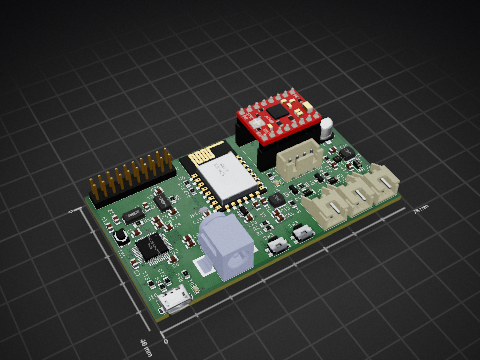
o7-machinehum/Hydroponic
Please find the electronics files in the ee folder, all pcb design is done with the open source software KiCad. Is uses an STM32 as the main controller, and an ST L6470 moter driver for the stepper motor.
60 parts, built around the LM1117S-3.3, LM1117S-5.0, SSM-124-L-SV and PJ-036AH-SMT-TR. The full list of its parts is on this page, with links to each part's symbol and footprint where PCBKit's library has them.
From the Hansolini/Take-home-Maglev-lab repository on GitHub, at the commit this page was made from: the board is physical_system/hardware/blueprints/maggyV2.6/pcb_files/maglev26.kicad_pcb and its schematic physical_system/hardware/blueprints/maggyV2.0/maglev cv2.kicad_sch. PCBKit opens the board in the browser, with nothing to install.
Its repository publishes it under the MIT licence: you may reuse it on that licence's terms (keep the author's notice, and for a copyleft licence share your changes alike).