2 layers40 × 34 mm

 GadgetReboot/Midi_Breakout17
Midi In/Out/Thru Breakout PCB
GR Midi Breakout is an open-source printed circuit board by GadgetReboot, from the GadgetReboot/Midi_Breakout repository on GitHub. It is a 2-layer board of 87.4 × 43.4 mm with 37 parts on 30 nets, routed with 165 tracks and 6 vias.
It is built around the PSG03463. Its parts include 15 resistors, 7 connectors, 4 transistors, 2 capacitors and 1 IC. It belongs with the audio and music and interfaces and adapters boards of this library.
Midi In/Out/Thru Breakout PCB
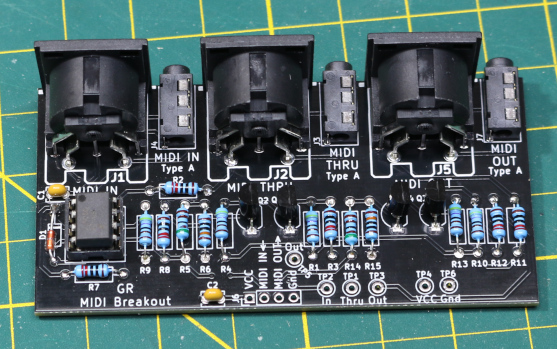
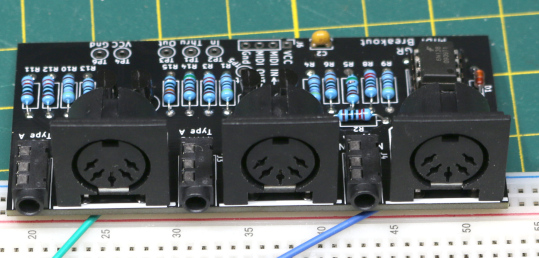
Configured for 5V logic levels
| Qty | Value | Footprint | References |
|---|---|---|---|
| 7 | 4K7 | Resistor_THT:R_Axial_DIN0207_L6.3mm_D2.5mm_P10.16mm_Horizontal | R1, R4, R5, R9, R10, R13, R14 |
| 6 | 220r | Resistor_THT:R_Axial_DIN0207_L6.3mm_D2.5mm_P10.16mm_Horizontal | R2, R3, R7, R8, R11, R12 |
| 6 | TestPoint | TestPoint:TestPoint_Loop_D1.80mm_Drill1.0mm_Beaded | TP1, TP2, TP3, TP4, TP5, TP6 |
| 4 | 2N3904 | Package_TO_SOT_THT:TO-92_Inline_Wide | Q1, Q2, Q3, Q4 |
| 3 | AudioJack4 | footprints:PJ320A | J3, J4, J7 |
| 3 | PSG03463 | footprints:DIN5 | J1, J2, J5 |
| 2 | 100K | Resistor_THT:R_Axial_DIN0207_L6.3mm_D2.5mm_P10.16mm_Horizontal | R6, R15 |
| 2 | 100nF | Capacitor_THT:C_Disc_D3.8mm_W2.6mm_P2.50mm | C1, C2 |
| 1 | 1N4148 | Diode_THT:D_DO-35_SOD27_P10.16mm_Horizontal | D1 |
| 1 | 6N138 | Package_DIP:DIP-8_W7.62mm_Socket_LongPads | U1 |
| 1 | Conn_01x04 | Connector_PinHeader_2.54mm:PinHeader_1x04_P2.54mm_Vertical | J6 |
| 1 | LOGO | _Custom_Footprints:pcb way logo | G*** |

hoglet67/RGBtoHDMI
Bare-metal Raspberry Pi project that provides pixel-perfect sampling of Retro Computer RGB/YUV video and conversion to HDMI

hackclub/OnBoard
💡 Join 1,000 teenagers and make your first PCB with a $100 grant!

FreeYourStream/freedeck-hardware
all the stuff you need to build your own FreeDeck

stuartpittaway/diyBMS
Do it yourself battery management system for Lithium ion battery packs/cells

Pwnsat/FlatSat
Flatsat v1.0 is a hardware based platform for aerospace cybersecurity research


vsfteam/vsf
Versaloon Software Framework -- a tiny preemptive-capable event-driven incremental software framework for embedded systems
It measures 87.4 × 43.4 mm and has 2 copper layers, 1.6 mm thick.
37 parts, built around the PSG03463. The full list of its parts is on this page, with links to each part's symbol and footprint where PCBKit's library has them.
From the GadgetReboot/Midi_Breakout repository on GitHub, at the commit this page was made from: the board is KiCad/GR_Midi_Breakout.kicad_pcb. PCBKit opens the board in the browser, with nothing to install.
Its repository states no licence, so its author keeps all rights: ask GadgetReboot before reusing the design.