2 layers32.4 × 24.8 mm
1ch-4-20mA
Fescron/2ch-4-20mA-converter
1/2 channel 4-20 mA to voltage converter boards using LMP8640 current sense monitor.
13 parts10

 Fescron/2ch-4-20mA-converter10
1/2 channel 4-20 mA to voltage converter boards using LMP8640 current sense monitor.
2ch-4-20mA is an open-source printed circuit board by Fescron, from the Fescron/2ch-4-20mA-converter repository on GitHub. It is a 2-layer board of 46.4 × 46.4 mm with 30 parts on 12 nets, routed with 79 tracks and 8 vias.
It is built around the TEC 2-0913 and LMP8640MK-F. Its parts include 3 ICs, 3 connectors, 2 capacitors and 2 resistors. It belongs with the sensors and measurement and interfaces and adapters boards of this library.





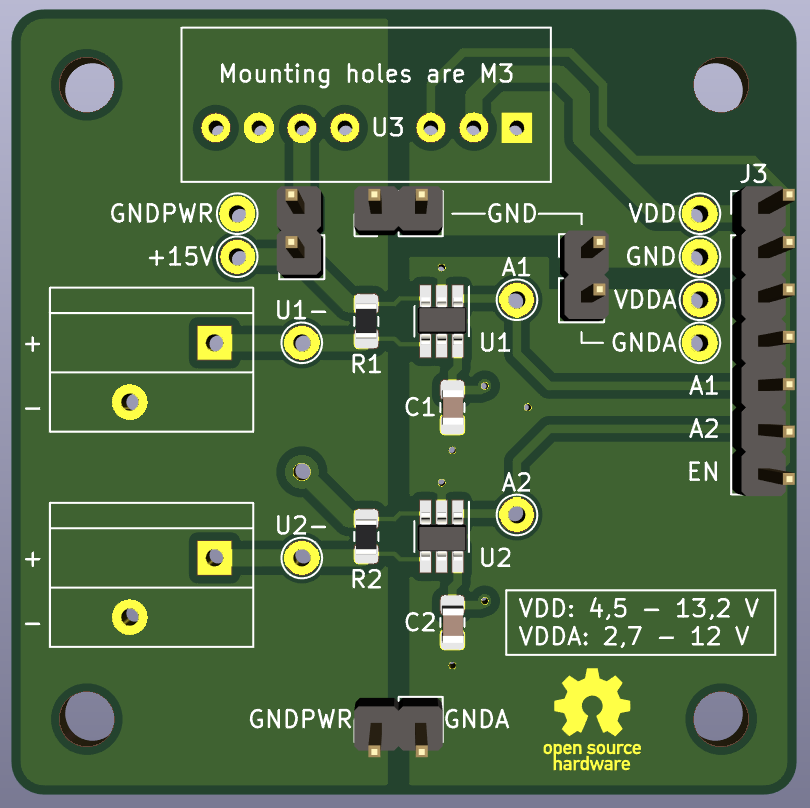
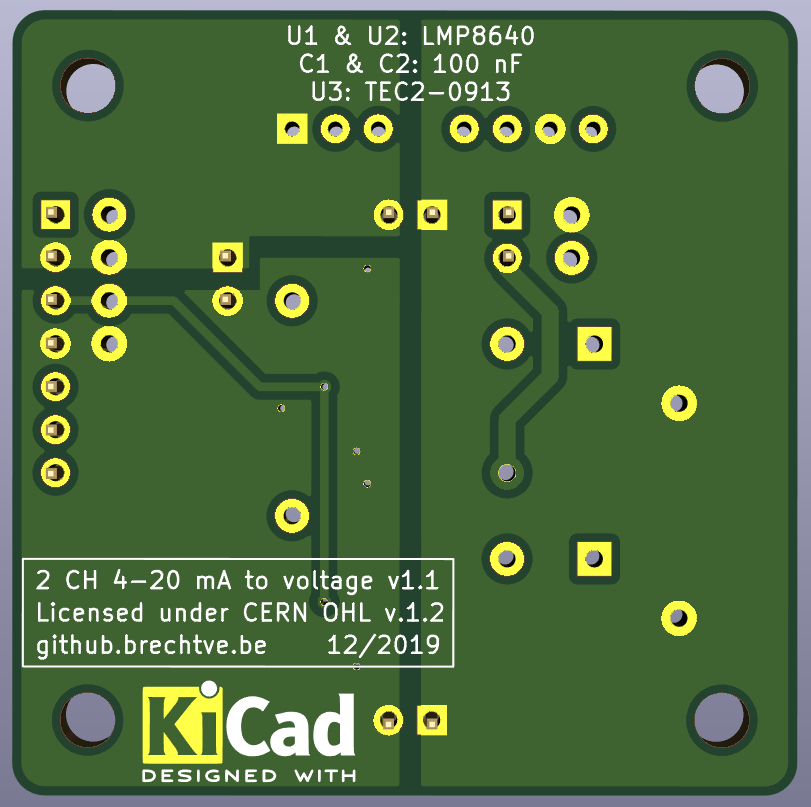
This board converts two 4 - 20 mA signals to a voltage using a LMP8640 Current Shunt Monitor from Texas Instruments. To provide power to the 4 - 20 mA sensors a TEC2-0913 2W 15V Isolated DC-DC converter is used from Traco Power. Quick-connect terminals from Phoenix Contact are also used.
To allow for extensive testing three separate GND nets/planes and a lot of test points are used. They can be connected together using jumpers if necessary. The power supply can also be disabled and fully disconnected from the sensors using a jumper as well (wich can also be used to measure the in-line current given to the whole sensor circuit).
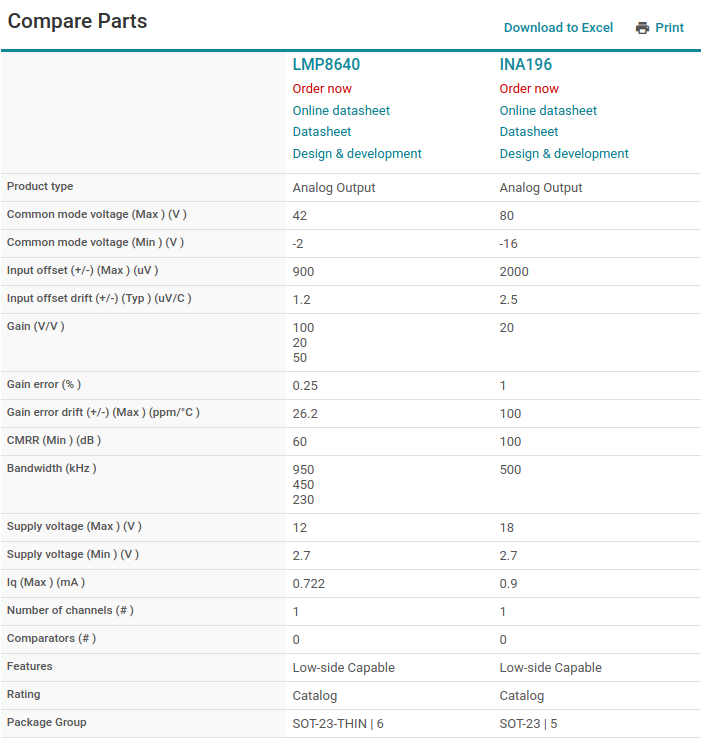
A lot of designs still use the INA196 Current Shunt Monitor from Texas Instruments. In the picture below is a comparison between the LMP8640 and the INA196. No real disadvantage was found to not use the LMP8640.
| Component | Value | Footprint | Other | Ordering |
|---|---|---|---|---|
| U1, U2 | LMP8640 | SOT-23-Thin-6 | Texas Instruments Current Shunt Monitor | Mouser.be |
| U3 | TEC2-0913 | SIP-8 | Traco Power 2W 15V Isolated DC-DC converter | Mouser.be |
| C1, C2 | 100 nF = 0,1 µF | 0805 | X7R, 16V, 10% | Mouser.be |
| R1, R2 | 6,2 Ω | 0805 | 0,1% | Mouser.be |
| R1, R2 (alt) | 4,99 Ω | 0805 | 0,1% | Mouser.be |
| J1, J2 | PTSA_1,5/_2-3,5-Z_BK | Pitch: 3,5 mm | 2 contacts @ 45° (20-16 AWG), 250V 2A | Mouser.be |
To better conduct tests with the LMP8640 chip a simple 1-CH board was layed out without a power supply and etched on a single sided board.
| Qty | Value | Footprint | References |
|---|---|---|---|
| 10 | TestPoint | TestPoint:TestPoint_THTPad_D2.0mm_Drill1.0mm | TP1, TP2, TP3, TP4, TP5, TP6, TP7, TP8, TP9, TP10 |
| 4 | M3 | MountingHole:MountingHole_3.2mm_M3 | H1, H2, H3, H4 |
| 3 | Jumper_NO_Small | Connector_PinHeader_2.54mm:PinHeader_1x02_P2.54mm_Vertical | JP1, JP2, JP3 |
| 2 | 100 nF | Capacitor_SMD:C_0805_2012Metric_Pad1.15x1.40mm_HandSolder | C1, C2 |
| 2 | 6,2 Ω | Resistor_SMD:R_0805_2012Metric_Pad1.15x1.40mm_HandSolder | R1, R2 |
| 2 | Conn_01x02 | Connector_Phoenix_PTSA_extra:PhoenixContact_PTSA_1,5_2-G-3,5_1x02_P3.50mm_Angled | J1, J2 |
| 2 | LMP8640 | Package_TO_SOT_SMD:SOT-23-6_Handsoldering | U1, U2 |
| 1 | Conn_01x07 | Connector_PinHeader_2.54mm:PinHeader_1x07_P2.54mm_Vertical | J3 |
| 1 | Jumper_NC_Small | Connector_PinHeader_2.54mm:PinHeader_1x02_P2.54mm_Vertical | JP4 |
| 1 | OSHW-EEVBLOG-SPFMDBC-10mm | BrechtVE_Aesthetics:OSHW-Logo_5.7x6mm_SolderMask | G1 |
| 1 | TEC2-0913 | Package_SIP_extra:SIP-8 TEC2-0913 | U3 |
The 29 most common of 30 parts.
Fescron/2ch-4-20mA-converter
1/2 channel 4-20 mA to voltage converter boards using LMP8640 current sense monitor.

Fescron/masterthesis
This repository is a collection of hardware, firmware and some documentation files for the project I created for my masterthesis.

jerinabr/Drone_ESC_Bridge
PCB that allows the NVIDIA Jetson to communicate with the 4-in-1 ESC for the drone


google/mozc-devices
Circuit diagrams and firmware source code for Gboard DIY keyboards


VoronDesign/Voron-Hardware
Cool Hardware designed by the Voron Design group

hoglet67/RGBtoHDMI
Bare-metal Raspberry Pi project that provides pixel-perfect sampling of Retro Computer RGB/YUV video and conversion to HDMI

tenderlove/initial-v
It's a BMW shifter converted to a Bluetooth Keyboard that you use with Vim
It measures 46.4 × 46.4 mm and has 2 copper layers, 1.6 mm thick.
30 parts, built around the TEC 2-0913 and LMP8640MK-F. The full list of its parts is on this page, with links to each part's symbol and footprint where PCBKit's library has them.
From the Fescron/2ch-4-20mA-converter repository on GitHub, at the commit this page was made from: the board is hardware/2ch-4-20mA/2ch-4-20mA.kicad_pcb. PCBKit opens the board in the browser, with nothing to install.
Its repository states no licence, so its author keeps all rights: ask Fescron before reusing the design.