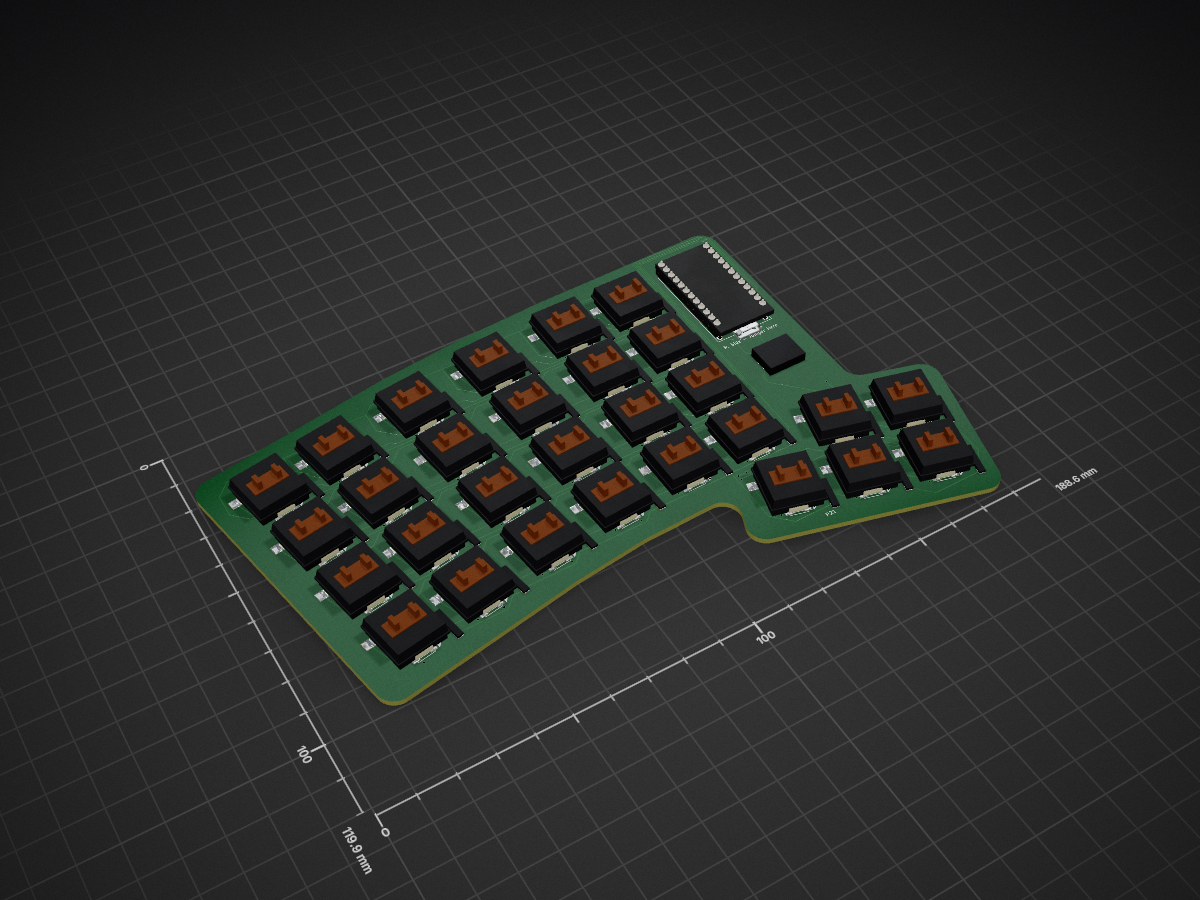
2 layers188.4 × 119.7 mm
 EpicPantalones/Str8-Key2
A design for an RGB ortho-linear split keyboard
BoardPcb is an open-source printed circuit board by EpicPantalones, from the EpicPantalones/Str8-Key repository on GitHub. It is a 2-layer board of 188.4 × 119.7 mm with 118 parts on 88 nets, routed with 1,666 tracks and 134 vias.
Its parts include 87 diodes and 29 switches. It belongs with the keyboards and input boards of this library.
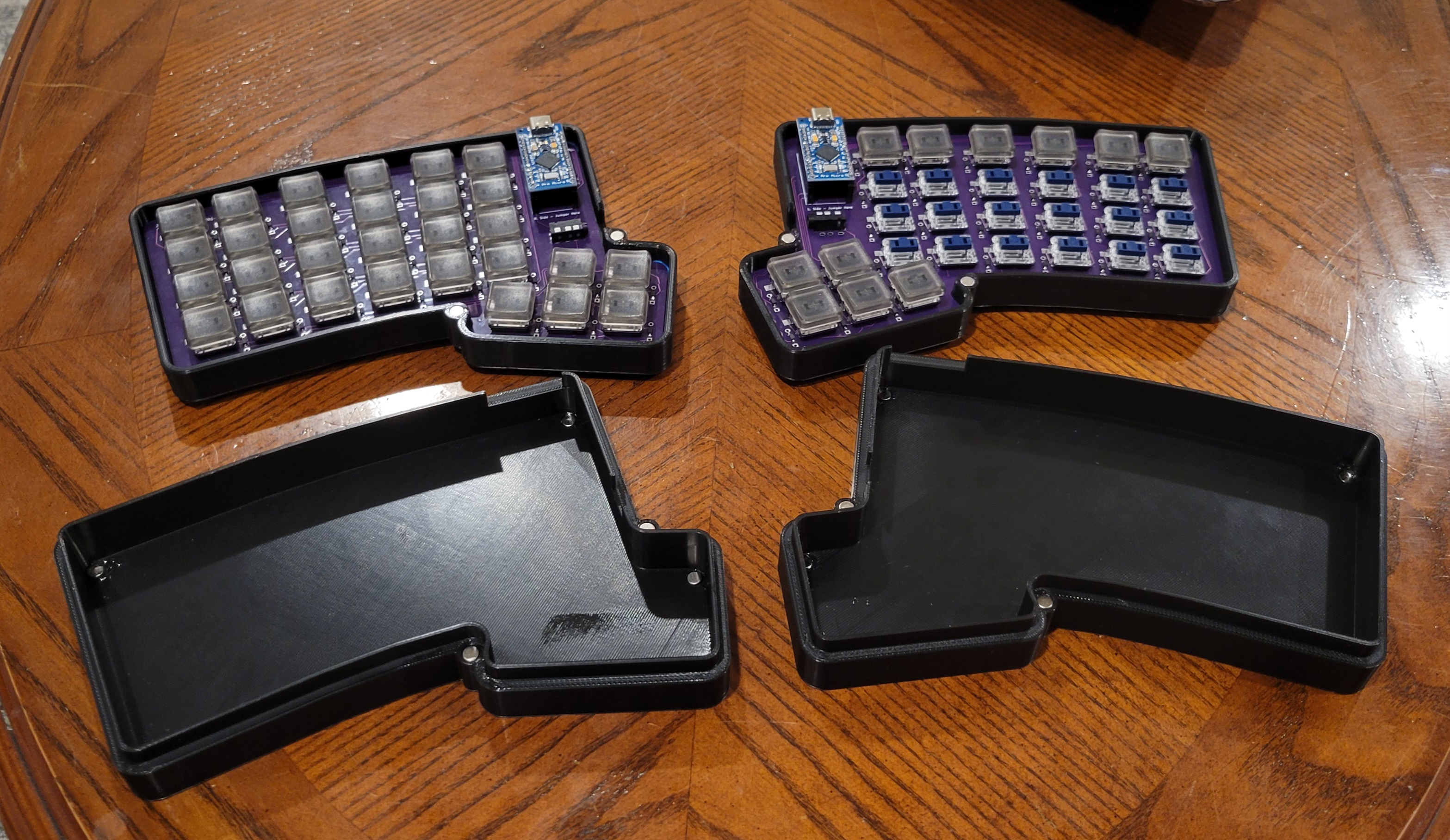
Welcome to Str8-Key, a custom mechanical keyboard in both form and function. Co-designed by Ethan Sorensen and John Rowberry, this ortho-linear, staggered, split keyboard is powered by dual Arduino Pro-Micro microcontrollers and connected via USB-C. Str8-Key bridges a fun engineering project with the great configurability of the QMK firmware, the result of which offers a unique and ergonomically safe typing experience! With 58 keys and infinite possibilities, this keyboard can be used to create layouts tailored perfectly to your workflow (or gameflow!). Built entirely from scratch, it remains an affordable project at just around $140, excluding 3D printing costs — actually a pretty good price for a fully customized typing experience.
Wow this is the 225 recitation! there are so many cool people here today.
You can look in the Tree.txt file to see a full list of all the files contained in the tree. Most of them are specific to our design, but you might find some jumping off points if you're interested in making your own.
metadata:
  engine: 4.0
  version: 1.2
  author: John Rowberry
  contact: johnrowberries@gmail.com
units:
  default_spread: 'cx'
  default_splay: 0
  default_width: 'cy'
  default_padding: 'cx'
  default_autobind: 10
  xspace: cx
  yspace: cy
  paddingy: yspace
...
and more
YAML (YAML Ain't Markup Language) is a human-readable data serialization format often used for configuration files. It focuses on simplicity and uses indentation to represent structure, making it easy to read and write. YAML supports key-value pairs, lists, and nested structures, and it's useful to us because Ergogen uses YAML structures to generate layouts for custom keyboards. Look at Flatfox's guide (linked below) for more info on the structure of the YAML code, but its really simple and in most cases you can reference an example like our code and get the right result.
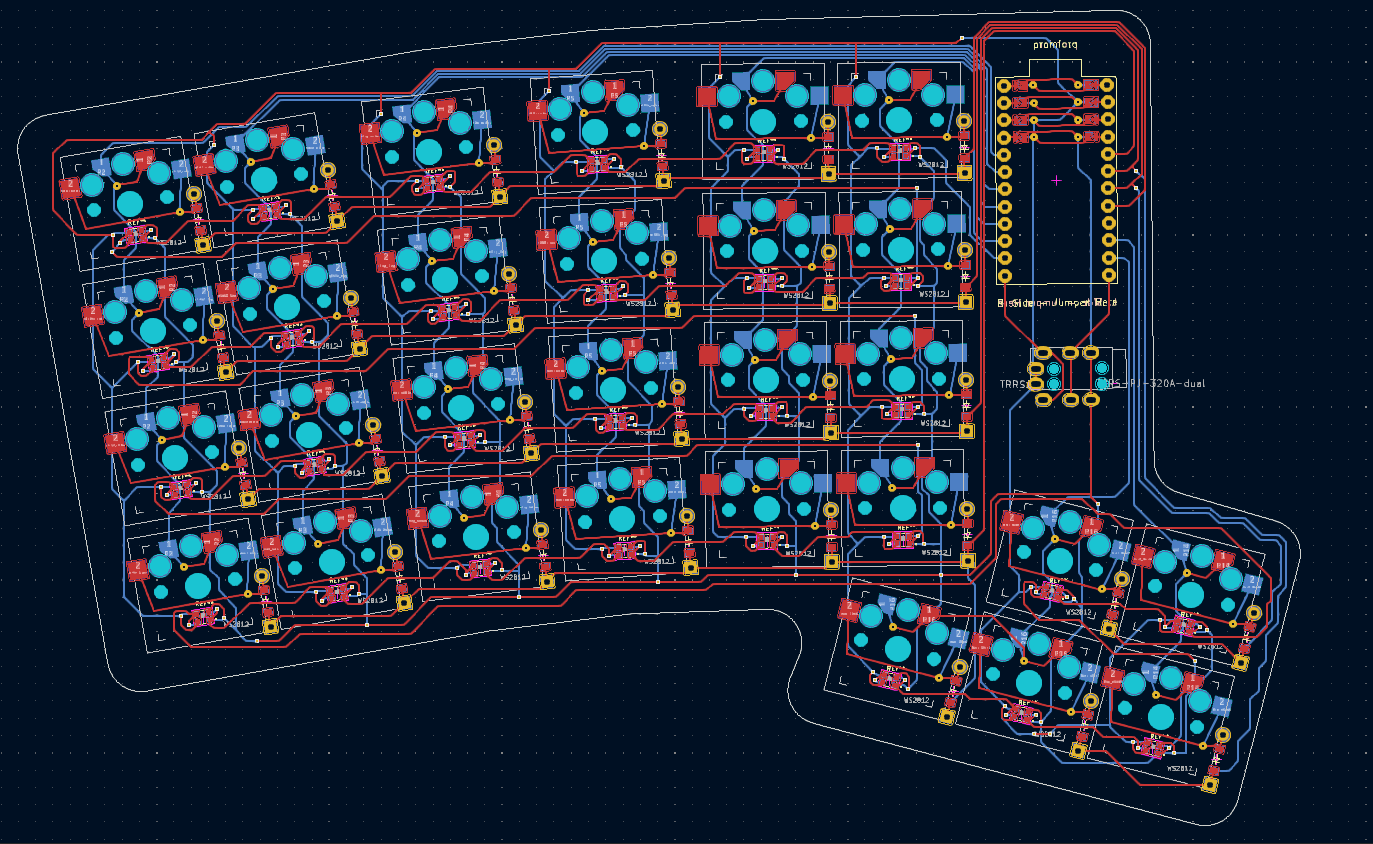
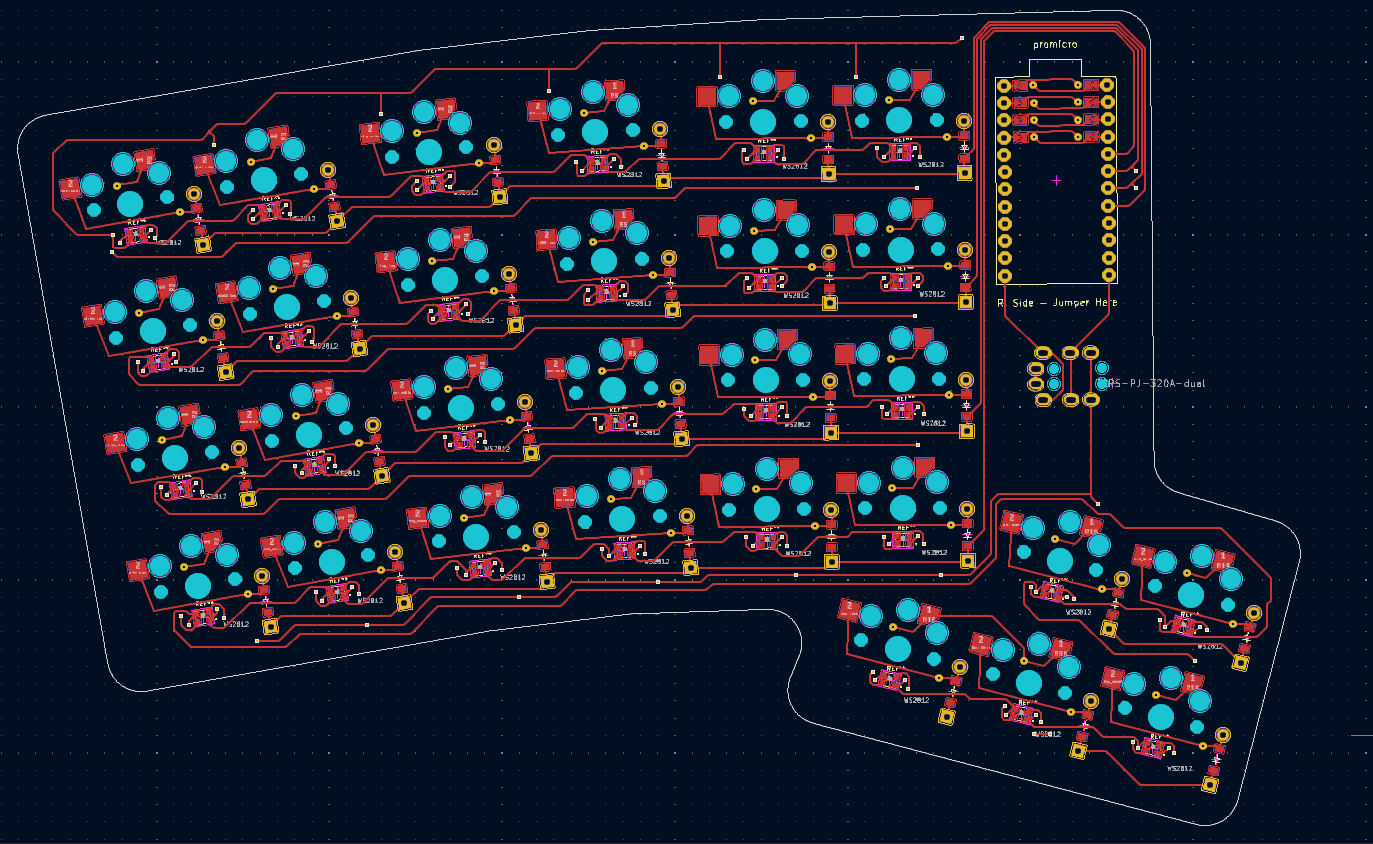
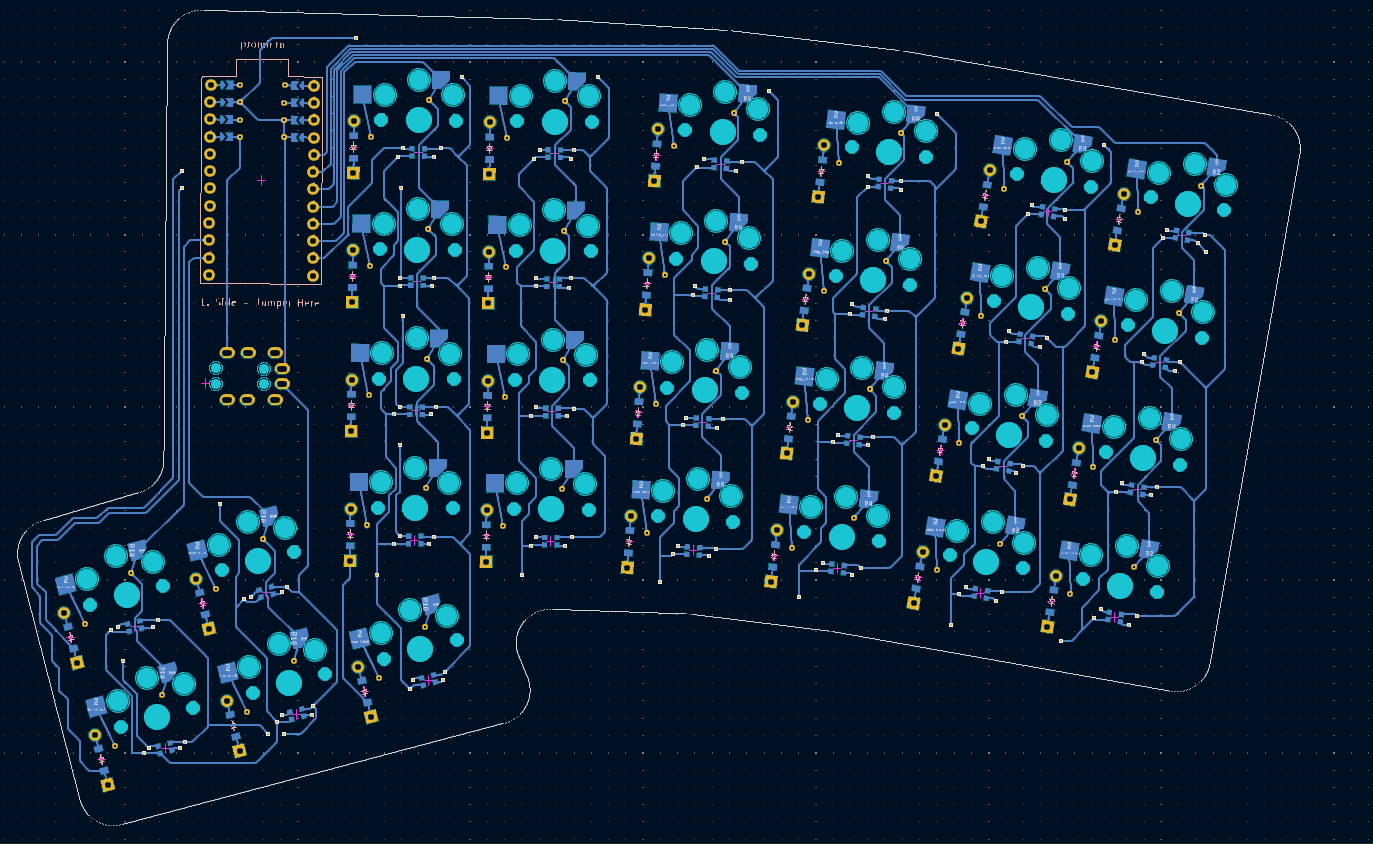
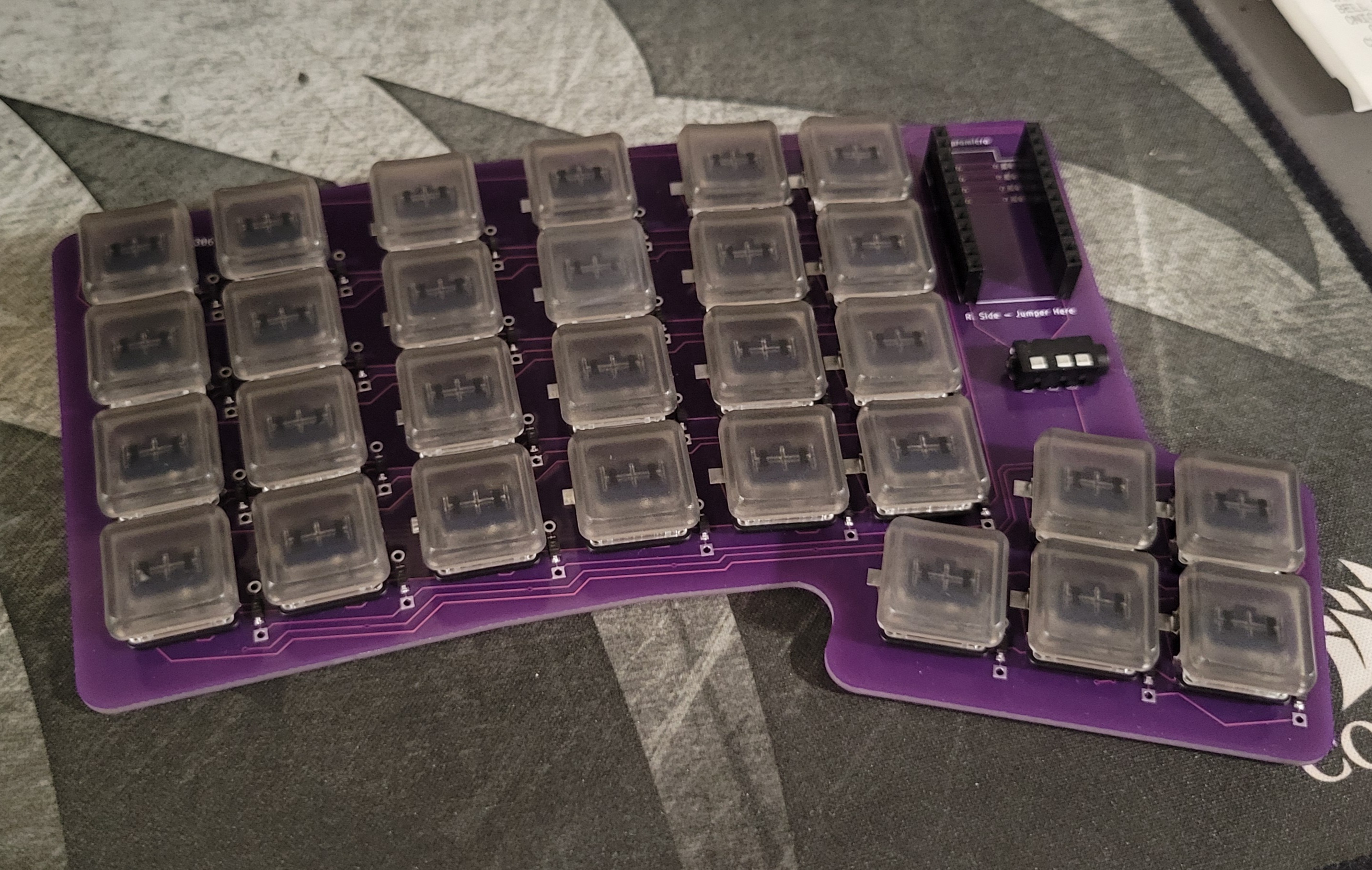
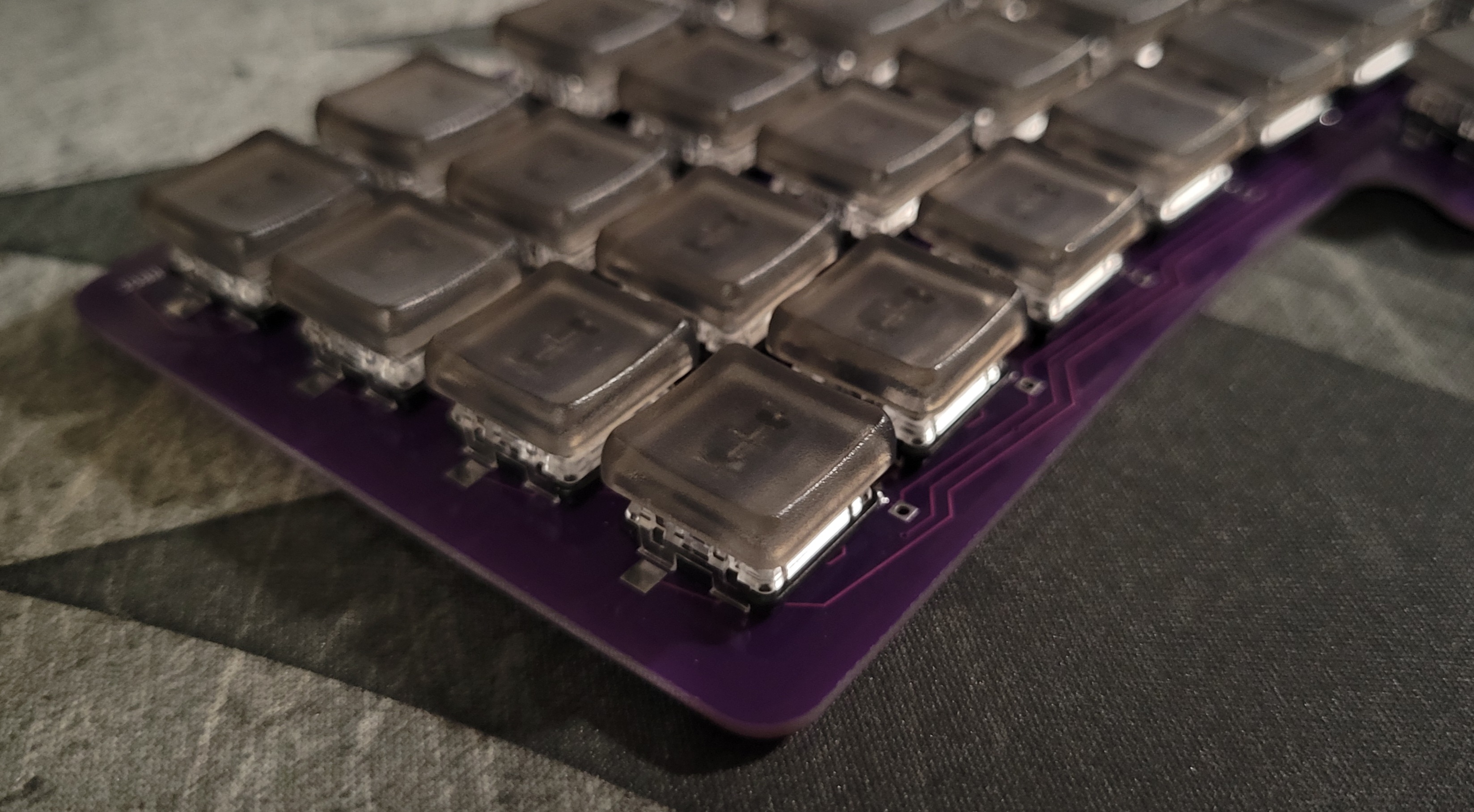
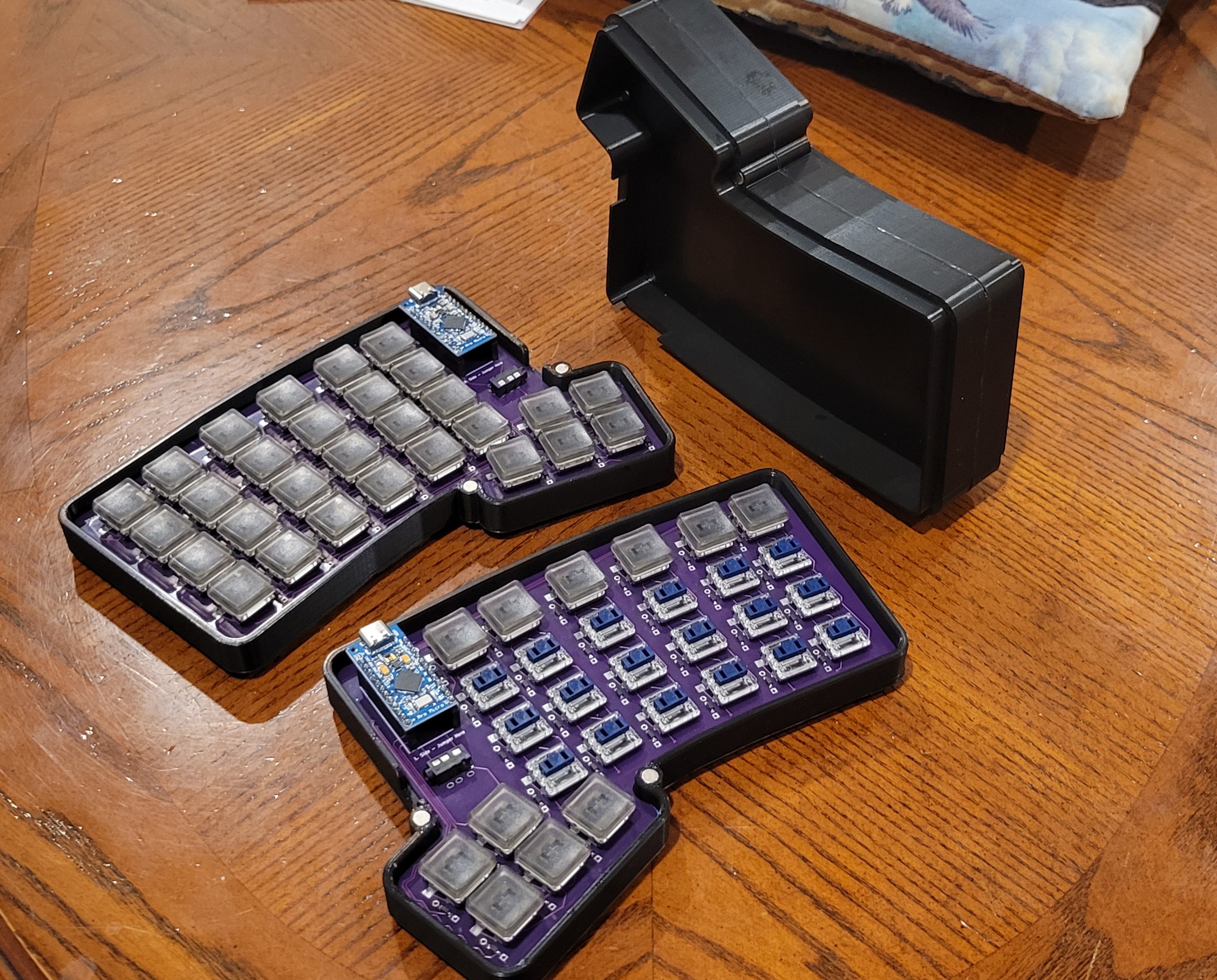
The Ergogen guide by FlatFootFox was instrumental in helping us bring Str8-Key to life, serving as both a comprehensive resource and our virtual teacher, alongside guidance from BYU's IEEE Club. Initially, we used the Ergogen Unofficial Website, which offers better real-time rendering in some cases compared to the official site, but we eventually transitioned to running Ergogen locally on Node, as suggested in FlatFootFox's guide, for even greater control. QMK Firmware was chosen to program the keyboard, and though this is still a work in progress, it offers immense flexibility. Additionally, Carter's GitHub project was invaluable, providing a template for the YAML files and saving us on more than one occasion during the build process.
The documentation for the LEDs we chose came from the same Adafruit link where we purchased them, and I used this SNAP EDA footprint as a starting point for the Ergogen code found in footprints/epicpantalones/WS2812. To ensure the choc switches fit and aligned properly, I referenced this choc switch datasheet. The Ergogen code I wrote was primarily based on a guide to converting KiCad footprints to Ergogen, with some additional reference from this LED code that I used as a basis.
We ordered the PCB from JLCPCB, and the price was incredibly affordable at just $13 plus shipping, totaling about $30 for five boards. The keys cost around $50, depending on the type, and we opted for frosted black choc switch keycaps, as the frosted look let the RGB lighting through. The LEDs were sourced from Adafruit. Our controller head unit is the Arduino Pro Micro, a board we discovered during this project, and they are connected via an audio connector (links forthcoming). We also included hot-swap sockets for the choc switches, which makes customization easy, and control flow diodes, although we don't have the sourcing details or costs for those at the moment.
| Qty | Value | Footprint | References |
|---|---|---|---|
| 58 | WS2812B | LED1, LED2, LED10, LED11, LED12, LED13, LED14, LED15, LED16, LED17, LED18, LED19, LED20, LED21, LED22, LED23 +42 | |
| 29 | ComboDiode | D1, D2, D10, D11, D12, D13, D14, D15, D16, D17, D18, D19, D20, D21, D22, D23 +13 | |
| 29 | PG1350 | S1, S2, S10, S11, S12, S13, S14, S15, S16, S17, S18, S19, S20, S21, S22, S23 +13 | |
| 1 | ProMicro | ||
| 1 | TRRS-PJ-320A-dual | TRRS-PJ-320A-dual | TRRS1 |


TweetyDaBird/Lotus-58-Classic
A split ergo linear keyboard derived from the Lily58 family

ZeroPhone/ZeroPhone-PCBs
PCB files for ZeroPhone - for gerbers and schematics, go to "Releases" tab!

BerkeleyHCI/PolymorphicBlocks
A Python-based hardware description language for PCBs for higher-level (block-diagram / system-architecture level) PCB design through libraries of directly reusable subcircuit generators.


OPRobots/FujitoraBot
Robotracer - siguelíneas de alto rendimiento; con succión, tracción brushless en sistema tetra y procesador STM32F4

richardeoin/ax
This repository contains hardware and software for the AX5043 and AX5243 radios from AxSemi (now ON Semiconductor). They are probably the same die, but the AX5243 has fewer pins.

It measures 188.4 × 119.7 mm and has 2 copper layers, 1.6 mm thick.
118 parts. The full list of its parts is on this page, with links to each part's symbol and footprint where PCBKit's library has them.
From the EpicPantalones/Str8-Key repository on GitHub, at the commit this page was made from: the board is output/v1.0-rejected/boardPcb.kicad_pcb. PCBKit opens the board in the browser, with nothing to install.
Its repository states no licence, so its author keeps all rights: ask EpicPantalones before reusing the design.