2 layers160 × 80 mm
 DamianPodrazaCode/KiCad-PRJ
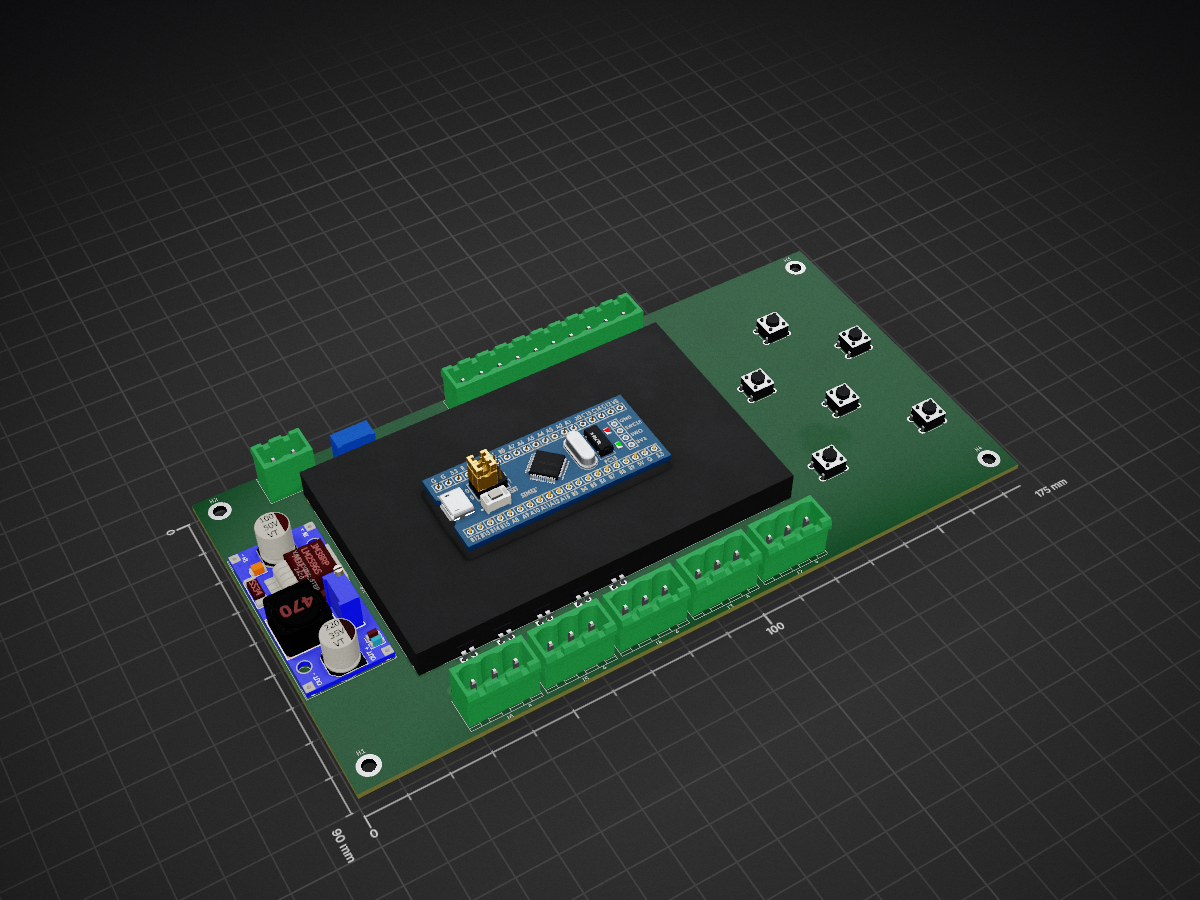
Skaner3d is an open-source printed circuit board by DamianPodrazaCode, from the DamianPodrazaCode/KiCad-PRJ repository on GitHub. It is a 2-layer board of 175 × 90 mm with 56 parts on 69 nets, routed with 321 tracks and 14 vias.
It is built around the 74HCT244D, 1N4148W and SS14. Its parts include 16 resistors, 8 ICs, 7 diodes, 7 connectors and 6 capacitors.


| Qty | Value | Footprint | References |
|---|---|---|---|
| 16 | R | Resistor_SMD:R_1206_3216Metric_Pad1.30x1.75mm_HandSolder | R1, R2, R3, R4, R5, R6, R7, R8, R9, R10, R11, R12, R13, R14, R15, R16 |
| 6 | C | Capacitor_SMD:C_1206_3216Metric_Pad1.33x1.80mm_HandSolder | C1, C2, C3, C4, C5, C6 |
| 6 | SW_Omron_B3FS | Button_Switch_THT:SW_PUSH_6mm_H5mm | SW1, SW2, SW3, SW4, SW5, SW6 |
| 5 | 1N4148W | Diode_SMD:D_SOD-123 | D1, D2, D3, D4, D5 |
| 5 | PC817 | Package_DIP:DIP-4_W7.62mm | U3, U4, U5, U6, U7 |
| 5 | Screw_Terminal_01x03 | Connector_Phoenix_MSTB:PhoenixContact_MSTBVA_2,5_3-G-5,08_1x03_P5.08mm_Vertical | J2, J3, J4, J5, J6 |
| 4 | MountingHole_Pad | MountingHole:MountingHole_3.2mm_M3_ISO14580_Pad | H1, H2, H3, H4 |
| 2 | SS14 | Diode_SMD:D_SMA | D6, D7 |
| 1 | 74HCT244 | Package_DIP:CERDIP-20_W7.62mm_SideBrazed | U2 |
| 1 | LCD-20X4B | lcd20x4:LCD_LCD-20X4B | DS2 |
| 1 | R_Potentiometer | Potentiometer_THT:Potentiometer_Vishay_T93YA_Vertical | RV1 |
| 1 | Screw_Terminal_01x02 | Connector_Phoenix_MSTB:PhoenixContact_MSTBVA_2,5_2-G-5,08_1x02_P5.08mm_Vertical | J1 |
| 1 | Screw_Terminal_01x10 | Connector_Phoenix_MSTB:PhoenixContact_MSTBVA_2,5_10-G-5,08_1x10_P5.08mm_Vertical | J7 |
| 1 | YAAJ_BluePill_Part_Like | bluepill:YAAJ_BluePill_2 | U1 |
| 1 | YAAJ_DCDC_StepDown_LM2596 | YAAJ_DCDC_StepDown_LM2596:YAAJ_DCDC_StepDown_LM2596 | U8 |


dchwebb/MidiMonger
Eurorack MIDI interface supporting USB and serial MIDI. Based on ARM STM32F446 MCU.


leafai-io/leaf-node-v3.x
Modular node for sensor monitoring and device control in grow environments.


It measures 175 × 90 mm and has 2 copper layers, 1.6 mm thick.
56 parts, built around the 74HCT244D, 1N4148W and SS14. The full list of its parts is on this page, with links to each part's symbol and footprint where PCBKit's library has them.
From the DamianPodrazaCode/KiCad-PRJ repository on GitHub, at the commit this page was made from: the board is skaner3d/skaner3d.kicad_pcb and its schematic GPS_Gms-g9_USB_ch340g/GPS_Gms-g9_USB_ch340g/GPS_Gms-g9_USB_ch340g.kicad_sch. PCBKit opens the board in the browser, with nothing to install.
Its repository states no licence, so its author keeps all rights: ask DamianPodrazaCode before reusing the design.