
2 layers100 × 57 mm
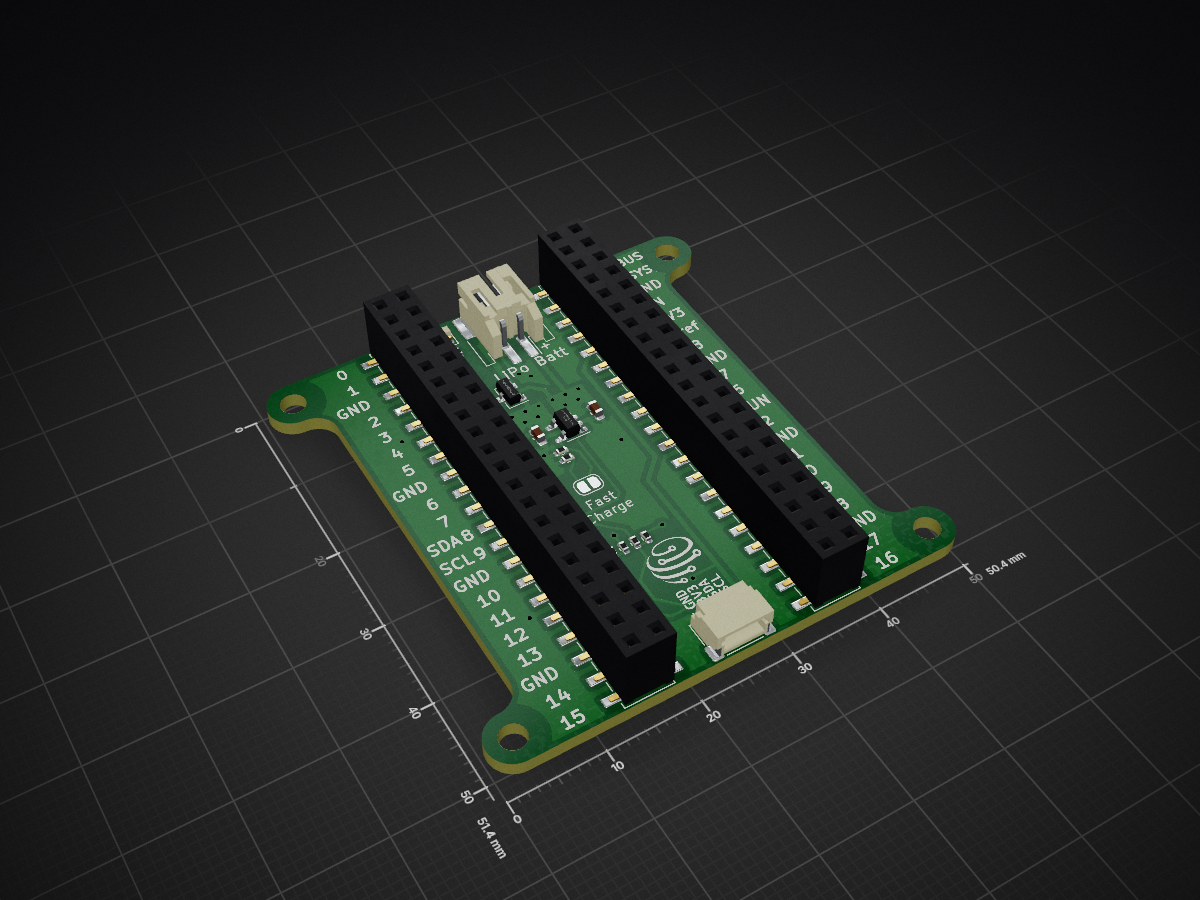
 CoreElectronics/CE-PiicoDev-LiPo-Expansion-Board-for-Raspberry-Pi-Pico3
A prototyping platform for Raspberry Pi Pico, with solderless I2C connector and battery charging
PiicoDev LiPo Expansion Board for Raspberry Pi Pico is an open-source printed circuit board by CoreElectronics, from the CoreElectronics/CE-PiicoDev-LiPo-Expansion-Board-for-Raspberry-Pi-Pico repository on GitHub. It is a 2-layer board of 50.4 × 51.4 mm with 33 parts on 42 nets, routed with 152 tracks and 26 vias.
It is built around the DMG3415U-7. Its parts include 8 resistors, 4 connectors, 2 capacitors, 1 IC and 1 diode. It belongs with the power boards and the RP2040 boards of this library.
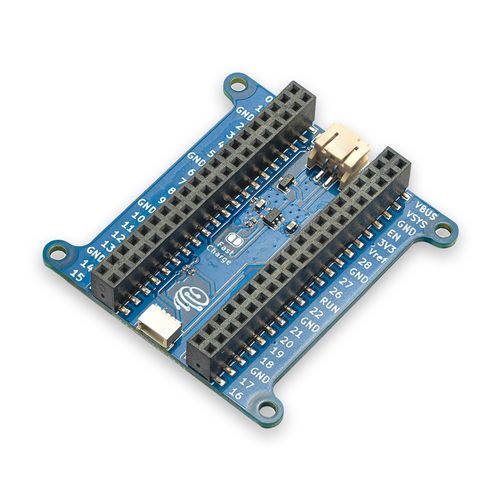
The PiicoDev® LiPo Expansion Board for Raspberry Pi Pico is a great way to start experimenting with Raspberry Pi Pico/RP2040. Thanks to the onboard PiicoDev connector, you can quickly and easily connect to the PiicoDev family of sensor modules without soldering.
Technical Details
This project is open source - please review the LICENSE.md file for further licensing information.
If you have any technical questions, or concerns about licensing, please contact technical support on the Core Electronics forums.
"PiicoDev" is a registered trademark of Core Electronics Pty Ltd
| Qty | Value | Footprint | References |
|---|---|---|---|
| 5 | 4k7 | Resistor_SMD:R_0402_1005Metric | R1, R2, R3, R5, R6 |
| 4 | MountingHole:MountingHole_2.7mm_M2.5 | H1, H2, H3, H4 | |
| 2 | CoreElectronics_Components:PinSocket_2x20_P2.54mm_Vertical_SMD_With_Post | J3, J4 | |
| 2 | 10u | Capacitor_SMD:C_0603_1608Metric | C1, C2 |
| 2 | 120R | Resistor_SMD:R_0402_1005Metric | R7, R8 |
| 1 | 100k | Resistor_SMD:R_0402_1005Metric | R4 |
| 1 | DMG3415U-7 | Package_TO_SOT_SMD:SOT-23 | Q1 |
| 1 | FAST_CHG | Jumper:SolderJumper-2_P1.3mm_Open_RoundedPad1.0x1.5mm | JP1 |
| 1 | G*** | kibuzzard-629D8D64 | kibuzzard-629D8D64 |
| 1 | G*** | kibuzzard-629D909F | kibuzzard-629D909F |
| 1 | G*** | kibuzzard-629D8D5D | kibuzzard-629D8D5D |
| 1 | G*** | kibuzzard-629D8D6F | kibuzzard-629D8D6F |
| 1 | G*** | kibuzzard-629D90AA | kibuzzard-629D90AA |
| 1 | G*** | kibuzzard-629D8D51 | kibuzzard-629D8D51 |
| 1 | G*** | kibuzzard-62DE0FE6 | kibuzzard-62DE0FE6 |
| 1 | G*** | kibuzzard-629D9090 | kibuzzard-629D9090 |
| 1 | I2C | CoreElectronics_Components:SolderJumper-3_P1.3mm_Closed_RoundedPad1.0x1.5mm | JP2 |
| 1 | JST PH | Connector_JST:JST_PH_S2B-PH-SM4-TB_1x02-1MP_P2.00mm_Horizontal | J2 |
| 1 | LED | LED_SMD:LED_0603_1608Metric | D1 |
| 1 | LOGO_CoreElectronics_made-with-love | CoreElectronics_Artwork:CoreElectronics_logo_5mm | G1 |
| 1 | LOGO_PiicoDev | CoreElectronics_Artwork:piicodev_logo_14.2x3.4mm | G2 |
| 1 | MCP73832-2-OT | Package_TO_SOT_SMD:SOT-23-5 | U1 |
| 1 | PiicoDev | Connector_JST:JST_SH_SM04B-SRSS-TB_1x04-1MP_P1.00mm_Horizontal | J1 |

ElectronicCats/Minino
Minino is an original multiprotocol and multiband board made for sniffing, communicating, and attacking IoT devices. It was designed as a mini Cat that integrates the powerful ESP32C6, GPS, microSD and OLED.

Circuit-Digest/MLX90640-Thermal-Camera
An Open Source Thermal Imaging IR camera that you can build yourserlf


solderparty/rp2xxx_stamp_carrier_xl_hw
The RP2xxx Stamp Carrier XL, as the (somewhat long) name suggests, supports all the RP2-based Stamp boards. The Mega/Due form-factor ensures compatbility with many shields, including Uno ones.

Cyber-Professionals-Enthusiast-Club/DC-34-Badge
CPEC Badge Kicad design files for DEFCON 34
It measures 50.4 × 51.4 mm and has 2 copper layers, 1.6 mm thick.
33 parts, built around the DMG3415U-7. The full list of its parts is on this page, with links to each part's symbol and footprint where PCBKit's library has them.
From the CoreElectronics/CE-PiicoDev-LiPo-Expansion-Board-for-Raspberry-Pi-Pico repository on GitHub, at the commit this page was made from: the board is PCB/PiicoDev-LiPo-Expansion-Board-for-Raspberry-Pi-Pico.kicad_pcb and its schematic PCB/PiicoDev-LiPo-Expansion-Board-for-Raspberry-Pi-Pico.kicad_sch. PCBKit opens the board in the browser, with nothing to install.
Its repository states no licence, so its author keeps all rights: ask CoreElectronics before reusing the design.